
High mast lighting brings light to large outdoor spaces, from container yards to football grounds. Start with two questions: How will you reach the lights for maintenance? and Where does the light need to go? A circular head, a lowering system and a stadium application describe different parts of the same design.
This visual guide explains those choices with product and application photographs, practical strengths and trade-offs, and links to the detailed guides for each decision. Start with the maintenance arrangement, then choose the head layout for your site.

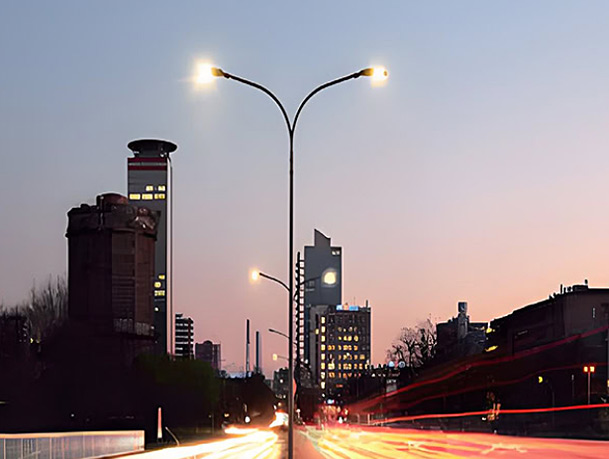
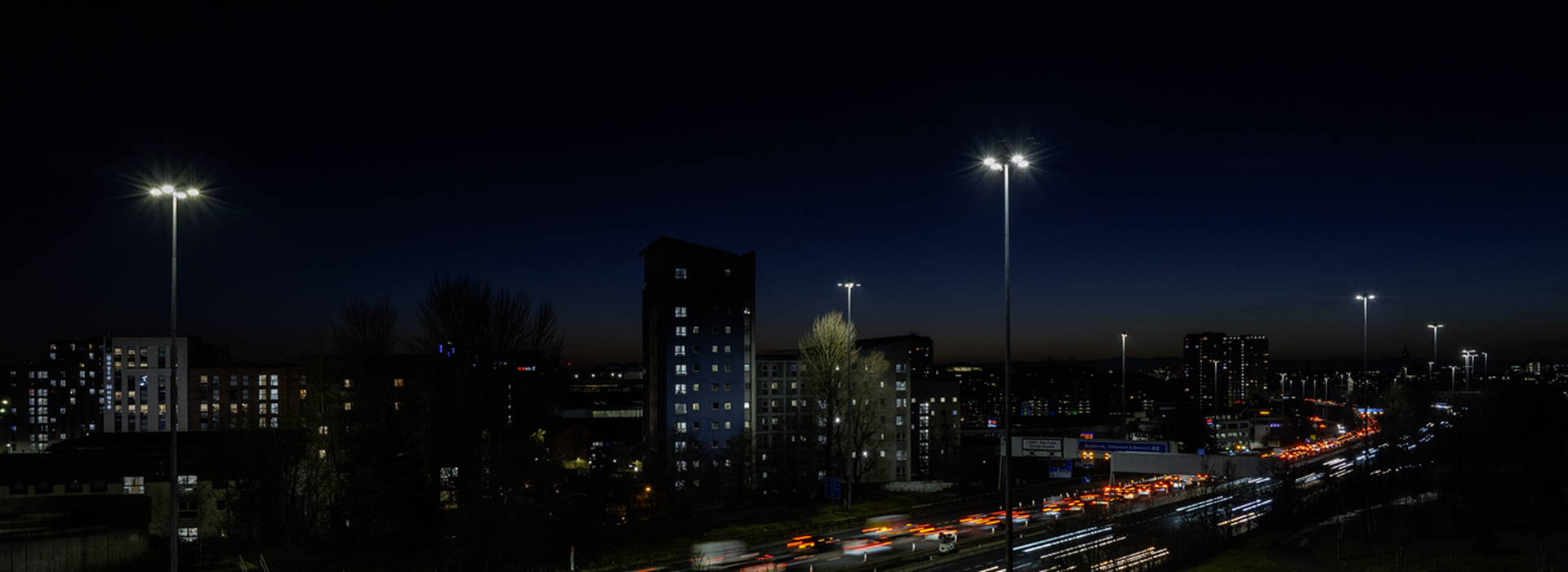
High mast lighting beside a major road — an application example.
In this guide
Maintenance types · Headframe layouts · Applications · How to choose · Buyer questions
Compare a lowering headframe, a fixed headframe and, where appropriate, an engineered hinged mast. Then choose the head layout and maintenance access together. Height, LED wattage and surface finish refine that configuration; they do not define the maintenance type.
A product name can describe several things at once. Separate the choices below:
Does the lighting carriage move, does the mast tilt, or does the lighting head stay fixed? This determines how service access is planned.
A radial crown, rectangular carriage, crossarm or floodlight bank describes where the equipment is mounted.
Height, shaft design, coating, light source, power supply and application complete the specification.
For example, a mast can have a lowering system, rectangular carriage and galvanized sectional shaft at the same time. Another can have a fixed radial head with permanent maintenance access. Counting each of these labels as a separate, exclusive pole type makes selection harder.
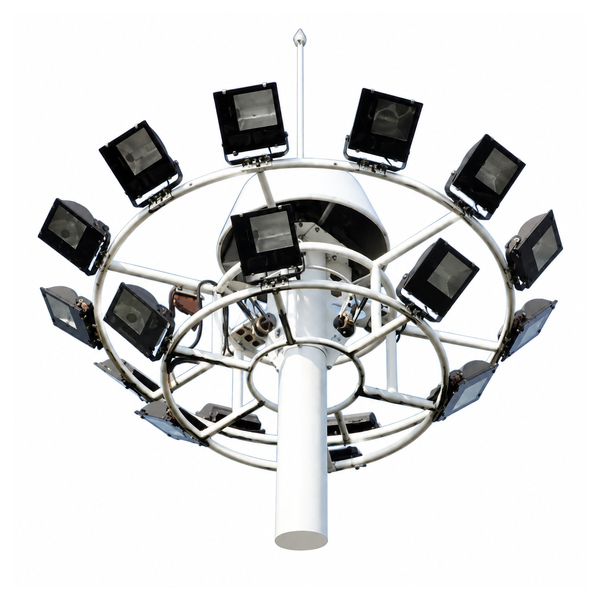
Circular floodlight carriage and mast-head assembly.
With a lowering headframe, the frame carrying the lights travels down the mast for maintenance. The shaft stays upright. A winch and suspension system control the movement. The frame can be round or rectangular, so ask how it works rather than judging it by shape.
Where it fits: large-area sites that want to service luminaires near ground level and can keep the required operating and service area available.
Why choose it: maintenance staff can reach the lowered lights without working at the top of the mast.
Keep in mind: the winch, ropes, guides, moving cable and any latches also need inspection. Include these parts in the maintenance schedule.
Some designs latch the carriage at its working position; others use a different support arrangement. Abacus’s published lowering-headframe range, for example, offers latching and non-latching options. Specify the arrangement actually supplied. [1]
Explore the raising and lowering high mast system. For a closer mechanical review, read the winch selection guide.
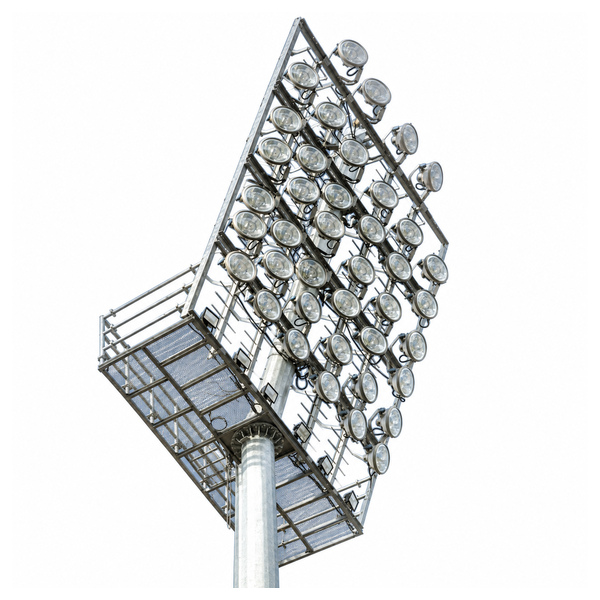
Fixed floodlight head with a maintenance platform.
On a fixed-head mast, the lighting frame stays at the top. Maintenance staff reach it with suitable access equipment or a designed ladder and platform. Plan that access before choosing the mast.
Where it fits: projects with a practical, accepted route for maintaining equipment at height, including some sports and area-lighting installations.
Why choose it: there is no moving lighting carriage. The frame can be arranged around the floodlights and the chosen maintenance access.
Keep in mind: a maintenance vehicle may need room to park and work. Check whether traffic, stored goods or other equipment could block access later.
A ladder or platform is an access option within the fixed-head family. Review whether a technician can reach each floodlight, driver and connection from the intended working position. Include the access equipment in the structural and maintenance scope. Fixed masts are also used with externally provided access, so an integrated ladder is not universal. [2]
See ladder-access lighting masts with maintenance platforms for this product direction.
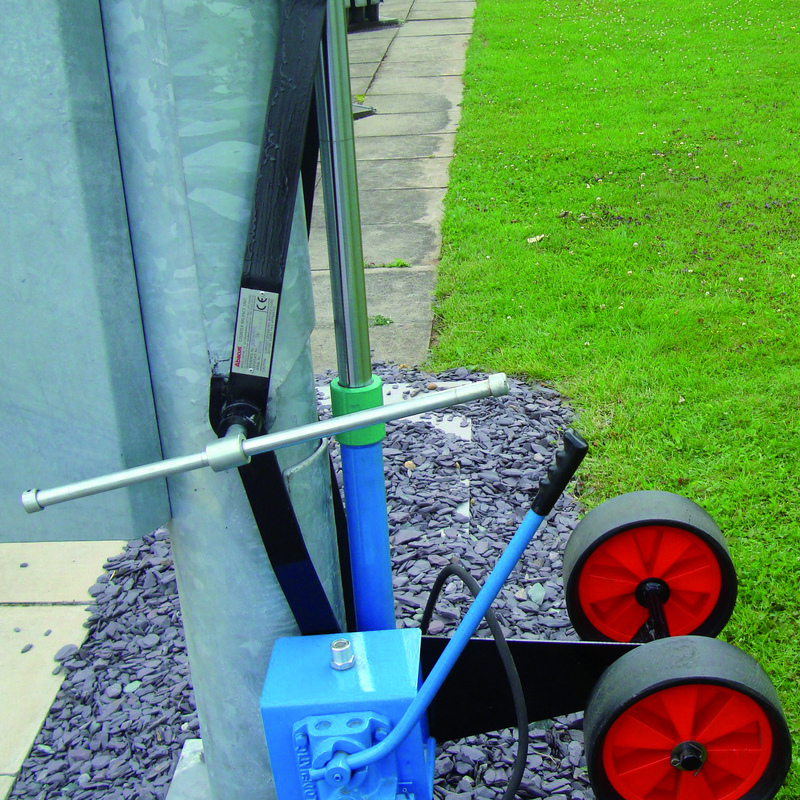
Base-hinge connection and operating equipment.
A hinged mast tilts a section of the pole to bring the mounted equipment toward a service position. Depending on the design, the hinge is at the base or partway up the shaft.
Where it fits: sites where a tilting arrangement suits the equipment, available lowering direction and maintenance space.
Why choose it: the upper pole section and its lights can move toward an accessible service position.
Keep in mind: the moving pole needs a clear path. Check fences, roads, cables and nearby structures before selecting the folding direction. Converting an existing fixed mast requires a separate design review.
Base-hinged masts are a separate commercial system family in manufacturers’ ranges. Their operating equipment and permitted configurations are design-specific. [3]
Our hinged and tilting pole guide explains hinges, movement and maintenance interfaces in more detail.
If maintenance must happen near the ground while the shaft stays upright, investigate a lowering headframe. If suitable access at height is part of the site plan, investigate a fixed head. If a clear tilting path is practical, compare an engineered hinged arrangement.
For a detailed comparison of the first two options, use the existing fixed-head versus lowering-ring guide.
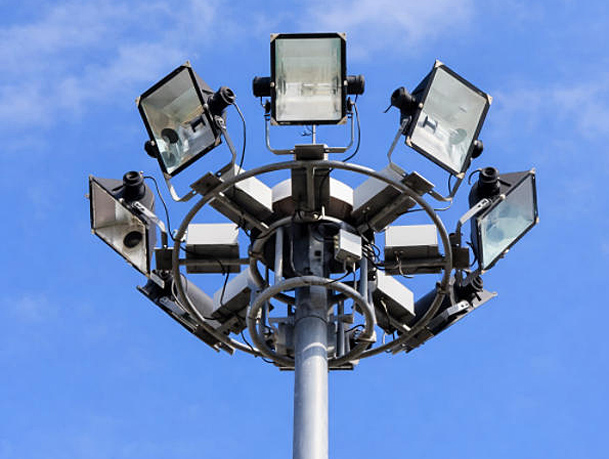
The headframe supports the floodlights and establishes their mounting positions. Its outline is useful for understanding the equipment arrangement, but the floodlight optics and aiming determine the light distribution. A circular head does not guarantee an evenly lit circle on the ground.
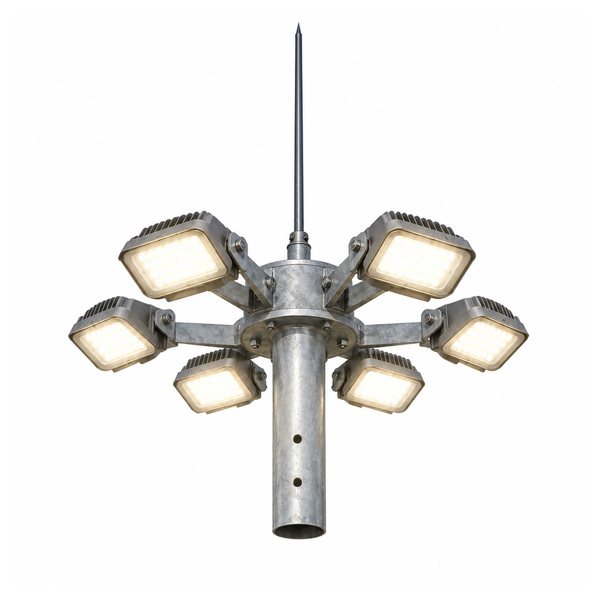
Radial floodlight arrangement around a mast shaft.
Floodlights sit around the mast axis. This gives mounting positions facing several directions and can be useful when the lighting areas surround the support. Compare the individual beam directions and boundaries rather than assuming identical coverage on every side.
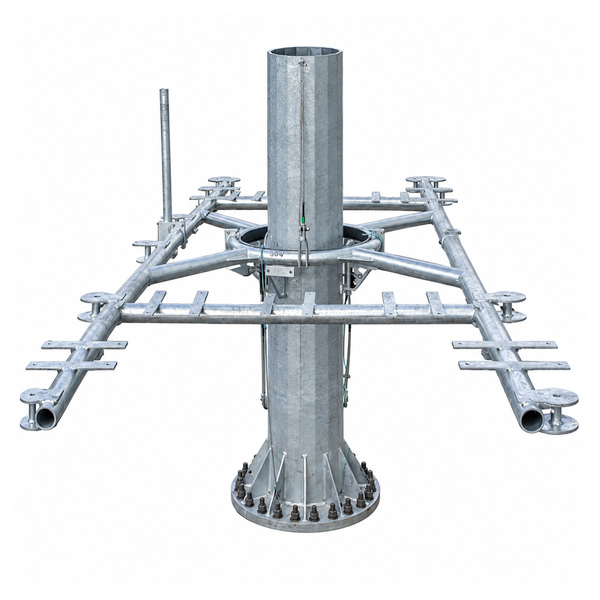
Rectangular luminaire carriage around a mast shaft.
A rectangular outline organizes the mounting rails around the shaft. It can be used to position light groups on different sides and provide space for their brackets. Check whether the frame is fixed or part of a lowering system in the assembly description.
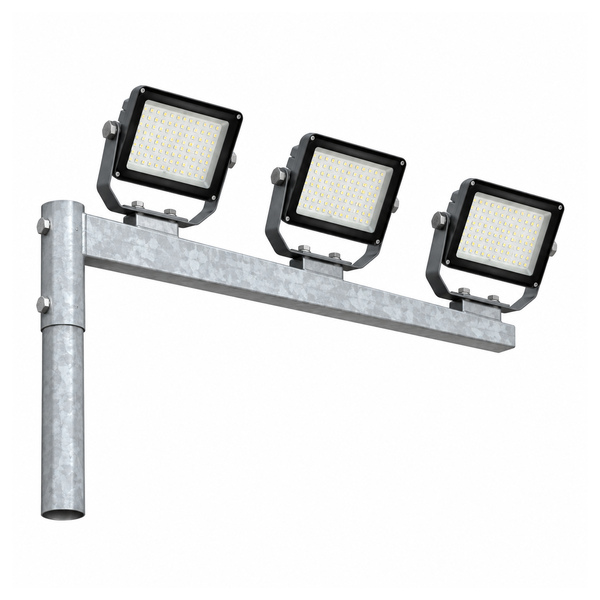
Floodlights on a directional crossarm.
A crossarm puts fixtures along a mounting line. Single-direction and opposing arrangements can support different lighting zones. The arm direction, fixture position and optic should follow the area being lit, particularly where the mast sits at an edge.
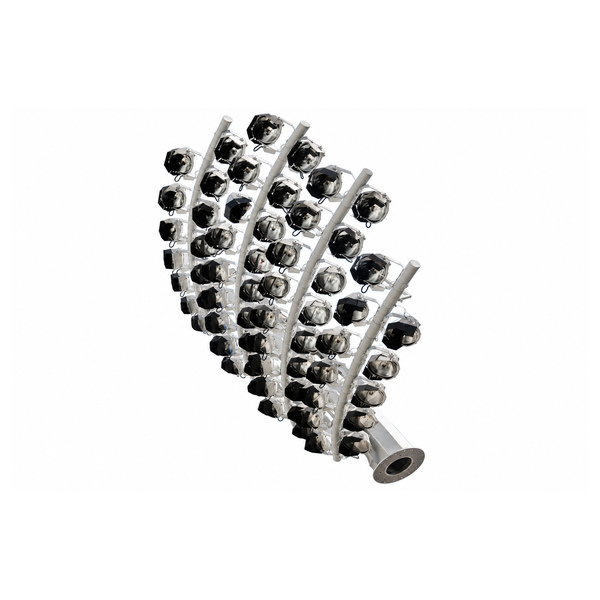
Floodlight bank on a stadium-style headframe.
A bank groups multiple floodlights on a frame. It provides positions for individually aimed beams, often associated with sports and other directed floodlighting. The frame must also accommodate the fixture interfaces and selected maintenance access.
Some projects use several arms or equipment levels. Treat these as mounting configurations and check how every attached item affects the mast. Adding a camera, extra arm or second lighting level changes more than the product description: its connection, cable route, wind exposure and maintenance access also enter the design.
Start with what happens on the site. A container yard needs light around tall stacks; a football ground needs light across the playing surface. Even within one site, different work areas may need different beam directions.
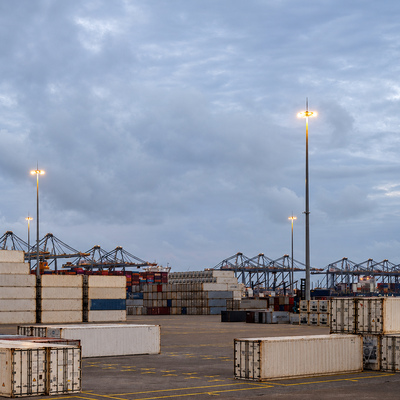
High mast lighting in a container terminal — an application example.
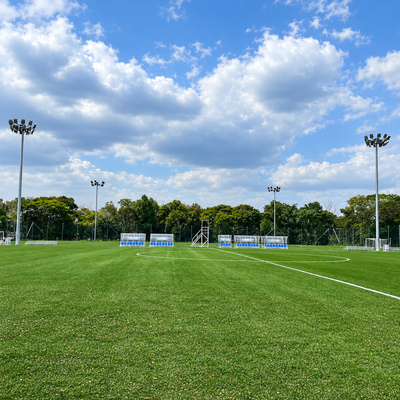
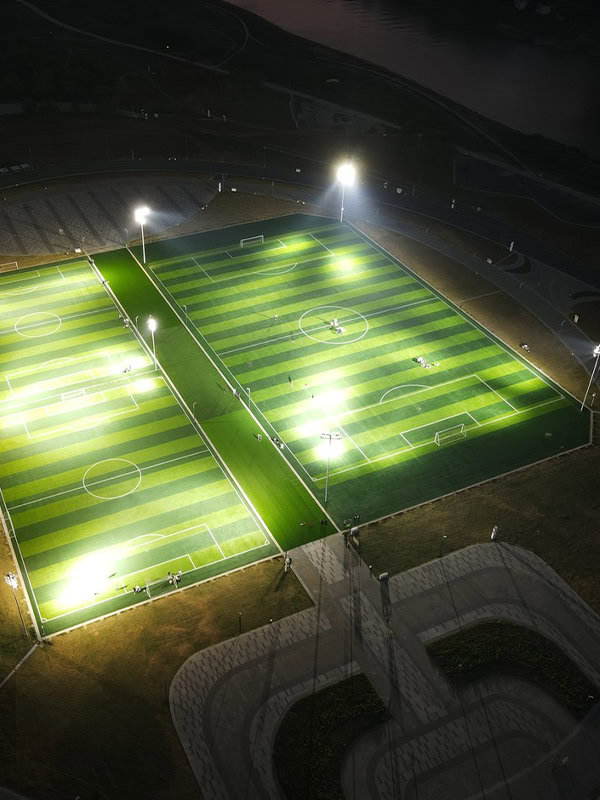
High mast lighting around a football ground — an application example.
↔ On a small screen, swipe the table to see every column.
| Application | What to check | Related guide |
|---|---|---|
| Ports and container terminals | How do stacks and cranes obstruct the light? Where can the carriage be serviced without disrupting handling? | Container terminal lighting |
| Road interchanges and large open areas | Which mast positions are available, and how will fixtures be reached after traffic management is in place? | Interchange lighting layouts |
| Football grounds and sports facilities | Which playing surfaces and camera directions need light? Can the fixed bank or carriage support the required aiming? | Football lighting criteria |
| Rail yards and logistics sites | How do tracks, loading equipment and restricted access affect head direction and maintenance space? | Rail-yard high mast poles |
| Airport aprons and operational areas | What obstacle limits, stand geometry, glare-sensitive views and service restrictions govern the airport project? | Review the airport brief with the responsible project team. |
| Industrial yards and public squares | Where do people work or gather, which boundaries need protection, and what maintenance resources are available? | Compare the task areas, permitted mast locations and service route. |
Identify the area to be lit, the activities, obstacles and nearby sensitive boundaries. Include the owner’s lighting criteria and operating hours. This gives the designer a reason to prefer one mounting arrangement over another.
Decide where people and equipment can reach the luminaires during normal site operation. Include the operating area for a lowering system, the swept path of a hinged mast or the access required for a fixed head. A maintenance preference should be tested against that space.
Use the selected fixture’s photometric file to compare mounting positions and aiming. A nominal 20 m or 30 m height is a configuration input, not a separate maintenance type. The mast-height comparison guide covers the wider height decision.
The head, fixtures and access equipment become structural inputs. Confirm the site wind basis, equipment mass and projected area, then coordinate the mast and foundation design. Choose galvanizing and any paint system for the exposure; a finish does not select a headframe type. For coastal projects, review the marine coating system guide.
Identify which mast, head, luminaires, lowering or access equipment, electrical items and site interfaces are included. Compare options against the same scope and maintenance requirements. The complete project-selection guide develops that proposal review.
LED can be fitted to several head arrangements. It does not tell you whether the carriage lowers, the mast tilts or the head stays fixed.
Look for the specified mechanical arrangement. A fixed radial head and a lowering circular carriage can have a similar outline.
“Port mast” and “stadium mast” describe intended use. The layout, access, fixtures and structural conditions still determine the offered configuration.
No. Fixed heads can serve a range of area-lighting applications when their mounting arrangement and maintenance access suit the site. A stadium can also use a different access concept; the venue name alone does not make the decision.
No. A travelling carriage can have a circular, rectangular or another engineered outline. Confirm its movement, support and equipment arrangement from the system description and drawings.
It is a maintenance-access configuration, commonly associated with a fixed lighting head. The light source and photometric performance are separate choices.
A photograph shows an arrangement. The required fixture quantity comes from the lighting design and must be coordinated with head loading, connections and electrical scope.
Choose the arrangement that delivers the required lighting and has a workable service route at the site. Compare complete options, including access and maintenance, rather than choosing from head shape or purchase price alone.
Share the site plan, intended use, preferred maintenance arrangement and any equipment constraints with Yangzhou Jieyao Lighting Equipment Co., Ltd. Add the required quantities, destination and existing drawings so the shaft and lighting assembly can be discussed together.
This guide combines Jieyao’s product and application image library with published explanations of the maintenance arrangements.
References reviewed 10 November 2026. Images from the supplied Jieyao product and application library. Headframe photographs include different luminaire generations; the discussion concerns their mounting arrangements.
By Yangzhou Jieyao Lighting Equipment Co., Ltd. · 10 November 2026
Contact Us
Get a custom lighting solution and quotation for your project. Yangzhou Jieyao Lighting Equipment Co., Ltd. manufactures outdoor lighting and steel poles in Guoji Town Industrial Park, Gaoyou City, Yangzhou, Jiangsu, China. The company reports a 10,000 m² factory site, more than 60 employees including more than 10 technical personnel, and more than 100 production and testing machines. The present company name dates from 2017; Jieyao Poles’ published history traces the team’s manufacturing lineage to 2006. The stated 15 years of experience refers to the team. The company reports exports to more than 60 countries. Do you have any questions or requests?
Email: jay@jieyaolighting.com

Click to Chat.
Im online now.
 English
 Español
 Bahasa Indonesia