
Football field lighting standards describe the light delivered to defined reference planes. Start with the venue’s governing requirements, then specify maintained lux, uniformity, glare and any camera-related criteria. Luminaire watts, total lumens or mast height alone cannot establish the result.
This guide addresses association football (soccer) and separates the standards question from equipment selection. It compares a named UEFA classification example, explains horizontal and vertical illuminance, and uses two original teaching datasets to show why the same average lux can hide different conditions across a pitch.

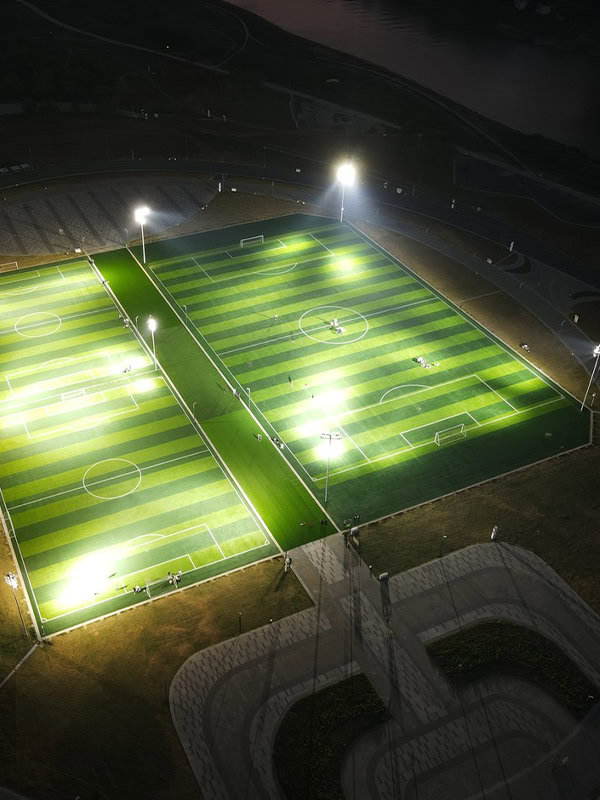
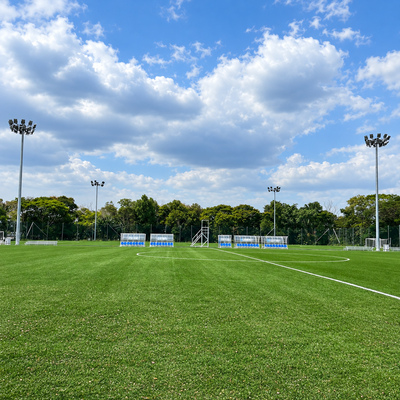
Floodlight poles around an outdoor sports field — an application example.
A community training pitch, a school sports field and a televised competition venue do not necessarily share one specification. Record the owner, intended events, governing body, document edition and operating modes before asking suppliers for a fixture quantity. A future broadcast requirement also belongs in the brief: it can affect support positions, power, controls and the evidence needed at handover.
Keep classification systems distinct. UEFA’s stadium infrastructure categories are not interchangeable with the lighting levels in its lighting guide, and neither is a substitute for a FIFA competition requirement. The UEFA 2023 guide distinguishes broadcast-related levels from non-broadcast use. Confirm the applicable route with the venue authority rather than assigning an event level from a catalogue. [1–3]
↔ Swipe to read all columns.
| What to define | Why it changes the review |
|---|---|
| Playing and spectator use | Activities, pitch dimensions, required modes and the owner’s acceptance criteria. |
| Broadcast or recording | Camera positions, reference directions and required imaging performance. |
| Site and neighbours | Stands, roofs, boundaries, surrounding properties and viewing directions. |
| Existing supports or new high masts | Coordinates, heights, structural condition, connection details and service access. |
Lux measures illuminance: the light incident on an area. Horizontal illuminance describes a horizontal reference plane; vertical illuminance describes a vertical one. A bright-looking ground surface does not establish the light reaching a player from a camera-facing direction. FIFA’s stadium guidance addresses both the playing environment and broadcast views. [4]
For a specific published example, UEFA’s Stadium Infrastructure Regulations, effective 1 June 2025, Article 16.01 lists the following category requirements. The two illuminance columns must be read alongside the associated uniformity criteria. These categories apply within that regulation; they are not universal targets for every school or football field. [1]
↔ Swipe to read all columns.
| UEFA infrastructure category | Average horizontal illuminance | Average vertical illuminance | Horizontal uniformity | Vertical uniformity |
|---|---|---|---|---|
| 2 | 800 lx | 350 lx on each reference plane | U1h > 0.4; U2h > 0.6 | U1v > 0.35; U2v > 0.45 |
| 3 | 1,200 lx | 700 lx on each reference plane | U1h > 0.4; U2h > 0.6 | U1v > 0.35; U2v > 0.45 |
| 4 | 1,400 lx | 1,000 lx on each reference plane | U1h > 0.5; U2h > 0.7 | U1v > 0.4; U2v > 0.5 |
Use the document edition in the project schedule. Copying an old table or combining criteria from different classification systems can produce an inconsistent brief. The table above is an extract of selected lighting criteria, not the complete set of conditions for a venue or a competition.
UEFA defines U1 as minimum illuminance divided by maximum illuminance, and U2 as minimum divided by average, for the specified reference plane. [2] Averages alone therefore miss an important part of the design decision.
The following nine-value datasets were created for this explanation. They are illustrative lux values, not measurements, a lighting simulation or UEFA’s official reference grid. Both total 7,200 lx across nine samples, giving an arithmetic average of 800 lx. Their minimum values are very different.
| 160 | 320 | 480 |
| 640 | 800 | 960 |
| 1120 | 1280 | 1440 |
| 560 | 620 | 680 |
| 740 | 800 | 860 |
| 920 | 980 | 1040 |
↔ Swipe to read all columns.
| Calculated measure | Dataset A | Dataset B |
|---|---|---|
| Average | 800 lx | 800 lx |
| Minimum / maximum | 160 / 1,440 lx | 560 / 1,040 lx |
| U1 = minimum ÷ maximum | 0.111 | 0.538 |
| U2 = minimum ÷ average | 0.200 | 0.700 |
Dataset B has a higher minimum and a narrower range even though its average is unchanged. In a real review, ask where the lower values occur and which playing or viewing task they affect. Increasing the fixture wattage without changing the distribution can leave a weak area unresolved. Repositioning, aiming and optic selection must be assessed in the actual layout.
These nine samples demonstrate the arithmetic only. UEFA’s published uniformity method refers to a defined reference grid; the project calculation and installed test must use their required method. A favourable ratio in this illustration does not establish a venue’s category. [2]
For televised football, the relevant image is not just a plan view of illuminated grass. Camera positions, player faces, moving subjects and shadows matter. FIFA’s guidance connects broadcast needs with vertical illuminance, modelling, colour and temporal-light performance. [4] The designer needs the intended camera plan and operating modes before judging whether the arrangement is suitable.
Treat colour rendering and temporal behaviour as separate evidence requests. A CRI value does not report flicker, and an LED label does not prove slow-motion camera performance at every dimming setting. Identify the exact luminaire, driver, controls and modes covered by the submitted evidence. Keep any required broadcaster acceptance checks explicit.
For equipment selection after the criteria are settled, use our LED stadium-light selection guide. The guide connects the venue brief to optics, controls and purchasing evidence.
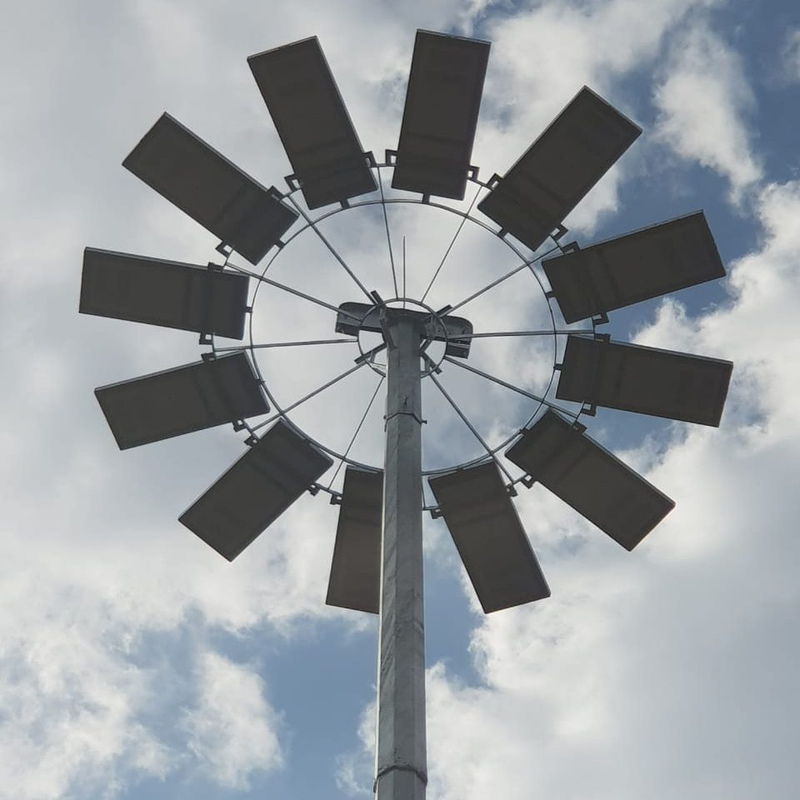
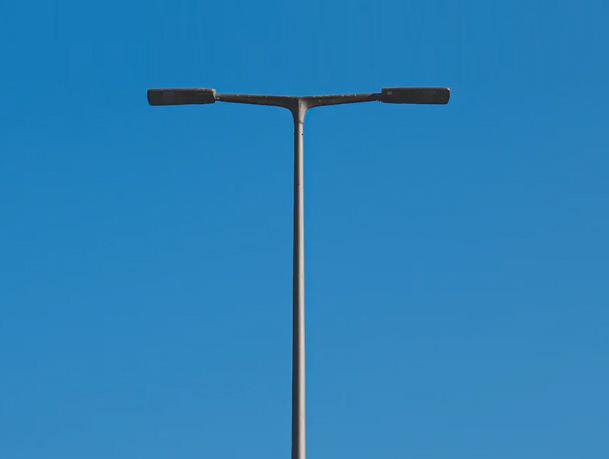
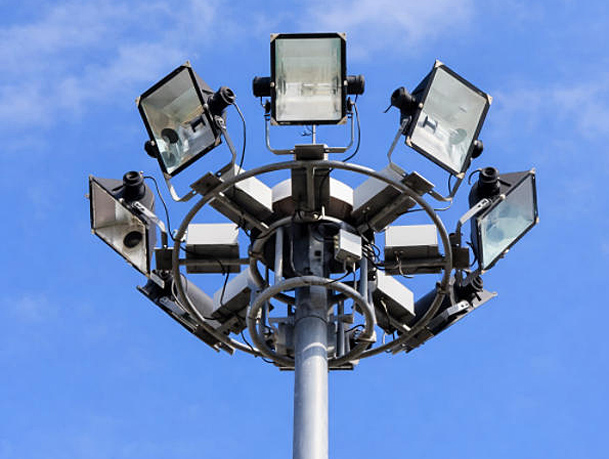
Floodlight arrangement on a high mast — an equipment example.
Mast height and luminaire quantity are outputs of coordinated layout and structural work. Give the designer the support positions, setbacks, surrounding structures and maintenance constraints. Request calculations tied to the named photometric files, optics and aiming schedule. A taller mast or a larger lumen package does not automatically produce an acceptable pitch.
Where the offer includes supports, review the high mast lighting system scope alongside the lighting calculation. The structure needs the selected equipment mass, wind-facing information and mounting arrangement. The electrical and maintenance scope must support the approved modes and access method.
↔ Swipe to read all columns.
| Stage | Record to request | Question it answers |
|---|---|---|
| Brief | Named standards, editions, reference planes and required modes | What does this venue have to achieve? |
| Design | Layout, photometric files, aiming, maintained assumptions and results | Does this proposed arrangement address the criteria? |
| Equipment | Models, optics, drivers, controls, mounts and support interfaces | Is the supplied configuration the one that was assessed? |
| Handover | As-built records, required test reports, settings and maintenance documents | What was installed, checked and accepted? |
A calculation describes a proposed arrangement. Installation can change positions, aiming or settings, so the handover record must identify the final equipment and the checks required by the project. The high-mast aiming and glare checklist covers the commissioning workflow without replacing the venue’s standards or formal test method.
Before ordering, resolve who supplies the lighting calculation, who approves the criteria, who checks the supporting structures and who performs the installed tests. Keep all parties working from the same revision. Record unresolved items in the offer rather than treating a supplier’s attractive night photograph as measurement evidence.
Download the football pitch lighting review checklist
A two-page record for criteria, equipment identity, calculations and handover documents. Download PDF.
Use the requirement for the named activity, competition and venue. Identify the reference plane and uniformity criteria as well as the average lux. The UEFA examples above have a defined scope and are not a universal school-pitch specification.
Total lumens describe source output. Fixture distribution, position, aiming, maintenance assumptions and obstructions affect the light delivered to the pitch. Use the actual layout calculation.
Height alone does not establish the camera-facing illumination, uniformity or temporal-light performance. Review the complete arrangement and the evidence for the selected operating modes.
Discuss a football-pitch lighting package with Jieyao Lighting. Share the pitch plan, intended use, governing criteria, camera brief where applicable, existing supports and requested supply scope through our project enquiry page. Jieyao Lighting supplies outdoor lighting and steel-pole systems; the enquiry should identify the actual luminaires, supports and documents required for the project.
1. UEFA Stadium Infrastructure Regulations, effective 1 June 2025, Article 16.
https://documents.uefa.com/r/PxVtjcYr9Ntgwd0wYgq2xw/P1QRtOar3QJL_XQWZllUsg
2. UEFA Stadium Lighting Guide 2023, Uniformity.
https://documents.uefa.com/r/UEFA-Stadium-Lighting-Guide-2023-2023/Uniformity-Online
3. UEFA Stadium Lighting Guide 2023, Illuminance levels.
https://documents.uefa.com/r/UEFA-Stadium-Lighting-Guide-2023-2023/Illuminance-levels-Online
4. FIFA Football Stadiums Guidelines, section 5.6.
https://publications.fifa.com/de/football-stadiums-guidelines/technical-guideline/stadium-guidelines/technical-systems-and-services/
Sources checked 10 November 2026. The nine-value comparison is an original explanatory calculation with the inputs printed above. It is separate from the cited standards and from any installed project assessment.
Contact Us
Get a custom lighting solution and quotation for your project. Yangzhou Jieyao Lighting Equipment Co., Ltd. manufactures outdoor lighting and steel poles in Guoji Town Industrial Park, Gaoyou City, Yangzhou, Jiangsu, China. The company reports a 10,000 m² factory site, more than 60 employees including more than 10 technical personnel, and more than 100 production and testing machines. The present company name dates from 2017; Jieyao Poles’ published history traces the team’s manufacturing lineage to 2006. The stated 15 years of experience refers to the team. The company reports exports to more than 60 countries. Do you have any questions or requests?
Email: jay@jieyaolighting.com

Click to Chat.
Im online now.
 English
 Español
 Bahasa Indonesia