
Traffic signal poles are easiest to identify by how they support the signal heads: on an upright post, on a cantilever mast arm, or on a span-wire system. “Pedestrian signal pole” describes the crossing equipment served; “combination pole” describes shared functions such as signals and street lighting. These labels can apply to the same assembly.
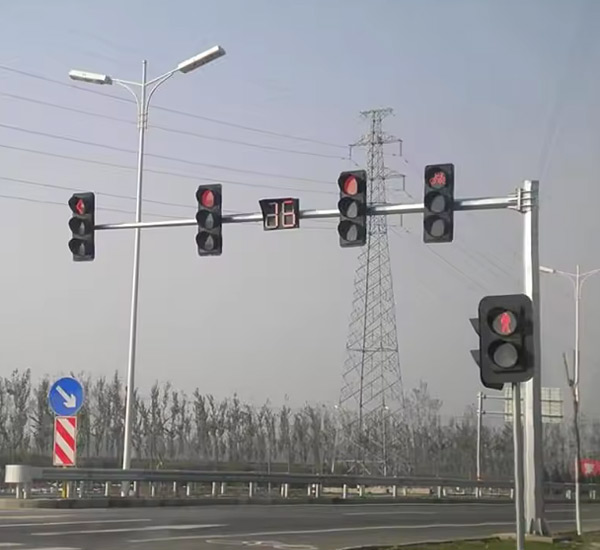
Mast-arm traffic signals at a road junction — an application example.
Start with the part carrying the signal heads, then look at what else is attached. A long horizontal member projecting from one pole is a mast arm. A head fixed beside an upright is post-mounted. Heads hanging from a cable between supports belong to a span-wire arrangement. The signal display itself does not identify the support structure.
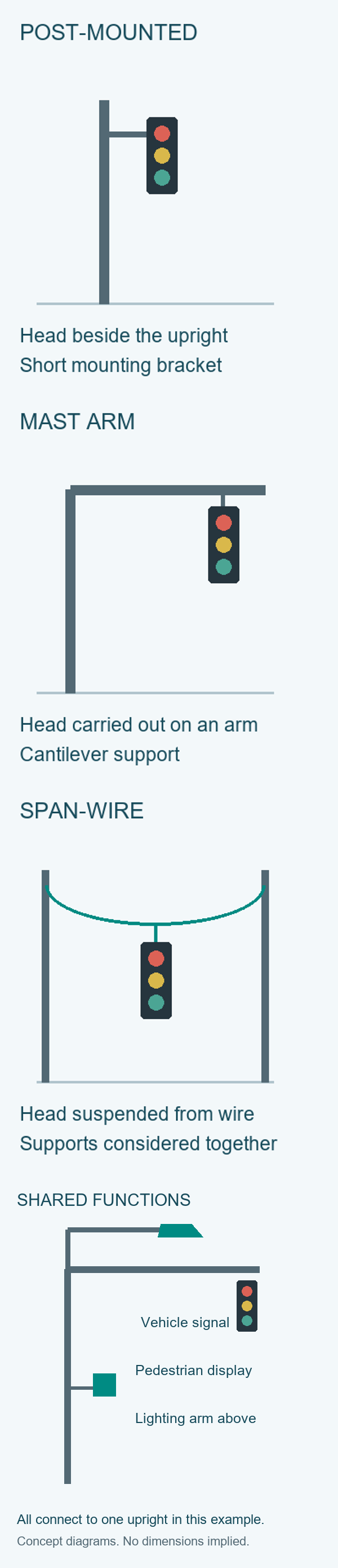
Traffic signal support arrangements and shared functions — concept diagrams.
Swipe the table sideways on a phone to see the final column.
| Arrangement | What you see | Why it is considered | Main selection question |
|---|---|---|---|
| Post-mounted / pedestal | Signal heads fixed to an upright or short bracket | A signal position close to the pole | Can the intended road user see the display from the required approach? |
| Mast-arm / cantilever | An arm projects from a pole over the approach | Signal placement away from the roadside upright | Does the arm put each head in the approved position without conflicting with other equipment? |
| Span-wire | Signal heads suspended from a wire between supports | Head positions along a span between available supports | Are the support locations, sag, clearances and maintenance method suitable? |
| Pedestrian application | Pedestrian display and, where specified, push-button equipment | A controlled crossing | Are display orientation, accessible approach and button location coordinated? |
| Combination signal and lighting | Signal equipment and a luminaire arm on a shared support | Two functions at one pole location | Has the complete assembly been designed and documented together? |
The first three rows describe support arrangements. The last two describe uses or added functions. A mast-arm assembly can also carry pedestrian signals and a street light. Counting these as five mutually exclusive products makes the selection less clear.
A post-mounted head sits on, or immediately beside, an upright. “Pedestal” is another term used for this form of signal support. It is visually simpler than an overhead arm and can serve vehicle signals, pedestrian signals or supplementary displays when the approved layout calls for them.
The useful question is where the head needs to be seen. A small pole footprint does not establish a clear sight line: parked vehicles, roadside planting, nearby signs and the angle of the approach can affect the view. Check the proposed head position on the junction plan before selecting the pole.
Trace the mounting bracket back from the signal housing. If it returns directly to the vertical post, that head is post-mounted even when another head on the same assembly is suspended from a mast arm. The junction photograph above shows both relationships.
A mast arm carries signal heads out from a roadside pole. This gives the designer freedom to place displays over or closer to the traffic lanes they control. One upright may have arms serving different approaches, but each arm direction and equipment position must be shown on the layout.
Arm outreach is the horizontal reach from the pole toward the head positions. It differs from pole height and from the length measured along a curved arm. For an initial selection, mark the pole centre, lane positions and head locations on a plan; this makes “long arm” a usable dimension rather than a catalogue description.
The mast arm also carries the weight and wind effects of its attachments. Signal heads, backplates, signs and any additional equipment belong in the same equipment schedule. Adding a sign to an existing arm can change the design duty even when the sign appears small.
For the supply documents after choosing the arrangement, use the traffic signal pole RFQ checklist. It covers the detailed information needed for arms, wind basis and anchor interfaces.
A span-wire system suspends signal heads from a cable between supporting poles. It is a different structural arrangement from a rigid mast arm. The supports, cable system and suspended equipment are considered together.
Compare it when a suspended layout is being considered by the road authority. Available pole positions, cable geometry, approved clearances, movement of the suspended equipment and access for maintenance all affect suitability. A photograph alone cannot establish those conditions. This guide identifies the arrangement; supply availability should be checked separately from Jieyao’s mast-arm products.
A pedestrian signal pole supports crossing equipment such as a pedestrian display and a push-button unit. That equipment may use a dedicated post or share another signal support. Its position needs to work for the person approaching the crossing, rather than simply copying the position of a vehicle signal.
Read a crossing layout in two parts: identify where the pedestrian must see the display, and where the user must reach the control. A convenient structural location does not automatically satisfy both.
Specify the equipment interfaces and cable entry positions along with the pole. The applicable road authority and accessibility requirements determine the final location and mounting details; a generic pole-height recommendation is not a substitute for that layout.
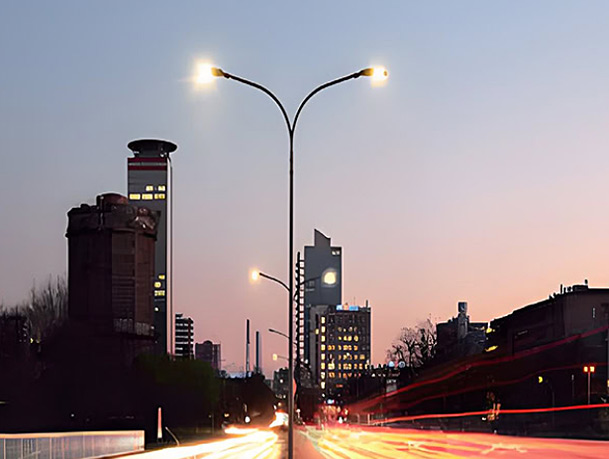
A combination pole carries both traffic-control equipment and a road-lighting arm. In the junction photo, the luminaire is on a separate nearby lighting pole. That is different from a combination assembly in which both functions connect to the same upright.
Combining functions can help coordinate equipment at a constrained junction, provided the signal sight lines, lighting positions, cable routes and maintenance access all work. The complete set of attachments must be included in the design. It should not be called a “smart pole” merely because it carries more than one function; communications and control equipment are separate features.
Compare the visible arrangements in Jieyao’s standard galvanized traffic signal pole and multi-function traffic signal pole pages. Select the interfaces from the project layout rather than treating the page photograph as a dimensioned drawing.
First, place the signals. Mark the approaches, movements, crossing points and required head locations on the approved traffic layout. Pole selection follows those locations.
Next, test the available support positions. Review sight lines, pavement and footway space, utilities and access. Compare post-mounted, mast-arm or suspended arrangements where appropriate.
Then identify shared equipment. List pedestrian devices, luminaire arms and signs explicitly. Keep signal supports distinct from ordinary road-sign posts and lighting-only poles.
Finally, define the complete assembly. Confirm arm directions, head interfaces, structural design basis, base connection and cable routes before manufacture. A photograph plus a marked-up plan is a useful starting point for a discussion with Jieyao Lighting.
Both project from a pole, but they support different equipment and positions. A lighting arm intended for a luminaire should not be assumed suitable for signal heads, signs or their combined loads. Specify the actual supported equipment and connection.
No. Required signal positions and available pole locations determine the outreach. Multiple supports or a different arrangement may be more appropriate than extending a single arm. The traffic layout and structural design must be coordinated.
Terminology for mast-arm and pedestal supports: FHWA, Signalized Intersections: Informational Guide, Chapter 4, section 4.4 (August 2004, archived). Used here for classification, not current numerical design requirements.
Combination lighting/signal pole coordination: City of Overland Park, Streetlight Design Manual, Computation of Quantities (page revised August 26, 2025). Its local specifications are not general requirements for other markets.
Prepared by Jieyao Lighting. Product and application images are used to explain visible arrangements; final equipment locations and dimensions belong in the project drawings.
Contact Us
Get a custom lighting solution and quotation for your project. Yangzhou Jieyao Lighting Equipment Co., Ltd. manufactures outdoor lighting and steel poles in Guoji Town Industrial Park, Gaoyou City, Yangzhou, Jiangsu, China. The company reports a 10,000 m² factory site, more than 60 employees including more than 10 technical personnel, and more than 100 production and testing machines. The present company name dates from 2017; Jieyao Poles’ published history traces the team’s manufacturing lineage to 2006. The stated 15 years of experience refers to the team. The company reports exports to more than 60 countries. Do you have any questions or requests?
Email: jay@jieyaolighting.com

Click to Chat.
Im online now.
 English
 Español
 Bahasa Indonesia