
◈ What does a five-coat fluorocarbon specification tell you?
For a marine steel light pole, five coats describe the number of applications. Protection depends on the compatible coating system, prepared substrate, dry film thickness and curing. A fluorocarbon topcoat is one part of that system.
A request for “five layers of fluorocarbon paint” can lead suppliers to describe different constructions. One may mean five full coats; another may include local stripe coats; a third may count galvanizing as a layer. Before comparing marine light poles, translate that phrase into a layer-by-layer coating schedule.
FEVE is one type of fluoropolymer resin used in protective topcoats. AGC explains that FEVE coatings on steel are typically applied over a primer, or over a primer and intermediate coat. This supports treating the finish as part of a system; it does not establish the performance of a particular light pole. [1]
Distinguish the starting surface first. Bare steel and hot-dip galvanized steel require different preparation and compatibility decisions. The coating manufacturer’s approved system should identify the substrate, preparation method, primer, intermediate material, finish and recoat conditions. A familiar paint name alone does not settle these interfaces.
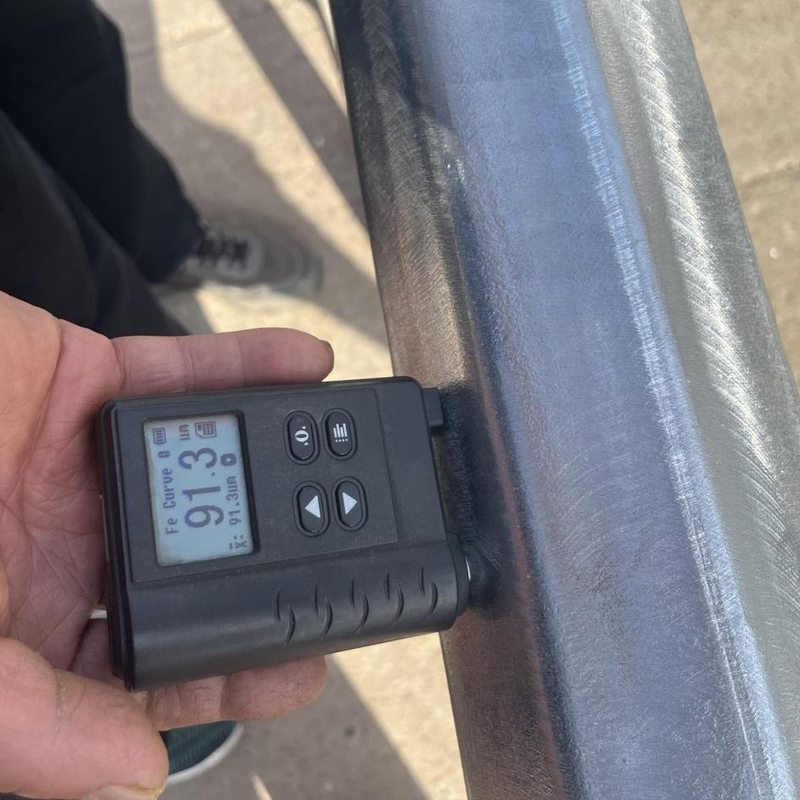
Thickness measurement on a galvanized steel pole.
Illustrative arithmetic: these schedules use assumed dry film thicknesses (DFT). They are comparison examples, not application recipes or recommended marine specifications. Material compatibility and permitted thickness ranges must come from a validated coating system.
↔ Swipe horizontally to read all columns.
| Application | Example A DFT | Example B DFT |
|---|---|---|
| 1 | 60 μm | 40 μm |
| 2 | 100 μm | 40 μm |
| 3 | 100 μm | 40 μm |
| 4 | 40 μm | 40 μm |
| 5 | 40 μm | 40 μm |
| Total | 340 μm | 200 μm |
Both descriptions contain five coats, yet their totals differ by 140 μm. Example A has 70% more specified dry film than B. This does not prove A will last longer: excessive film build can also fall outside a product’s allowed range. Compare whether each complete system meets the same project requirements and has supporting evidence.
✓ Make the layer count explicit
Write the product identity, function and permitted DFT for every full coat. State separately whether galvanizing and local stripe coats are included in the count. Record total paint DFT independently from the metallic zinc coating.
Wet film thickness (WFT) can help control the eventual dry film during application. DeFelsko uses solids by volume for the conversion. Without added thinner, WFT = target DFT ÷ volume-solids fraction. Weight-solids data cannot be substituted. [2]
▤ Worked example: a 40 μm dry coat
Assume 60% solids by volume and no added thinner. Target WFT = 40 ÷ 0.60 = 66.7 μm. A 40 μm wet application under these assumptions would leave about 24 μm dry. Application limits and measurement tolerances follow the product data sheet.
This makes the inspection sequence useful: establish the substrate condition, check application against its wet target where appropriate, and verify the cured film against the agreed acceptance method. One photograph of a gauge cannot represent a complete pole or production batch.
A smooth shaft gives only part of the picture. Include welds, base-plate edges, access-door edges, bracket interfaces and areas disturbed by transport or assembly in the inspection plan. Local stripe coats may improve coverage at details, but describe them separately from full coats. The specified system should define where they are needed.
On painted galvanized steel, a conventional magnetic reading may include zinc and paint above the steel. The method must distinguish the layers when separate acceptance values are required. Record the instrument, calibration or adjustment method, locations and whether the reading represents paint alone or combined coating build.
↔ Swipe horizontally to read all columns.
| Evidence | What it helps establish | What it cannot establish alone |
|---|---|---|
| System data sheet | Named materials, substrate and application limits | The condition of the delivered pole |
| DFT inspection record | Measured build at recorded locations | Adhesion, curing or field life |
| Adhesion / corrosion report | The identified tested construction | A different substrate or coating stack |
| Repair procedure | How damage will be restored | That each repair was completed correctly |
A corrosion report should match the substrate, preparation, stack and assessment criteria. Do not convert salt-spray hours directly into outdoor years. For receiving and repair checks, see our galvanized light pole coating inspection guide.
Layer names should follow the approved system. Calling all five applications “fluorocarbon” can hide primer and intermediate functions. Specify the actual material in each position and the evidence for the complete construction.
Discuss your project with Jieyao Lighting
For a marine pole inquiry, send the exposure conditions, substrate preference, colour and required coating schedule. Include project inspection and corrosion-testing requirements so that options can be compared consistently. Explore coastal road lighting poles or use the website contact form to share the project requirements.
1. AGC LUMIFLON education — Steel-substrate FAQ: FEVE topcoats over primers and intermediate coats.
https://lumiflonusa.com/education/
2. DeFelsko wet-film guidance — No-reducer WFT/DFT formula; volume versus weight solids.
https://www.defelsko.com/resources/how-to-measure-wet-film-paint-thickness-before-cure
The numerical examples are original calculations by Jieyao Lighting using the stated assumptions. They illustrate a comparison method and are not measured results for a supplied product.
Contact Us
Get a custom lighting solution and quotation for your project. Yangzhou Jieyao Lighting Equipment Co., Ltd. manufactures outdoor lighting and steel poles in Guoji Town Industrial Park, Gaoyou City, Yangzhou, Jiangsu, China. The company reports a 10,000 m² factory site, more than 60 employees including more than 10 technical personnel, and more than 100 production and testing machines. The present company name dates from 2017; Jieyao Poles’ published history traces the team’s manufacturing lineage to 2006. The stated 15 years of experience refers to the team. The company reports exports to more than 60 countries. Do you have any questions or requests?
Email: jay@jieyaolighting.com

Click to Chat.
Im online now.
 English
 Español
 Bahasa Indonesia