

Quick answer: choose a raising and lowering system when frequent luminaire maintenance must be performed safely at ground level or when access by crane is restricted. A fixed-head system can be simpler when permanent climbing access or suitable lifting equipment is available and the maintenance plan accepts work at height. The decision should be made from lifecycle access, safety procedures, ring load and site conditions—not initial price alone.
| Decision factor | Raising and lowering ring | Fixed head/platform |
|---|---|---|
| Routine fixture access | Ring is lowered for service near ground level. | Requires climbing system, platform or external lift. |
| Mechanical complexity | Winch, ropes, pulleys, guides and locking system. | Fewer moving components in the head assembly. |
| Site access | Useful where large cranes cannot be mobilized routinely. | Suitable when safe elevated access is permanently available. |
| Head load | Ring and lifting components are included in system design. | Platform, ladder and safety equipment may add area and weight. |
| Inspection | Requires scheduled inspection of ropes, winch, locks and cables. | Requires inspection of access, platform, fixed brackets and fall-protection provisions. |
| Typical use | Ports, interchanges, logistics yards and large parking areas. | Projects with established access procedures or special platforms. |
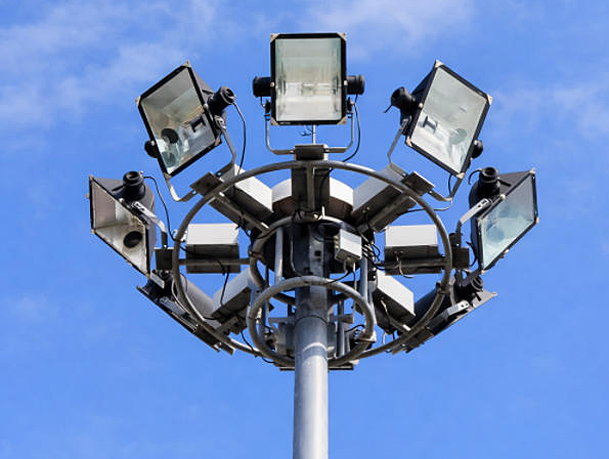
A project-specific system may include an electric winch, emergency manual drive, stainless-steel wire ropes, pulleys, power cable, guide mechanism, junction box, control pendant, limit controls and a mechanical latching system at the mast head. The exact arrangement varies by ring weight, mast height and specification.
The latches support the ring in the operating position so the wire ropes do not remain the sole service support. A clear visual or mechanical indication of correct engagement should be included in the operating procedure.
A lowering system reduces routine elevated access but does not eliminate inspection. The owner should keep a maintenance schedule for wire ropes, terminations, pulleys, winch brake, limit functions, electrical cable, latches and corrosion. The operating zone around the mast must be controlled whenever the ring is moved.
Before lowering, isolate or control the electrical supply as specified, confirm weather conditions, establish an exclusion area and use trained personnel. After raising, verify all locking points are fully engaged before returning the system to service.
A fixed system may be selected for a venue that already maintains certified climbing access, a service platform and documented fall-protection procedures. It may also suit a project with permanent crane access and a low expected maintenance frequency. The structural design must include all ladders, cages, platforms and handrails because they add weight and wind-exposed area.
It can reduce routine work at height, but safety still depends on correct design, operation, inspection, exclusion zones and trained personnel.
Conversion should not be assumed. The mast head, internal space, doors, structural capacity and electrical routing must be evaluated as a complete engineering modification.
The quantity and arrangement depend on the system design and applicable specification. Buyers should review capacity, redundancy, terminations and inspection access rather than selecting by rope count alone.
Operation must follow the manufacturer's wind limit and procedure. Raising or lowering should be postponed when conditions exceed the approved operating limit.
See the 30m, 40m and 45m stadium high mast configurations, or request a maintenance-system proposal.
Contact Us
Get a custom lighting solution and quotation for your project. Outdoor lighting manufacturer in Yangzhou, ChinaAbout Jieyao LightingYangzhou Jieyao Lighting Equipment Co., Ltd. is an outdoor lighting manufacturer focused on solar street light systems and high mas... Do you have any questions or requests?
Email: jay@jieyaolighting.com

Click to Chat.
Im online now.