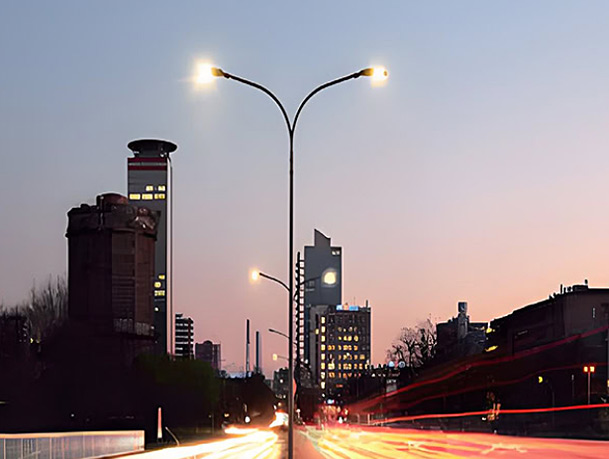
Choose the road-lighting result first: select an LED street light by the approved road criteria, layout and exact luminaire configuration. Wattage, mounting height and a headline efficacy cannot independently establish illumination, uniformity, glare or whole-life cost.
This guide is for road-lighting buyers comparing offers for streets, pedestrian areas and related access roads. Start with the actual road and retained infrastructure. A new installation, a luminaire-only retrofit and a project that also replaces poles or controls have different scopes. A generic family specification cannot prove that every version in an offer meets the same requirements.
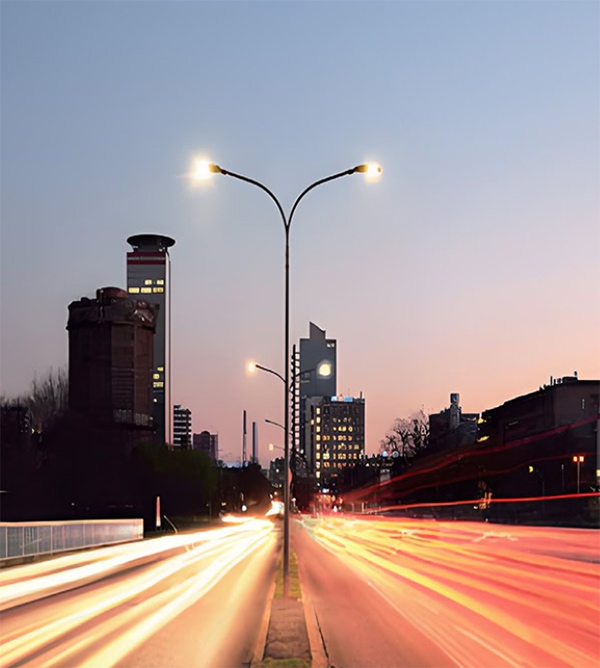
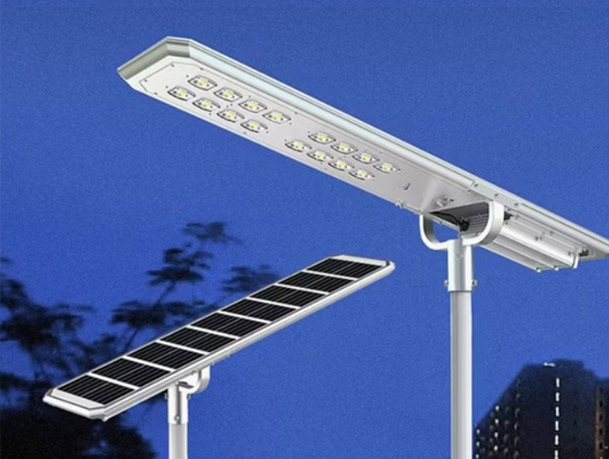
Street lighting along an urban road at dusk — an application example.
Record the road geometry, lanes and pedestrian areas, surface and junction conditions, surrounding properties, authority-approved lighting criteria and operating modes. Add the proposed or existing pole positions, mounting heights, outreach, tilt limits and obstructions. Identify the design responsibility and required calculation files.
| Application context | Inputs that change the selection | Evidence to compare |
| Residential street or footpath | Pedestrian task, nearby windows, mounting constraints and required night modes. | Layout-specific lighting, glare and spill assessment for the offered optic. |
| Urban carriageway or junction | Road geometry, conflict areas, traffic/pedestrian criteria and retained positions. | Maintained-performance calculation including the relevant surfaces and junctions. |
| Higher-speed road | Applicable road criteria, spacing/geometry, road surface and service access. | The project’s required luminance or illuminance and uniformity/glare checks. |
| Industrial access road or yard | Vehicle movements, work areas, obstructions and environmental exposure. | A task-appropriate layout; a road fixture is not automatically a complete yard-lighting solution. |
FHWA’s 2012 lighting application guidance describes calculating pole spacing and refining layouts around geometry and conflicts. It also explains that no exact height-and-wattage formula determines the optimum arrangement for every road. Use that design method alongside the project’s applicable current criteria; do not substitute a universal wattage-by-road table for the calculation.
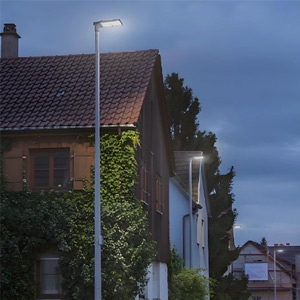
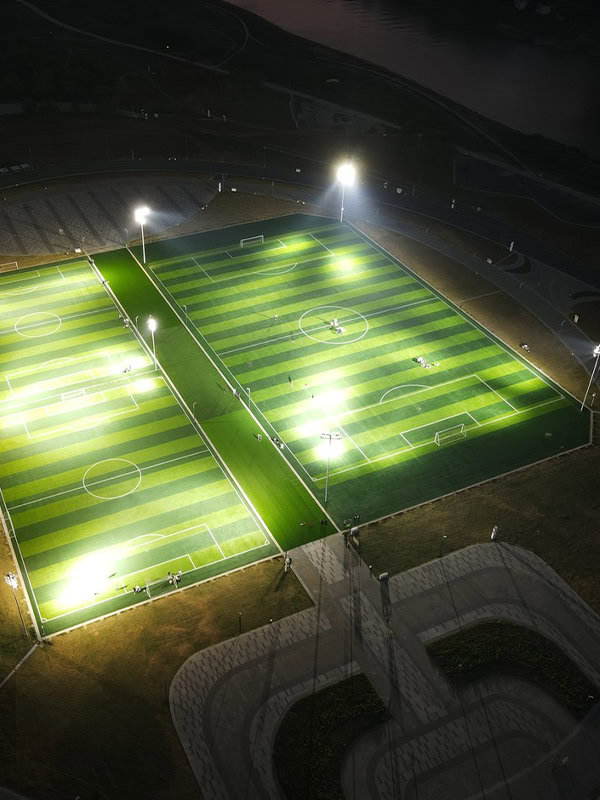
Lighting beside homes — an application example.
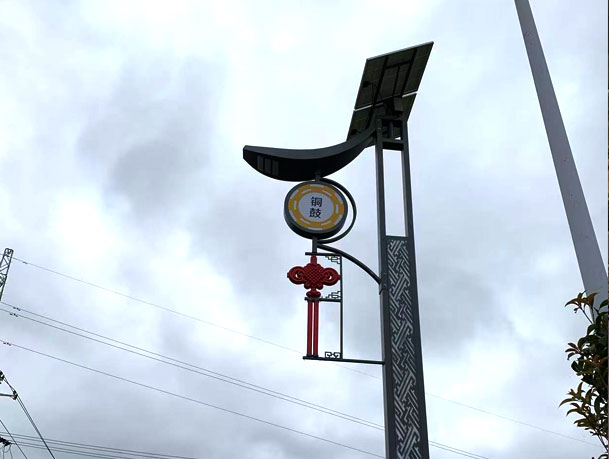
Urban roadway lighting — an application example.
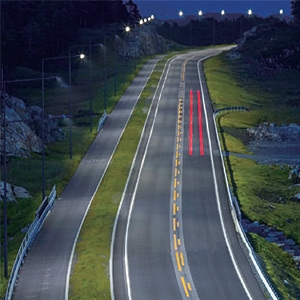
Lighting along a rural road — an application example.
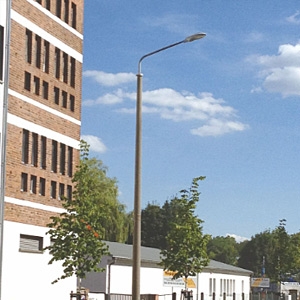
Roadside lighting near buildings — an application example.
Each bid should identify the exact model, optic, output setting, driver, control option and mounting arrangement. Request the matching photometric file and supporting performance information, with the test conditions and configuration identified. LED-package efficacy, luminaire efficacy and useful light on the road are different quantities. A high lm/W claim does not establish that the proposed distribution meets the road brief.
| Offer item | Evidence to request | Do not infer |
| Optical and electrical configuration | Model/optic revision, output setting, matching photometric file and input-power evidence. | That the best efficacy in a family applies to every colour, optic, power or driver. |
| Supply and switching | Driver input conditions, controls, protection and a project electrical interface. | That a wide-voltage label guarantees immunity to all surges, brownouts or poor power quality. |
| Enclosure and exposure | Model-specific ingress, temperature, corrosion and other required evidence for the declared installation. | That an IP code certifies salt resistance or operation through every storm. |
| Mechanical fit and service | Spigot/arm connection, permitted tilt, mass/wind information, service access and spare-part scope. | That any mounting diameter fit proves the retained pole, arm or aiming is suitable. |
| Compliance and warranty | Applicable documentation identifying the product, manufacturer, scope, dates and actual warranty terms. | That a collection of logos or a general company-system certificate certifies every luminaire configuration. |
Intertek’s ingress-protection overview describes enclosure testing for dust and water. Treat the declared ingress result as evidence for that test scope; obtain separate evidence for corrosion, thermal operation and the electrical protection required by the project. A powder-coated housing, cooling fins or a stated input-voltage range do not alone prove those other outcomes.
Specify the control interface, operating scenes, configuration owner and behaviour if a node, sensor or network is unavailable. A socket does not by itself provide a commissioned city-management service. Confirm mechanical/electrical compatibility, software/network scope, access and commissioning responsibilities for the selected system.
Check every proposed dimmed mode against the approved lighting requirement. Energy comparison should use a declared baseline, actual input power, operating hours and auxiliary/control consumption. Identify what is estimated or measured and what services change. There is no guaranteed saving or payback period simply because LED or smart controls are selected.
Ask which parts can be accessed and replaced on the quoted revision, what seals or fasteners need attention after service, and which spares and instructions are supplied. Multiple LED chips do not guarantee that the remainder of a luminaire will operate normally after any single-chip fault. Service access and failure behaviour depend on the electrical and mechanical design.
IES’s position on LED product lifetime prediction separates LED-component maintenance projections from whole-luminaire reliability. A light-output life claim is not a complete warranty or a maintenance-free period. The LED lifetime and warranty guide covers that distinction in more detail.
| Decision | Record before purchase | Verify at delivery or commissioning |
| Lighting selection | Approved road layout and named luminaire/optic/output revision. | Delivered identifiers and the required aiming/lighting checks. |
| Retained infrastructure | Existing pole/arm condition and the approved new loads and interface. | Fit, orientation, connections and controlled deviations. |
| Electrical and control scope | Supply/control drawings, protection, modes and responsible parties. | Connection/settings records, required tests and demonstrated operating modes. |
| Support and commercial scope | Included items, spare parts, installation/acceptance responsibilities and warranty conditions. | Packing/condition records, manuals and the handover document index. |
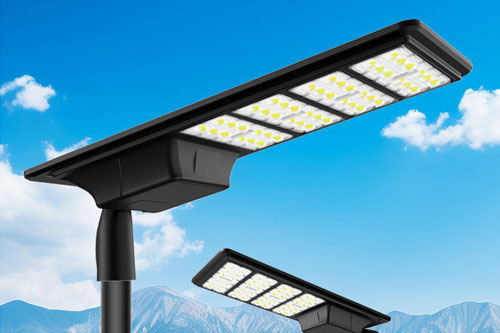
Jieyao’s modular LED street light page is a configuration option for road-luminaire procurement. The offer must define what modular means for the actual model and which parts are serviceable. Send the road plan, required operating modes, mounting information, supply conditions and requested documents through the project enquiry page so the equipment and responsibility scope can be identified. This guide does not establish a fixed family-wide certification, warranty or performance rating.
The answer comes from the approved road brief and calculation using the offered luminaire. Road type or pole height alone does not establish the required wattage.
No. Ingress, corrosion and electrical surge claims need their respective scope and evidence for the actual equipment.
Possibly, after the condition, loads, arm/spigot fit, aiming and electrical interfaces are checked. A physically fitting clamp is not enough.
No universal percentage applies. Compare the agreed lighting service, input power, hours and added equipment against a documented baseline.
This is an offer-review method, not a test of a particular Jieyao luminaire. The sources support layout calculation, ingress-test scope and component-versus-luminaire lifetime distinctions. They do not certify a supplier or establish a universal saving, warranty or installed result.
FHWA, Lighting Handbook (August 2012), Chapter 7, Lighting Application: https://highways.dot.gov/safety/other/visibility/fhwa-lighting-handbook-august-2012/7-lighting-application
Intertek, IP Testing — Ingress Protection per IEC 60529: https://www.intertek.com/lighting/performance/ingress-protection/
IES, PS-10-18: IES Position on LED Product Lifetime Prediction (2018): https://ies.org/advocacy/ps-10-18/
Contact Us
Get a custom lighting solution and quotation for your project. Yangzhou Jieyao Lighting Equipment Co., Ltd. manufactures outdoor lighting and steel poles in Guoji Town Industrial Park, Gaoyou City, Yangzhou, Jiangsu, China. The company reports a 10,000 m² factory site, more than 60 employees including more than 10 technical personnel, and more than 100 production and testing machines. The present company name dates from 2017; Jieyao Poles’ published history traces the team’s manufacturing lineage to 2006. The stated 15 years of experience refers to the team. The company reports exports to more than 60 countries. Do you have any questions or requests?
Email: jay@jieyaolighting.com

Click to Chat.
Im online now.
 English
 Español
 Bahasa Indonesia
 Français