

 English
 Español
 Bahasa Indonesia
 Français

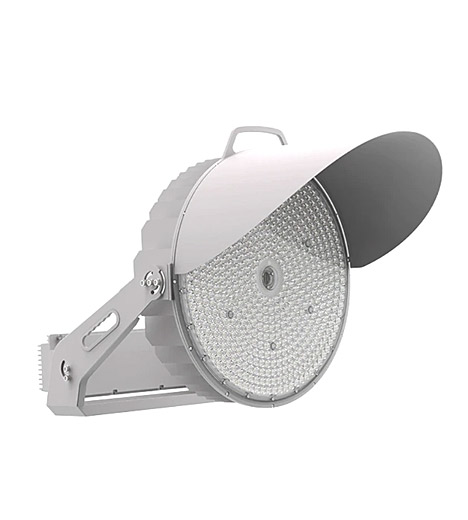
- Product details
-
LED basketball court lights for outdoor project enquiries. Review the luminaire, optic, driver, bracket and any shielding as one offered configuration. Identify whether the enquiry covers luminaires only or also poles, headframes, controls and site work.
Round floodlight construction and mounting
The illustrated round luminaire has a circular optical face, rear cooling fins, a support bracket and a hood or visor arrangement. These views help describe the form of the product; the selected model drawing and quotation define its dimensions, materials, electrical configuration and included accessories.
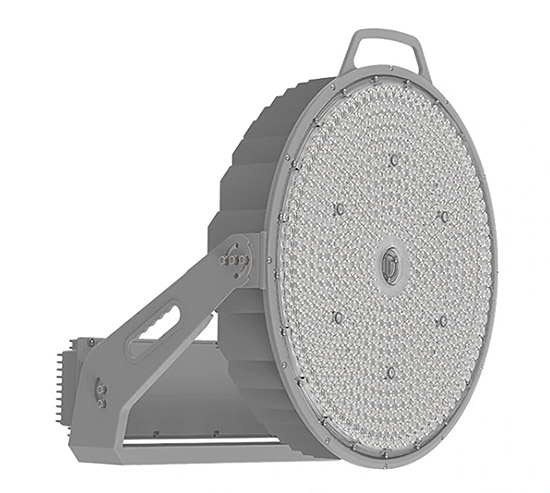
Round sports floodlight illustration showing the optical face, rear housing and mounting bracket; no tested output or protection rating is established by this view.
Product area Detail visible in the illustrations Confirm for the offered version Optical face Circular lens area with multiple light-source positions LED and optic codes, rated input and matching photometric file. Hood or visor Shielding arrangement illustrated with the round housing Whether supplied, its mounting detail and the photometric configuration with the accessory fitted. Support bracket Side fixing and slotted adjustment features Hole pattern, permitted aiming range, locking method and support connection. Rear assembly Cooling fins, cable entry and rear equipment envelope Driver identity, supply, cable interface, mass, wind-area basis and service clearances. 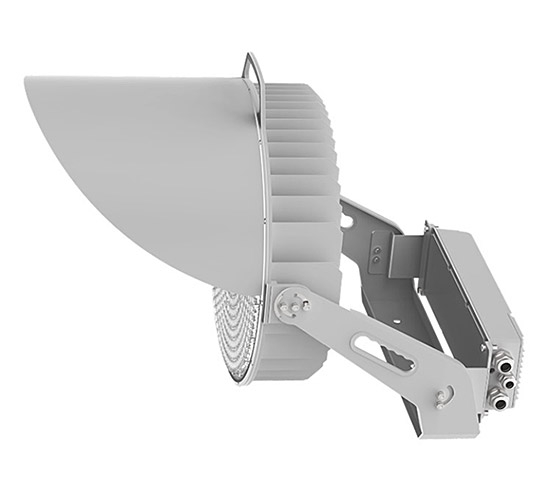
Side view of the illustrated round floodlight with hood, cooling fins, bracket and cable interface; the released mounting drawing defines the supplied arrangement.
JY model references for quotation
Use these nominal-power references when requesting a configuration-specific quotation. Ask for the current model, revision and included options.
Existing model reference Nominal power label JY-500W 500 W JY-600W 600 W JY-1000W 1000 W JY-1200W 1200 W JY-1500W 1500 W Dimensions, light output, efficacy, input-voltage range, IP and IK ratings, surge protection and warranty must be stated for that selected version.
Optics and the court lighting calculation
Specify the sport, level of use, court boundaries, playing and safety areas, player sightlines and any camera positions. Agree the project lighting criteria and the calculation method before choosing wattage or aiming. Pole height, quantity, spacing and optic selection should be coordinated through the proposed layout.
Use the actual offered luminaire IES or LDT file with its LED, optic, driver setting and mounting orientation. State how uniformity is defined, including the calculation surface and maintenance assumptions. This page does not assign a universal lux target, uniformity ratio or beam angle to every court.
Review light spill at nearby homes, roads and other sensitive boundaries, together with operating hours, aiming, shielding and glare criteria. An enclosure rating alone does not establish glare control, corrosion resistance or neighbourhood compliance.
Configuration and supply boundary
Decision State in the quotation or project schedule Luminaire configuration Exact model and revision; nominal and rated input; optic, driver, CCT and any hood or visor. Electrical and controls Supply voltage, circuit interface, requested dimming protocol and the specific compatible driver/controller. List any gateway, software or commissioning scope separately. Mounting and support Bracket drawing, fixing details, aiming limits, cable access, mass and wind-area data; coordinate with the pole or building support. Outdoor exposure Applicable ambient temperature, ingress, impact, surge and coating requirements, with evidence for the offered configuration. Documents and inspection Selected-model drawings, photometric file, applicable reports, agreed inspection records and written warranty terms. Included and excluded work Luminaires, accessories, poles, foundations, cables, controls, installation, aiming and commissioning itemized by supplier responsibility. An off-grid solar court system and an indoor arena installation have different power, support and design requirements. They need separate configuration review; neither is automatically included in this outdoor luminaire offer. A controller description does not establish compatibility with every protocol.
Project information for a coordinated quotation
Send this information Why it affects the offer Court dimensions, quantity and site plan Defines the area, boundaries, obstructions and proposed lighting positions. Training, recreation or competition use and governing criteria Defines the lighting task and any authority, association or camera requirements. Existing or proposed pole positions, heights and brackets Allows the mounting interface and aiming arrangement to be reviewed. Electrical supply and requested control functions Identifies driver, circuits and any controller or communications requirements. Neighbouring properties and operating hours Allows spill-light and operating restrictions to be incorporated into the layout. Quantity, delivery destination and supply scope Distinguishes a luminaire order from poles, foundations, installation or a broader project package. For a retrofit, add the existing fixture and bracket identification, supply details and available drawings. Compare energy and maintenance costs using the same lighting target, operating hours and documented baseline; no fixed percentage saving or service-life guarantee applies to every replacement.
Discuss your basketball court projectSend the site plan and the information above so the quotation can identify the proposed luminaire configuration, documents, exclusions and unresolved interfaces.
Request a Project QuotationFrequently asked questions
How many lights are needed for a full or half court?
The quantity follows the court dimensions, lighting criteria, pole positions and selected photometric file. A fixed two- or four-light rule does not establish that a particular half-court layout meets its requirements.
Which JY model should I include in an enquiry?
Use the existing reference schedule as a starting point, then request the exact available model and revision. The offer should identify the optic, driver, mounting arrangement and documents that belong to that version.
How should glare and spill be assessed?
Review the proposed distribution, aiming and any shielding against player sightlines, neighbouring boundaries and the adopted project criteria. A narrow beam or a visor alone does not prove a glare-free installation.
How are protection ratings confirmed?
A rating must refer to the exact enclosure and report. Confirm IP, IK, surge and environmental requirements separately for the quoted model; the illustrations do not establish common ratings for all variants.
Does this offer include solar panels, poles and installation?
Only items explicitly listed in the quotation are included. Solar supply, steel supports, foundations, wiring and site installation require their own coordinated scope and design review.
Can the lights support dimming or camera use?
Specify the required interface, operating scenes and camera conditions. Confirm compatibility and applicable test information for the selected luminaire, driver and controller, rather than assuming full-protocol or broadcast capability.
What warranty and maintenance information should I request?
Request written duration, component coverage, exclusions, labour, freight, spare-part availability and maintenance instructions. Projected LED life, driver service life and warranty obligations are different.
Can the same configuration be used in cold or hot climates?
Check the rated ambient range and operating conditions of the selected luminaire and driver, including any project derating and maintenance requirements.
-
-