

 English
 Español
 Bahasa Indonesia
 Français

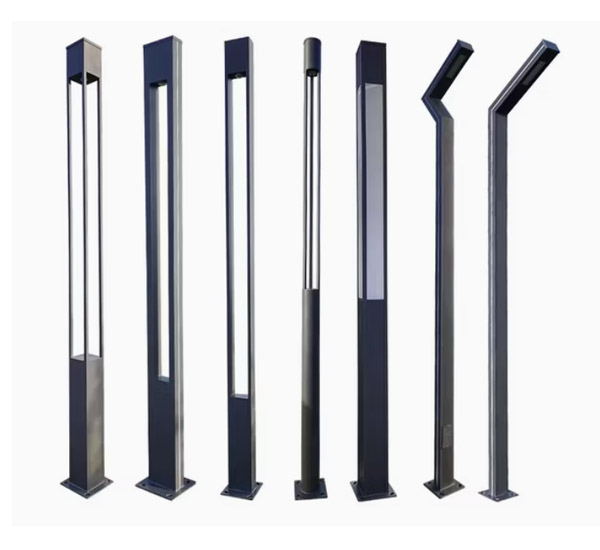
- Product details
-
Short answer: Choose a wired LED garden light by the visual task, mounting position, beam distribution, glare control and service plan—not by wattage or a catalogue photograph alone. A path needs comfortable wayfinding, a plaza needs usable area light, and a planting bed may need only controlled accent light. This page covers mains-powered LED garden and landscape luminaires for project purchasing; if the site has no practical power connection, assess a solar garden-light system separately.
Match the garden light to the job
Landscape lighting is not one task. People walking to a building entrance need to see the route and its edges. Visitors in a park need orientation without distracting glare. A hospitality courtyard may also use light to show planting and architecture, but the decorative layer should not hide steps or crossings. State which surfaces need light, who uses the space, when it operates and which adjacent areas should remain dark.
Jieyao lists a range of garden and landscape lighting products. For a project enquiry, begin with the site drawing and the intended visual effect. The exact luminaire, distribution, finish and electrical configuration should then be checked against the selected product record and submittal. A generic range page is not a substitute for a model-specific photometric file or installation drawing.
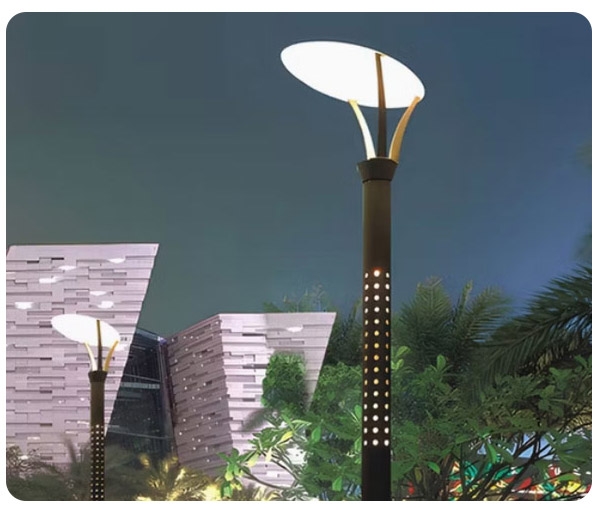
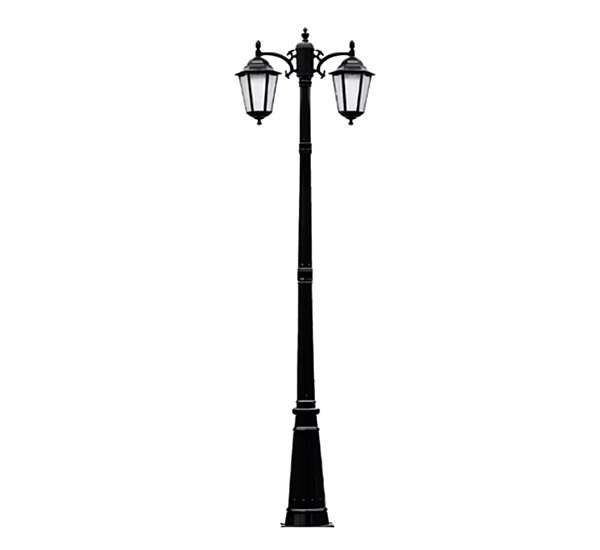
Illustrative post-top form and landscape setting; this is not presented as a documented project or proof of a particular specification.
Application-to-fixture decision guide Project area What matters most What to verify in the layout Pedestrian path Route recognition and comfortable forward visibility Light at curves, junctions and level changes; glare at eye level Garden or park edge Guidance without excessive spill into planting or neighbouring property Beam control, fixture spacing and maintenance access Courtyard or plaza Usable area light alongside architectural character Task zones, faces, entrances and possible dark pockets Planting or facade accent Controlled emphasis rather than general illumination Aiming, spill, shadow and view from occupied spaces Which LED garden-light form fits?
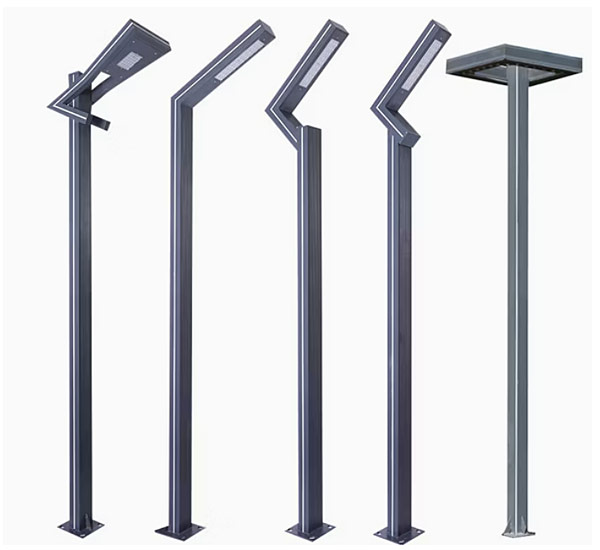
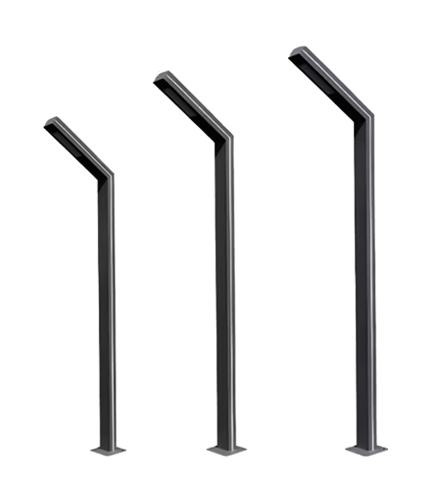
Post-top and short-pole luminaires can light a wider pedestrian area from above. Bollards mark a route at low level but are more vulnerable to obstruction, impact and glare at eye height if their shielding is poor. Ground-mounted accents and wall-mounted fixtures serve different surfaces and should not be substituted for a path-lighting calculation simply because the housing looks similar.
Choose the form after the lighting task is defined. On a narrow walkway, a fixture placed too close to planting may be blocked as vegetation grows. In an open plaza, a decorative bollard may create pools of light while leaving the centre insufficiently lit. Fixture geometry, mounting height and beam distribution work together; review them on a plan and, where useful, in a nighttime sample.
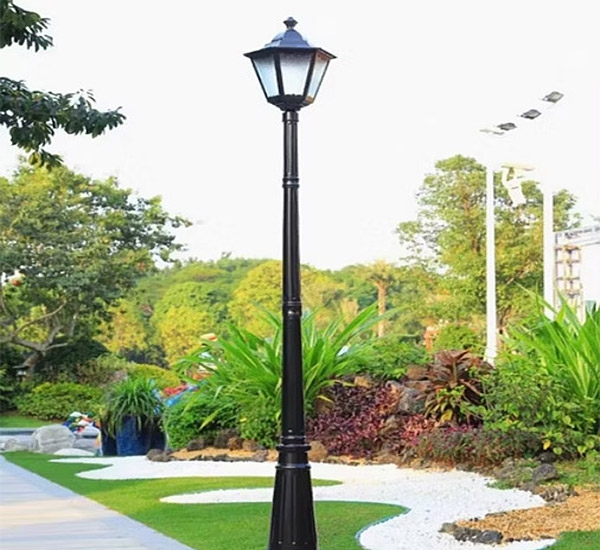
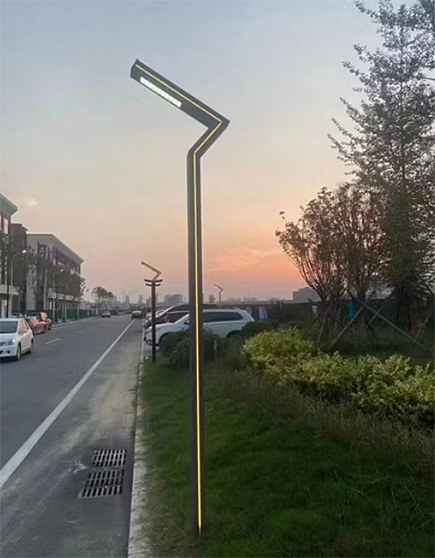
Illustrative path-side mounting; fixture appearance alone does not establish its optical or electrical configuration.
Fixture-form comparison Form Typical role Buyer check Post-top or short-pole Route and area illumination Distribution, mounting interface, glare and pole position Bollard Low-level wayfinding and edge definition Shielding, impact exposure, access to driver and foundations Wall-mounted Building edge, entrance or perimeter Facade fixing, cable route and spill toward windows Accent fixture Tree, planting or architectural feature Aiming, glare from viewing points and future landscape growth Light quality: distribution, glare and colour
Catalogue power is an electrical input, not a measure of light delivered to the intended surface. Ask for the exact model's photometric distribution and test it at the proposed mounting height and orientation. A broad symmetrical optic can be useful in an open area, while a more directional optic may keep light on a path and away from adjacent planting or residences. The correct choice depends on the geometry.
Glare matters because many landscape fixtures are viewed directly by pedestrians. Check the luminaire from common approaches and seating positions, not only from a plan view. Select colour appearance for the setting and coordinate it with nearby street or architectural lighting. In a hospitality space, consistent colour can be as important as peak brightness; in a park, clear route recognition and restrained spill may take priority.
If controls or dimming are needed, identify the exact driver and control interface in the quote. A label such as “smart” is not enough: the buyer should know how the light switches, whether scenes can be maintained, and what happens if a controller fails.
Outdoor construction and serviceability
Garden lights encounter rain, dust, irrigation water, insects, temperature changes and landscape maintenance equipment. The required enclosure protection depends on the mounting position and exposure. Request the test report for the selected model and examine the cable entry, seals, lens and access cover shown in the drawing. Do not transfer an ingress rating from a different housing in the same product family.
At ground level, drainage and splash exposure can dominate. On a pole, wind, corrosion environment and the pole-to-fixture connection matter. Where a landscape contractor may use sprinklers or pressure washing, confirm how the product and wiring should be installed and cleaned. A serviceable driver, replaceable parts and a clear isolation method can reduce future disruption, but the actual repair approach must be confirmed for the offered model.
Finish selection should match the site environment. Coastal spray, urban pollution and contact with planting media are different conditions. Ask for the material and coating schedule rather than assuming that a product described as “outdoor” suits every exposure.
Coordinate the lighting with the landscape plan
Before finalising positions, mark paths, roots, irrigation lines, drainage, buried services and maintenance access. A fixture placed where a tree will grow can lose effectiveness; a bollard at a mower edge can be damaged. Coordinate civil and electrical drawings so foundations, cable routes and junction boxes remain accessible after paving and planting are complete.
At handover, compare the installed model and orientation with the approved lighting layout. Inspect fixings and cable entries, test switching and any control scenes, and walk the site after dark from the users' likely approach directions. Photograph the installed positions and retain the model, driver and maintenance documents for the operator.
When to use a wired LED garden light instead of solar
A mains-powered luminaire and a solar garden-light system solve different infrastructure problems. Wired lighting can use a defined supply and central control strategy, but requires a feasible cable route and electrical works. Solar avoids some cabling where an adequate, unshaded collection position is available, yet needs an energy budget, battery and maintenance plan. Neither option is universally cheaper or easier; compare the site works and operating requirements together.
If solar is under consideration, use the separate solar garden lights page to frame that enquiry. Do not use a solar photograph or runtime claim to specify a wired LED luminaire. The selected product's drawing and power architecture must match the final procurement schedule.
What to send with an LED garden-light RFQ
A useful enquiry identifies the visual task and site constraints, not just a desired wattage. Send a scaled plan, photos, the intended operating hours, mounting locations, nearby sensitive areas and the power/control conditions. Note whether the luminaire is a new installation or a replacement on an existing pole or base.
Submittals to request for the selected garden-light model Item Why the buyer needs it Model and configuration schedule Prevents a catalogue-family image from standing in for the quoted fixture Photometric file and layout Shows light on the required surfaces and spill outside them Installation drawing Defines mounting, cable entry, clearance and maintenance access Electrical and control data Coordinates supply, protection, switching and dimming Material, finish and test reports Checks the selected enclosure against the actual exposure Spare and service information Allows the operator to maintain the chosen configuration Share the brief through the Jieyao contact page. Where the project also includes roadway lighting, keep the garden-light and street-light schedules separate: their optics, mounting and design criteria are not interchangeable.
LED garden-light FAQ
How bright should a garden path be?
There is no single wattage or lumen figure for every path. Define the use, geometry, nearby ambient light and applicable project criteria, then test candidate luminaires in a layout and on site where possible.
Are garden lights the same as street lights?
No. A garden luminaire is usually selected for pedestrian scale, visual comfort and landscape integration. Roadway lights have different mounting, distribution and traffic-visibility requirements.
Can a solar garden light replace a wired model?
Sometimes, but only after checking solar exposure, energy storage, operating hours and the maintenance strategy. A matching appearance does not mean the two systems have the same electrical architecture or output.
What should be checked in a sample?
Confirm the exact model, colour, finish, beam, glare from typical viewing positions, mounting interface, cable access and service method. Check these against the proposed layout and submitted documents.
-
-