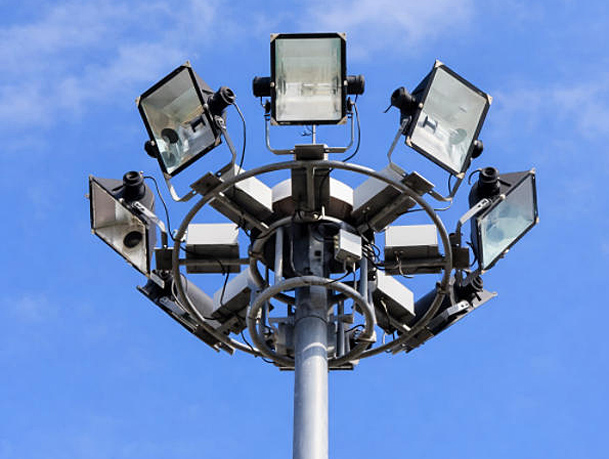

A high mast installation method statement should define what must be accepted before the next stage proceeds, who releases it and which record proves the result. Tie foundation, shaft, anchor connection, lowering mechanism, electrical tests and lighting checks to one pole ID and one approved equipment configuration.
This guide develops the inspection and handover side of installation. It helps a buyer or site team build an evidence trail through civil, steel, mechanical and electrical interfaces. The lifting procedure, tightening method, test limits and operating sequence come from the approved project documents and the actual equipment manuals.
In this guide: Release gates · Civil and steel interfaces · Commissioning · Original record example · Download checklist

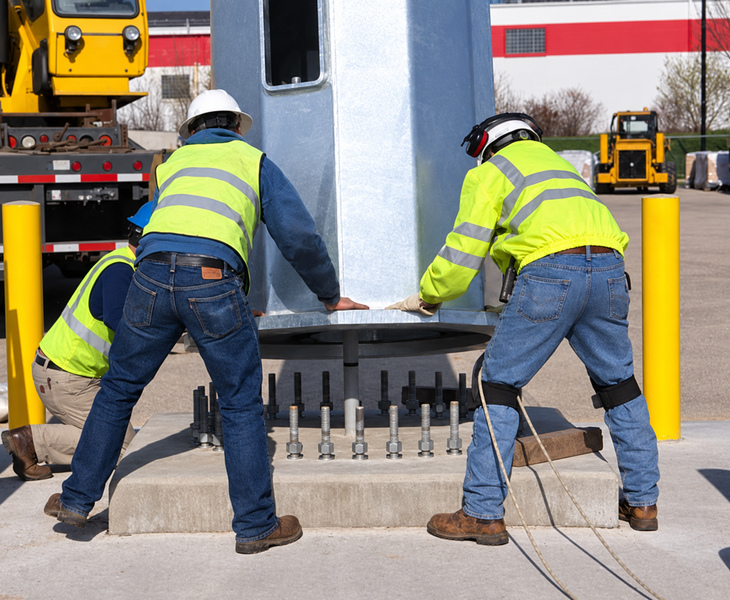
High mast base connection during site installation — an installation example.
Create an inspection and test plan alongside the work method. A hold point requires the designated authority’s release before the next activity. A witness point invites a named party to observe under the agreed notice rules. A review point checks a document or result. Agree these meanings and responsibilities for the contract; a generic checklist cannot assign them to the supplier, civil contractor or owner automatically.
Give every mast a location and asset mark. Use the same mark on the foundation survey, section identification, joint record, lowering-system configuration and electrical test sheet. Where the shaft, headframe or luminaire changes, identify the revision before the associated check is released.
↔ Swipe to read all columns.
| Proposed gate | What must be coordinated | Record to retain |
|---|---|---|
| Before erection | Civil interface and accepted equipment set | Foundation release, anchor survey, lift plan and component schedule |
| Before shaft / connection release | Correct section sequence, orientation and joint details | Assembly measurements, drawing revision and connection record |
| Before powered functional testing | Mechanical assembly and electrical test readiness | Manufacturer procedure, inspection results and test authorization |
| Before service handover | Required functions, lighting and defect closure | Test reports, final settings, as-built pack and signed disposition |
These gates are a planning structure. The responsible project parties set the actual hold points and acceptance criteria. For the equipment choice itself, see the separate high mast winch selection and maintenance guide.
Compare the erected asset with its civil design before the lift: location, base orientation, anchor pattern and projection, top levels, cable entries and the concrete release record. The foundation designer should approve deviations. Do not correct an anchor mismatch by enlarging a baseplate hole or altering a connection without an approved disposition. The foundation and anchor-bolt design guide covers the design inputs; this article covers the installation evidence.
For a sectional mast, retain the section IDs, approved sequence, alignment, orientation and the joint measurement required by that mast drawing. Record the measurement method and final result. The Jieyao library installation notes specifically identify overlap as dependent on the pole configuration; that is why a value from another mast is unsuitable as a universal site criterion. [1]
↔ Swipe to read all columns.
| Interface | Acceptance basis | Useful installed evidence |
|---|---|---|
| Foundation and anchors | Approved civil drawing, survey tolerances and concrete release | Pole mark, levels, projection, orientation and signed survey |
| Shaft section joint | Matched section drawing and manufacturer assembly method | Section IDs, orientation and specified engagement / joint reading |
| Base and anchor connection | Connection design and specified tightening method | Fastener identity, tool/check record and final disposition |
| Coating and cable route | Project coating repair and cable protection requirements | Damage/repair photos, protected entries and accessible door |
A torque number has meaning only with the fastener, connection and tightening procedure to which it belongs. Lubrication, coating and assembly condition can change the torque-preload relationship. Use the prescribed procedure and record its completion; do not convert a generic online torque table into the project acceptance sheet.
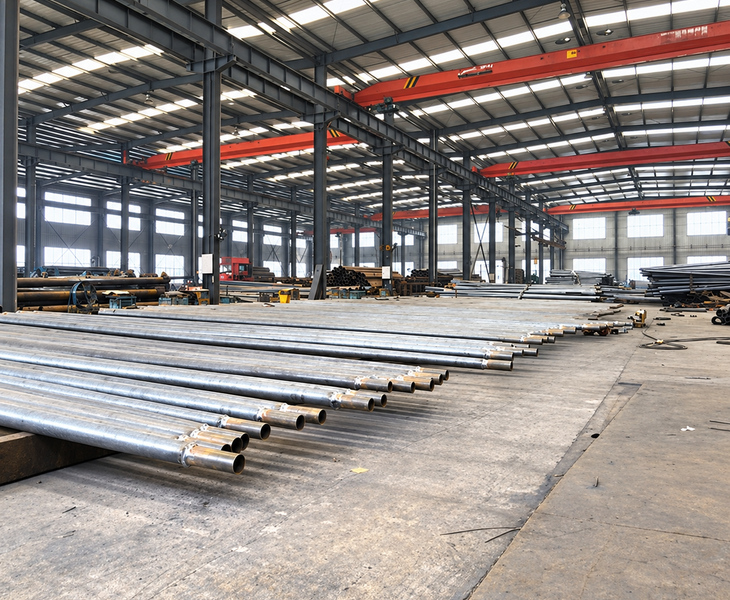
Steel pole sections arranged for preparation and identification — a production example.
Confirm the headframe, carriage, ropes, winch, guides, power cable and control arrangement against the equipment schedule. Inspect the intended routing and clearances before operation. Different systems can carry the ring on ropes, transfer its service load to latches or use another engineered arrangement. The inspection needs to establish the load path required by that system, including its indication and verification method.
The supplied Jieyao notes describe a three-branch-rope arrangement with latching components. They support reviewing rope routing, connection and control checks for that configuration. They do not establish the rope layout, operating clearance, travel speed or trial-cycle count for every high mast. Apply the manufacturer’s matched instructions and the approved site method. [1]
↔ Swipe to read all columns.
| Commissioning item | What the record should identify | Disposition if unresolved |
|---|---|---|
| Ropes, guides and termination | Matched configuration, accessible condition, routing and specified checks | Hold operation for the authorized technical review |
| Ring travel and service support | Test procedure, observed travel and support / latch verification | Record the abnormality and its approved correction before retest |
| Controls, limits and stopping | Specified functional tests and observed responses | Retain test result and responsible release |
| Electrical and protective measures | Circuit identity, competent tester, instrument and specified test results | Close unacceptable results before energization / service |
| Luminaire orientation and scene | Installed model/optic, aiming and operating settings | Compare with the lighting design and record any revision |
Carry out operating tests under the approved exclusion, isolation and supervision arrangements. If movement, sound or indication differs from the procedure, stop the test and retain the observation for diagnosis. The acceptance sheet should record what happened, the action taken and the retest; “operates normally” alone is hard to audit.
Keep electrical acceptance and photometric acceptance distinct. Turning the lights on confirms only part of the function. Record the required electrical results and then the lighting mode, aiming and survey evidence required for the site. Our floodlight aiming and glare commissioning guide develops the optical checks.
The following is an author-created teaching example with three assets and six required evidence gates each. C means accepted evidence for that gate; M means required evidence missing; R means a drawing-revision mismatch; N means an open nonconformance. These are invented record states for explaining traceability, not results from an installed project.
↔ Swipe to read all columns.
| Example asset | Foundation | Shaft joints | Anchors | Lowering | Electrical | Lighting records |
|---|---|---|---|---|---|---|
| HM-01 | C | C | C | C | C | C |
| HM-02 | C | C | M | C | C | C |
| HM-03 | C | R | C | M | N | C |
14 of 18 gate records are complete: 77.8%. Only HM-01 has all six gates marked C. HM-02 lacks its anchor-connection evidence. HM-03 has a shaft revision mismatch, missing lowering evidence and an open electrical nonconformance. The overall percentage cannot release either held asset.
The arithmetic is 14 ÷ (3 × 6) × 100 = 77.8%. One of three example assets has all six records complete. Even that count depends on the project’s actual gate definitions and sign-off authority; it is a document-status demonstration, not a safety score. In a real project, one critical unresolved item can stop the next operation regardless of the number of completed forms.
This is why the register needs both an asset row and an evidence reference. A photograph, measurement sheet or test report should have an ID and revision, not just a check mark. Keep the nonconformance number, responsible party and disposition linked to the same gate. A blank result should remain open rather than becoming a default pass.
The final pack should connect the as-built location and equipment schedule to civil release, assembly and tightening records, electrical and functional tests, aiming/lighting reports, closed defects and the supplied manuals. Record spare-part identity and the maintenance route for the actual lowering assembly. Include settings and drawing revisions so a later luminaire or cable replacement can be checked against the installed configuration.
TxDOT’s Highway Illumination Manual provides a practical public example of this record-based approach: it calls for documented high-mast inspections and refers to Form 1409 or a similar form. It also ties fixture replacement to the specified equipment and aiming information. Those provisions belong to TxDOT’s system; this article’s blank worksheet is a separate Jieyao planning aid, not a TxDOT approval form. [2]
Two-page evidence register and release checklist
Use it to assign the acceptance basis, evidence reference, reviewer and open-item disposition by mast ID.
Download the high mast installation acceptance checklist · PDF
The checklist organizes evidence. The approved design, actual equipment instructions and site method set the assembly sequence, operating conditions and acceptance limits.
It is one part of the required evidence. The project also needs the specified civil, structural, electrical, lighting and defect-closure records for the installed asset.
Identify who supplies, installs, tests, witnesses and accepts each interface. Send Jieyao the mast schedule, arrangement and foundation drawings, lowering-system configuration, exposure, inspection plan and required handover pack. Review the high mast system package or share the installation and acceptance brief.
[1] Jieyao supplied library: High Mast Installation and Operating Notes (高杆灯安装使用说明), sections on system arrangement, preparation, assembly and operating checks. Used for the described configuration and model-matching principle. The original internal document is retained in the project library; this download is a newly prepared blank worksheet.
[2] TxDOT, Highway Illumination Manual, Chapter 9, Section 4, High Mast Lighting Inspection and Servicing: inspection documentation, fixture identity and aiming. Accessed 10 November 2026. https://www.txdot.gov/manuals/trf/hwi/construction_and_maintenance_guidelines/high_mast_lighting_inspection_and_servicing-i10004.html
The three-asset matrix is Jieyao’s original illustrative analysis. It contains no customer inspection results, pricing or private project details. Project acceptance follows its approved documents and authorized reviewers.
Published 10 November 2026 · Yangzhou Jieyao Lighting Equipment Co., Ltd.
Contact Us
Get a custom lighting solution and quotation for your project. Yangzhou Jieyao Lighting Equipment Co., Ltd. manufactures outdoor lighting and steel poles in Guoji Town Industrial Park, Gaoyou City, Yangzhou, Jiangsu, China. The company reports a 10,000 m² factory site, more than 60 employees including more than 10 technical personnel, and more than 100 production and testing machines. The present company name dates from 2017; Jieyao Poles’ published history traces the team’s manufacturing lineage to 2006. The stated 15 years of experience refers to the team. The company reports exports to more than 60 countries. Do you have any questions or requests?
Email: jay@jieyaolighting.com

Click to Chat.
Im online now.
 English
 Español
 Bahasa Indonesia