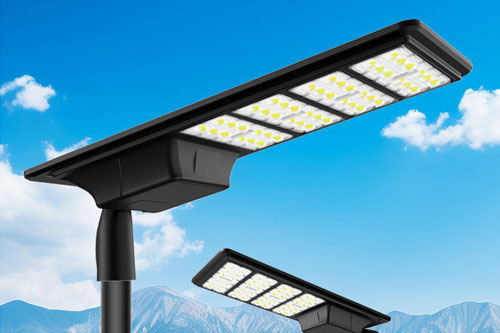

Street light pole types describe several different choices: material, shaft cross-section, shaft profile, arm layout, base mounting and maintenance access. A pole can be steel, octagonal, tapered, double-arm and flange-mounted at the same time. Identify each feature separately to compare equivalent assemblies.
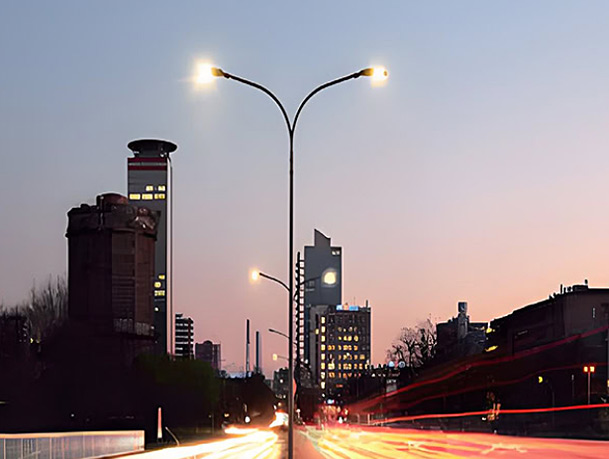
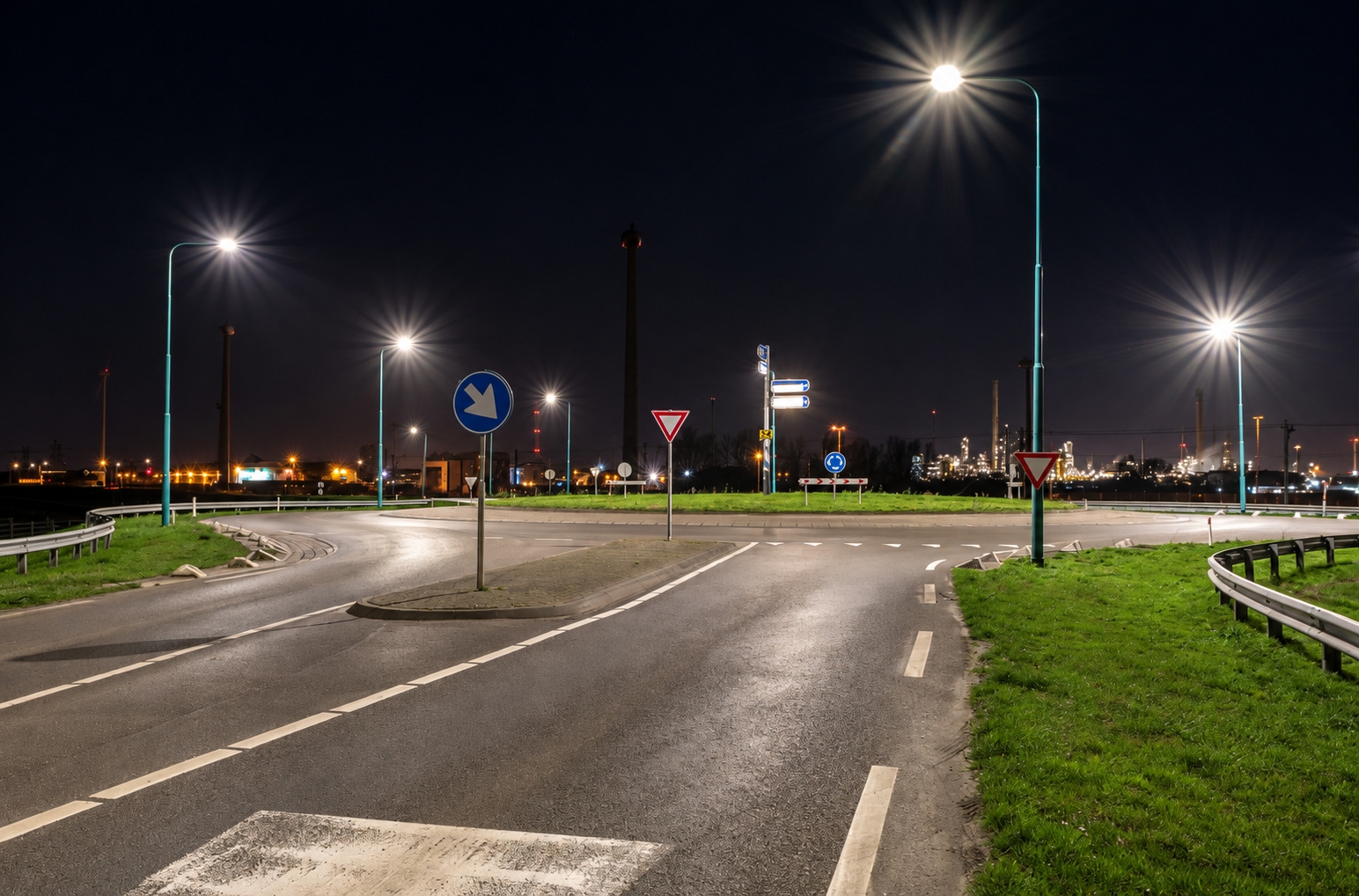
Street lighting at a road junction — an application example.
Look first at the luminaire and its arm, then the shaft, and finally the base. This gives you a practical description without guessing a model number. “Highway pole”, “solar pole” and “decorative pole” tell you something about use or appearance, but leave important structural choices open.
Swipe the table sideways on a phone to see the final column.
| Feature | Common descriptions | What it identifies | What it does not establish |
|---|---|---|---|
| Material | Steel, aluminium, stainless steel, concrete, composite | The main structural material | Strength, life or suitability without grade, dimensions and exposure |
| Shaft section | Round, octagonal, square | The cross-sectional shape | Whether the shaft is tapered or straight-sided |
| Shaft profile | Tapered, constant-section | How the section changes along the pole | Arm count or base connection |
| Luminaire arrangement | Single arm, double arm, post-top, multi-head | How and where lights attach | Illuminance, uniformity or required pole spacing |
| Base mounting | Flange-mounted, direct embedded | Connection at ground level | A universal anchor pattern or burial depth |
| Maintenance arrangement | Fixed, hinged / tilt-down | How equipment is accessed | A safe lowering procedure for every configuration |
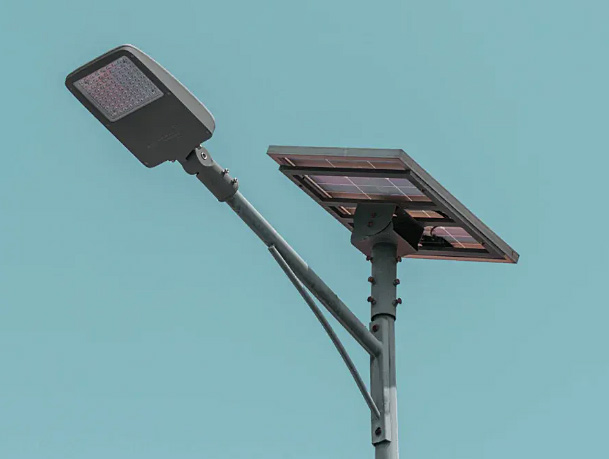
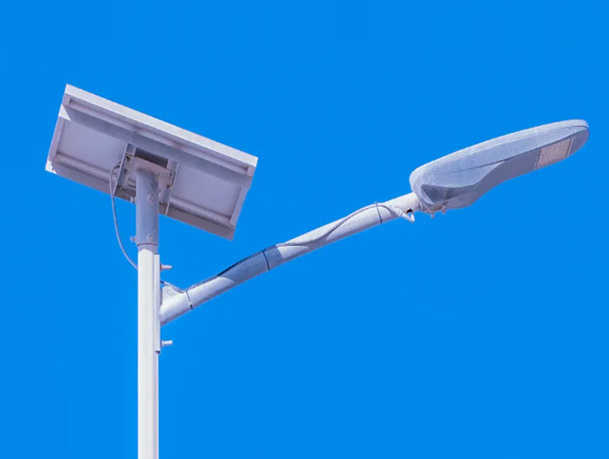
A single-arm pole places a luminaire to one side of the shaft. It is a familiar arrangement along a road edge, where the light needs to project toward the carriageway. The arm may be straight or curved; its direction, outreach and rise determine the luminaire position.
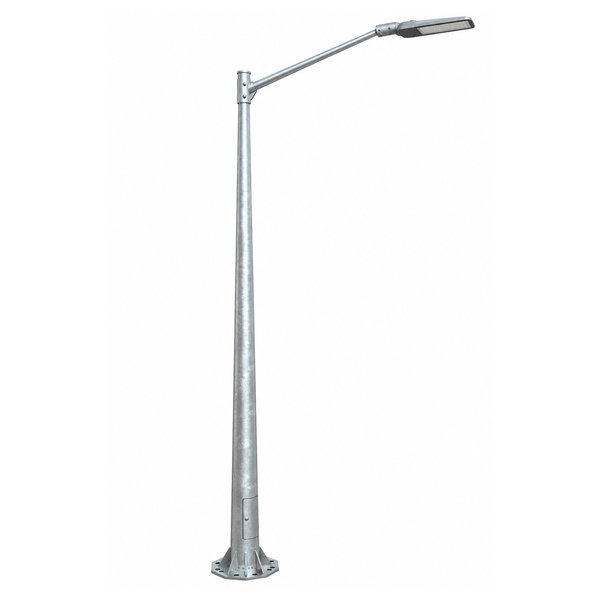
Single-arm street light pole — product configuration example.
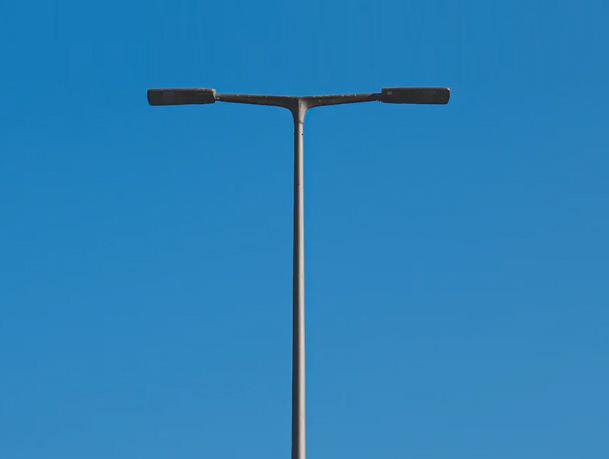
A double-arm pole supports two luminaire positions. Opposed arms are often considered where lighting is required on two sides of a pole, such as a median. Other angles can suit a particular layout, so “double arm” alone does not define orientation.
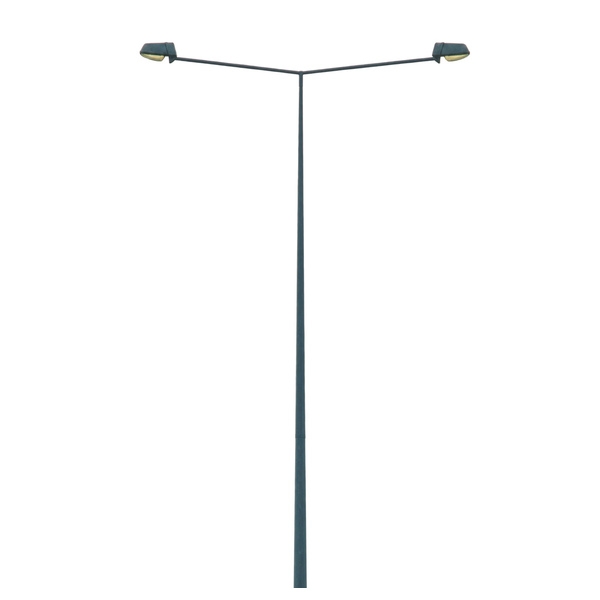
Opposed double-arm street light pole — configuration example.
Two luminaires do not automatically halve the pole count or improve uniformity. Compare the lighting calculations for the actual carriageways and pole positions. See single arm vs double arm for that focused comparison.
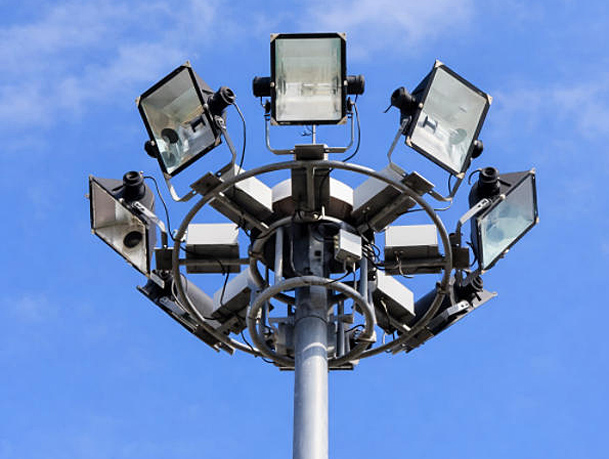
A post-top luminaire mounts at the shaft top rather than at the end of a road arm. Multi-head arrangements use a bracket or top assembly to carry several lights. Their appearance can suit a walkway, square or public space, but the optics and mounting position must still serve the intended area.
For procurement, identify the fixing interface as well as the number of lights. A luminaire designed for side entry may need a different connection from one designed for a vertical spigot. Jieyao’s single- and double-arm product page shows road-arm configurations.
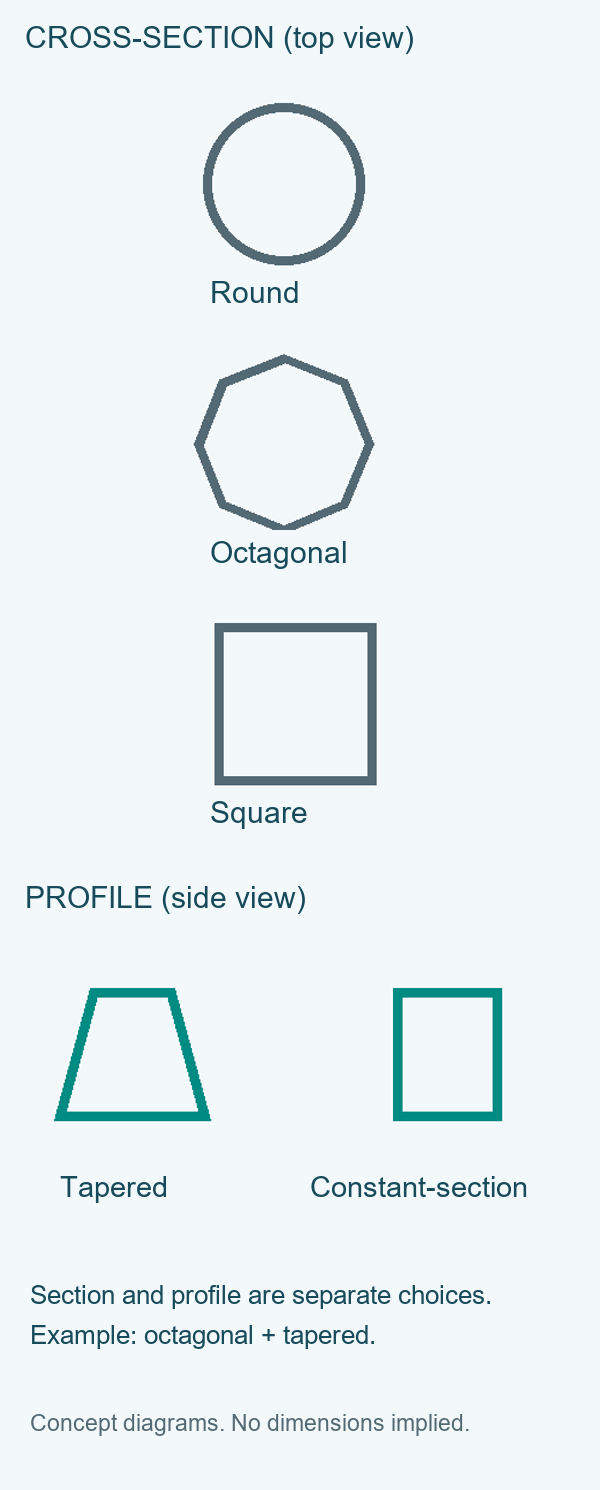
Street light pole cross-sections and shaft profiles — concept diagrams.
These names describe the shaft cross-section. A round shaft has a circular section; an octagonal shaft has eight faces; a square shaft has four. You may notice the flat faces more easily at the base or on an unfinished shaft than in a distant road photograph.
A cross-section name is not a structural rating. Diameter or across-flat dimensions, wall thickness, steel grade, welds, openings and attachments also affect the design. A round pole should not be described as weaker than an octagonal pole simply from its outline.
A tapered pole becomes narrower toward its top. A constant-section shaft maintains its section along the main length. Either round or polygonal shafts can be tapered, which is why “round vs tapered” is an incomplete comparison.
Use the round vs octagonal comparison when you need to compare complete designs. For this first selection, record both the section and profile: for example, octagonal tapered shaft.
Galvanized steel is the main pole material covered by Jieyao’s road-pole product range. Aluminium, stainless steel, concrete and composite poles also appear in lighting projects. They are material categories rather than interchangeable versions of one design.
Compare actual grade, section, finish and installation requirements for the same duty. Aluminium’s lower material density does not by itself establish the finished assembly’s weight, and a material name does not establish corrosion life. A site beside salt water needs an exposure-specific finish specification and maintenance plan.
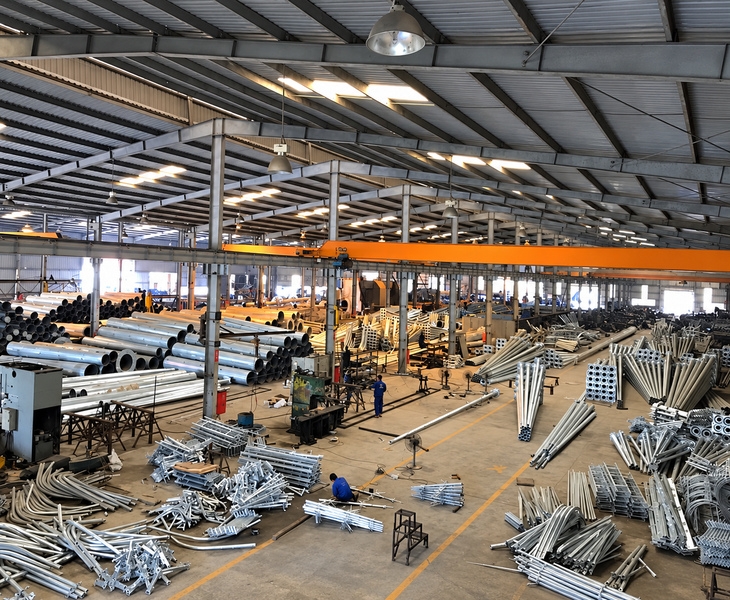
Steel pole shafts and brackets on a production floor.
For a broader specification and supply checklist, continue to the street light pole buying guide. This type guide focuses on recognising the configuration rather than ranking materials for every project.
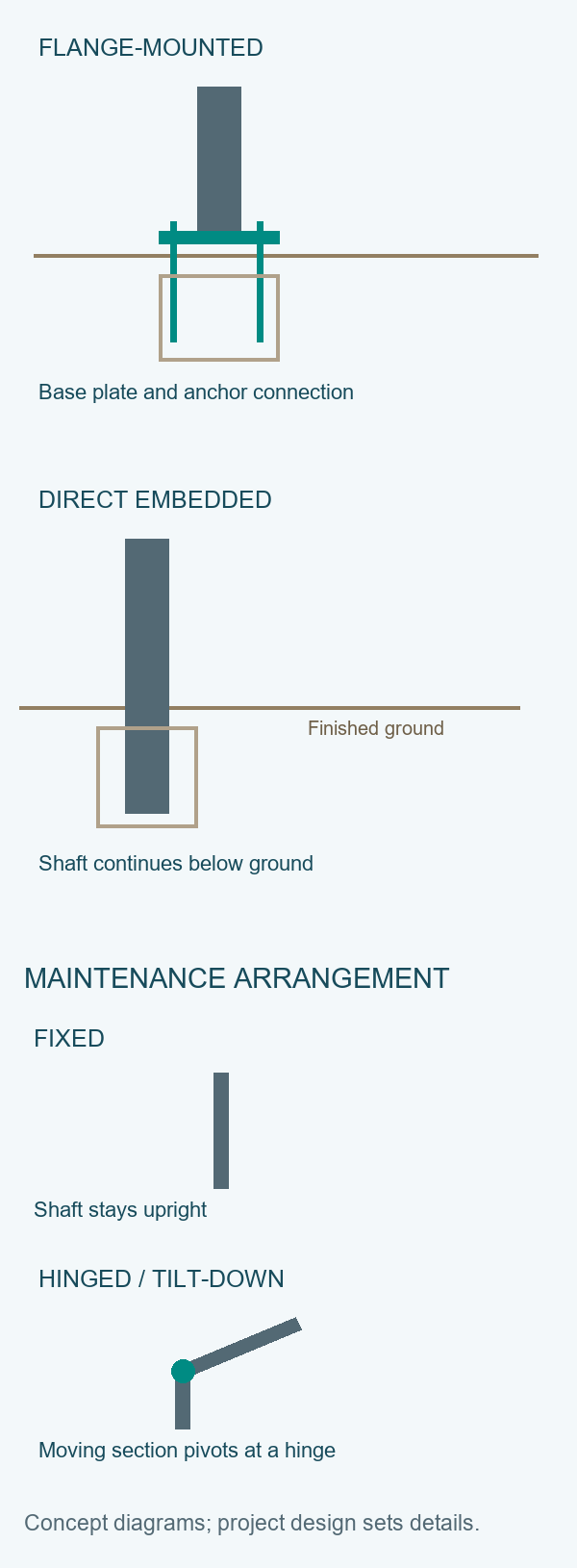
Base connections and maintenance arrangements — concept diagrams.
A flange-mounted pole has a base plate connected to a designed support, commonly through anchor bolts. The visible base plate is a useful identifying feature. Plate dimensions, hole positions and bolt projection must match the foundation interface; they are not universal across poles of the same height.
A direct-embedded pole has a below-ground shaft section instead of a surface flange connection. The buried length and surrounding foundation arrangement are part of the design. Total manufactured length and height above finished ground are different dimensions.
Label both dimensions on a direct-embedded pole drawing: the length above finished ground and the total shaft length. This avoids comparing a buried portion with a flange-mounted pole’s exposed height.
Select the mounting arrangement with the ground conditions, underground services, foundation design and replacement strategy in view. An existing foundation should be checked against the proposed pole; a matching height alone does not establish compatibility.
A fixed pole keeps its shaft upright during routine luminaire servicing. A hinged or tilt-down design allows a defined part of the assembly to lower for access. The hinge can be at the base or above it, so a photograph of a hinge should be read together with the movement arrangement.
A lowering design needs space along its movement path and a compatible system for controlling and securing the moving section. Locks, cables, attachments and maintenance access matter alongside the hinge itself. Select it where the site can accommodate the complete lowering operation.
This differs from a high mast with a lowering luminaire ring: on that system the ring moves while the mast remains upright. For those categories, see types of high mast lighting.
Road edge: shortlist an arm arrangement that places the luminaire toward the lit area, then confirm the lighting layout and safe pole position.
Divided road: compare median double-arm and roadside single-arm layouts using the same lighting task. Median space, vehicle access and maintenance can change the preferred arrangement.
Walkway or square: consider post-top or multi-head layouts alongside road-arm alternatives. Check glare, pedestrian visibility and the architecture rather than choosing by decorative appearance alone.
Restricted vehicle access: consider a suitable hinged arrangement only after checking the clear lowering area. Where the shaft stays fixed, plan how the luminaire will be reached.
An application narrows the shortlist; it does not create a new shaft type. Solar equipment, banners or cameras add attachments that must be included explicitly in the pole design.
A clear starting description is: galvanized steel, octagonal tapered shaft, two opposed road-lighting arms, flange-mounted base, fixed shaft. This is a configuration example, not a dimensioned product specification.
Add the site layout, required luminaire positions, fixture data, exposure and applicable design basis. Jieyao Lighting can then discuss the corresponding steel-pole configuration through the project enquiry page. Keep any model selection tied to the approved assembly drawing.
“Decorative” describes appearance. A decorative pole still has a material, shaft section, mounting connection and luminaire arrangement. Specify those features underneath the finish or style description.
The pole positions the luminaire; its shape does not set light output. Brightness on the road depends on the luminaire’s photometric distribution, output and mounting layout. Use a lighting calculation to compare proposed arrangements.
A useful example of configuration-based scheduling is the City of Overland Park Streetlight Design Manual, “Streetlight Poles and Bracket Arms”. It schedules assemblies using mounting height, bracket length and arm count. The city’s own material and dimension requirements apply locally.
The photographs above show visible pole and arm configurations. They do not establish dimensions, structural capacities or measured lighting performance. Prepared by Jieyao Lighting using its published steel-pole product images and application image library.
Contact Us
Get a custom lighting solution and quotation for your project. Yangzhou Jieyao Lighting Equipment Co., Ltd. manufactures outdoor lighting and steel poles in Guoji Town Industrial Park, Gaoyou City, Yangzhou, Jiangsu, China. The company reports a 10,000 m² factory site, more than 60 employees including more than 10 technical personnel, and more than 100 production and testing machines. The present company name dates from 2017; Jieyao Poles’ published history traces the team’s manufacturing lineage to 2006. The stated 15 years of experience refers to the team. The company reports exports to more than 60 countries. Do you have any questions or requests?
Email: jay@jieyaolighting.com

Click to Chat.
Im online now.
 English
 Español
 Bahasa Indonesia