
A light pole base cover is a removable shell around the bottom of a pole. It conceals the base plate and anchor hardware and gives the installation a finished appearance. Choose it by the shaft opening, the space around the hardware and the way it opens for service. Its appearance does not establish a structural, waterproof or breakaway rating.
What this guide covers

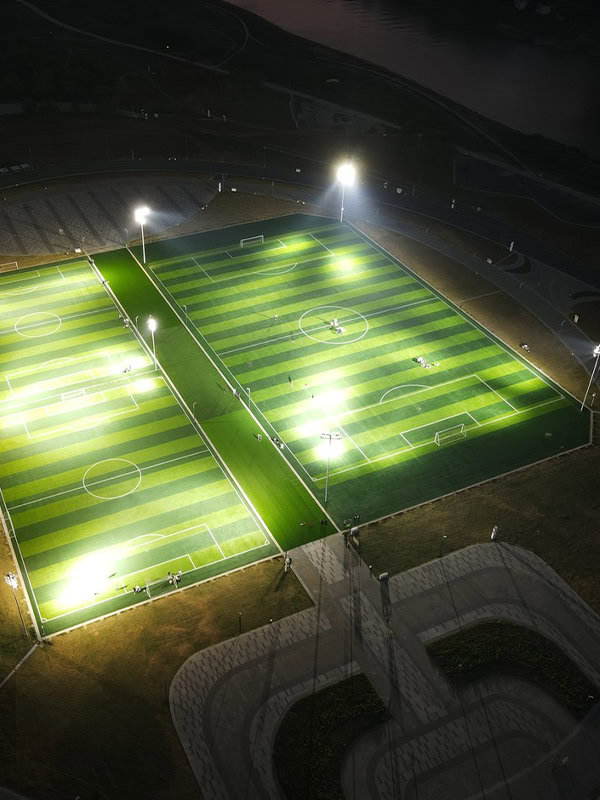
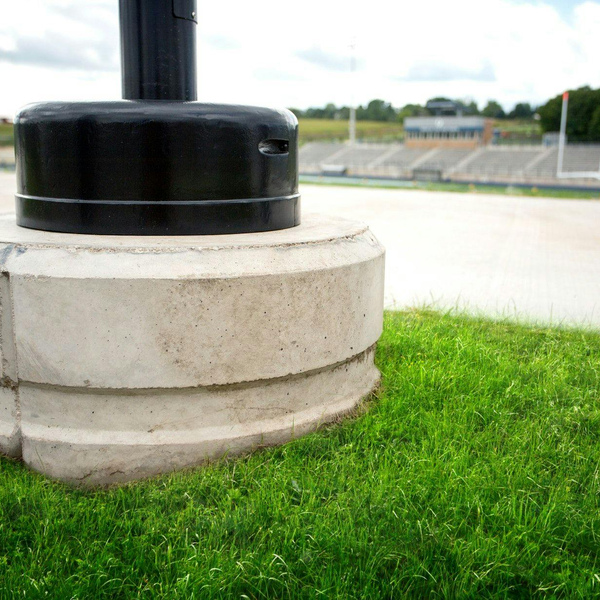
A base cover at a sports ground — an application example.
Three parts are easily confused. The base plate connects the pole to its support. The base cover, also called a shroud or skirt, fits around that connection. The access door is an opening in the shaft through which the electrical compartment is reached. A missing cover and a missing access door call for different replacements.
In the photograph above, the black shell sits above the concrete pedestal and around the shaft. The concrete is not part of the cover. That distinction matters when measuring a replacement: an outside pedestal diameter will not tell the supplier how much clear space the cover needs inside.
A split cover separates into parts that assemble around the shaft. This can make replacement possible while the pole remains erected, provided the fastening and removal path are accessible. Look at the joint, screw positions and how the pieces locate against one another. A similar outside shape can hide a different fixing arrangement. Check that the pieces can be brought together around the shaft and that their fasteners remain reachable beside the pedestal.
A one-piece slip-over cover passes over the shaft during the planned assembly sequence. Before selecting one for an existing installation, consider whether the pole top, arm or luminaire prevents it from passing into position. A cover that fits at the bottom may still be impossible to install from above.
Manufacturer catalogues use both clamshell and slip-over descriptions, and offer covers for different shaft shapes. Those are useful categories; they are not universal dimensions. Match the actual pole and cover drawings and keep the agreed cover drawing with the maintenance records for future replacements.
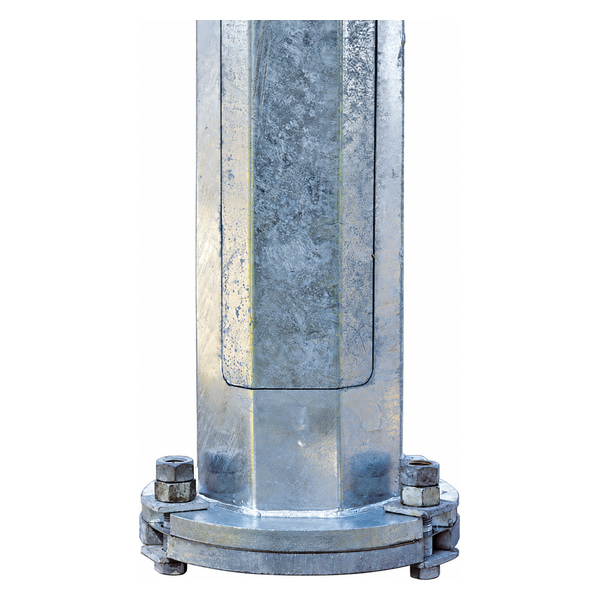
Exposed flange and hardware — the space a cover must accommodate.
The exposed flange photo shows why the shaft opening alone is insufficient. Nuts, washers, bolt projection and plate corners occupy space outside the shaft. On another pole, stiffeners or an earthing connection may also affect the envelope. The cover needs the specified clearances without bearing on hardware that is not intended to support it.
On a phone, swipe this table sideways to see the final column.
| Measure or record | Why it matters | How to describe it |
|---|---|---|
| Shaft at cover height | Controls the top opening | Round outside diameter, or square/polygon dimensions and orientation |
| Hardware envelope | Controls internal width and depth | Base plate outline, nut and bolt positions, maximum projection and any stiffeners |
| Cover height and underside | Controls fit above finished surface | Height, bottom footprint and clearance to pedestal or paving |
| Joint and fasteners | Controls installation and later removal | Number of pieces, fixing method, screw locations and available tool access |
| Finish and identification | Helps match an existing streetscape | Material if known, colour reference, photographs and existing part identification |
Take photographs from more than one side with a scale, and label where each measurement was taken. Measuring around a shaft with tape gives its circumference, not its diameter. For a round shaft, dividing circumference by π gives an approximate diameter; a direct measurement is preferable when tolerances or an irregular coating surface matter.
A tidy cover should still allow the maintenance team to reach the intended base hardware and shaft access door. Check the removal path after paving and landscaping are finished. Raised soil, asphalt overlays or sealant applied around a removable seam can turn a serviceable cover into an obstruction. A fence or adjacent fitting can also block access to a screw even when the cover itself fits.
The cover should follow its intended fastening and drainage arrangement. Do not assume it is a watertight electrical enclosure, or fill openings simply because they appear untidy. Water collecting around the base is a site and detailing problem to investigate, rather than something a decorative shell necessarily solves.
Dented or missing covers are often a replacement-parts issue. Loose anchors, damaged threads, cracking around the foundation or corrosion affecting the support need a separate assessment. Replacing the shell can improve appearance while leaving the underlying defect untouched.
The distinction is especially important on a breakaway support. FHWA notes that an added decorative shell can affect its crash performance. Use the cover specified for the accepted assembly. For a decorative modification, review the applicable crash-test evidence and acceptance requirements with the project designer and road authority. A design review alone does not establish crash performance.
Match the visible footprint and finish after resolving the fit. In the sports-ground photograph, the concrete pedestal, dark shell and shaft form three separate visible elements. A replacement with a wider skirt might look similar in isolation yet sit awkwardly on that pedestal. Compare the complete outline at the finished surface, including the side from which maintenance staff approach.
Base-cover catalogues include different materials and constructions. An aluminium cover and a plastic cover should not be compared solely by colour or outside diameter. Ask for the material, fixing arrangement and finish of the proposed part. On a coastal or frequently washed site, describe that exposure when selecting the complete part and its fasteners; a photograph cannot establish its corrosion performance.
For an existing streetscape, record a finish reference as well as a photograph. Lighting, weathering and camera settings can make two matching finishes appear different, or hide a mismatch. A physical sample or an agreed finish reference is more useful than choosing from a small on-screen image.
Consider a replacement with the correct shaft opening but insufficient space below it. It may contact the tallest anchor nut before reaching its intended position. Enlarging the opening would not address that interference. The drawing needs to show both the shaft opening and the internal envelope around the plate and hardware.
Send the shaft dimensions at cover height, the base hardware envelope, the existing cover’s opening method and clear photographs. State whether the pole is already erected. That last fact can change the choice from a one-piece part to a split arrangement.
Jieyao Lighting can review these details alongside the pole drawing through the project enquiry page. For a shaft door rather than a base shell, use the access-door replacement guide. If the anchor pattern itself is in question, the bolt-circle and bolt-square guide addresses that separate measurement.
Valmont Structures base-cover catalogue — Catalogue examples of clamshell and slip-over covers for different shaft shapes.
https://www.valmontstructures.com/product-catalog/us/base-covers
FHWA, FAQs: Breakaway Sign and Luminaire Supports — Discussion of decorative modifications and breakaway support behaviour; includes historical standards references.
https://highways.dot.gov/safety/rwd/reduce-crash-severity/faqs-breakaway-sign-and-luminaire-supports
Contact Us
Get a custom lighting solution and quotation for your project. Yangzhou Jieyao Lighting Equipment Co., Ltd. manufactures outdoor lighting and steel poles in Guoji Town Industrial Park, Gaoyou City, Yangzhou, Jiangsu, China. The company reports a 10,000 m² factory site, more than 60 employees including more than 10 technical personnel, and more than 100 production and testing machines. The present company name dates from 2017; Jieyao Poles’ published history traces the team’s manufacturing lineage to 2006. The stated 15 years of experience refers to the team. The company reports exports to more than 60 countries. Do you have any questions or requests?
Email: jay@jieyaolighting.com

Click to Chat.
Im online now.
 English
 Español
 Bahasa Indonesia