

When buyers ask for a street light pole quotation, one of the first practical questions is simple:
Should the project use a single arm pole or a double arm pole?
At first glance, the difference seems obvious—one has one arm, the other has two. But in real road lighting projects, the decision affects much more than appearance.
It changes lighting coverage, pole spacing, installation cost, foundation requirements, and even long-term maintenance.
Choosing the wrong type often leads to wasted budget or poor lighting performance. A road may look bright enough on paper but still create dark zones after installation. In other cases, buyers pay for oversized structures that were never actually needed.
This is why experienced contractors do not choose based on product pictures. They start with the road itself.
Road width, traffic flow, pole position, and lighting standards all decide whether a single arm or double arm street light pole is the better solution.
There is no universal “better” option. There is only the right match for the project.
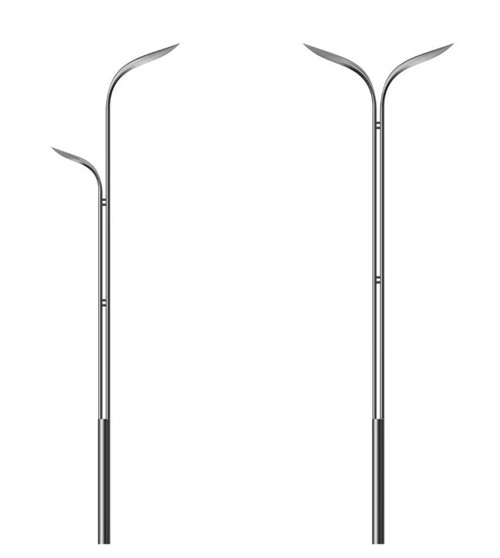
A single arm street light pole has one outreach arm extending from the pole, carrying one lighting fixture.
It is the most common choice for urban roads, residential streets, industrial roads, and many municipal lighting projects.
Because the structure is simpler, manufacturing is faster, installation is easier, and the overall project cost is usually lower.
Single arm poles are widely used where lighting is needed on one side of the road or where staggered pole arrangement can provide enough coverage.
Typical applications include:
For many projects, this is the most practical and cost-effective option.
A double arm street light pole has two outreach arms, usually extending in opposite directions.
This design allows one pole to illuminate both sides of the road or larger open areas with fewer installation points.
It is often used for wider roads, main traffic routes, intersections, highways, and large municipal roads where broader and more balanced lighting coverage is required.
Double arm poles are also common in boulevard projects where road symmetry and visual consistency matter.
Because the structure carries more load, the pole itself is usually stronger, heavier, and more expensive than a single arm design.
The foundation requirements are also higher.
This means better lighting coverage—but also higher project investment.
Most buyers focus first on price.
Professional buyers focus first on lighting effect.
That is where the real difference begins.
A single arm pole mainly covers one lighting direction. If both sides of the road need strong and balanced illumination, more poles may be required.
A double arm pole spreads light across two directions, reducing dark zones and improving road uniformity.
This becomes especially important on wide roads and central medians.
For example, if poles are installed on the center divider of a dual carriageway, a double arm structure is often the natural choice.
If poles are installed only on one roadside, a single arm design may be enough.
The correct decision depends on lighting layout, not simply on product preference.
Some buyers compare only the unit price of the pole.
This creates problems later.
A double arm pole costs more per unit, but that does not automatically mean the total project is more expensive.
Sometimes fewer poles are needed, which reduces excavation, cable work, transportation, and installation labor.
In other projects, a single arm system with more installation points may actually cost more overall.
A practical comparison looks like this:
| Item | Single Arm Pole | Double Arm Pole |
|---|---|---|
| Pole Unit Cost | Lower | Higher |
| Foundation Cost | Lower | Higher |
| Number of Poles Needed | Usually More | Usually Fewer |
| Installation Complexity | Simpler | More Complex |
| Lighting Uniformity | Standard | Better for wide roads |
| Visual Symmetry | Basic | Stronger |
This is why experienced project managers calculate total project cost, not just product price.
In most cases, road width gives the first clear direction.
Narrow roads and internal roads usually work well with single arm poles.
Wide municipal roads and highways often require double arm solutions.
A simple reference looks like this:
| Road Type | Common Recommendation |
|---|---|
| Residential Street | Single Arm |
| Rural Road | Single Arm |
| Factory Road | Single Arm |
| Main Urban Road | Depends on layout |
| Boulevard with Median | Double Arm |
| Highway Access Road | Double Arm |
| Large Intersection | Double Arm |
This is not a fixed rule, but it is how most projects begin the evaluation.
The final decision should always consider pole height, spacing, lux requirements, and traffic conditions.
The longer the arm, the greater the wind load.
Double arm poles carry more weight and face more structural pressure, especially in coastal areas, open highways, and regions with strong seasonal storms.
This affects:
Ignoring these details is a common mistake in low-budget projects.
A cheaper pole that bends after one storm is never cheap.
For export projects, local wind speed standards should always be confirmed before production.
This is especially important in Africa, the Middle East, Southeast Asia, and coastal regions.
Street lighting projects are long-term infrastructure.
The decision should not be based only on installation day.
Single arm poles are generally easier to maintain because the structure is simpler and replacement work is faster.
Double arm poles may offer better lighting efficiency, but maintenance access can be more complex depending on the arm design.
Some municipal buyers also plan for future upgrades such as:
In these cases, pole strength and reserved installation space become more important than arm quantity alone.
The best choice is often the one that still works well ten years later.
Experienced buyers rarely start by asking for “the cheapest pole.”
They start with project details.
Before production, suppliers usually need:
| Required Information | Why It Matters |
|---|---|
| Road Width | Determines lighting coverage |
| Pole Height | Affects brightness performance |
| Installation Position | Side road or center median |
| Wind Speed Requirement | Structural safety |
| Fixture Weight | Arm load calculation |
| Local Standards | Compliance and approval |
Without these details, even a good product can become the wrong product.
Street lighting is not a catalog purchase. It is an engineering decision.
Single arm and double arm street light poles are both good solutions when used in the right place.
Single arm poles are practical, cost-effective, and ideal for many standard road projects.
Double arm poles provide stronger coverage, better symmetry, and better performance for wide roads and central medians.
The better choice is not the one with more steel.
It is the one that fits the road, the budget, and the long-term maintenance plan.
For municipal roads, highways, industrial parks, and commercial developments, the right pole structure often decides whether the project performs well for the next twenty years.
Contact Us
Get a custom lighting solution and quotation for your project. Outdoor lighting manufacturer in Yangzhou, ChinaAbout Jieyao LightingYangzhou Jieyao Lighting Equipment Co., Ltd. is an outdoor lighting manufacturer focused on solar street light systems and high mas... Do you have any questions or requests?
Email: jay@jieyaolighting.com

Click to Chat.
Im online now.