
JIEYAO LIGHTING · PRACTICAL SELECTION GUIDE
A straight light pole keeps a constant cross-section along its main shaft; a tapered light pole becomes narrower toward the top. Either profile can use different cross-sectional shapes. Choose between complete designs for the same height, lighting arrangement and site loads. Taper alone does not prove greater strength, lower weight or a smaller foundation.
Look along the main shaft rather than the outreach arm. On a straight, or non-tapered, shaft the specified outside section stays constant over that length. On a tapered shaft the base section is larger and the section reduces toward the top. A curved arm does not turn a straight shaft into a tapered one.
Both profiles are used in outdoor lighting. Valmont’s US catalogue, for example, separately lists round tapered, round non-tapered, square tapered and square straight steel poles. This is a useful naming example: “round” and “tapered” describe different features. It is not a capacity comparison between the catalogue products. [1]
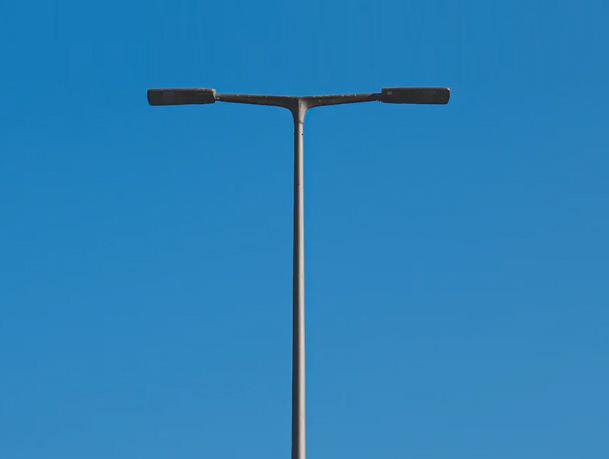
In a site photograph, perspective can make a constant-section shaft appear to narrow. A base cover may also make the lower part look wider. Use the dimensioned shaft drawing to confirm the profile. Photographs help recognise the arrangement, while the drawing defines the product.

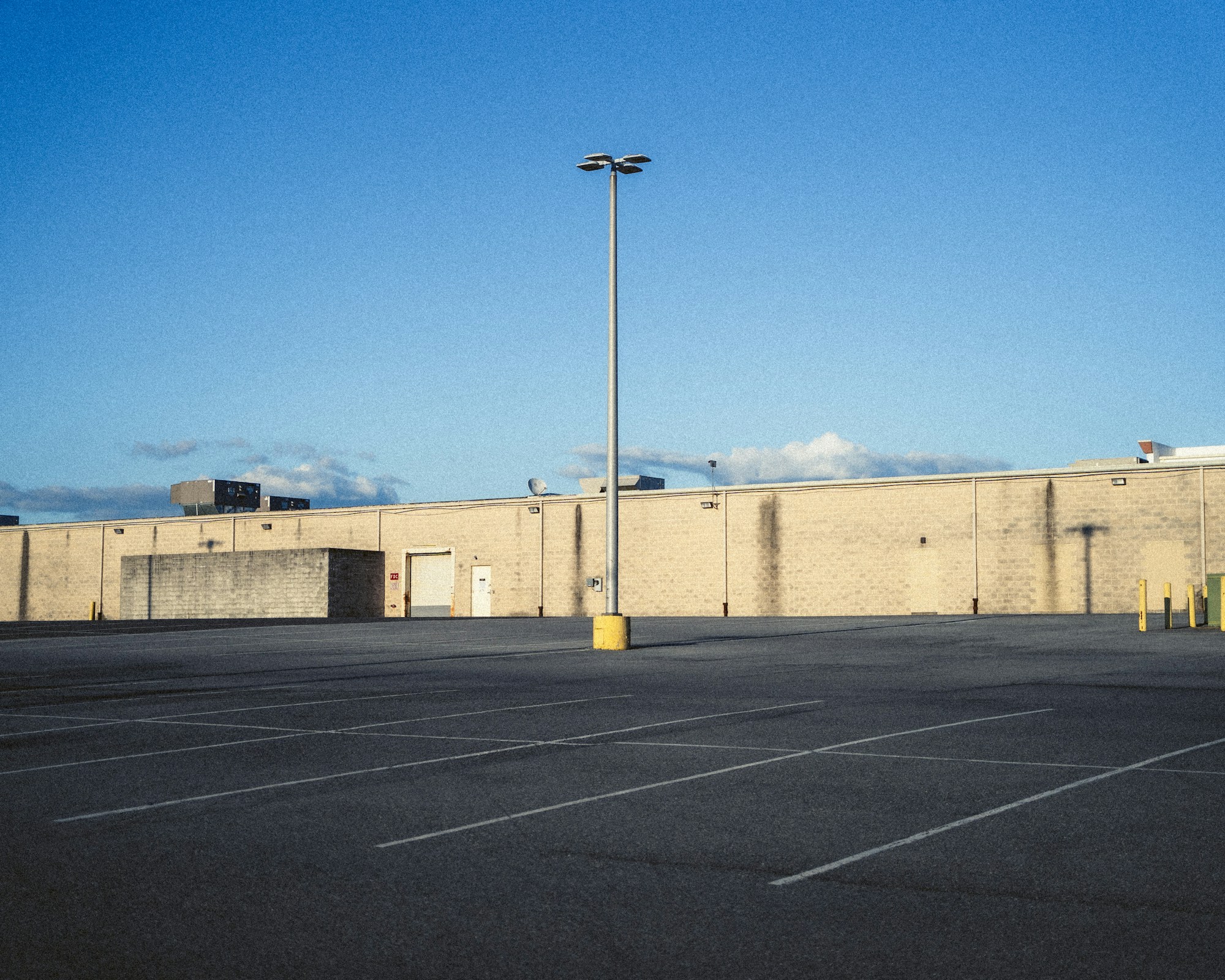
Light pole in a commercial parking area — an application example.
A round straight pole combines a circular cross-section with a constant shaft diameter. A round tapered pole has a circular section whose diameter reduces with height. A square straight pole retains its outside square dimensions; a square tapered pole reduces those dimensions toward the top.
An octagonal tapered shaft has eight faces and a reducing profile. “Conical” is often used for a round tapered shaft, but an eight-sided shaft is more precisely described as polygonal and tapered. Use the supplier’s drawing terminology consistently so dimensions are measured in the same way.
For polygonal poles, check whether a stated dimension is across flats or across corners. Those are different measurements. Do not compare an across-flat dimension on one offer with an across-corner dimension on another and call the shafts equivalent.
↔ On a phone, swipe the table to see every column.
| Description | Cross-section | Profile | Useful drawing check |
|---|---|---|---|
| Round straight | Circular | Constant diameter | Outside diameter and wall thickness |
| Round tapered | Circular | Reducing diameter | Base diameter, top diameter and tapered length |
| Square straight | Four sides | Constant section | Outside side dimension and orientation |
| Octagonal tapered | Eight faces | Reducing section | Across-flats/corners convention, both end sizes and orientation |
For the wider family of configurations, see street light pole types. The rest of this guide focuses on profile selection, rather than repeating the arm, material and base categories.
A useful tapered-pole drawing identifies the outside base size, top size and the length over which the reduction takes place. It should also show any parallel spigot, separate arm, sectional joint or below-ground portion. The overall assembly height and the tapered shaft length may be different.
Taper rate is an easy arithmetic check. For a round shaft, subtract the top outside diameter from the base outside diameter, then divide by the tapered length. This gives the change in diameter per unit length. It does not give the wall thickness, a structural capacity or the slope of just one side.
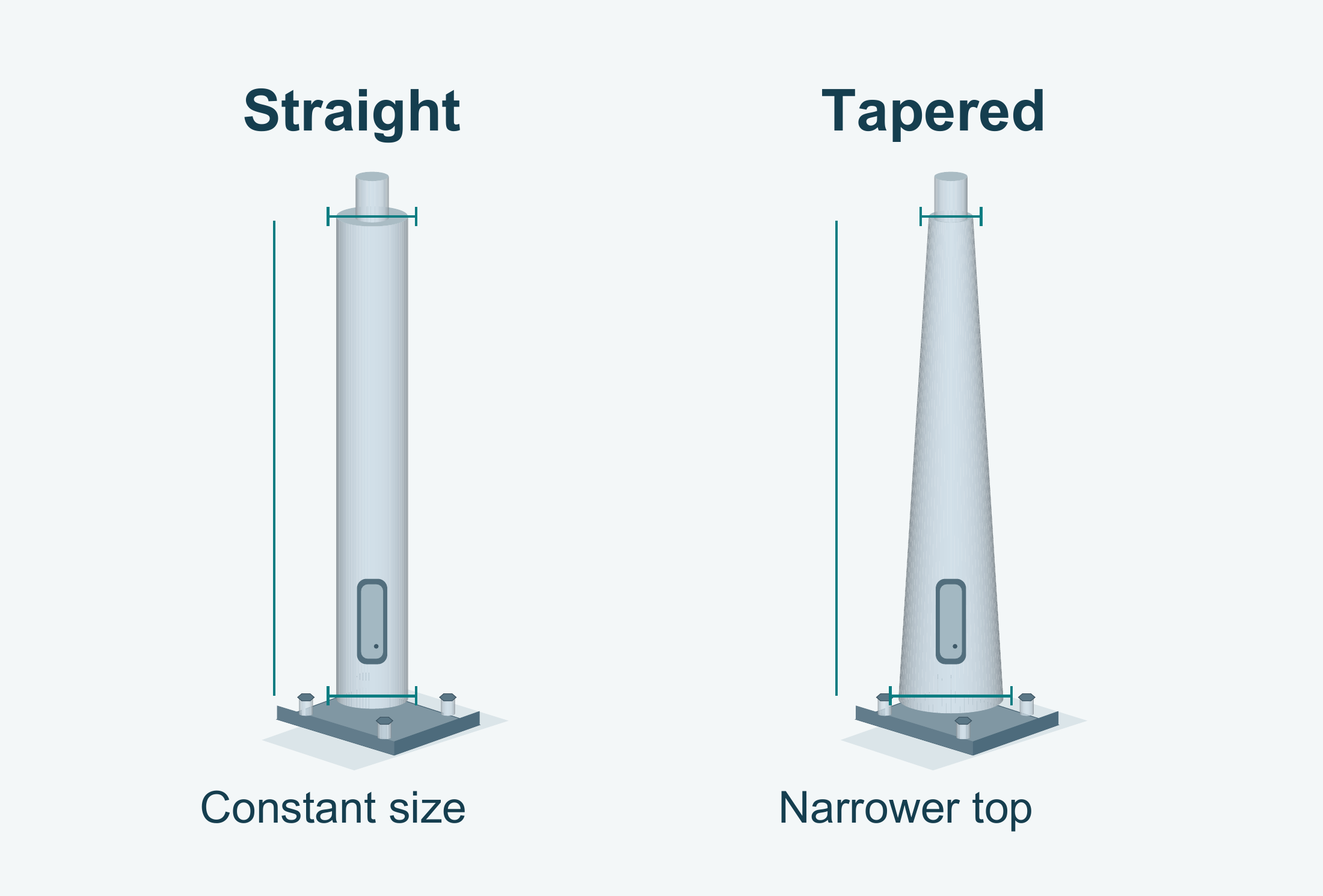
Straight and tapered shaft profiles — three-dimensional concept illustration, not a manufacturing drawing.
Assume a hypothetical 8 m tapered length, a 180 mm base outside diameter and a 76 mm top outside diameter. The diameter reduction is 104 mm, so the average taper is 104 ÷ 8 = 13 mm per metre. For a linear taper, the outside diameter 3 m above the start of the taper is 180 − 13 × 3 = 141 mm.
These are illustrative dimensions, not a Jieyao model or recommended pole specification. At a bracket location, the actual drawing and tolerances still control the fit.
This check can reveal a misunderstood dimension before manufacture. If a schedule says “13 mm/m”, confirm whether it refers to total diameter change, across-flat change or another explicitly defined measure. A single taper number without its measurement convention is incomplete.
The top connection deserves its own dimension. The luminaire or arm may fit over a short parallel tenon, into a socket or onto a separate bracket. Do not assume the main tapered shaft’s top size is the complete luminaire mounting interface.
A constant-section shaft can simplify the interpretation of accessories mounted at different heights: the nominal outside section does not change along that portion of the pole. That can be useful for a coordinated family of clamps, provided their actual fit, fasteners and loads are designed for the shaft.
Straight square poles are often considered in area-lighting layouts using side-mounted fixtures or brackets. A flat face provides a clear orientation reference, but drilling and bolting still need an approved detail. A flat surface does not permit arbitrary holes, cameras or signage to be added later.
Appearance is another legitimate reason to shortlist a straight profile. A site may use a consistent architectural language across luminaires, signs and furniture. Keep that visual preference in the project brief, then evaluate the resulting pole as a structure and a maintained asset.
The trade-off is that a constant outside section remains present near the top, where a tapered alternative may be narrower. Whether this affects weight, wind loading or cost favourably depends on the complete design. Two shafts with different profiles may also use different wall thicknesses, materials and base details.
A tapered profile can distribute shaft size along the height rather than keeping one outside size throughout. It is a familiar choice for road lighting and taller fabricated steel poles. The reducing outline can also create a slimmer appearance at the upper end.
That geometry is useful to a designer, but it is not a universal structural advantage. The required sections depend on wind exposure, the luminaire and arm arrangement, material properties, openings, joints and serviceability. A taller pole or a longer arm can change the design even when the shaft has the same general appearance.
Tapering also changes accessory fit with height. A clamp that fits low on the shaft may not fit higher up. A solar-panel bracket, banner arm or camera support should therefore identify its mounting elevation and the section dimensions at that location. The load from the accessory must be included as well as its physical fit.
Jieyao’s round tapered galvanized steel pole is a relevant product route for road and area-lighting enquiries. Compare the offered drawing with the required mounting arrangement rather than ordering by the word “tapered” alone.
Start with a common lighting position: mounting height, arm outreach, rise and orientation. Keep the proposed fixtures, other attachments and design basis the same. Otherwise, a comparison of profiles becomes a comparison of different projects.
Request the finished assembly mass separately from the structural assessment. A lighter assembly can affect handling, but it does not establish greater capacity. Equally, a heavier assembly is not automatically more robust. Wall thickness, local details and the relationship between the applied loads and the shaft section matter.
↔ On a phone, swipe the table to see every column.
| Question | Straight-profile check | Tapered-profile check |
|---|---|---|
| What supports the light? | Constant-section shaft and actual arm interface | Reducing shaft, top detail and actual arm interface |
| Where do accessories fit? | Outside section plus approved local detail | Section at each attachment elevation plus approved detail |
| What is the handling package? | Declared mass, centre of gravity and lifting method | Declared mass, centre of gravity and lifting method |
| Can the base be retained? | Actual plate, holes, anchors and support assessment | Actual plate, holes, anchors and support assessment |
| How is performance compared? | Same project loads and acceptance basis | Same project loads and acceptance basis |
Also separate wind resistance from vibration behaviour. Adding attachments or changing a luminaire can affect more than the steady wind load. The responsible design review should address the actual assembly. Our wind-load and luminaire EPA guide explains the input information; the pole vibration guide covers a different service issue.
A road corridor: begin with the light position and the road authority’s requirements. A tapered road pole is a sensible configuration to investigate, but the required arm and luminaire geometry must be preserved when comparing a straight alternative. The pole profile does not determine road illuminance or pole spacing.
A parking area: compare the fixture arrangement, vehicle-clearance needs and base locations. A straight square profile may suit the selected side-entry brackets; a tapered round arrangement may work with a different top assembly. Check the complete mounting detail before deciding that one appearance is interchangeable with the other.
A replacement: survey the retained foundation, cable route, arm and fittings before choosing a profile. The old base plate and anchor pattern are not guaranteed to match a new pole of the same height. Record the base interface and retained equipment explicitly.
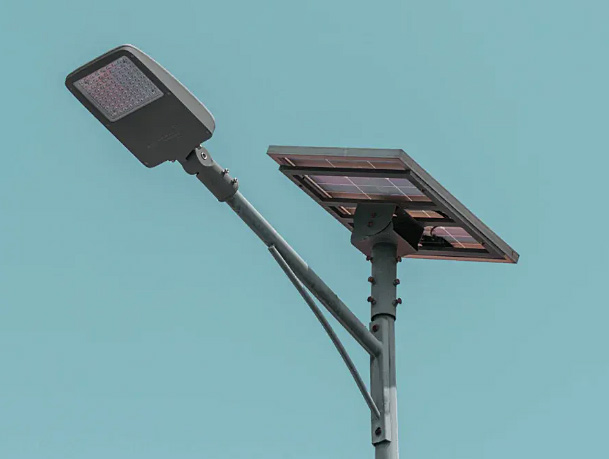
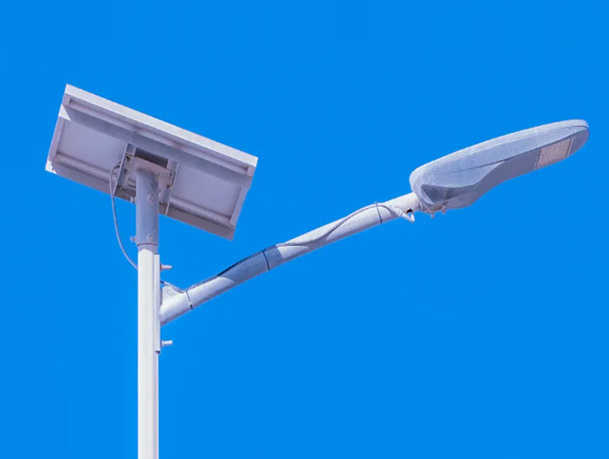
A pole carrying solar equipment: allow for the panel’s mounting elevation, orientation and wind exposure. A panel bracket that can physically clamp to the shaft is only part of the answer. Its loads and the permitted attachment method belong in the designed assembly.
See direct-burial versus anchor-base poles for the separate support decision. Profile and base mounting are choices that can be combined.
A clear enquiry identifies the shaft section and profile together, for example “round tapered steel shaft” rather than “conical lamp post” alone. Add the required light position, equipment, site conditions and base arrangement. If an existing bracket must be retained, send its measured interface and photographs.
Ask for a drawing that connects all of those details: base and top sizes, wall thickness or thickness schedule, shaft length, arm geometry, openings, attachment elevations and foundation interface. Keep the finished weight and the transport arrangement identifiable against the same revision.
Before approving the order, check that the pole schedule, drawing and luminaire arrangement tell the same story. A top diameter corrected on one document but left unchanged on another can become an installation problem even when both suppliers use the same profile name.
Download the straight and tapered pole comparison worksheet (PDF) to record both offers on one basis. For project-specific fabrication, see Jieyao custom steel poles.
Is tapered the same as octagonal? No. Taper describes the reducing profile; octagonal describes the eight-sided cross-section. A pole can be both.
Is a straight pole always cheaper? No universal price ranking follows from profile alone. Compare the actual steel, fabrication, finish, attachments, delivery and design scope.
Can the same clamp be moved up a tapered shaft? Its fit may change with the shaft size. Check the section at the new elevation, the approved connection and the changed loading.
Does changing the shaft profile make the street brighter? Not by itself. Lighting depends on the luminaire output and distribution, its position and the layout. Keep those inputs consistent when comparing poles.
Prepared by Jieyao Lighting, Yangzhou Jieyao Lighting Equipment Co., Ltd., 25 November 2026. The taper example is our disclosed geometry calculation, not a load calculation or measured product result.
[1] Valmont Structures, US Poles and Posts catalogue: separately identifies cross-section and taper in its product descriptions. https://www.valmontstructures.com/product-catalog/us/poles-and-posts
Product references: Jieyao round tapered poles and custom steel poles, reviewed for their stated supply scope. No other manufacturer’s dimensions or capacities are represented as Jieyao specifications.
Photography: Raymond Kotewicz / Unsplash, commercial parking-area application. https://unsplash.com/photos/light-pole-in-empty-parking-lot-wcPSARz7Xbo — Unsplash License. Original three-dimensional illustration by Jieyao editorial; geometry is explanatory and not to scale.
Send the site, lighting duty and proposed equipment arrangement so the product discussion addresses your application.
Contact Us
Get a custom lighting solution and quotation for your project. Yangzhou Jieyao Lighting Equipment Co., Ltd. manufactures outdoor lighting and steel poles in Guoji Town Industrial Park, Gaoyou City, Yangzhou, Jiangsu, China. The company reports a 10,000 m² factory site, more than 60 employees including more than 10 technical personnel, and more than 100 production and testing machines. The present company name dates from 2017; Jieyao Poles’ published history traces the team’s manufacturing lineage to 2006. The stated 15 years of experience refers to the team. The company reports exports to more than 60 countries. Do you have any questions or requests?
Email: jay@jieyaolighting.com

Click to Chat.
Im online now.
 English
 Español
 Bahasa Indonesia