Hybrid solar street lights combine solar generation with another supply or energy source. Two arrangements buyers encounter are solar lighting with mains backup and wind-solar lighting with battery storage. Mains backup provides an additional supply path when the grid is available; wind adds variable generation when the site has a suitable resource. Neither label establishes runtime, outage operation or a finished system specification.
On this page
A catalogue may use hybrid for a light that can draw from solar storage and the mains. Another may use it for a pole carrying both a photovoltaic panel and a wind turbine. Those are different energy arrangements, even if the luminaire looks similar.
The first question is therefore simple: what supplies the light at night, and what supplies it when one source is unavailable? Ask for the energy path and control description before comparing watts, battery capacity or the appearance of the pole.
For context, an ordinary off-grid solar street light charges a battery from its panel and uses the stored energy for lighting. A mains-backup arrangement adds an electrical supply path. A wind-solar arrangement adds another generating source; it still needs storage and controls suited to the duty.

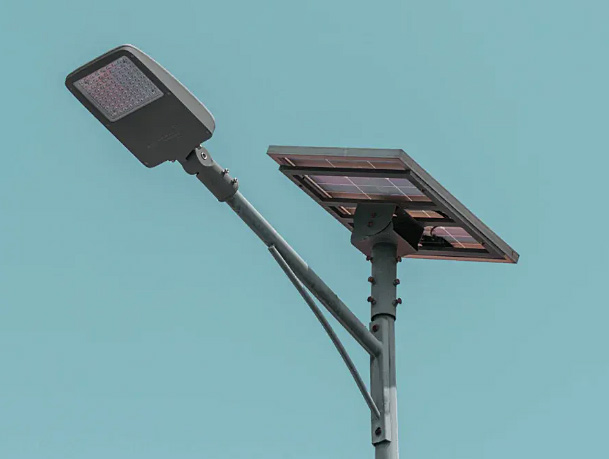
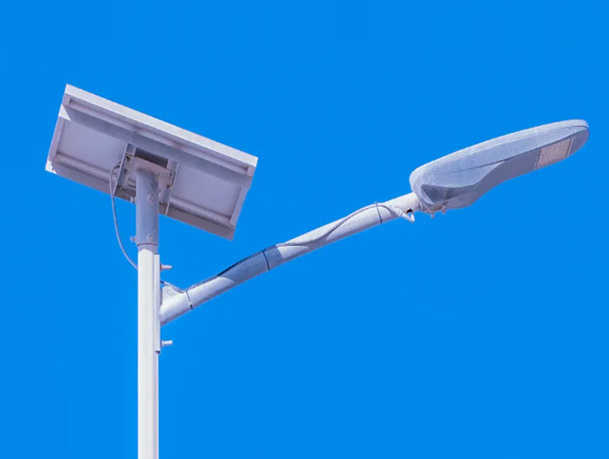
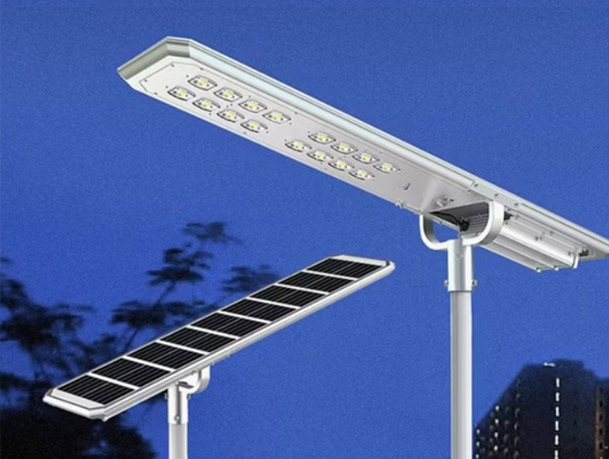
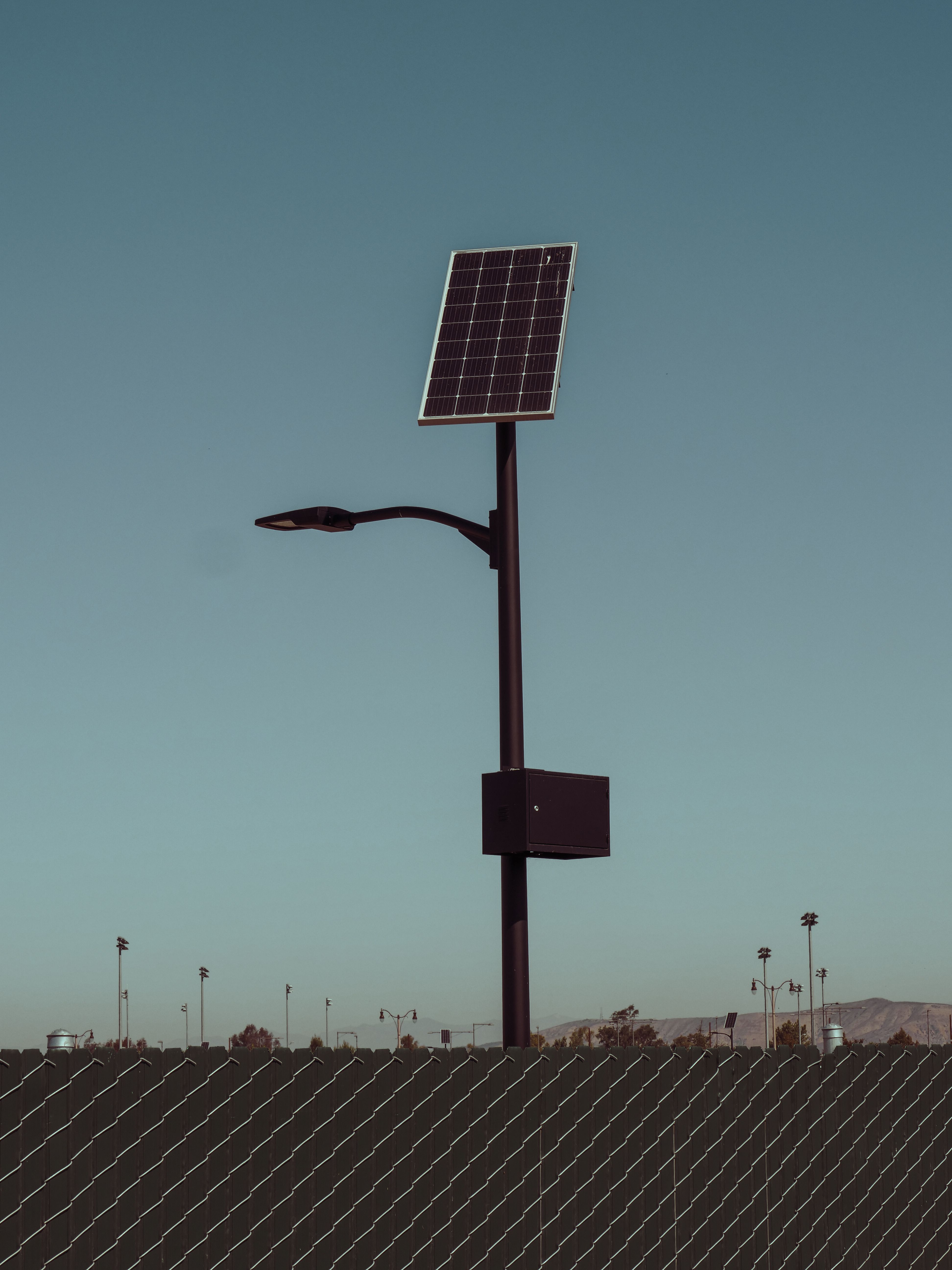
A solar street light with a separate panel and pole-mounted equipment box.
Our off-grid solar street lighting guide explains the standalone starting point. This article concentrates on what changes when another source is introduced.
A mains-backup solar light has an intended way for the electrical supply to support the lighting system when needed. Depending on the product, the mains may supply a compatible charger, an alternate driver input or another designed power path. Request the arrangement for the offered model rather than assuming one internal circuit from a product name.
The controls determine when the extra supply is used. A system might prioritize solar storage and call on mains support at a threshold, or use a different operating strategy specified for the project. The operating description should explain normal nights, low storage and recovery after a shortage.
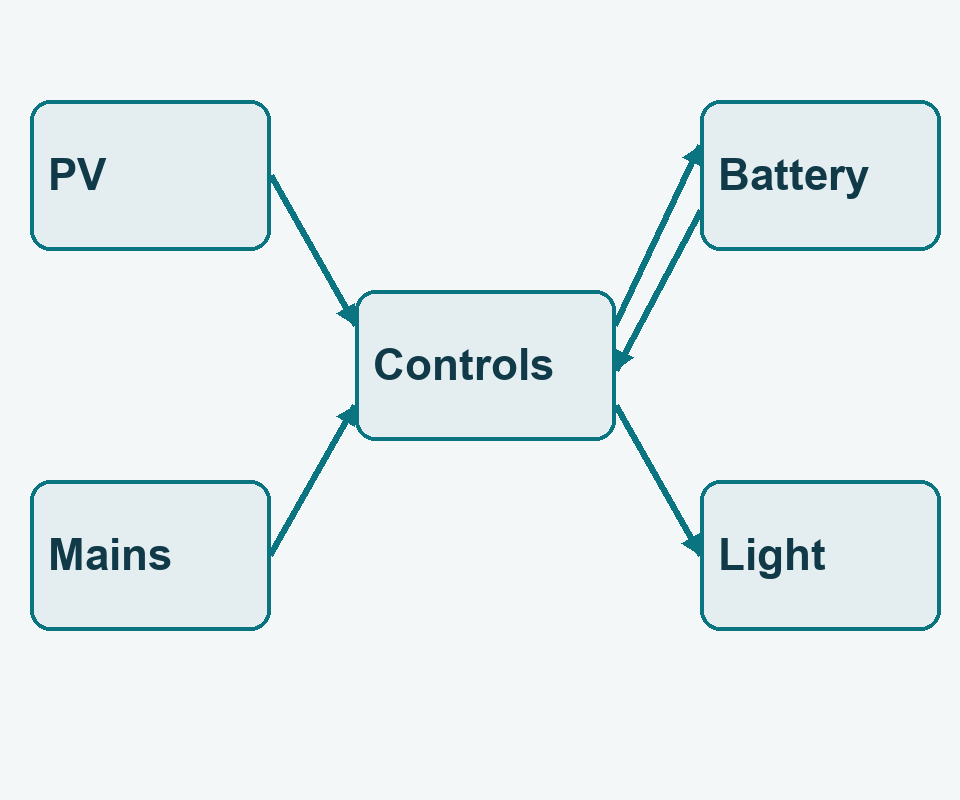
Original concept diagram — arrangement only.
Where an appropriate supply is available, mains support can address periods when the solar input is insufficient for the intended duty. The tradeoff is that the project now includes the mains connection, electrical protection, energy use and maintenance of that additional path.
It is not an off-grid installation merely because a solar panel is visible. Include trenching or cable access where needed, and compare the full installed scope with the alternative of a conventional grid-powered light.
Jieyao’s solar street lights with mains backup provide a product route for discussing the supply, controller and lighting duty together.
The answer depends on the actual power path and controls. A product connected to both PV and the grid does not automatically keep its lights on when the grid fails. Confirm whether stored energy can independently supply the luminaire, what triggers the changeover and what happens if the battery is already low.
Battery capacity and the permitted discharge range determine the available reserve. The light’s brightness schedule determines how quickly that reserve is used. If a heater, communications device or other equipment is also supplied, include its load.
Ask for a sequence of operation that covers loss of mains, low battery, restoration of mains and recovery of solar input. It should also distinguish a source shortage from an electrical fault. Changing over a supply does not make a damaged load or protective fault disappear.
Where outage service is part of the brief, state the required service level and duration explicitly. A label such as hybrid, backup or emergency should lead to a defined operating duty, not replace it.
A wind-solar system combines PV generation with a wind turbine and the controls needed to charge storage and supply the light. The turbine can contribute only when the wind resource and its operating conditions permit useful generation.
The U.S. Department of Energy describes hybrid wind-solar systems as a way of combining resources, while emphasizing site assessment and the variability of wind. A turbine’s rated power is not the energy it will deliver through an ordinary day at a particular pole location. [1]
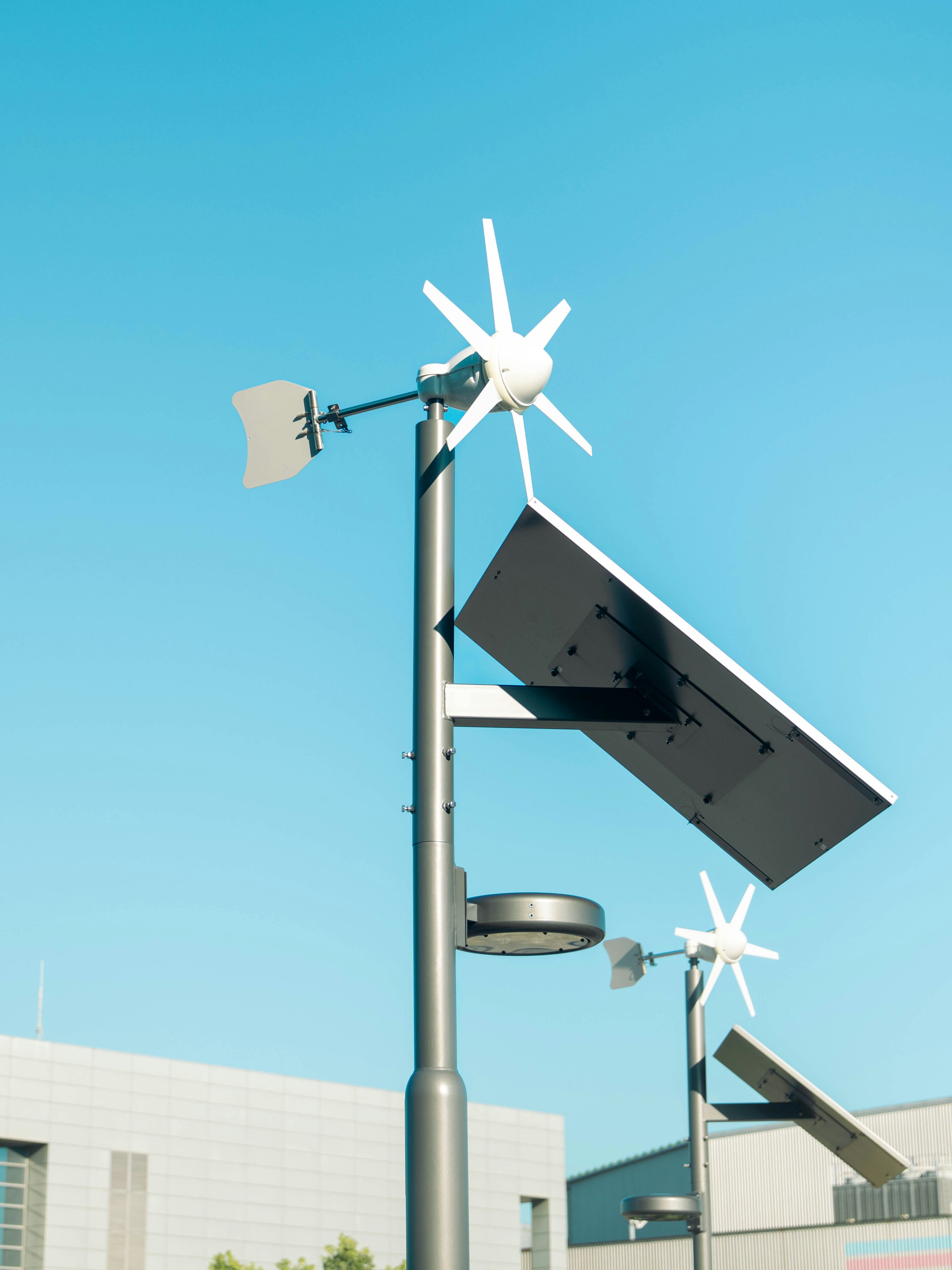
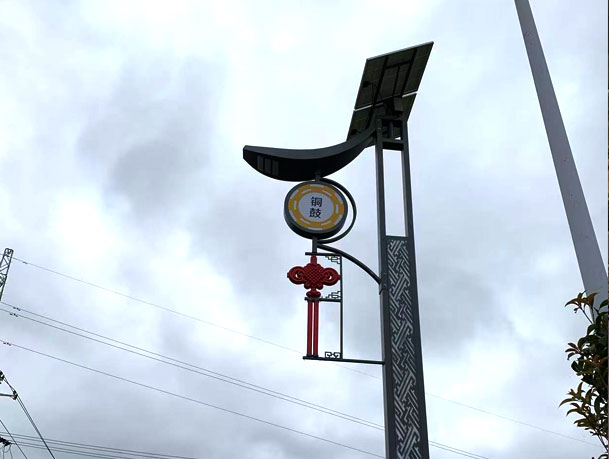
Street lighting with photovoltaic panels and small wind turbines.
Buildings, trees and surrounding terrain can affect wind speed and turbulence at the proposed height. A windy coastal region does not establish the resource at a sheltered roadside pole. Review site information relevant to the turbine position and the product’s performance information.
Include the turbine in the structural and maintenance discussion. Its mass, geometry, operating loads and service needs are different from those of a passive solar panel. The pole, attachments and foundation need the corresponding design inputs.
For a site that merits that assessment, see Jieyao’s solar-wind hybrid street light. The enquiry should include both the lighting duty and the resource and maintenance conditions.
Consider a hypothetical lighting load drawing 30W for 12 hours. It uses 360Wh per night. Assume the PV system delivers 280Wh per day to the usable energy balance after the losses already allowed in the example. The daily shortfall is 80Wh.
If nothing changes, the battery has to cover that shortfall as well as the night-to-night variation. A larger battery can delay depletion, but it does not remove a continuing negative balance.
On a small screen, swipe inside the table to read every column.
| Illustrative case | Usable daily input | Night load | What the balance shows |
|---|---|---|---|
| PV only | 280Wh assumed | 360Wh | 80Wh daily shortfall |
| PV + mains support | 280Wh PV + at least 80Wh usable mains contribution | 360Wh | The chosen contribution closes this arithmetic shortfall while mains is available |
| PV + wind | 280Wh PV + an assumed 80Wh wind contribution | 360Wh | A chosen daily total balances; actual wind timing and variation remain unproven |
| No input; storage only | 720Wh usable reserve assumed | 360Wh/night | 2 nights arithmetically, before any other load or change in assumptions |
The example uses chosen arithmetic assumptions, not measured weather, a Jieyao test or an offered model’s performance. Its purpose is to show why the additional source must be defined in usable energy and availability, rather than merely placed in a photograph.
For storage-only autonomy, an assumed 720Wh of usable energy would cover two 360Wh nights with no input and no other loads. That calculation does not show how quickly the reserve can be recharged, or what happens when input and demand vary.
The solar panel energy-check guide develops the location and recharge question. The rainy-day backup guide explains the separate autonomy claim.
Compare the supply arrangement against the problem the site needs to solve. A mains-backup system and a wind-solar system are not interchangeable fixes for every shortage.
On a small screen, swipe inside the table to read every column.
| Arrangement | What it adds | What to establish | Common mistake |
|---|---|---|---|
| Solar + mains backup | A designed additional supply path | Source priority, protection, outage operation and energy use | Assuming every grid-connected PV product works in an outage |
| Wind + solar + storage | Another variable generation source | Wind at turbine height, control compatibility and structural/service requirements | Using turbine rated watts as a daily energy figure |
| Solar only + storage | No second source | Site solar input, usable storage and the actual schedule | Expecting a larger battery to remove a continuing energy deficit |
Study the mains connection, protection and energy path. If the goal is sustained service through low solar input, specify how and when the grid supports the light. If the goal includes outage service, identify the independent storage path and required reserve as well.
Study the usable wind contribution at the proposed height and its timing relative to solar input and lighting demand. Compare the extra equipment and service access with a properly sized solar-only alternative. The turbine should earn its place through the site assessment.
Adding a turbine is not a substitute for assessing the site. First examine whether the PV location can improve, whether an available mains supply is a better fit, or whether another lighting and storage arrangement meets the duty more reliably.
State the location, required nightly schedule and the lighting output or calculation criteria. Identify any mains supply and the required outage service. For a wind-solar study, include information about obstructions, the intended turbine height and relevant resource data.
Ask for the energy architecture, exact equipment schedule, operating sequence and a balance for the selected site conditions. The storage proposal should identify usable-energy assumptions and temperature limits. The structural proposal should use the complete panel, turbine, light and accessory arrangement.
Then compare installation and maintenance. A solar-only pole, a mains-backed pole and a turbine-equipped pole can require different access, wiring and inspection work. Those differences belong in the decision alongside energy performance.
Download the practical checklist
For the broader choice between available supply approaches, continue to the solar versus grid-powered lighting comparison. The purpose of a hybrid proposal is to define a workable operating system, not to combine the largest number of energy labels.
No. It may describe wind-solar generation or a solar lighting system supported by the mains. Ask the supplier to identify the sources and their power paths.
Only its actual contribution and the storage balance can answer that. Cloudy conditions do not guarantee useful wind at the turbine location.
That depends on the offered product’s electrical design and compatible controls. Do not add a mains input to a standalone product without a designed, approved arrangement.
No. Compare the required service, site resources, connection work, equipment and maintenance for complete alternatives. An additional source has value when it addresses a defined operating need.
[1] U.S. Department of Energy, Small Wind Guidebook
https://www.energy.gov/cmei/systems/windexchange/small-wind-guidebook
Small-wind resources, siting and hybrid-system concepts.
[2] Jieyao Lighting, Solar Street Lights with Mains Backup
https://www.jieyaolighting.com/product/solar-street-lights-with-mains-backup
Jieyao solar lighting with a mains-support option.
[3] Jieyao Lighting, Solar-Wind Hybrid Street Light for Remote Road Projects
https://www.jieyaolighting.com/product/solar-wind-hybrid-street-light-for-remote-road-projects
Jieyao wind-solar street-light product information.
Contact Us
Get a custom lighting solution and quotation for your project. Yangzhou Jieyao Lighting Equipment Co., Ltd. manufactures outdoor lighting and steel poles in Guoji Town Industrial Park, Gaoyou City, Yangzhou, Jiangsu, China. The company reports a 10,000 m² factory site, more than 60 employees including more than 10 technical personnel, and more than 100 production and testing machines. The present company name dates from 2017; Jieyao Poles’ published history traces the team’s manufacturing lineage to 2006. The stated 15 years of experience refers to the team. The company reports exports to more than 60 countries. Do you have any questions or requests?
Email: jay@jieyaolighting.com

Click to Chat.
Im online now.
 English
 Español
 Bahasa Indonesia