The main battery choices discussed in solar street lighting include lithium iron phosphate (LiFePO4 or LFP), other lithium-ion chemistries such as nickel manganese cobalt (NMC), and lead-acid products such as AGM or gel batteries. LFP and NMC are both lithium-ion batteries. Compare the identified pack, charging controls, temperature limits and usable energy; “lithium”, amp-hours or enclosure size alone cannot select a replacement.
On this page
A battery description can mix chemistry, construction and marketing terms in the same line. Start by separating them. LFP and NMC identify lithium-ion cathode chemistries. AGM and gel describe types of lead-acid battery construction. Integrated and external describe where the pack is installed in the lighting system.
These labels answer different questions. An integrated solar light can contain an LFP pack, while a separate battery box can also contain LFP. The mounting arrangement does not establish the chemistry.
LFP / LiFePO4
NMC
Other cathode chemistries
Flooded
AGM
Gel
Chemistry and construction are separate from installation: “integrated” and “external box” describe placement.
The U.S. Department of Energy’s lithium-ion technology assessment lists LFP and NMC among several lithium-ion cathode classes. That is why “LiFePO4 versus lithium-ion” is an incomplete comparison: the first is a member of the second family. [1]
For procurement, request the battery manufacturer, model or pack identification, chemistry, nominal voltage, rated capacity and applicable operating limits. For replacement, add the connector arrangement and protection/control requirements before comparing offers.
LFP uses lithium iron phosphate as the cathode material. It is relevant to stationary energy storage, including appropriately designed off-grid lighting systems. Compared with other lithium-ion chemistries, it has a different balance of energy density, thermal behaviour and operating characteristics.
Those characteristics do not turn an LFP label into a runtime or service-life promise. Cell quality, pack assembly, protection, temperature, charging and the actual nightly load remain important. A battery chemistry cannot establish that a light will run for a stated number of rainy nights.
The solar controller or charger needs settings suitable for the supplied pack, including its series configuration and protection requirements. Victron’s LFP battery instructions, for example, require a matching charging profile and give model-specific operating requirements. Those settings should not be copied to a different pack simply because both products say LiFePO4. [2]
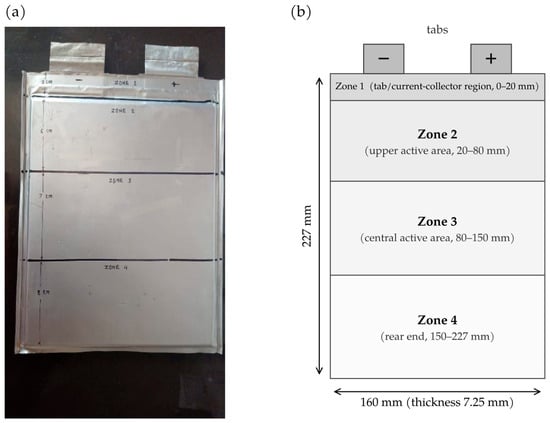
LFP can be manufactured in different cell formats. The published research image below shows a pouch cell, with measurement zones marked by the researchers. A cell’s chemistry, its physical format and the finished street-light pack remain separate parts of the specification.

LiFePO4 pouch cell with the researchers’ measurement zones. Mane et al., Thermo 6(4), 77 (2026), Fig. 1. CC BY 4.0.
Ask whether charging is inhibited at low cell temperature, how that limit is detected, and whether the product includes a heater. A heater also uses energy, which belongs in the system balance. An enclosure’s IP rating addresses ingress protection; it does not, by itself, make cold charging acceptable.
For a solar street light, the useful proposal shows how the battery, controller, panel and load operate together across the specified site conditions.
NMC refers to lithium nickel manganese cobalt oxide. Other lithium-ion chemistries also exist, so a product described only as “ternary”, “lithium” or “lithium-ion” needs a more precise identification before you compare it with LFP.
Different chemistries can have different nominal cell voltages, charge limits and energy-density characteristics. Those differences affect the number of cells used in series and the controller settings. A compact pack is not proof of a particular chemistry or of superior usable energy.
A supplier’s complete pack specification is therefore more useful than an assumed chemistry based on the outside case. Request the cell/pack identification and charging requirements, then check the controls and the temperature range for that exact product.
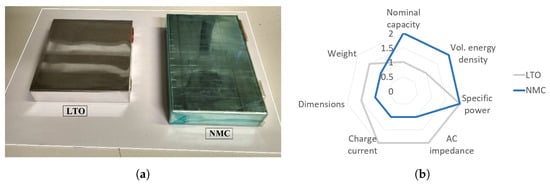
A published comparison identifies an LTO cell on the left and an NMC cell on the right. Kalogiannis et al., Energies 12(21), 4031 (2019), Fig. 1. CC BY 4.0.
In the published cell comparison above, the cell on the right is identified as NMC and the one on the left as LTO, another lithium-ion chemistry. Both use a prismatic format. The photograph is useful for understanding why shape alone cannot identify the chemistry; the adjacent radar chart belongs to that study’s particular cells.
If replacing an existing pack, do not infer compatibility from a familiar plug or a nominal “12V” system label. Confirm the voltage range seen by the light and controller, the pinout and any temperature or communication connections. Physically connecting two parts is different from establishing that they operate together correctly.
Where a proposal offers NMC or another chemistry, compare it on the specified duty, dimensions and protection arrangements. Avoid declaring one chemistry the winner from a general energy-density statement.
Lead-acid remains another battery family a buyer may encounter in solar-power systems. Flooded, AGM and gel products have different construction and charging or maintenance requirements. Treat the manufacturer’s product instructions as part of the proposed system.
A sealed-looking case does not mean that installation ventilation, temperature or overcharging can be ignored. The enclosure needs to suit the battery’s requirements, and the charge controller needs the correct profile. Replacing one lead-acid construction with another can require a settings review.
The published AGM test setup below pairs a real battery with charge and load circuits and temperature measurements. It illustrates how the battery is assessed as part of a controlled operating setup, rather than by its case size alone.
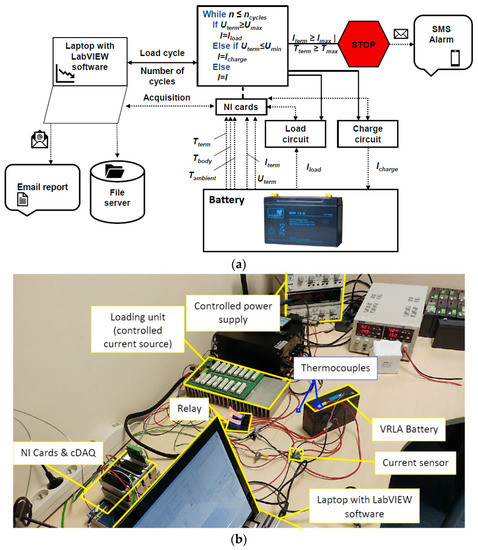
An AGM lead-acid battery in a controlled charge/discharge test setup. Chmielewski et al., Energies 11(11), 3160 (2018), Fig. 1. CC BY 4.0.
Handling weight, space and access often make the physical arrangement important. An externally housed battery needs a location that can be installed, inspected and serviced under the site’s conditions. A buried or inaccessible box is not automatically a better arrangement because the battery disappears from view.
Compare the discharge conditions behind the capacity rating as well. A capacity number does not tell you how much energy the lighting system should routinely withdraw, or how temperature and discharge rate affect the duty. Ask for a usable-energy basis for the specified load profile.
A useful comparison starts with the complete pack and the same lighting duty. Keep chemistry, voltage, capacity and usable energy in separate fields so that the larger printed number does not dominate the decision.
On a small screen, swipe inside the table to read every column.
| Check | LFP / LiFePO4 | NMC lithium-ion | Lead-acid |
|---|---|---|---|
| Name identifies | A lithium-ion cathode chemistry | Another lithium-ion cathode chemistry | A separate chemistry family; identify flooded, AGM or gel |
| Pack label | Chemistry, voltage, Ah / Wh and pack ID | Actual chemistry and pack ID, not “lithium” alone | Construction, voltage, rating conditions and product ID |
| Charging | Profile and temperature limits for the actual pack | Profile and limits for the actual pack | Manufacturer’s profile for the identified construction |
| Protection | Required BMS and system coordination | Required BMS and system coordination | Specified electrical protection, ventilation and installation |
| Energy comparison | Use matched voltage and usable-energy assumptions | Use the same duty and usable-energy basis | Include stated discharge and temperature conditions |
| Replacement | Confirm controls, connector functions, size and mounting | Confirm controls, connector functions, size and mounting | Confirm charger settings, installation, handling and fit |
For example, a nominal 12.8V, 30Ah pack represents 384Wh by the simple label calculation 12.8 × 30. A nominal 3.7V, 70Ah pack represents 259Wh. These are illustrative label-energy calculations, not measured delivered energy or a declaration of chemistry. The 70Ah figure is larger, but it does not represent the larger nominal energy in this comparison.
Neither result tells you the permitted depth of discharge, losses, low-voltage cutoff, capacity at the site temperature or the battery’s condition. Use those factors when translating nominal energy into a nightly operating plan.
The battery capacity guide develops the voltage and watt-hour comparison in more detail. The chemistry guide adds the charging and replacement choices that the label-energy calculation cannot answer.
Think of the pack as one part of a controlled energy system. The panel and controller supply charging energy; the battery stores it; the light uses it under the selected schedule. Protection can interrupt charging or discharge when the pack reaches a limit.
This explains why an apparently healthy panel may not recharge a cold battery, or why a larger replacement battery may still leave the lamp switching off early. The operating limits and settings need to match, and there must be enough solar input to replenish the intended use.
Jieyao’s controller settings guide explains high- and low-voltage thresholds and recovery. Use the settings for the actual matched system; the article is not a universal menu of values for every chemistry.
At a hot, cold or exposed site, also review where temperature is measured and how the enclosure is arranged. See the battery temperature and enclosure guide for that part of the enquiry.
Record the existing pack label and photograph the connector arrangement before choosing a replacement. Note the light and controller identification, settings, available space, fastening method and cable route. An enlarged battery can affect the housing, mounting or access as well as the electrical system.
Ask the supplier to identify the replacement pack and the compatible charging and discharge limits. Confirm whether the controller needs reconfiguration, whether temperature sensing is part of the pack, and whether the existing connectors retain the same pin functions.
Then check the expected use. If the original light is now running a longer schedule or a different brightness profile, a like-for-like label may no longer describe the needed storage. Review the energy balance before ordering another pack to repeat the same operating problem.
Download the practical checklist
For a complete lighting proposal, compare the battery together with Jieyao’s split-type solar street light or all-in-one solar street light. State the location, nightly schedule and required service so that the selected pack belongs to a matched configuration.
LiFePO4 is one lithium-ion chemistry. A meaningful comparison identifies the other chemistry, such as NMC, and then compares actual pack specifications.
No. Nominal voltage alone is insufficient to identify a complete pack’s chemistry. Obtain its manufacturer or pack documentation.
Only after checking voltage, controls, usable energy, temperature limits, connectors and available charging energy. A larger Ah label alone is not a compatible upgrade.
The answer depends on usable storage, the lighting schedule and energy arriving during that period. Follow the rainy-day autonomy guide to compare the system duty rather than a chemistry slogan.
[1] U.S. Department of Energy, Technology Strategy Assessment: Lithium-ion, July 2023
https://www.energy.gov/sites/default/files/2023-07/Technology%20Strategy%20Assessment%20-%20Lithium-ion.pdf
LFP, NMC and other lithium-ion cathode classes.
[2] Victron Energy, Lithium Battery Smart manual: Operation
https://www.victronenergy.com/media/pg/Lithium_Battery_Smart/en/operation.html
Charging and temperature guidance for the manufacturer’s identified battery products.
[3] Victron Energy, Gel and AGM Batteries datasheet
https://www.victronenergy.com/upload/documents/Datasheet-GEL-and-AGM-Batteries-EN.pdf
AGM and gel construction and manufacturer-specific battery characteristics.
[4] Mane et al., Thermal Response of LiFePO4 Pouch Cells Under Dynamic Drive Cycles, Thermo 6(4), 77 (2026)
https://www.mdpi.com/2673-7264/6/4/77
Figure 1: identified LFP pouch cell and measurement zones.
[5] Kalogiannis et al., Energies 12(21), 4031 (2019)
https://www.mdpi.com/1996-1073/12/21/4031
Figure 1: identified LTO and NMC prismatic cells.
[6] Chmielewski et al., Energies 11(11), 3160 (2018)
https://www.mdpi.com/1996-1073/11/11/3160
Figure 1: AGM battery charge/discharge test setup.
Contact Us
Get a custom lighting solution and quotation for your project. Yangzhou Jieyao Lighting Equipment Co., Ltd. manufactures outdoor lighting and steel poles in Guoji Town Industrial Park, Gaoyou City, Yangzhou, Jiangsu, China. The company reports a 10,000 m² factory site, more than 60 employees including more than 10 technical personnel, and more than 100 production and testing machines. The present company name dates from 2017; Jieyao Poles’ published history traces the team’s manufacturing lineage to 2006. The stated 15 years of experience refers to the team. The company reports exports to more than 60 countries. Do you have any questions or requests?
Email: jay@jieyaolighting.com

Click to Chat.
Im online now.
 English
 Español
 Bahasa Indonesia