

A battery label cannot tell you how many nights a light will work. Check the promised lighting schedule, usable energy and recharge assumptions before comparing offers.
A checkable solar street light autonomy claim states the battery’s usable energy, the electrical load for each part of the night, the starting charge and whether solar charging is excluded. For a first check, divide usable energy by nightly consumption at the same measurement boundary. Then verify that the promised lighting output is maintained throughout those hours.
With an assumed 614.4 Wh usable, the electrical schedule changes the number of complete nights.
Bar width represents hours in a 12-hour night. Hypothetical battery and electrical loads; the reduced scene needs a separate lighting check.
Accept a backup night only when every agreed scene meets its lighting and duration criteria. A 10 W electrical setting does not establish road illuminance.
Imagine two solar street light quotations. Each promises three rainy nights. One keeps the agreed output for twelve hours; the other drops power after the first four hours. Those are different services, even when both lamps remain visibly on until dawn.
For a buyer, the useful question is: three nights at which lighting level, for how many hours, under which charge conditions? Ask for a schedule that links electrical consumption to the light delivered on the ground. An emergency reduced-output mode should have its own declared performance.
The June 2025 Efficiency for Access procurement handbook checks autonomy by comparing usable battery energy with daily consumption. It treats backup duration as a requirement selected for the application. Its streetlight recommendations concern pedestrian public spaces; the scope excludes roads used mainly by motor vehicles. We use the energy check here, not its example lighting values as universal road requirements.
Source: section 7.1, PDF page 38; autonomy row in Table 6, PDF page 43. The calculations and buyer templates below are this article’s original examples.
| Item | What to have written into the offer |
|---|---|
| Lighting service | Required operating hours and the approved output for every scene, including any low-battery mode. |
| Starting condition | Initial state of charge and how that state will be established. |
| Charging condition | Zero solar input, or a stated weather/generation case. These should be separate claims. |
| Acceptance endpoint | The first failure to maintain the agreed service—not only the moment the lamp switches off. |
Ah: electric charge capacity. Wh: energy, allowing voltage-aware comparisons. Usable energy: the energy available within the agreed operating limits.
A 100 Ah label is incomplete without its nominal voltage. Two hypothetical packs labelled 100 Ah store different nominal energy when one is 3.2 V and the other is 12.8 V. Always ask whether a quoted capacity describes a cell or the complete assembled pack.
This is a nameplate comparison. Delivered energy still depends on the operating conditions and discharge endpoint.
| Hypothetical battery | Nominal energy calculation | Result |
|---|---|---|
| 3.2 V · 100 Ah | 3.2 × 100 | 320 Wh |
| 12.8 V · 100 Ah | 12.8 × 100 | 1,280 Wh |
For an external manufacturer example of this reporting convention, Victron’s SuperPack NG technical data lists the 12.8 V / 100 Ah model at 1,280 Wh. That example does not identify the battery used in a Jieyao street light.
Next, move from nominal energy to energy actually available for the agreed service. Request the usable state-of-charge window, cutoff setting, temperature basis and capacity-retention assumption. Do not subtract the same allowance twice if a supplier has already reported usable energy at the required conditions.
The following desk calculation shows how a three-night claim can change without changing the battery. Both scenarios start with a fully charged hypothetical 12.8 V, 60 Ah pack. For arithmetic only, assume 80% of nominal energy is available before cutoff, with no additional temperature or ageing reduction. All stated load values are measured-equivalent total power at the battery output, including controls and conversion losses. Daytime standby is assumed negligible.
768 = 12.8 × 60; 614.4 = 768 × 0.80. The 80% value is an explicit assumption, not a recommended setting or a measured result.
| Input / result | Schedule A: constant load | Schedule B: staged load |
|---|---|---|
| Nightly schedule | 30 W for 12 h | 30 W for 4 h, then 10 W for 8 h |
| Energy per night | 30 × 12 = 360 Wh | (30 × 4) + (10 × 8) = 200 Wh |
| Usable energy ÷ nightly load | 614.4 ÷ 360 ≈ 1.71 | 614.4 ÷ 200 = 3.072 |
| Complete repeated nights supported by energy budget | 1 complete 12-hour night | 3 complete 12-hour nights |
| Usable energy needed for three complete nights | 1,080 Wh | 600 Wh |
| Nominal energy needed at assumed 80% availability | 1,350 Wh | 750 Wh |
Schedule B fits three nights in this simplified energy budget; Schedule A does not. Schedule B reduces nightly consumption by 44.4%, but it also provides a different lighting service during eight hours. Its 10 W scene still needs a matching photometric check against the buyer’s requirements.
The “3.072” figure is an energy ratio, not a promise of exactly 36.864 operating hours under every schedule. The timing of higher and lower loads affects when the cutoff is reached. For procurement, count complete nights in which every required scene is satisfied.
A paper calculation is a useful screening tool. A supplier acceptance record should demonstrate what the exact quoted configuration actually does. Agree on the following record before a sample run, so a control change cannot silently alter the promise.
| Record | Why the buyer needs it |
|---|---|
| Configuration identity | Battery pack, controller, firmware/settings, luminaire and optic revisions must match the offer. |
| Initial conditions | Starting charge, ambient/battery temperature, cutoff and solar-input condition make the run interpretable. |
| Electrical log | Time-stamped voltage, current/power and accumulated energy reveal consumption and any unannounced power reduction. |
| Lighting checks | Record the agreed lighting measurement at defined positions and scenes, including late-night and final-night performance. |
| Result and deviations | State complete compliant nights, the first missed requirement, faults and any configuration changes. |
Our 30W solar street light lumens guide explains how to read an optical result. That kind of report helps establish light output under stated conditions; it cannot replace a battery-powered autonomy record. Keep both forms of evidence connected to the same offered build.
This record is a procurement proposal, not a prescribed laboratory standard. The test method, instruments and acceptance criteria must be agreed for the project.
Download the fillable autonomy review sheet (PDF)
Use the blank record below for each supplier. Enter the response, evidence reference and status (Met / Open / Not met). Keep one copy for every offer.
| Requirement | Supplier response | Evidence ID | Status |
|---|---|---|---|
| Exact configuration and settings | ________________ | ________________ | ________________ |
| Usable energy and nightly load | ________________ | ________________ | ________________ |
| Starting charge and solar input | ________________ | ________________ | ________________ |
| Lighting in every scene | ________________ | ________________ | ________________ |
| Complete nights and recovery | ________________ | ________________ | ________________ |
After several weak-sun days, the battery must recover while the light continues its nightly duty. Ask the supplier to show both the stored-energy reserve and the generation needed to restore that reserve.
The European Commission JRC’s PVGIS off-grid tool models energy consumption, solar production and battery charging/discharging over a solar-radiation time series. Its outputs include the frequency of battery depletion and missing energy. This is the type of site-based check to request after the simple autonomy calculation; no PVGIS simulation has been run for this article.
Start the recovery check immediately after the third zero-charging night: 14.4 Wh remains from the 614.4 Wh usable store. Assume each following day offers 300 Wh at the storage boundary, followed by a 200 Wh nightly duty. Limit stored usable energy to 614.4 Wh.
| Day | Start | Available | Stored | Before night | After night |
|---|---|---|---|---|---|
| 1 | 14.4 | 300 | 300 | 314.4 | 114.4 |
| 2 | 114.4 | 300 | 300 | 414.4 | 214.4 |
| 3 | 214.4 | 300 | 300 | 514.4 | 314.4 |
| 4 | 314.4 | 300 | 300 | 614.4 | 414.4 |
| 5 | 414.4 | 300 | 200.0 | 614.4 | 414.4 |
The usable store reaches its 614.4 Wh cap during the fourth charging day, before that night begins. After the fourth night it holds 414.4 Wh. On the fifth day, only 200 Wh of the available 300 Wh can be stored; the remaining 100 Wh is not stored. A charge-then-discharge cycle therefore has a different endpoint from a daytime full-charge check.
Here, 300 Wh/day means energy available for storage after the assumed conversion losses, not energy the battery necessarily accepts. This example places charging before each night and limits charging only by the usable-energy cap. Weather, charge-rate limits, temperature, ageing and daytime loads would require a project-specific time-series check.
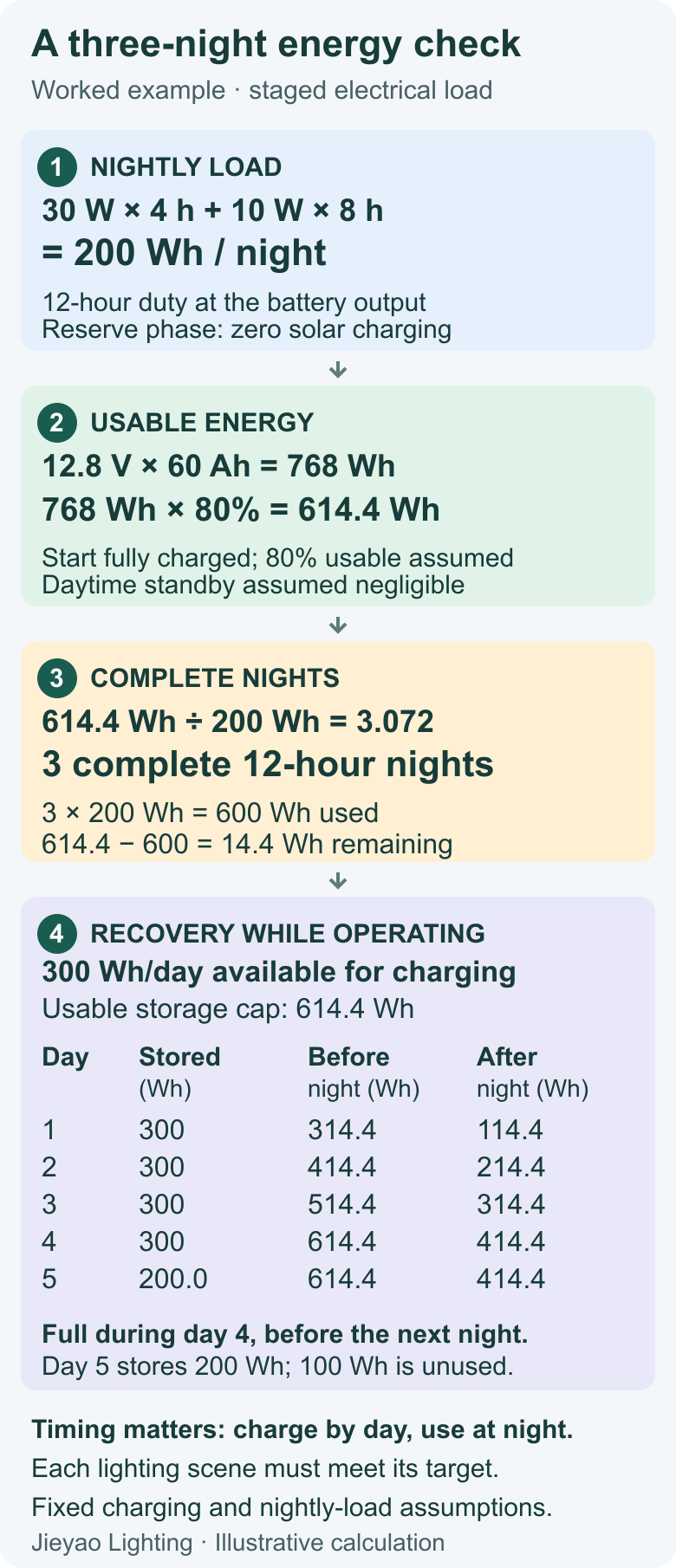
From nightly load to reserve and recovery — a worked example.
Request the site coordinates, panel orientation and shading basis, weather dataset and time span, seasonal shortfall results and the actual load profile. A yearly average generation figure can conceal the period when the site most needs backup.
Yangzhou Jieyao Lighting Equipment Co., Ltd. is an outdoor lighting manufacturer in Yangzhou, China. When requesting a solar street light configuration, provide the service requirement first, then ask for a traceable energy proposal.
For full component sizing, use our solar street light battery and panel calculation guide. This article focuses on checking a backup promise against an agreed service.
Please propose a solar street light for [location and application], operating for [hours] with the attached lighting requirements and scene schedule. State the complete battery pack voltage, Ah and Wh; usable-energy basis; nightly consumption at a defined measurement boundary; starting charge and zero-input autonomy calculation. Identify any low-battery scene. Include a site-based solar generation/recovery assessment and a proposed sample verification record for the exact offered configuration.
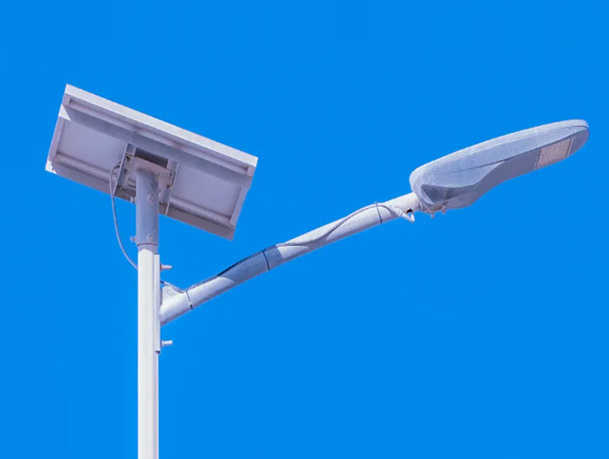
A split-type solar street light is one layout to discuss when the panel and luminaire need separate positioning. Component layout alone does not establish backup duration. Compare offers using the same site, lighting scenes and energy assumptions.
Send Jieyao the location, operating schedule and lighting brief. Ask for a configuration proposal with its battery-energy and charging assumptions stated alongside the price.
Discuss a project configuration →For an initial zero-charging energy check, divide usable battery energy in Wh by consumption per complete night in Wh. Use the same electrical boundary, then verify the required lighting scenes and count fully compliant nights.
Only if the offer defines it that way. A cloudy-weather assessment may include some generation. A zero-input reserve test excludes charging. Ask the supplier to distinguish the two.
Reducing electrical consumption can extend backup, as the worked example shows. Accept the reduced scene only when its lighting performance meets the agreed application requirements.
No. The 12.8 V / 60 Ah pack and both schedules are hypothetical. They demonstrate how to question a quotation. A proposed product requires its own component data, calculation and verification.
All numerical scenarios are original desk calculations. No field measurements, supplier ranking, measured battery performance or location-specific reliability result is claimed. For roads primarily used by motor vehicles, have the lighting criteria and operating scenes reviewed through the applicable project design process; the pedestrian handbook is not a substitute.
Contact Us
Get a custom lighting solution and quotation for your project. Yangzhou Jieyao Lighting Equipment Co., Ltd. manufactures outdoor lighting and steel poles in Guoji Town Industrial Park, Gaoyou City, Yangzhou, Jiangsu, China. The company reports a 10,000 m² factory site, more than 60 employees including more than 10 technical personnel, and more than 100 production and testing machines. The present company name dates from 2017; Jieyao Poles’ published history traces the team’s manufacturing lineage to 2006. The stated 15 years of experience refers to the team. The company reports exports to more than 60 countries. Do you have any questions or requests?
Email: jay@jieyaolighting.com

Click to Chat.
Im online now.
 English
 Español
 Bahasa Indonesia