
 English
 Español
 Bahasa Indonesia
JIEYAO LIGHTING · POLE PROCUREMENT
A pole schedule, a steel calculation and a packing list can show different weights for good reasons. Before comparing the numbers, identify the parts, quantity and measurement boundary behind each one.
First identify whether the value covers modelled shaft members, the supplied pole assembly, a packed bundle or the entire container. Recalculate the model where dimensions are available, reconcile the included components, then check the shipment’s weight record. An engineering estimate and a measured shipping mass serve different purposes.
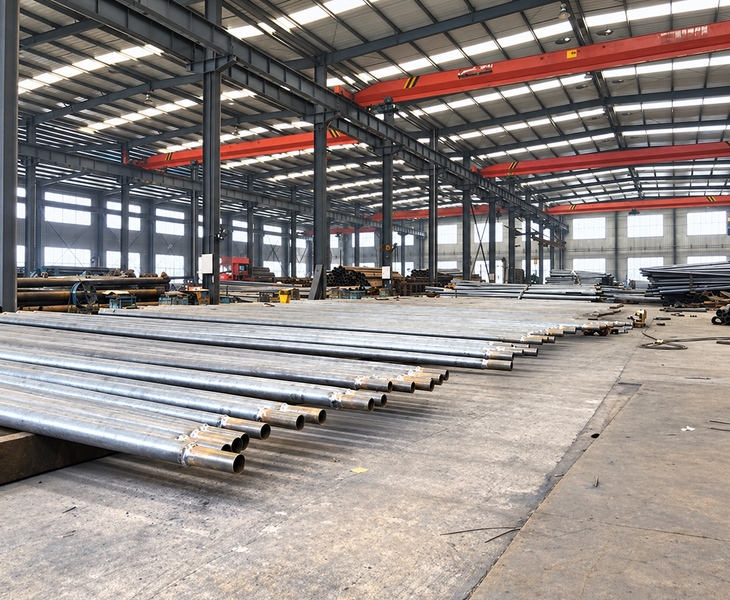
Pole sections arranged on a factory floor.
1. Put a scope beside every weight
“Weight per pole” is incomplete when one supplier means the shaft and another includes arms, a base plate, an anchor cage or luminaires. A number can be accurate for its own scope and still be unsuitable for the comparison you are making.
| Boundary | What to identify | Useful record |
|---|---|---|
| Calculated member mass | Modelled sections, lengths and material density | Calculation member schedule |
| Supplied goods | Which shafts, arms, plates, fasteners and accessories are included | Assembly bill of materials and weight basis |
| Packed bundle or crate | Goods plus its stated packaging boundary | Package marks, quantities and net/gross entries |
| Packed container | All contents and the container itself | Applicable verified gross mass record |
Agree these boundaries before dispatch. For the wider component-selection process, use the street light pole buying guide; the calculation below focuses specifically on mass reconciliation.
2. Recalculate a documented two-member example
An archived structural calculation dated 17 April 2024 models two straight circular hollow members. Its material table uses a mass density of 7.85 × 10⁻⁶ kg/mm³, equivalent to 7,850 kg/m³. Its steel summary lists the member masses below.
For an ideal straight circular tube, calculate the metal volume from its outside and inside diameters:
D = outside diameter; t = wall thickness; L = member length; ρ = mass density. Use metres and kg/m³ to obtain kilograms.
| Model member | Length | Record mass | Independent result |
|---|---|---|---|
| Ø200 × 5 mm | 10.500 m | 252.472 kg | 252.472130 kg |
| Ø150 × 5 mm | 1.500 m | 26.819 kg | 26.819384 kg |
| Two-member total | 12.000 m | 279.291 kg, summing printed rows | 279.291514 kg before rounding |
The record’s overall summary rounds this model to 279 kg. Summing its already-rounded rows gives 279.291 kg; rounding the independent total to three decimals gives 279.292 kg. That small difference follows the rounding sequence. It does not establish a manufacturing discrepancy.
This check reproduces the two modelled members. A completed pole has its own component schedule and actual dimensions. A tapered or polygonal shaft needs the geometry appropriate to that section; use the circular-tube formula only for the circular members it describes.
3. Reconcile the assembly before using the number for dispatch
Take the model schedule and the released assembly list side by side. Mark which items are included in the calculated mass, supplied separately or outside the model. For a single- or double-arm pole assembly, an arm arrangement and its connections are part of this scope check.
Look for the base plate, stiffeners, arms, top adaptors, door and reinforcement, fasteners, coatings and any internal equipment. Treat anchor components as a separate counted item when they are supplied separately. Account for joint overlap where relevant. Avoid adding an item twice simply because it appears on both the model and assembly schedule.
Next compare that defined assembly with the production weight record. Differences need an explanation tied to the same revision and quantity. More decimal places alone do not prove that a number was measured; ask for the weighing basis and package identity.
4. Keep package gross mass separate from container VGM
The U.S. International Trade Administration’s export-document guidance describes packing lists with quantities, package types, net and gross weights, marks and dimensions. Use these fields to trace a bundle back to its goods and supplied parts.
Container verified gross mass, or VGM, has a wider boundary. The IMO explanation includes the container’s tare mass as well as its contents. It describes verification by weighing the packed container or by an approved method combining weighed contents with container tare. The shipper and logistics provider should establish the applicable process.
A calculated shaft mass is therefore an input for planning, rather than a substitute for a verified container mass. Keep packaging, dunnage and securing material within the appropriate shipment record. Read the pole packing and loading checklist for handling and protection questions.
5. Resolve a difference with the right question
| Difference observed | First check |
|---|---|
| Steel model versus supplied pole | Member geometry and the included assembly components |
| Per-pole value versus bundle total | Quantity, separately packed accessories and package marks |
| Goods net mass versus package gross mass | The agreed packaging boundary and recorded tare |
| Package totals versus container VGM | All loaded contents, securing material and container tare |
If the section schedule changed, reconcile against the released revision before accepting the old estimate. The shop drawing review guide covers document control and interfaces. Weight agreement by itself does not approve structural capacity, the foundation or a lifting operation.
Questions buyers ask
Does the 279 kg example describe every 12 m pole?
It describes the two circular members in this calculation record. Other sections, materials, arms and assembly details change the mass. Request the schedule for the configuration being purchased.
Can I calculate shipping weight from steel density alone?
Density and geometry can estimate the modelled metal. Shipping documentation also needs the supplied quantities, components, packaging and relevant weighing process.
Send a reviewable pole enquiry
For a Jieyao Lighting pole enquiry, provide the pole marks, quantities, drawing revision, arm and accessory scope, destination and package requirements. Ask for the calculated or measured basis beside each weight entry.
Sources and calculation basis
Original arithmetic reanalysis of an archived structural calculation dated 17 April 2024: Material Properties and Steel Summary. The source’s two circular members and density are reproduced in the table; the calculation checks model mass, not a finished-product weighing result. Shipment-document boundaries follow the linked ITA and IMO explanations, reviewed 31 October 2026. The factory photograph illustrates pole-section handling context.
Official source references:
ITA — https://www.trade.gov/common-export-documents
IMO — https://www.imo.org/en/ourwork/safety/pages/verification-of-the-gross-mass.aspx