
 English
 Español
 Bahasa Indonesia
POLE ENGINEERING · BUYER ANALYSIS
The short answer
A hinged lighting pole's moving mass is only part of the lowering-equipment selection. The position of that mass relative to the hinge also matters. Two assemblies with the same total mass can produce different gravitational moments. Match the operating equipment to the identified pole, attachments and manufacturer's approved configuration.

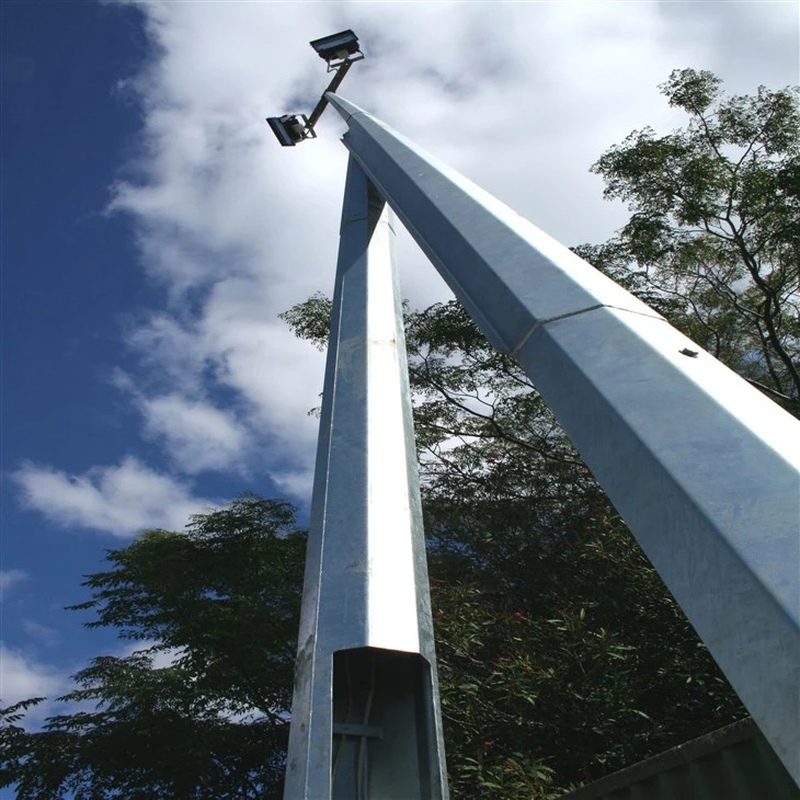
A hinged lighting pole in a raised position.
A kilogram figure does not describe the complete moving assembly
When comparing a folding street light pole, ask what the stated weight includes. It may refer to the luminaire, the upper shaft, a complete pole, or a packed shipment. For a lowering review, identify the components that rotate about the hinge, their masses and their centres of gravity. Include the arm, brackets and other equipment in the defined arrangement.
A component's gravitational moment about a horizontal hinge axis is its weight multiplied by the perpendicular lever arm to the vertical line of action of gravity. In a planar model, this lever arm is the horizontal offset of the component's centre of gravity from the hinge. It changes as the assembly rotates.
m in kg · g = 9.81 m/s² in this example · d in m · moment in N·m
Distances measured along the shaft are not automatically these perpendicular lever arms. Use the actual geometry at the position being assessed. A complete operating review considers the travel, rather than one photograph or one end position.
Worked example: identical mass, different gravitational moment
The following is an original, simplified calculation using assumed inputs. It is not a product test or a rating for a supplied pole model. Each row represents a single hypothetical position. All listed gravitational contributions act in the same rotational direction; the model does not include an assisting mechanism.
| Assumed input | A | B | C |
|---|---|---|---|
| Moving shaft mass; horizontal CG offset | 40 kg; 2 m | 40 kg; 2 m | 40 kg; 2 m |
| Luminaire/arm assembly mass; offset | 12 kg; 4 m | 12 kg; 5 m | 12 kg; 5 m |
| Added accessory mass; offset | None | None | 4 kg; 5 m |
| Total moving mass | 52 kg | 52 kg | 56 kg |
| Calculated gravitational moment | 1,255.68 N·m | 1,373.40 N·m | 1,569.60 N·m |
For A, the calculation is 9.81 × [(40 × 2) + (12 × 4)] = 1,255.68 N·m. Moving the same 12 kg fitting assembly's horizontal centre of gravity from 4 m to 5 m adds 117.72 N·m in B, with no change in total mass. Adding a 4 kg accessory at a 5 m offset adds another 196.20 N·m in C.
The useful procurement question is therefore: does the operating-equipment approval cover this equipment arrangement and its positions through the travel? A mass-only comparison cannot answer it.
This moment is not an operating-equipment rating
The calculated values above describe gravity in the stated idealised geometry. They do not establish the required actuator force, winch pull, operator effort, safe working load or allowable wind. Mechanism geometry, its attachment points, counterbalancing and changing leverage affect the operating forces. The complete review also addresses structural capacity, locking, motion control and the applicable design criteria.
Primary manufacturer guidance illustrates why configuration matters. Abacus's November 2022 base-hinged column manual relates counterbalance selection to column type, height and headload; its spring-counterbalance section distinguishes a moment rating from a configuration-dependent safe working load. It also provides equipment-specific clearance diagrams and operating instructions. Those instructions and ratings apply to the named Abacus equipment. They are not interchangeable ratings for a Jieyao hinged pole.
Jieyao's archived 6 m hinged-pole drawing shows the upright and lowered arrangement, hinge, arm socket and base details. It does not establish the moving assembly's mass distribution or an approved assist-equipment rating. Treat its dimensions as drawing information; obtain the load and operating documents for the ordered configuration.
What to send with a hinged street light pole enquiry
For a Jieyao Lighting folding-pole enquiry, send one controlled equipment schedule with the site layout. Connect each attachment to the same drawing revision so a later luminaire or camera substitution can be reviewed against the original configuration.
| Input | Document to provide or request | Decision it supports |
|---|---|---|
| Moving assembly | Component masses, centres of gravity and mounting positions | Identify the load arrangement through the travel |
| Hinge and operating equipment | Named assembly, interfaces and approved configuration data | Check the selected equipment's compatibility and operating scope |
| Site geometry | Upright/service positions, swept path and operating-equipment space | Confirm that the selected arrangement fits the completed site |
| Handover | Matching operating instructions, inspection requirements and agreed acceptance records | Give the owner a traceable basis for service and future changes |
If the fitting changes after approval, record both the mass and its location. Refer the revised assembly for the appropriate design and operating-equipment review before use. An unchanged electrical wattage or unchanged total mass does not establish equivalence.
Compare the complete folding-pole configuration
See Jieyao folding street lighting poles for the product and site-fit review. Use the shop drawing checklist to coordinate the submittal, or send your equipment schedule and site layout for an enquiry.
Sources and method
Original illustrative calculation: three assumed mass/offset cases, g = 9.81 m/s², gravity-only moment at one position. Values are reproducible from the input table; no field measurements or product operating limits are inferred.
Drawing context: the 6 m hinged-pole drawing described on the Jieyao folding-pole product page.
Abacus Lighting, Product Manual — Base Hinged (RL) Columns, November 2022, sections 2, 4.1.1 and 4.3. Consult the current instructions supplied with the actual equipment for operation. Source URL: https://www.abacuslighting.com/wp-content/uploads/2023/05/Product-Manual-Base-Hinged-Columns-November-2022.pdf