
JIEYAO LIGHTING · REPORT-BASED ORIGINAL ANALYSIS
A real 12V/10A controller report explains protection and recovery. Add a reproducible voltage-drop calculation and an event log before changing settings.
Report AGXB120W00589 records conforming charge/load disconnect and recovery behavior for one 12V/10A controller. It does not print numerical HVD/LVD settings. An early shutoff therefore needs a model-specific settings check and an under-load event record.
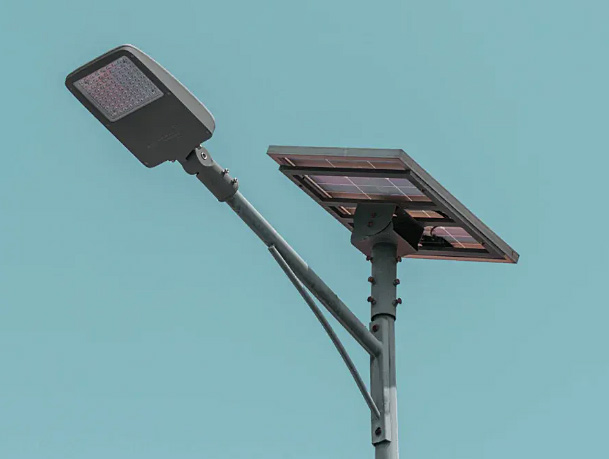
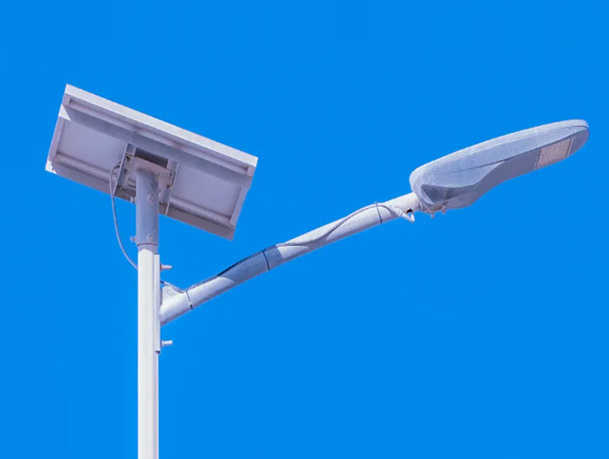
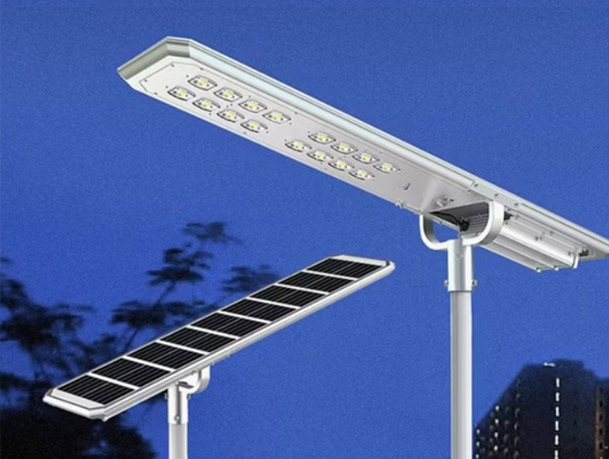
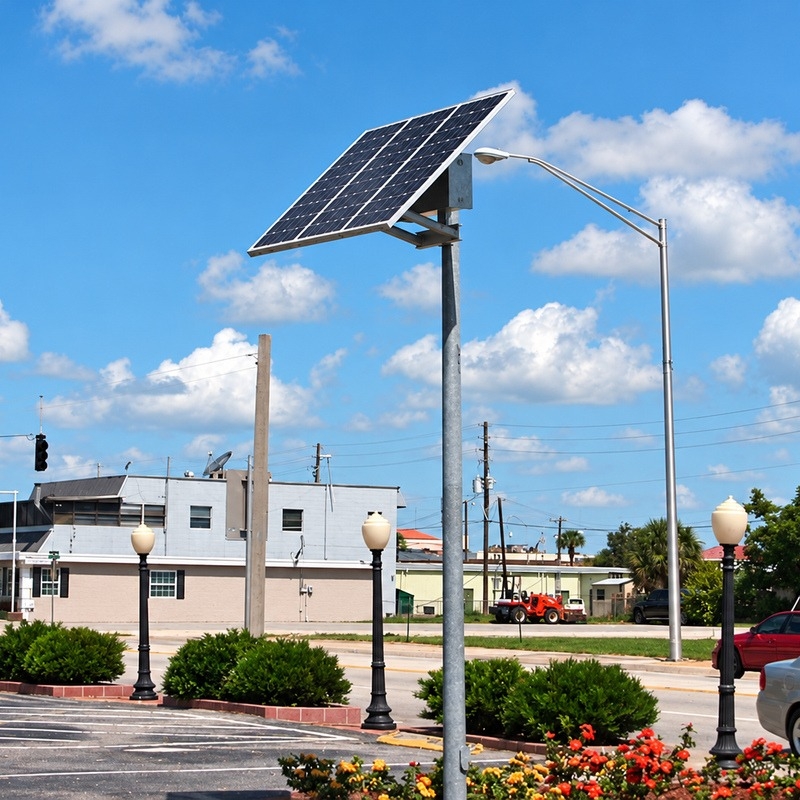
Real solar street light application photograph from the supplied image library, already hosted on this website. It is system context, not the controller submitted for report AGXB120W00589; the photograph does not verify its protection settings.
A solar street light can stop before dawn even when its battery is not visibly damaged. A controller may have disconnected the load, a timer may have ended the lighting period, or the battery management system may have intervened. Start by identifying which event occurred. A single voltage reading taken after the lamp has switched off cannot settle that question.
For a concrete example, we reviewed commissioned report AGXB120W00589, issued 11 September 2020. It identifies one Jieyao controller, specified as 12V/10A, tested on 9 September 2020 under GB/T 19064-2003. Its result page covers two functional groups: full-charge disconnect and recovery, and low-voltage disconnect and recovery. The test uses a DC source to simulate battery voltage; the load-side procedure also describes a variable resistor and rated-current condition.
The report is useful evidence of the submitted sample’s response. It does not identify a current retail model, battery chemistry, MPPT/PWM topology or firmware. The 12V/10A description alone does not establish a maximum compatible panel wattage or the rating of every terminal. Those require the actual controller datasheet.
| Report action | Circuit response described | Recorded result | Important missing detail |
|---|---|---|---|
| Reach full-charge disconnect point (HVD) | Charging circuit opens | Conforms | Numerical HVD voltage not printed |
| Lower voltage to charge-recovery point | Charging reconnects | Conforms | Numerical recovery voltage not printed |
| Reach low-voltage disconnect point (LVD) at rated-current test condition | Load disconnects | Conforms | Numerical LVD voltage not printed |
| Raise voltage to load-recovery point | Load reconnects | Conforms | Numerical recovery voltage/delay not printed |
| For the described undervoltage-lock function: recover above the recovery point and reset | Load reconnects after reset | Conforms | Actual reset procedure not printed |
HVD in this record concerns the charging circuit. LVD concerns the load circuit. Treating both as a generic “power-off voltage” loses the distinction needed for diagnosis. Recovery matters just as much as disconnection: a functioning cutoff can protect a battery while leaving a light off until its recovery condition is met.
“Conforms” is the qualitative result printed in this report. We have reorganized its sequence into five action rows for explanation. This is not a measured voltage curve, a 100% reliability statistic or proof of protection thresholds for all Jieyao controllers.
As independent background, Victron’s BlueSolar manual describes configurable low-voltage load disconnection. It illustrates why controller logic belongs in a system review, but its model-specific settings must not be copied to this unidentified controller. The external manual does not validate the Jieyao sample.
Ask for a configuration export or dated settings sheet tied to the supplied controller and battery. The sheet should distinguish charge regulation from the independent protections provided by a battery management system. A setting suitable for one chemistry or series-cell count may be inappropriate for another, even if a quotation calls both systems “12V”.
| Request | Why it matters | Evidence to attach |
|---|---|---|
| Battery chemistry and series-cell arrangement | Defines the applicable charge and protection limits | Battery manufacturer specification; BMS reference |
| Charge disconnect and recovery values | Connects HVD behavior to the intended battery | Controller-specific voltage values and tolerances |
| Load disconnect, reconnect and delay | Explains an early cutoff and conditions for restart | Settings export plus firmware/version |
| Lock/reset behavior | A recovered voltage may not complete the restart sequence | Model-specific reset instructions |
| Timer, dimming and light-sensing rules | Scheduled off and protection off are different | Dated nightly program and control mode |
| Separate input/output ratings | A single current label is not a complete compatibility check | PV voltage/current, charge and load specifications |
Do not lower an unknown LVD value simply to extend the night. First compare the configuration with the battery manufacturer’s limits and determine whether the voltage at the controller represents the battery under load. The practical goal is to meet the agreed lighting schedule with a compatible energy system, not to suppress a protection event.
A qualified technician should record battery-terminal voltage and controller battery-input voltage at the same time, with the lamp operating. A reading made after disconnection removes the load condition that may have caused the voltage drop. Use the actual terminal names and test method for the installed controller; the following calculation is an explanation, not instructions for live wiring work.
Assume, purely for illustration, a complete outgoing-and-return cable-loop resistance of 0.15Ω. With a 4A load, the calculated drop is 4 × 0.15 = 0.60V; resistive loss is 4² × 0.15 = 2.40W. If the battery terminals were at 12.0V in that example, the controller input would be approximately 11.4V, ignoring other effects. Whether that crosses LVD depends on the actual verified setting; the report does not provide it.
| Assumed current | Assumed loop resistance | Calculated drop I × R | Calculated loss I² × R |
|---|---|---|---|
| 2A | 0.15Ω | 0.30V | 0.60W |
| 4A | 0.15Ω | 0.60V | 2.40W |
| 6A | 0.15Ω | 0.90V | 5.40W |
2A load current 0.30V
4A load current 0.60V
6A load current 0.90V
Bars share a 0–1.00V scale. Assumed complete loop resistance: 0.15Ω.
Jieyao calculation, 28 October 2026. Voltage drop = I × R. Assumed resistance is not a cable-design limit. These values are not measurements from AGXB120W00589.
This gives a falsifiable check: if a simultaneous voltage log shows little difference between battery and controller, cable drop is less likely to explain the event. If the difference grows with load current, investigate the circuit before blaming battery capacity. Actual readings, connection condition and the manufacturer’s design requirements should drive that assessment.
| Observation | Possible explanation to investigate | Useful record |
|---|---|---|
| Light stops at the same clock time with normal status | Timer/dimming program | Clock, dusk event and programmed duration |
| Controller reports low-voltage load disconnection | Controller protection condition | Battery and controller voltages under load; verified LVD |
| Battery/BMS reports protection or output loss | Battery-side intervention | BMS event, cell/temperature information if supported |
| Voltage recovers but light remains off | Reconnect threshold, delay or lock/reset rule | Recovery voltage, elapsed time and permitted reset procedure |
These are diagnostic branches, not conclusions about an unseen installation. Record controller model, battery specification, firmware, date, local time, weather, programmed stage and fault indication. Preserve the settings before changing anything so the initial event remains interpretable. A photo of an illuminated status LED is useful only when the corresponding manual identifies its meaning.
When the issue is insufficient daily charge rather than a control event, use our winter recharge analysis. For stored-energy comparisons, use battery capacity in Wh rather than Ah alone. Neither calculation replaces the controller event log.
Yangzhou Jieyao Lighting Equipment Co., Ltd. supplies solar street lighting solutions from Yangzhou, China. For a split-type solar street light enquiry, provide the site, required nightly schedule, panel and battery configuration, and controller evidence requirements together. Ask which exact model and firmware correspond to the proposed protection settings.
A practical RFQ clause is: “Provide controller identification, compatible battery specification, charge and load protection thresholds, recovery/reset rules, nightly program and a configuration record. Identify the inspection report and explain its relationship to the delivered configuration.” A historical pass result can support that evidence package, but it cannot fill the missing numerical settings.
There is no value established for every system by this report. Use settings approved for the actual battery, BMS and controller. The report records functional conformity without the numeric thresholds.
No. Multiplying a nominal 12V by 10A does not establish a complete lamp, PV-input or continuous load rating. Identify what the current rating applies to and check the full datasheet.
No. The printed results concern disconnect and recovery behavior. They do not quantify conversion efficiency, solar harvest or battery autonomy.
Send the project requirements, proposed configuration and the evidence you need to Jieyao. Ask for a clear connection between the supplied variant and the applicable report.
Discuss your project with Jieyao →Contact Us
Get a custom lighting solution and quotation for your project. Yangzhou Jieyao Lighting Equipment Co., Ltd. manufactures outdoor lighting and steel poles in Guoji Town Industrial Park, Gaoyou City, Yangzhou, Jiangsu, China. The company reports a 10,000 m² factory site, more than 60 employees including more than 10 technical personnel, and more than 100 production and testing machines. The present company name dates from 2017; Jieyao Poles’ published history traces the team’s manufacturing lineage to 2006. The stated 15 years of experience refers to the team. The company reports exports to more than 60 countries. Do you have any questions or requests?
Email: jay@jieyaolighting.com

Click to Chat.
Im online now.
 English
 Español
 Bahasa Indonesia