
JIEYAO LIGHTING · ORIGINAL BUYER ANALYSIS
Four public battery specifications show why voltage changes the meaning of Ah—and what buyers should request before accepting a runtime claim.
Compare solar street light batteries in watt-hours at their nominal pack voltage, then check usable energy. A 3.2V 100Ah pack is 320Wh; a 12.8V 30Ah pack is 384Wh. Ah alone does not establish which stores more energy.

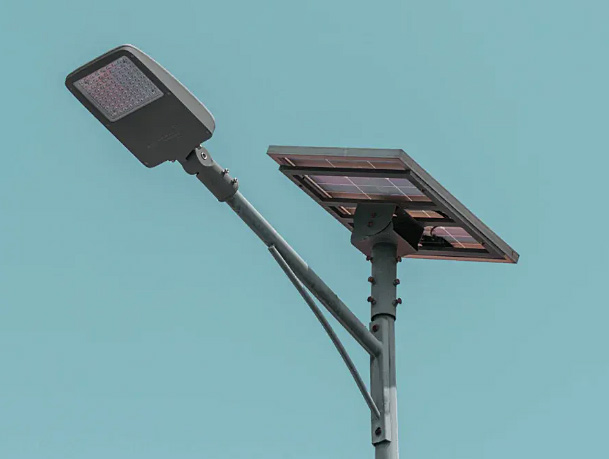
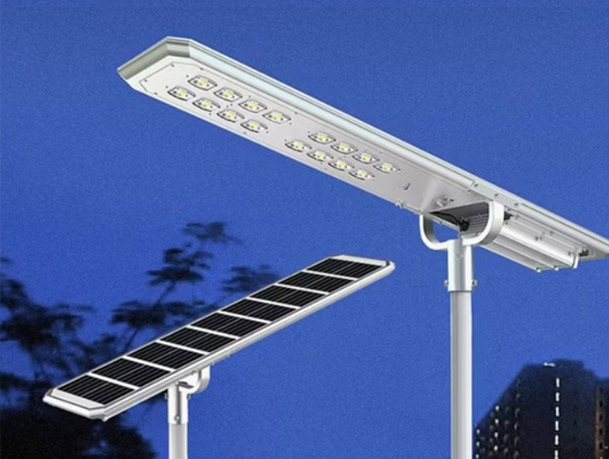
Product/application photograph from the supplied image library. No model rating or test result is assigned to the pictured item.
A solar street light battery offer marked “100Ah” is incomplete without its rated pack voltage. Amp-hours describe electric charge; watt-hours make the energy comparison possible. Two batteries can carry the same Ah figure while holding very different nominal energy. A higher Ah number can even describe the smaller energy store.
Use the pack’s nominal voltage for a nameplate comparison: nominal energy (Wh) = nominal pack voltage (V) × rated capacity (Ah). The FAA also gives this conversion in its battery guidance. Only that unit relationship is used here; its passenger-transport provisions are not solar-light design rules.
A hypothetical 3.2V 100Ah pack is 320Wh. A 12.8V 30Ah pack is 384Wh: 70% fewer amp-hours, yet 20% more nominal energy. Different voltage systems still need different compatible controllers and drivers. This comparison does not make the packs interchangeable.
We transcribed four entries from Goldencell’s solar-light battery catalogue and multiplied their stated pack voltage by capacity. This is an audit of public specifications, not an independent laboratory test. External models are examples for learning the comparison; they are not identified as Jieyao’s installed batteries.
| Published model | V | Ah | Published energy | V × Ah |
|---|---|---|---|---|
| JG-1IFR3.2-4.8-Y | 3.2 | 4.8 | About 15.3 Wh | 15.36 Wh |
| JG-3IFR9.6-4.8-Y | 9.6 | 4.8 | About 46.08 Wh | 46.08 Wh |
| JG-4IFR12.8-27-Y | 12.8 | 27 | About 345.6 Wh | 345.6 Wh |
| JG-4IFR12.8-30-Y | 12.8 | 30 | About 384 Wh | 384 Wh |
Source: Goldencell, “Customized Solar Street Battery Pack Solution,” checked 26 October 2026. The first entry rounds to about 15.3Wh; multiplication gives 15.36Wh. This small display difference is not evidence of a measured capacity shortfall.
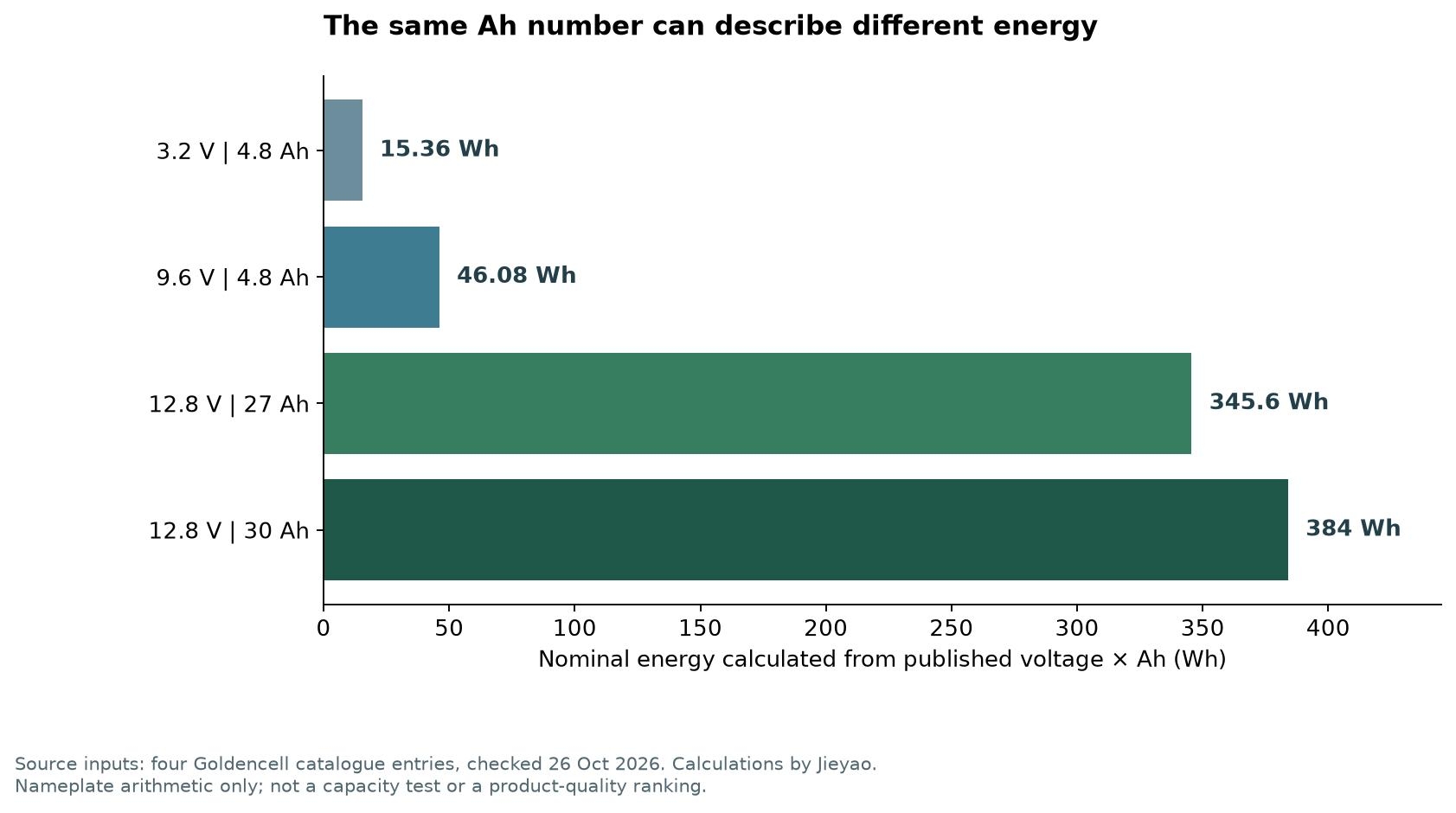
Original arithmetic using the public catalogue inputs above. The chart compares nominal energy only.
The two 4.8Ah entries show the central issue without any assumed capacity: 9.6V × 4.8Ah is three times 3.2V × 4.8Ah. Sorting these batteries by Ah alone would conceal that difference. Conversely, equal watt-hours would still leave temperature limits, current capability, life evidence and physical compatibility to compare.
A quotation should state whether voltage and Ah belong to one cell, a complete pack or a larger battery bank. Adding cell amp-hours without recording how the pack is configured can produce an unusable comparison. Ask the supplier for the completed pack rating and an identifiable configuration record.
Use nominal voltage consistently. For example, Victron’s Lithium NG specification lists 12.8V, 100Ah and 1,280Wh at 25°C; its listed charge voltage is different. Multiplying a nominal Ah rating by a charge-voltage setting would change the result without adding actual stored energy. These are model-specific external data, not a Jieyao capacity or charger setting.
| Claim on a quotation | Ask before accepting it |
|---|---|
| 100Ah, no voltage | What is the nominal voltage of the complete battery pack? |
| 100,000mAh | At which voltage and configuration? 100,000mAh equals 100Ah. |
| Cell capacities added together | Provide the complete pack voltage, capacity and configuration. |
| A charging-voltage × Ah calculation | Recalculate nominal energy with the nominal pack voltage. |
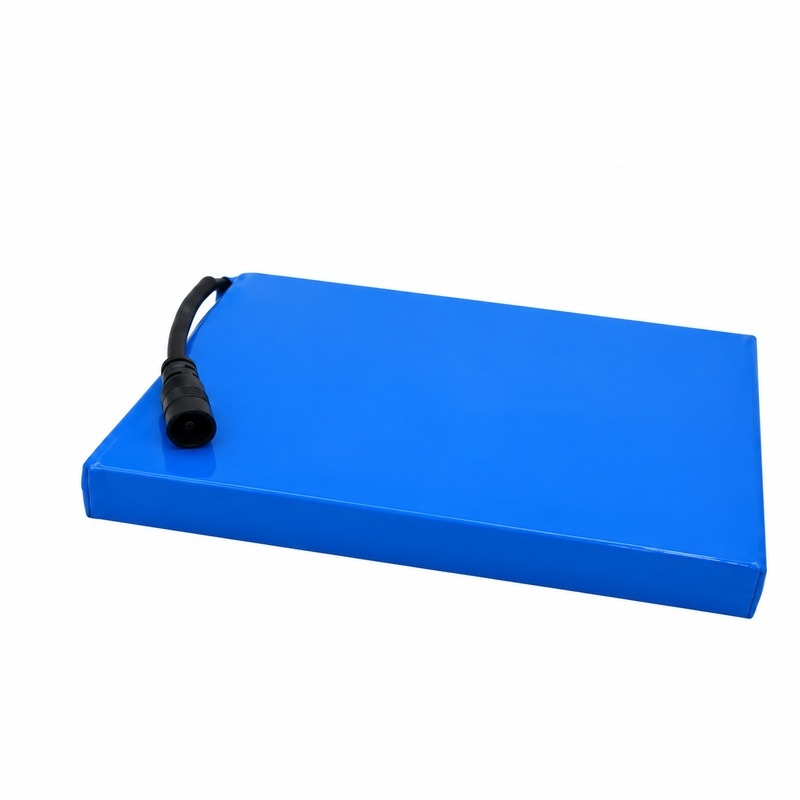
| A battery photograph only | Provide model, rating label and the supporting capacity record. |
This article is a document-review method, not instructions to reconnect cells or substitute batteries. An acceptable replacement needs the approved voltage range, charge profile, protection functions, connectors and enclosure arrangement. Energy matching is only one gate.
A nameplate comparison does not determine how much energy reaches the lamp. A project must also define the permitted discharge window, temperature basis, ageing allowance and conversion boundary. Keep each factor visible and avoid counting the same loss twice.
| Item | Assumption / calculation | Result |
|---|---|---|
| Nominal energy | 12.8V × 30Ah | 384 Wh |
| Permitted energy window | Illustrative 80% usable fraction | 307.2 Wh |
| Energy reaching the load | Illustrative 90% discharge-path efficiency | 276.48 Wh |
| Continuous 30W load | 276.48Wh ÷ 30W | 9.22 hours, arithmetically |
The 80% and 90% values are assumptions, not measured performance or a universal recommended setting. The last row assumes a constant 30W load and omits other effects unless already included. It does not verify a commercial all-night claim. If the 30W was measured at the battery terminals instead, applying a downstream driver-loss allowance again would use the wrong boundary.
For staged operation, sum each measured input-power block rather than assuming rated full power all night. Our three-night backup analysis continues from usable energy to complete-night schedules. The winter charging analysis adds the separate question of whether the selected battery can recharge in the cold.
Request a pack-level discharge record that identifies the specimen, starting condition, temperature, discharge current or power, end condition, elapsed time and delivered Ah/Wh. Confirm the rating’s own conditions before deciding whether a result agrees with it. A product photo or calculation cannot replace that record.
A useful review separates three statements: what the label declares, what the submitted sample delivered under documented conditions, and what the proposed solar-light system can supply through its programmed duty. A report for one pack does not automatically cover another cell arrangement, BMS revision or production configuration.
Please state complete-pack nominal V, rated Ah and nominal Wh; identify the pack model/configuration and capacity-test conditions; then show usable energy at the agreed operating temperature and load boundary. Confirm driver/controller compatibility and the actual lighting schedule.
Yangzhou Jieyao Lighting Equipment Co., Ltd. is an outdoor lighting manufacturer in Yangzhou, China. When discussing a split-type solar street light, send the road-lighting requirement, nightly schedule, site temperature basis and required backup period. Request pack-level evidence for the offered configuration.
Use our battery and panel sizing guide for the full workflow. This article has a narrower purpose: making battery-capacity numbers comparable before they enter that sizing calculation. A larger battery alone does not establish adequate daytime charging.
Not from Ah alone. At 3.2V, 100Ah is 320Wh; at 12.8V, 30Ah is 384Wh. Compare pack voltage and nominal energy first, then usable energy and compatibility.
It checks the label arithmetic. Verification requires an identifiable discharge test under the rating’s conditions.
Yes: divide mAh by 1,000 to obtain Ah, then use the corresponding nominal pack voltage. A number without voltage remains incomplete.
Send Jieyao the site, lighting schedule and evidence requirements. Keep the proposed model connected to the calculation inputs and supporting records.
Request a configuration review →Contact Us
Get a custom lighting solution and quotation for your project. Yangzhou Jieyao Lighting Equipment Co., Ltd. manufactures outdoor lighting and steel poles in Guoji Town Industrial Park, Gaoyou City, Yangzhou, Jiangsu, China. The company reports a 10,000 m² factory site, more than 60 employees including more than 10 technical personnel, and more than 100 production and testing machines. The present company name dates from 2017; Jieyao Poles’ published history traces the team’s manufacturing lineage to 2006. The stated 15 years of experience refers to the team. The company reports exports to more than 60 countries. Do you have any questions or requests?
Email: jay@jieyaolighting.com

Click to Chat.
Im online now.
 English
 Español
 Bahasa Indonesia