
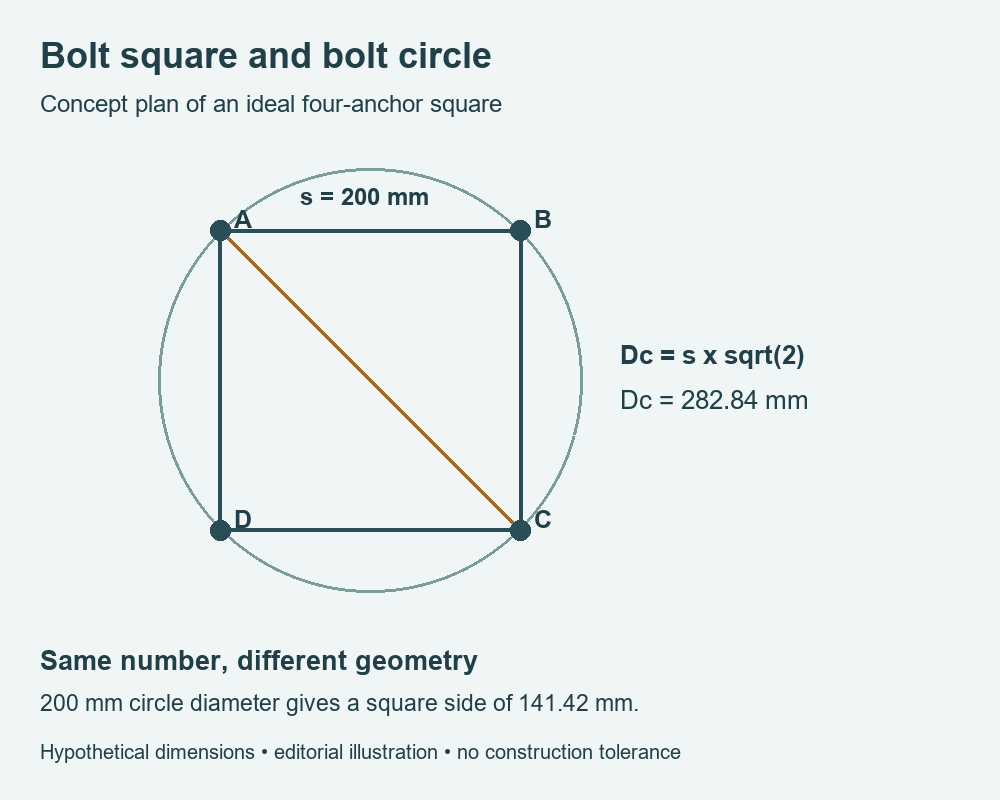
When ordering a replacement pole for an existing four-anchor foundation, state whether the recorded dimension is the bolt-circle diameter or the side of the bolt square. Include a labelled plan of the actual anchor centres and the proposed base-plate drawing. For an ideal four-hole square pattern, the diagonal and the side differ by a factor of √2. Confusing those two dimensions can send the supplier a substantially different pattern.
Four-anchor square pattern — conceptual geometry for a procurement check. The example dimensions are hypothetical.
Label the anchor centres A, B, C and D in order around the foundation. Show adjacent distances AB, BC, CD and DA, plus diagonals AC and BD. State the units and the height or reference plane at which the survey represents the centres. Add the pole-arm direction, cable entry and access-door orientation to the sketch.
LightMart’s technical guide distinguishes adjacent centre-to-centre spacing from the diagonal used for a four-anchor bolt-circle measurement. It asks buyers to record both and also check anchor diameter and projection. These are useful fields for a supplier review. The geometry example below applies specifically to an ideal square arrangement.
LightMart existing-foundation buying guide https://www.lightmart.com/blog/selecting-a-compatible-light-pole-for-existing-foundations-anchor-bolts/
In a hypothetical square pattern, each side s is 200 mm. The centre-to-centre diagonal is Dc = √(s² + s²) = s × √2. Therefore Dc = 200 × √2 = 282.8427 mm, or about 282.84 mm.
If the request instead says “200 mm bolt-circle diameter,” the corresponding ideal-square side is 200 ÷ √2 = 141.4214 mm, or about 141.42 mm. Those descriptions refer to different anchor layouts.
The calculation checks how a dimension is being described. Keep actual survey readings and the supplier’s acceptance limits on the drawing. If the measured sides or diagonals differ, submit the complete labelled measurements for review. Do not force the readings into a nominal square by averaging them or infer a permissible fabrication tolerance from the arithmetic.
A hole-pattern comparison answers whether the proposed geometry corresponds to the recorded anchors. Foundation reuse also depends on the anchors and concrete, the embedded detail, the new pole reactions and the project conditions. The responsible civil or structural engineer determines what investigation and design review are required.
The proposed plate drawing should identify hole or slot geometry, plate thickness, central cable opening and orientation. The anchor record should identify rod diameter and thread, projection, condition and the available drawings or material records. Ask which nuts, washers, bearing or leveling arrangement and access clearances the proposed assembly requires. The foundation and anchor-bolt guide covers that wider interface review.
Send the measured pattern and the proposed base drawing to the supplier before placing the pole order. Request a disposition identifying the compatible base arrangement or an alternative that requires engineering review. Record any change to the base height, cable opening, cover or attachment arrangement.
Hapco markets bolt-circle adapters for selected bases and directs buyers to its engineering team for compatibility and loading assistance. That is an example of a product-specific alternative requiring design review. An adapter changes the assembly being proposed and belongs in the drawing and approval package.
Hapco bolt-circle adapter information https://www.hapco.com/pole-solutions/bolt-circle-adapter/
Refer proposed hole enlargement, anchor alteration or other field correction to the responsible designer through an approved procedure. The procurement record should identify the accepted solution before installation work proceeds.
For a replacement lighting pole shaft, send Jieyao Lighting the existing interface record with the required height, attachments and finish. Ask for a proposed base arrangement tied to those inputs. Use the replacement survey checklist for the rest of the site information.
Request a replacement-pole interface review.
Sources reviewed 4 November 2026. The square-pattern example and diagram are original editorial illustrations with hypothetical dimensions. They provide no project tolerance or structural capacity rating.
Contact Us
Get a custom lighting solution and quotation for your project. Yangzhou Jieyao Lighting Equipment Co., Ltd. manufactures outdoor lighting and steel poles in Guoji Town Industrial Park, Gaoyou City, Yangzhou, Jiangsu, China. The company reports a 10,000 m² factory site, more than 60 employees including more than 10 technical personnel, and more than 100 production and testing machines. The present company name dates from 2017; Jieyao Poles’ published history traces the team’s manufacturing lineage to 2006. The stated 15 years of experience refers to the team. The company reports exports to more than 60 countries. Do you have any questions or requests?
Email: jay@jieyaolighting.com

Click to Chat.
Im online now.
 English
 Español
 Bahasa Indonesia