An LED high mast retrofit may retain the pole and lowering system, but only after the retained equipment is assessed with the proposed lighting assembly. Check the mast condition, carriage loading and balance, mounting clearances, electrical equipment and new photometry together. Lower wattage alone does not establish compatibility.
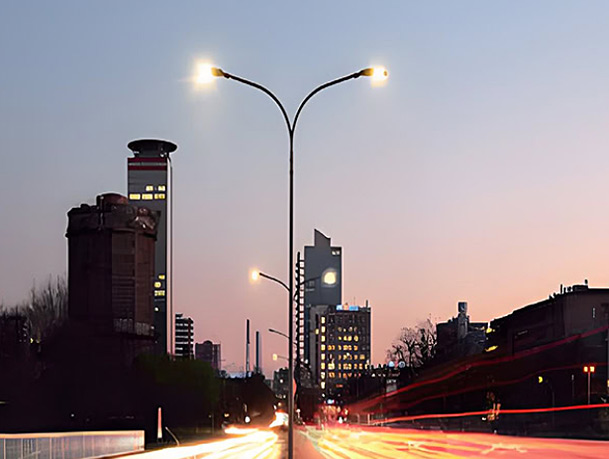
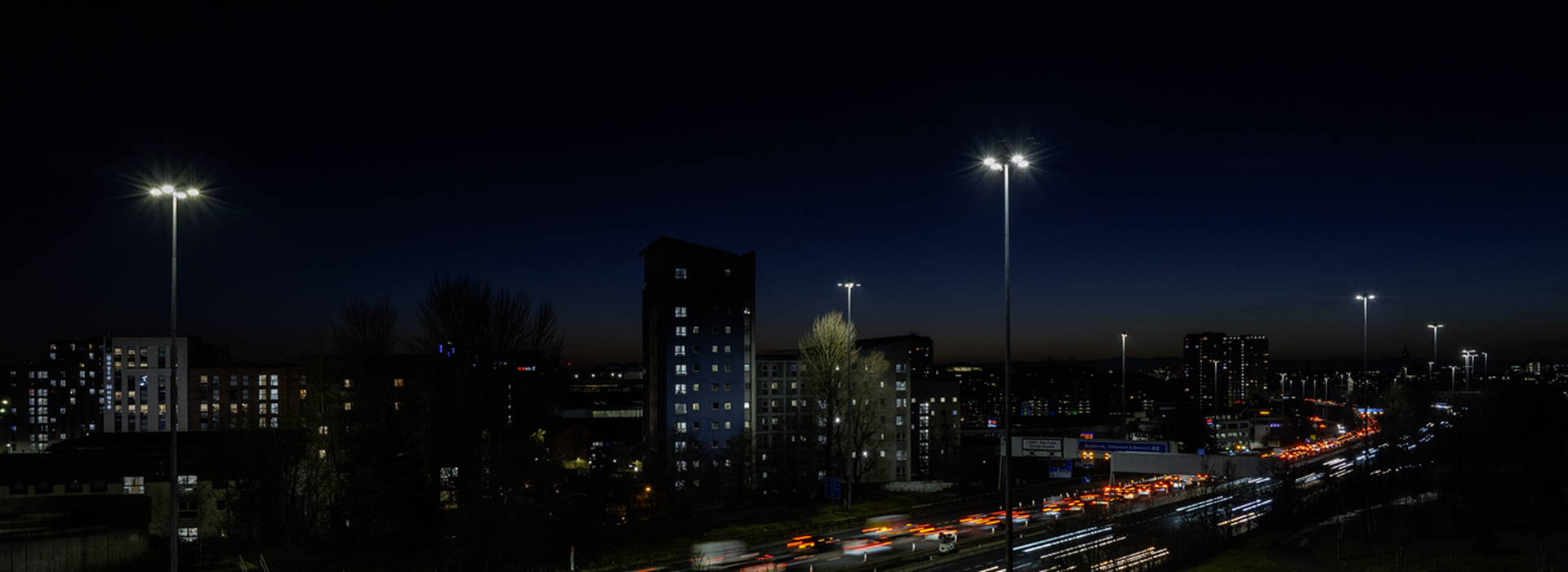
High mast lighting beside a major road — an application example.
A high mast is an assembly of structure, headframe or carriage, mechanical equipment and electrical services. Replacing discharge luminaires with LED changes some of those parts while leaving others in place. The project becomes clearer when the owner first decides what can remain and what must be renewed.
On a phone, swipe the table sideways to read all columns.
| Scope | What may remain | What needs a specific review |
|---|---|---|
| Luminaire replacement | An accepted mast, carriage and lowering arrangement. | New bracket interfaces, load layout, wiring and photometry. |
| Lighting assembly renewal | An accepted mast and foundation. | New headframe or carriage compatibility, lowering arrangement and electrical interfaces. |
| System replacement | Only assets separately accepted for reuse. | New mast/system design and civil/electrical connections. |
These are planning options, not interchangeable packages. A damaged carriage can rule out a luminaire-only change even when the mast shaft is serviceable. Conversely, a sound retained system does not need replacement merely because its old light source is inefficient.
The owner may want to keep the steel shaft, the foundation, the lighting carriage, the drive equipment or all of them. Write that boundary down before requesting an LED replacement. An offer that renews the complete head and another that replaces only the floodlights are different projects, even if both are described as a high-mast retrofit.
This option keeps a defined head arrangement and changes the light fittings and their immediate connections. It is worth investigating when the retained asset has a supported condition and the proposed equipment can work within its accepted geometry and loading. The new lights still need an optical, electrical and mechanical review; a matching bolt hole is only one part of the connection.
A new frame or carriage may organise the proposed lights more appropriately, but it also changes a major part of the top assembly. Its mass, wind exposure, fixture positions and cable arrangement enter the reuse assessment. If it moves, its travel and docking interfaces need to match the retained system. Do not describe it as a luminaire-only change.
A full replacement becomes a useful comparison when condition, missing records, site changes or compatibility prevent a supported reuse solution. It may also allow a different maintenance route or lighting layout. Compare it against the same site task and supply scope, rather than forcing a retrofit simply because the old shaft is already present.
Retain equipment by identification, not by assumption. Mark each item as retained, renewed or removed on one equipment schedule. Include the foundation and the access arrangement, not only the parts visible in a lighting photograph.
Start with the asset identity, drawings, previous changes and inspection history. Record the existing luminaires, brackets, cabling and other attachments. Compare what is installed with the drawing rather than assuming the original configuration has remained unchanged.
The condition survey should address the structure and its connections, with the inspection scope set by the responsible specialist. Visible deterioration, damage, unexpected movement or missing records may require more investigation before reuse can be decided. Replacing lights is not a repair for an unaccepted structural defect.
Keep foundation and anchor assessment in the reuse boundary. The high-mast foundation inputs guide explains the information needed for that support review; the high-mast types guide helps identify the existing head and access arrangement.
Circular high-mast lighting carriage and head assembly.
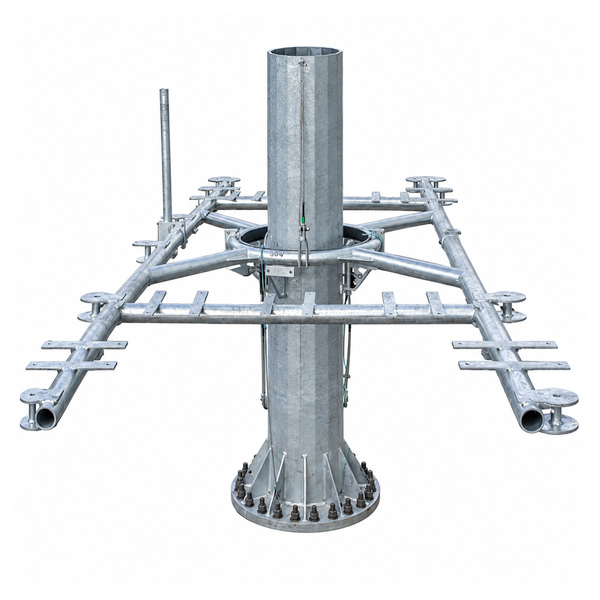
Rectangular luminaire carriage around a mast shaft.
The rectangular carriage photograph helps identify mounting rails, the space around the shaft and where light groups can be positioned. The outline does not establish the load rating or the particular suspension and locking arrangement. The system drawing and asset identification connect that visible frame to the equipment that supports and moves it.
Jieyao’s raising and lowering high-mast system describes a coordinated package that can include the mast, ring, floodlights, drive, suspension, headframe, mechanical locking, power cable and controls. That complete-system view is useful during retrofit: identify which of those interfaces the new lighting arrangement affects. A part from a new offered system is not automatically an interchangeable part for an existing one.
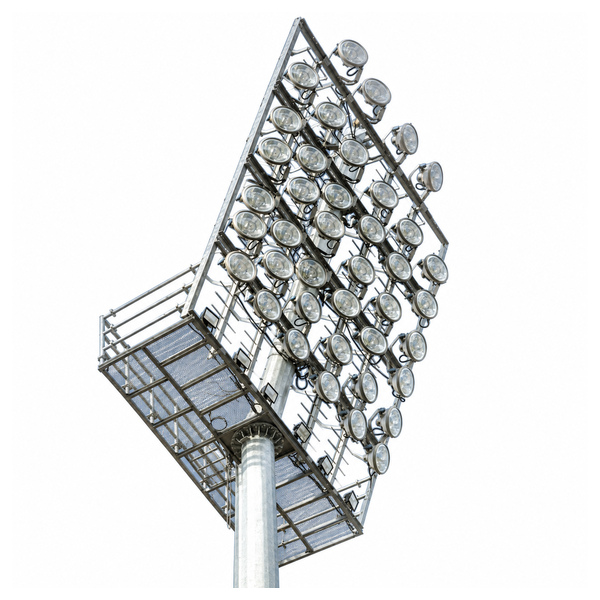
Fixed floodlight head and maintenance platform.
A fixed head creates a different service problem. The frame stays at its operating height, so the installer and owner need an accepted way to reach each new fitting, driver and connection. A platform visible in a photograph is useful context; the actual working position and reach still need to suit the proposed equipment. Replacing the lights should not leave a component inaccessible behind another fitting.
Keep the distinction between a lowering carriage and a hinged mast clear. In one, the lighting assembly moves on an upright mast; in the other, part of the support tilts. Do not plan a retrofit around a movement that the retained system does not provide. The high-mast types and selection guide explains these maintenance arrangements with further examples.
List the weight and wind-area information of each proposed luminaire and bracket, with its position on the carriage. Include drivers, junction boxes, cable and any additional equipment. The arrangement matters as well as the sum: moving equipment outward or grouping it on one side changes the loading and balance.
A lower-power LED fitting is not necessarily lighter, smaller or better balanced than the old fitting. A flat floodlight with a different mounting position may also occupy space needed for the carriage to dock or travel. Review the complete moving envelope and mounting detail with the system supplier.
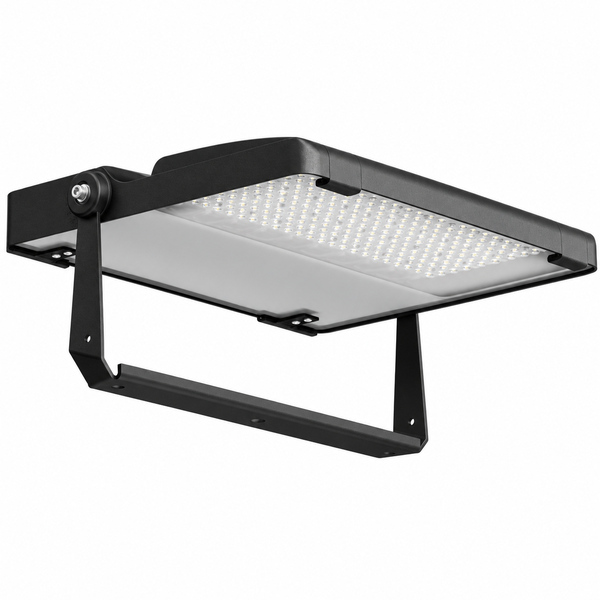
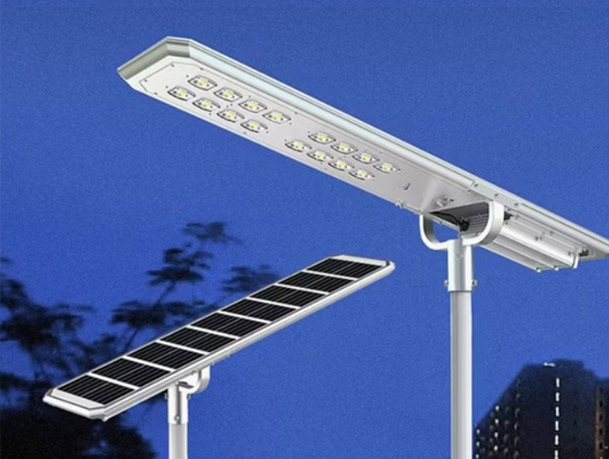
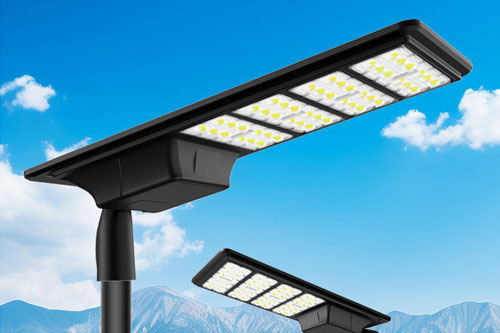
LED floodlight with an adjustable mounting yoke — a product example.
For a lowering mast, identify the carriage, suspension arrangement, drive equipment, docking or latching features and cable-management system. The new assembly needs to remain within the accepted operating conditions of that particular equipment.
Require the maintenance provider or system supplier to assess condition and compatibility before the changed assembly is operated. A generic winch rating does not establish suitability for every carriage, cable arrangement or loading condition. Our winch selection and maintenance guide covers equipment information to request; it is not a substitute for the retained system’s instructions.
If the existing system is fixed-head or ladder-access, define how the new luminaires will be installed and later maintained. A proposed retrofit should leave the owner with an achievable access method, not simply a new light source at the top of an old mast.
Start with the selected floodlight and its mounting yoke. Record where its mounting axis sits relative to the frame, where its body reaches when aimed, and where cables exit. Two fittings with similar mass can put that mass at different distances from the connection. The retained assembly must be assessed with the intended positions, not only the total kilograms on the packing list.
Also compare the directions in which the lights face. A radial arrangement, a one-sided bank and several opposed groups create different layouts around the head. The final design needs the complete equipment arrangement, including any drivers or boxes moved away from the fittings. A counterweight should not be improvised as a substitute for the system assessment.
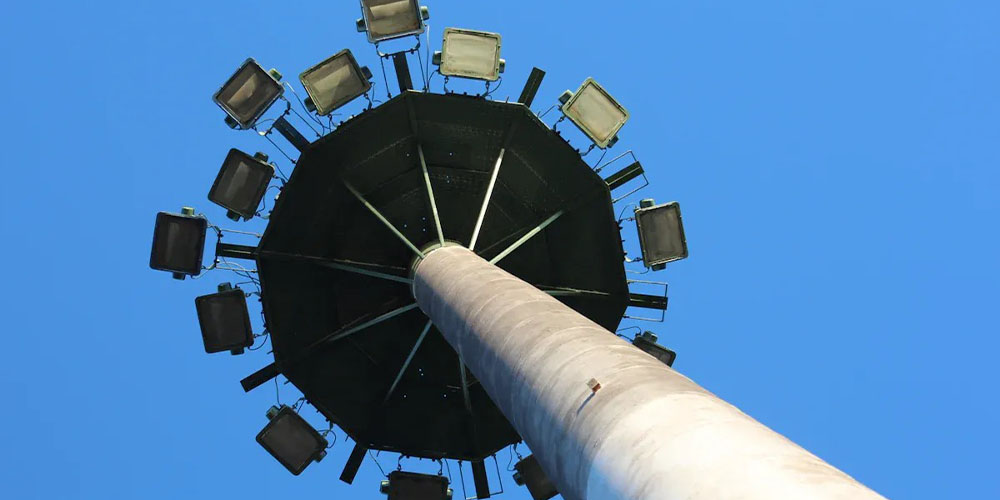
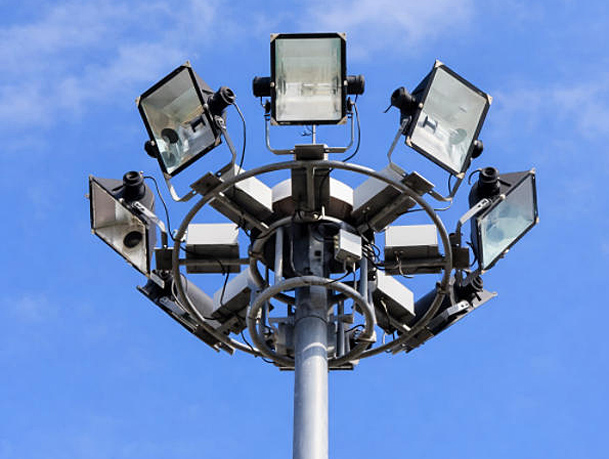
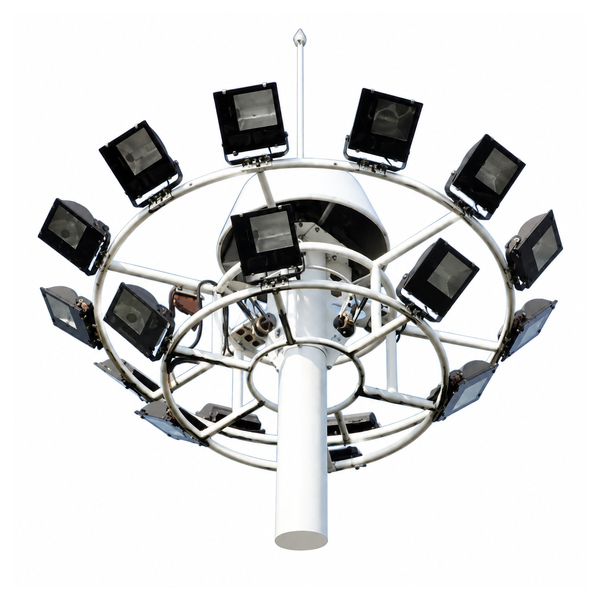
High-mast floodlight arrangement viewed from below.
The upward view shows how several luminaires occupy a shared head. In a retrofit survey, use views from more than one direction and connect them to a numbered fixture schedule. That makes it easier to identify an extra bracket, a changed fitting or a cable route that a single general photograph misses.
For a moving carriage, check the full envelope between its service position and its operating position. A light may fit on the rail at ground level but interfere with the mast, guides, head or adjacent equipment during travel or docking. Use the supplied system procedure and a compatible approved arrangement; the article does not provide a substitute operating sequence or permission to move an unaccepted assembly.
Document the new supply arrangement, driver locations, circuits, protection, earthing and control interfaces. If old ballasts or associated components are removed, the revised wiring needs to be defined rather than improvised from the existing connection.
Check the retained cable and connectors against the proposed voltage, current, environment and mechanical movement. Lower steady-state watts do not answer every electrical question: driver inrush, protection coordination and control behaviour also matter. Preserve a revised circuit schedule for maintenance.
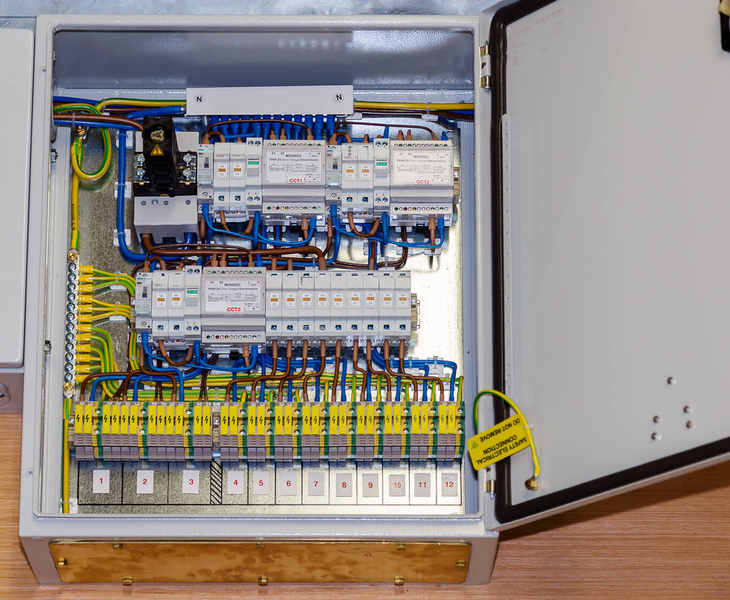
Numbered lighting circuits in a control cabinet.
Use the actual mast positions, mounting heights and proposed luminaire files in the calculation. Review the project’s maintained lighting criteria, uniformity, glare or spill constraints, and any relevant vertical task surfaces. Repeating the old lamp count is not a lighting design.
Cooper publishes a real interchange LED conversion using existing infrastructure. It demonstrates that reuse is a practical project approach, not a promise that every old mast accepts the same fixture. MnDOT’s high-mast product resource identifies an asymmetrical luminaire with its IES file and specification sheet—an important reminder to specify the optical task.
Retained mast locations can be valuable where civil work and traffic management are difficult, but the new optics must serve the actual lanes, ramps and boundaries. Include the approach and transition areas in the study. A higher-output replacement at the same position is not automatically a better visual environment for drivers.
Cooper’s published interchange conversion is an example of renewing light fittings while retaining identified infrastructure. Its project results belong to that installation. The useful lesson for another project is to define the retained assets and the new lighting task explicitly, rather than copy its energy-saving percentage or product approval.
Obstructions can change after the original mast was installed. Container stacks, cranes, buildings and handling equipment may block light or create additional vertical tasks. Use an up-to-date site plan and operating information, then compare beam directions and aiming with those obstructions. The maintenance operating area must also remain practical during the site’s normal work.
If the service position is occupied by a storage lane or a new fence, the owner may have a maintenance-access problem even when the lowering equipment is sound. Resolve that space together with the retrofit. For the lighting task itself, the container terminal lighting guide explains why horizontal and vertical work areas should be distinguished.
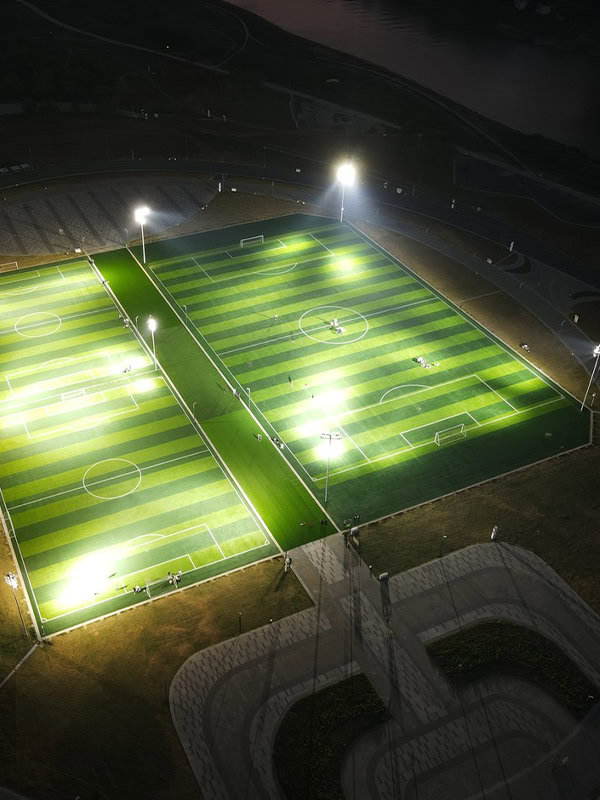
Sports and gathering areas can need different viewing directions, operating scenes and neighbour controls from the original installation. Treat any change in use as part of the brief. A new competition level, camera requirement or boundary restriction can turn an apparently simple lamp replacement into a new lighting-design decision.
Do not infer suitability from the number of floodlights on a similar stadium photograph. Compare the actual luminaire files, mounting geometry and applicable project criteria. Where the old frame cannot provide the necessary aiming or service access, include a revised or replacement system in the comparison.
Illustrative example: six old fittings drawing 1.05 kW each, including their control gear, total 6.30 kW. Six proposed LED fittings drawing 0.60 kW each total 3.60 kW. At an assumed 4,000 operating hours per year, the difference is 10,800 kWh/year, or 42.9% of the old lamp-system energy. These assumed powers are not a Jieyao test or a recommended replacement ratio.
This calculation compares electrical demand at equal operating hours. It does not establish equivalent lighting, the actual tariff saving, maintenance cost or project payback. Use measured existing input and the accepted proposed product data, then add any changes in operating schedule or control energy.
The existing six-fitting example compares electrical input at equal hours. For an actual decision, first establish that the proposed installation meets the lighting brief. Then add the work that makes that installation possible: survey, asset assessment, bracket changes, electrical renewal, access arrangements, installation and commissioning. A low luminaire price may leave important parts of that scope outside the offer.
Keep maintenance assumptions equally explicit. A new fitting may change which parts can be replaced, how they are identified and how long the site is closed for access. Separate those assumptions from projected energy. They may support a lifecycle comparison, but they need their own local labour, equipment and replacement inputs rather than a fixed saving claimed for every mast.
↔ Swipe sideways to read every column.
| Project stage | Useful evidence | What it resolves |
|---|---|---|
| Survey | Asset records, photographs and identified condition findings | Which installed equipment is being assessed |
| Selection | Exact fixture, bracket, optics and control options | What the new assembly actually contains |
| Compatibility | Accepted retained-asset and system-interface review | Whether the changed arrangement can be used |
| Installation | Revised drawings, electrical information and system procedure | How the accepted change is implemented |
| Handover | As-built schedule, settings, checks and maintenance records | How the owner keeps the arrangement identifiable |
Can the mast stay if the LED lights are lighter? Lower mass alone does not settle condition, wind exposure, bracket layout, movement or foundation suitability. Use the complete proposed arrangement in the reuse decision.
Can a more powerful winch solve a heavier carriage? A drive change does not, by itself, uprate the suspension, head, locking, carriage or mast. The matched system has to be assessed as an assembly.
Does LED mean the existing cable can stay? Identify the voltage, protection, control and movement requirements of the new system. Cable condition and compatibility remain part of the electrical review, even if steady-state input power falls.
Can the original light count be retained? It can be investigated, but the accepted quantity and aiming come from the lighting design and the compatible head arrangement. Do not use the old count as proof of equivalent performance.
Keep the approved equipment schedule, revised drawings, retained-asset assessment, photometric plan, electrical checks and system-specific commissioning record together. Record the final arrangement and settings so that later maintenance does not depend on the installer remembering what changed.
Send Jieyao Lighting the mast records, inspection findings, carriage photographs, existing fixture schedule and lighting brief through the project enquiry page. This supports a defined retrofit discussion. Where reuse cannot be supported, compare a replacement system against the same site task instead of forcing a luminaire-only solution.
For a new assembly comparison, see Jieyao’s raising and lowering high-mast system. Reuse of an existing system is a separate, asset-specific decision.
Yangzhou Jieyao Lighting Equipment Co., Ltd. (Jieyao Lighting) supplies outdoor lighting and lighting poles. Use the company profile to identify the manufacturer behind this guide, and keep the selected product and project documents together when comparing an offer.
Keep a project comparison sheet. Download the printable high-mast retrofit checklist. Record the selected configuration and document references so later comparisons use the same basis.
Cooper Lighting Solutions, Roadway Lighting Retrofit of Three Interchanges — Third-party retrofit example; its project results and warranty are not transferred to this guide.
https://www.cooperlighting.com/global/resources/case-studies/roadway-lighting-retrofit-of-3-interchanges
Minnesota DOT, LED High Mast Luminaires — Examples of separately specified symmetrical and asymmetrical high-mast optics; not a global approval list or Jieyao qualification.
https://www.dot.state.mn.us/products/roadwaylighting/ledhighmast2.html
Raising and Lowering High Mast Lighting System — Coordinated mast, carriage, drive, suspension, locking and electrical supply scope. New-system scope is not a retrofit compatibility certificate.
https://www.jieyaolighting.com/product/raising-lowering-high-mast-lighting-system
Product references reviewed 21 November 2026. Photographs show the described equipment or applications; illustrative calculations are labelled where used.
Contact Us
Get a custom lighting solution and quotation for your project. Yangzhou Jieyao Lighting Equipment Co., Ltd. manufactures outdoor lighting and steel poles in Guoji Town Industrial Park, Gaoyou City, Yangzhou, Jiangsu, China. The company reports a 10,000 m² factory site, more than 60 employees including more than 10 technical personnel, and more than 100 production and testing machines. The present company name dates from 2017; Jieyao Poles’ published history traces the team’s manufacturing lineage to 2006. The stated 15 years of experience refers to the team. The company reports exports to more than 60 countries. Do you have any questions or requests?
Email: jay@jieyaolighting.com

Click to Chat.
Im online now.
 English
 Español
 Bahasa Indonesia
 Français