
JIEYAO LIGHTING · REPORT-BASED ORIGINAL ANALYSIS
Two embedded-part specimens provide eight material results. We compare the report criteria and explain the missing links between specimen strength and an installed anchor connection.
Report AJDA323W01426 lists lower yield strengths of 431/433MPa and tensile strengths of 591/593MPa for two Φ14 embedded-part specimens. Those material results do not establish a finished anchor’s allowable load, thread class or foundation capacity.
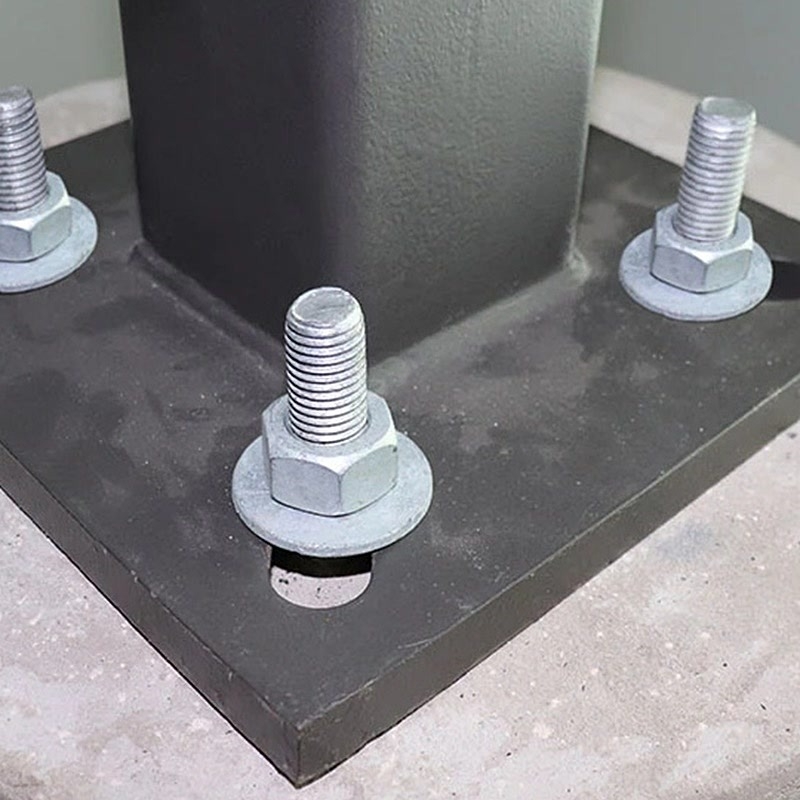
Anchor/base-plate detail photograph from the supplied image library. It is application context, not a photograph of the report’s Φ14 specimens or an approved installation detail.
For a street light anchor-bolt enquiry, a diameter and a photograph leave important material questions unanswered. Yield strength, tensile strength, ductility and hardness describe different aspects of a specimen. A useful material report records them separately and keeps the specimen identity visible.
Jieyao supplied report AJDA323W01426, issued 20 December 2023 by the Sichuan Provincial Institute of Product Quality Supervision, Inspection and Testing (四川省产品质量监督检验检测院). It identifies two embedded-part samples, described in Chinese as “预埋件,” designated Φ14 and produced in October 2023. The testing dates are 14–19 December 2023.
The report cites GB/T 228.1-2021 for room-temperature tensile testing and GB/T 4340.1-2009 for Vickers hardness. Its acceptance basis is technical conditions supplied by the commissioning party. The actual results and printed criteria follow; they are not a complete-anchor design table.
| Property | Printed criterion | Specimen 1 | Specimen 2 |
|---|---|---|---|
| Lower yield strength ReL | ≥400 MPa | 431 MPa | 433 MPa |
| Tensile strength Rm | ≥540 MPa | 591 MPa | 593 MPa |
| Elongation after fracture A | ≥16% | 37.5% | 37.0% |
| Vickers hardness | ≥100 HV30 | 182.5 HV30 | 185.7 HV30 |
The report marks the tensile and hardness items as passing the supplied technical conditions. Φ14 is the specimen designation recorded there. It does not, on its own, establish an M14 thread, thread pitch, finished fastener property class, embedment geometry or a particular current sales item.
Yield and tensile strength are both stress results, expressed here in MPa, but they are not the same endpoint. The source specifically reports lower yield strength ReL; we retain that designation rather than silently replacing it with an offset proof stress. Instron’s tensile-testing guidance distinguishes yielding from the maximum stress result.
Elongation after fracture adds information about ductility in the specified tensile test. It is not a percentage of safe field extension for an installed bolt. Hardness is reported on the HV30 test designation; it is not interchangeable with MPa or an allowable tightening torque.
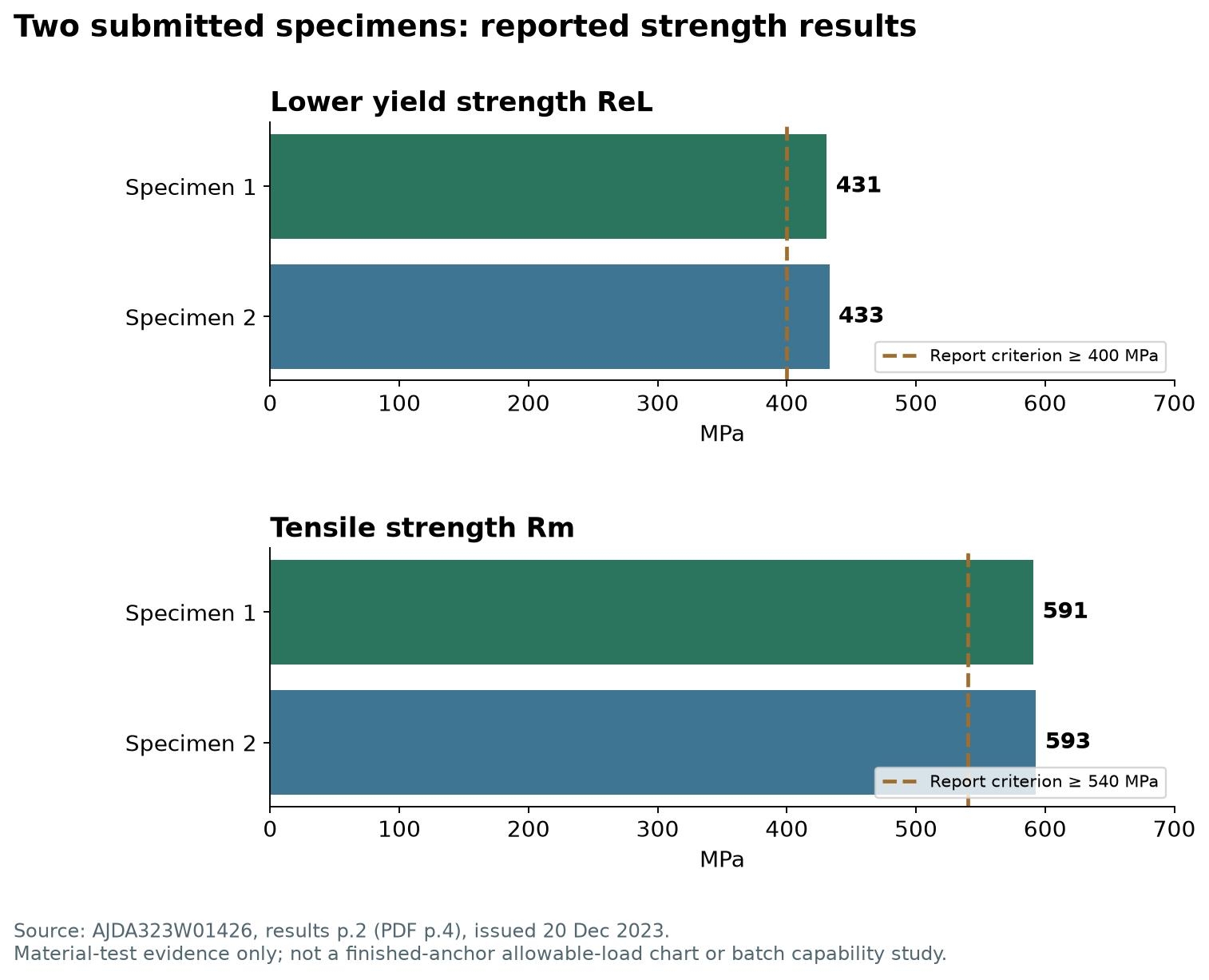
Direct transcription of strength results and printed criteria. Elongation and hardness remain in the table; the chart does not show complete anchor capacity.
The properties should remain connected to the relevant specimen preparation and test conditions. Elongation can depend on how it is measured and the specimen geometry. Instron also cautions against using elongation alone to predict sudden or repeated-load behavior. We therefore make no impact, fatigue or seismic qualification claim from this report.
For a conservative descriptive comparison within these two results, take the lower displayed result for each property and subtract the report’s criterion. This is an editorial calculation, not a statistical lower bound for production.
| Property | Lower observed result | Difference from printed criterion |
|---|---|---|
| Lower yield strength | 431 MPa | 431 − 400 = 31 MPa (7.75% of 400 MPa) |
| Tensile strength | 591 MPa | 591 − 540 = 51 MPa (9.44% of 540 MPa) |
| Elongation after fracture | 37.0% | 37.0 − 16 = 21.0 percentage points |
| Vickers hardness | 182.5 HV30 | 182.5 − 100 = 82.5 HV30 |
Percentage points matter in the elongation row: 37% minus 16% is 21 percentage points. That is not a promise that a foundation connection can stretch by an extra 21% in service. Nor does a larger difference above one lower limit automatically make a material preferable for every anchoring design.
Both submitted specimens have reported results above the four printed lower criteria. Their yield values differ by 2MPa and tensile values by 2MPa, but two observations without a population sampling plan or uncertainty statement cannot establish production uniformity, a process-capability index or a defect rate.
A material stress result is not the load capacity of a finished threaded anchor. Moving from material evidence to a connection assessment requires the actual geometry, relevant resistant section, grade and connection design basis. Simply multiplying a nominal circular diameter area by the report’s strength would leave those requirements unresolved.
The foundation side introduces further questions: embedment, edge distances, spacing, concrete properties, base-plate behavior and combined tension/shear demand. The loading can depend on pole and luminaire geometry, solar-panel area, site conditions and the design method. None of those is supplied by this material-test table.
| Evidence layer | What it contributes | What remains separate |
|---|---|---|
| Material specimen test | Documented tensile/hardness results for the identified specimens | Finished bolt geometry and property-class qualification |
| Finished anchor identification | Thread, dimensions, material/lot traceability and applicable product basis | Connection design and installation |
| Pole/base-plate connection | Hole pattern, plate, nuts/washers and load path | Concrete anchorage and site demand |
| Foundation assessment | Relevant concrete, embedment and design verification | Installation quality and actual site conformity |
| Installation and handover | As-built records, alignment and specified installation checks | Long-term inspection and maintenance |
This is why the report is useful but cannot be turned into a “safe load” chart for all Φ14 anchors. The inspection acceptance of material specimens is one link in the chain, not a substitute for the complete design. Do not infer a fastener grade, proof load, pull-out resistance or tightening torque from these eight results alone.
A report number becomes more useful when it connects to a heat or material lot, sample selection, production item and delivery record. Here we can identify the two specimens and the stated product designation, dates and criteria. We have not independently established the issuer’s online record or the link to a current offered anchor assembly.
For procurement, request the material designation and applicable product basis, the drawing and thread details, lot identification, sampling record and the relevant laboratory document. If manufacturing or surface treatment changes the accepted item, record how that change is reviewed. A copied report for an unidentified item does not close the traceability question.
Please connect the proposed anchor rods to their material/production lot and applicable product requirements. Provide the finished dimensions and thread details, relevant specimen-test reports and acceptance criteria, then the base-plate/foundation design and installation requirements for our project.
Yangzhou Jieyao Lighting Equipment Co., Ltd. supplies outdoor lighting and steel-pole solutions from Yangzhou, China. When enquiring about street light poles and foundation hardware, send the site and structural design basis, pole/attachment arrangement, base-plate drawing, anchor template and installation constraints. Ask which evidence applies to each proposed component.
The sample results in this case belong to the recorded embedded parts. They are not specifications for every Jieyao anchor, and the article does not confirm a finished M14 bolt model. A configuration review should explicitly close that gap instead of relying on a visually similar photograph.
For a companion inspection example, see the 6m pole dimensions and coatings report analysis. Read the galvanizing comparison when specifying surface protection. Strength, dimensional compatibility and corrosion protection each need their own evidence.
No. The report records an embedded-part specimen designation. Finished thread dimensions, geometry and product identity need separate documentation.
No. MPa is a material stress result. A complete connection assessment requires the actual product, resistant section, design basis, loading and foundation details.
No. The two results support the documented specimens. Production acceptance needs a traceable sampling and inspection plan.
Send your project requirements and proposed components to Jieyao. Ask for the relevant drawing, configuration-to-report reference and acceptance evidence together.
Discuss the project with Jieyao →Contact Us
Get a custom lighting solution and quotation for your project. Yangzhou Jieyao Lighting Equipment Co., Ltd. manufactures outdoor lighting and steel poles in Guoji Town Industrial Park, Gaoyou City, Yangzhou, Jiangsu, China. The company reports a 10,000 m² factory site, more than 60 employees including more than 10 technical personnel, and more than 100 production and testing machines. The present company name dates from 2017; Jieyao Poles’ published history traces the team’s manufacturing lineage to 2006. The stated 15 years of experience refers to the team. The company reports exports to more than 60 countries. Do you have any questions or requests?
Email: jay@jieyaolighting.com

Click to Chat.
Im online now.
 English
 Español
 Bahasa Indonesia