
JIEYAO LIGHTING · TECHNICAL BUYER ANALYSIS
Winter sunlight does not guarantee battery charging. Compare charge permission, lost charging windows and heater energy in a reproducible eight-period example.
Jieyao Lighting · 26 October 2026 · Original eight-period bookkeeping model with hypothetical inputs and external manufacturer examples. No thermal simulation, field test or universal battery limits.
Winter generation can be available while the battery is outside its approved charging limits. Check charging and discharging separately, follow the selected pack’s requirements and include delayed charging and heater energy in the balance. A cold-weather operating label alone does not prove recovery.

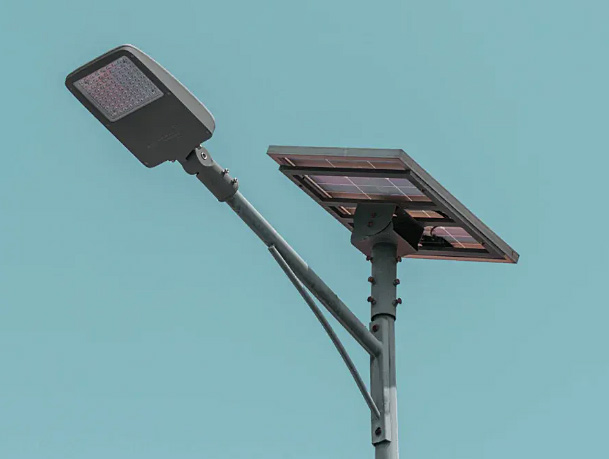
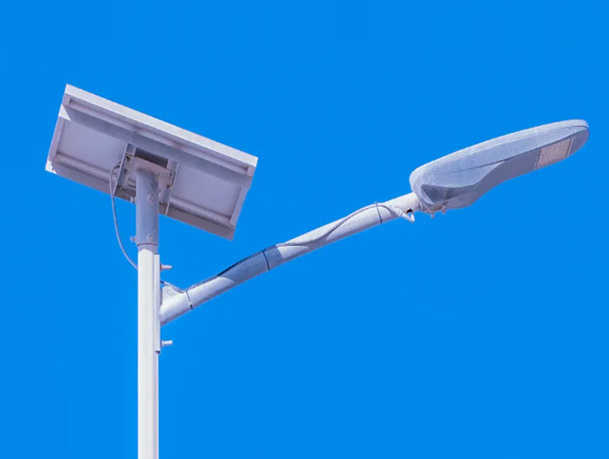
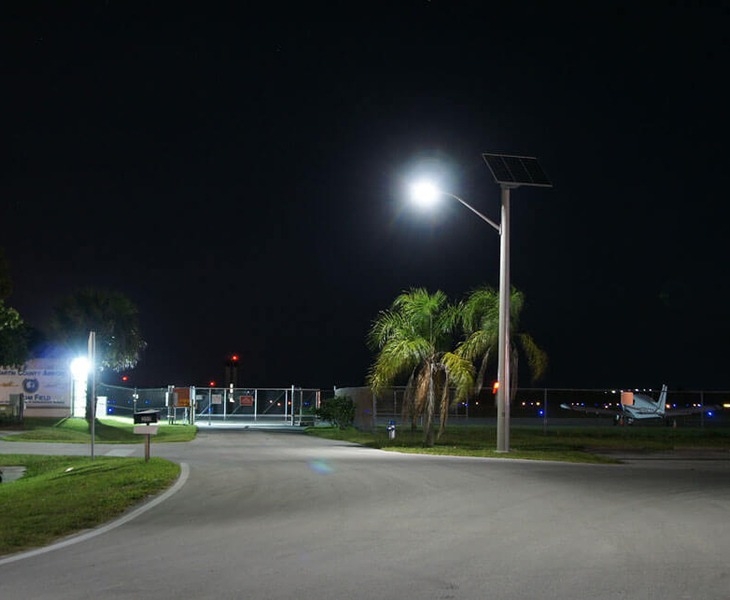
Photograph from the supplied image library, used for product/application context. It does not identify a tested specimen or verify the performance discussed below.
A panel can receive winter sunshine while the battery remains too cold to accept charging under its approved limits. A sizing sheet that assumes every generated watt-hour reaches storage may therefore overstate recovery. Being able to discharge at night does not establish permission to recharge the following morning.
Model-specific examples explain why the details matter. Victron’s Lithium NG 12.8 V operation manual permits charging from +5°C to +50°C and gives a different discharge range. SuperPack NG technical data describe suspension and self-heating below 0°C before charging resumes. These are external examples, not battery specifications for Jieyao lights or universal rules for every pack.
This desk model isolates one question: how much candidate charging energy remains when the early solar window is unavailable? It is not a thermal simulation. Eight one-hour periods, their energy values and charge-permission flags are invented inputs, not measured weather or battery performance.
Candidate energy is assumed to be after PV/controller losses, before the permission gate and any heater allocation. The battery has storage headroom, current limits are met, and other daytime loads are neglected. Real proposals must replace these simplifications.
| Period | Candidate Wh | Charge allowed without heating? | Eligible Wh |
|---|---|---|---|
| 1 | 20 | No | 0 |
| 2 | 40 | No | 0 |
| 3 | 70 | No | 0 |
| 4 | 90 | Yes | 90 |
| 5 | 100 | Yes | 100 |
| 6 | 80 | Yes | 80 |
| 7 | 50 | Yes | 50 |
| 8 | 20 | Yes | 20 |
Candidate energy: 20 + 40 + 70 + 90 + 100 + 80 + 50 + 20 = 470 Wh. Blocked: 20 + 40 + 70 = 130 Wh. Eligible: 470 − 130 = 340 Wh. The assumed gate removes 27.7% of candidate energy.
For a second fictional case, assume a qualified heating/control design unlocks all eight periods and consumes 80 Wh from that day’s candidate energy. This does not predict that an 80 Wh heater can warm a real pack in time. That response requires actual pack, enclosure and control evidence.
| Scenario | Available for storage | Surplus after night duty |
|---|---|---|
| No heater; first three periods blocked | 340 Wh | +40 Wh |
| Heating unlocks all periods; 80 Wh cost | 470 − 80 = 390 Wh | +90 Wh |
| Heating unlocks all periods; 150 Wh cost | 470 − 150 = 320 Wh | +20 Wh |
With these fixed assumptions, the heating allocation breaks even with the blocked-window case at 130 Wh. Below that cost it improves daily stored energy; above it, it reduces it. The boundary is an arithmetic finding, not a recommendation to add a heater to every solar street light.
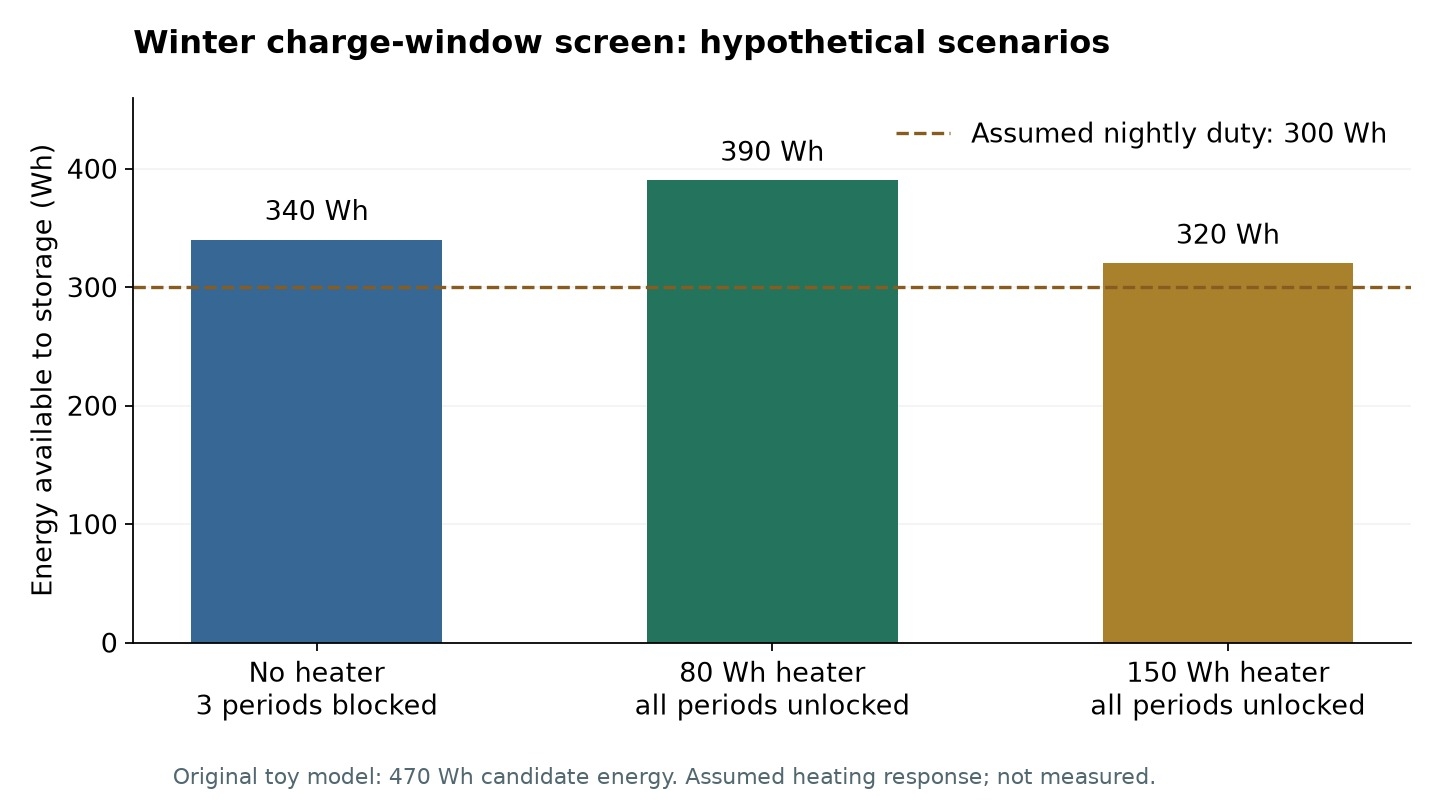
Original hypothetical scenario chart. Heating response is assumed, not simulated or measured.
Ask for a time-linked record of battery temperature, charge permission, charging power and accumulated energy. Air temperature alone may not describe the cells. Identify the sensor position, device that blocks charging, recovery logic and operator indication when charging is inhibited.
| Review point | Supplier evidence | Buyer decision |
|---|---|---|
| Operating envelope | Exact pack limits and current restrictions. | Compatible with the site temperature basis? |
| Permission logic | Sensor, BMS/controller interaction and fault indication. | Does charging stop when required? |
| Auxiliary energy | Heater power, duty and energy allocation. | Included in generation and load budget? |
| Seasonal recovery | Time series with declared generation/load assumptions. | Can reserve recover in the critical season? |
PVGIS illustrates a time-series method for tracking generation, storage and unmet demand. A project can need additional temperature-dependent controls beyond a basic energy balance. No site-specific PVGIS result or reliability percentage is claimed here.
Record whether heater energy comes from incoming PV, stored battery energy or another source. The timing matters: energy spent before solar charging starts may draw down the same reserve needed for the night. A daily total cannot fully describe this sequence.
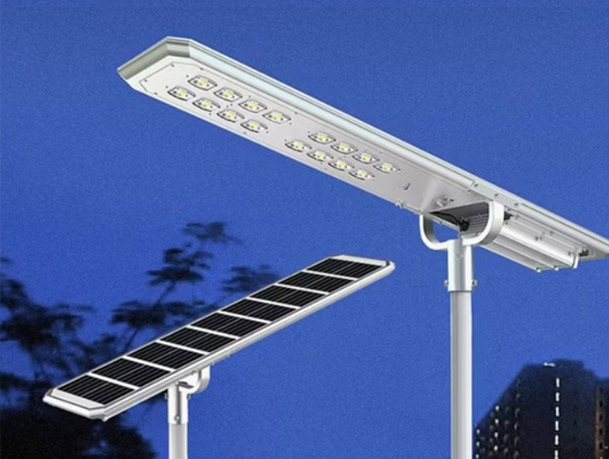
Jieyao Lighting is an outdoor lighting manufacturer in Yangzhou, China. For a cold-site proposal, send the location, operating scenes, design temperature basis and installation constraints. Ask for a specific winter assessment instead of one generic low-ambient operating label. For a proposal with a separate panel, luminaire and battery enclosure, review Jieyao’s split-type solar street light configuration and request the exact pack, controller and enclosure details for the winter assessment.
Use the battery temperature and enclosure guide for the wider RFQ. This article adds the charge-window screen. The three-night backup guide explains the separate reserve check.
State the selected pack’s charging and discharging limits separately. Show temperature-based charge permission, heater supply and energy accounting, and how the agreed nightly duty and recovery target are maintained in the specified winter case.
Follow the actual pack’s limits and control sequence. Some products inhibit charging until warmed; one threshold does not describe every design.
It can add reserve, but capacity alone does not establish charge permission or daily recovery.
No. They are a disclosed toy dataset illustrating the calculation and break-even condition.
Send the application, site conditions and proposed configuration. Ask for evidence matched to the requirement rather than a universal performance promise.
Discuss the technical requirements →Original eight-period bookkeeping model with hypothetical inputs and external manufacturer examples. No thermal simulation, field test or universal battery limits. Interpretations and templates are independent editorial analysis. Source organisations do not endorse this article or the offered products.
Source addresses (copy to open):
Victron Lithium NG 12.8 V: Operation: https://www.victronenergy.com/media/pg/Lithium_NG_battery_12,8_V/en/operation.html
Victron SuperPack NG: Technical Data: https://www.victronenergy.com/media/pg/Lithium_SuperPack_NG/en/technical-data.html
European Commission JRC: PVGIS off-grid systems: https://joint-research-centre.ec.europa.eu/photovoltaic-geographical-information-system-pvgis/using-pvgis-5/pvgis-5-tools/grid-pv-systems_en
Contact Us
Get a custom lighting solution and quotation for your project. Yangzhou Jieyao Lighting Equipment Co., Ltd. manufactures outdoor lighting and steel poles in Guoji Town Industrial Park, Gaoyou City, Yangzhou, Jiangsu, China. The company reports a 10,000 m² factory site, more than 60 employees including more than 10 technical personnel, and more than 100 production and testing machines. The present company name dates from 2017; Jieyao Poles’ published history traces the team’s manufacturing lineage to 2006. The stated 15 years of experience refers to the team. The company reports exports to more than 60 countries. Do you have any questions or requests?
Email: jay@jieyaolighting.com

Click to Chat.
Im online now.
 English
 Español
 Bahasa Indonesia