
JIEYAO LIGHTING · REPORT-BASED ORIGINAL ANALYSIS
A real 120W panel report provides six electrical results. We check the power and fill factor, and explain why Voc × Isc is not usable output.
Report AGXB120W00587 records 123.107W maximum power for one 120W module. Its Vmp × Imp and fill factor agree at the displayed precision. Voc × Isc is a reference product—not the output a solar street light can draw.
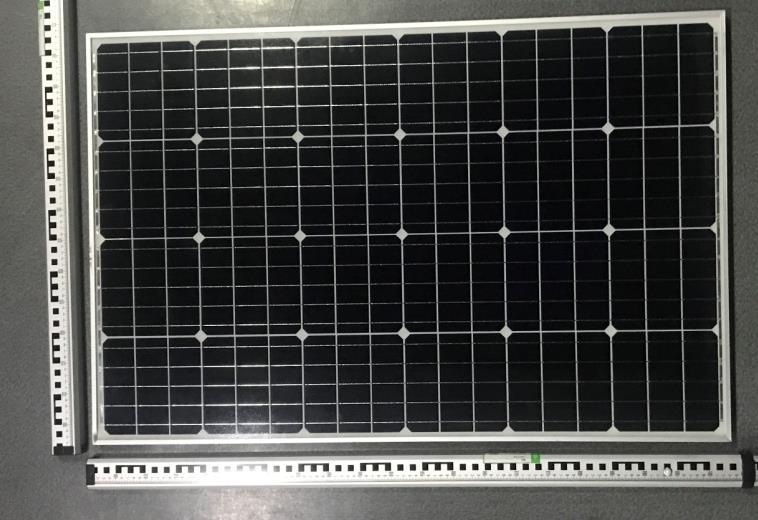
Original front photograph of the submitted sample, from report AGXB120W00587, PDF p.5.
When a solar street light quotation includes a 120W panel, request a result for the identified module rather than treating a photograph or open-circuit voltage as a power test. A useful report connects the specimen, test category and measured electrical values. This case shows how six numbers can be checked against each other.
Jieyao supplied commissioned report AGXB120W00587, issued 11 September 2020. It identifies one monocrystalline 120W solar-panel sample, tested on 9 September 2020. Its performance table is headed “performance under standard test conditions.” The results below are historical reported measurements, not a new field test or a current-model guarantee.
| Quantity | Reported value | Meaning in this review |
|---|---|---|
| Maximum power Pm | 123.107 W | Power result to compare with the printed ≥120W criterion |
| Voltage at maximum power Vmp | 18.501 V | Voltage at the reported maximum-power point |
| Current at maximum power Imp | 6.654 A | Current at that operating point |
| Open-circuit voltage Voc | 23.035 V | A separate open-circuit condition |
| Short-circuit current Isc | 7.001 A | A separate short-circuit condition |
| Fill factor FF | 76.34% | Maximum power relative to the Voc × Isc reference product |
The identification page cites IEC 61215:2005 and the company technical conditions. The conclusion concerns the items tested against those conditions. A single STC performance table does not establish completion of every module qualification test, nor compliance with a newer edition.
First check whether maximum-power voltage and current reproduce the reported watts. Then compare the result with the stated power criterion. Finally check the fill factor. These are arithmetic consistency checks using displayed values; they do not replace the laboratory measurement or its uncertainty.
| Check | Calculation | Result |
|---|---|---|
| Maximum-power product | 18.501 × 6.654 | 123.105654 W, about 123.106 W |
| Difference above the printed 120W criterion | 123.107 − 120 | 3.107 W, or 2.59% of 120 W |
| Fill-factor check | 123.107 ÷ (23.035 × 7.001) × 100 | 76.3369%, rounding to 76.34% |
The Vmp × Imp product is about 0.00135W below the displayed power result. Rounding of the displayed inputs can account for such a small arithmetic difference; it is not a demonstrated laboratory error. Likewise, the 3.107W difference is not a production tolerance, a confidence interval or a guarantee that another panel will exceed its label by the same percentage.
The power-point values and fill factor are arithmetically consistent at their displayed precision. That supports coherent reading of this one record. It does not independently verify the issuer, measurement accuracy or present production.
Multiplying the largest-looking voltage and current gives 23.035 × 7.001 = 161.268035. But Voc and Isc describe different electrical conditions; those two readings are not delivered together as a useful power point. Calling that product “161W output” would overstate this report’s 123.107W maximum-power result by approximately 31.0%.
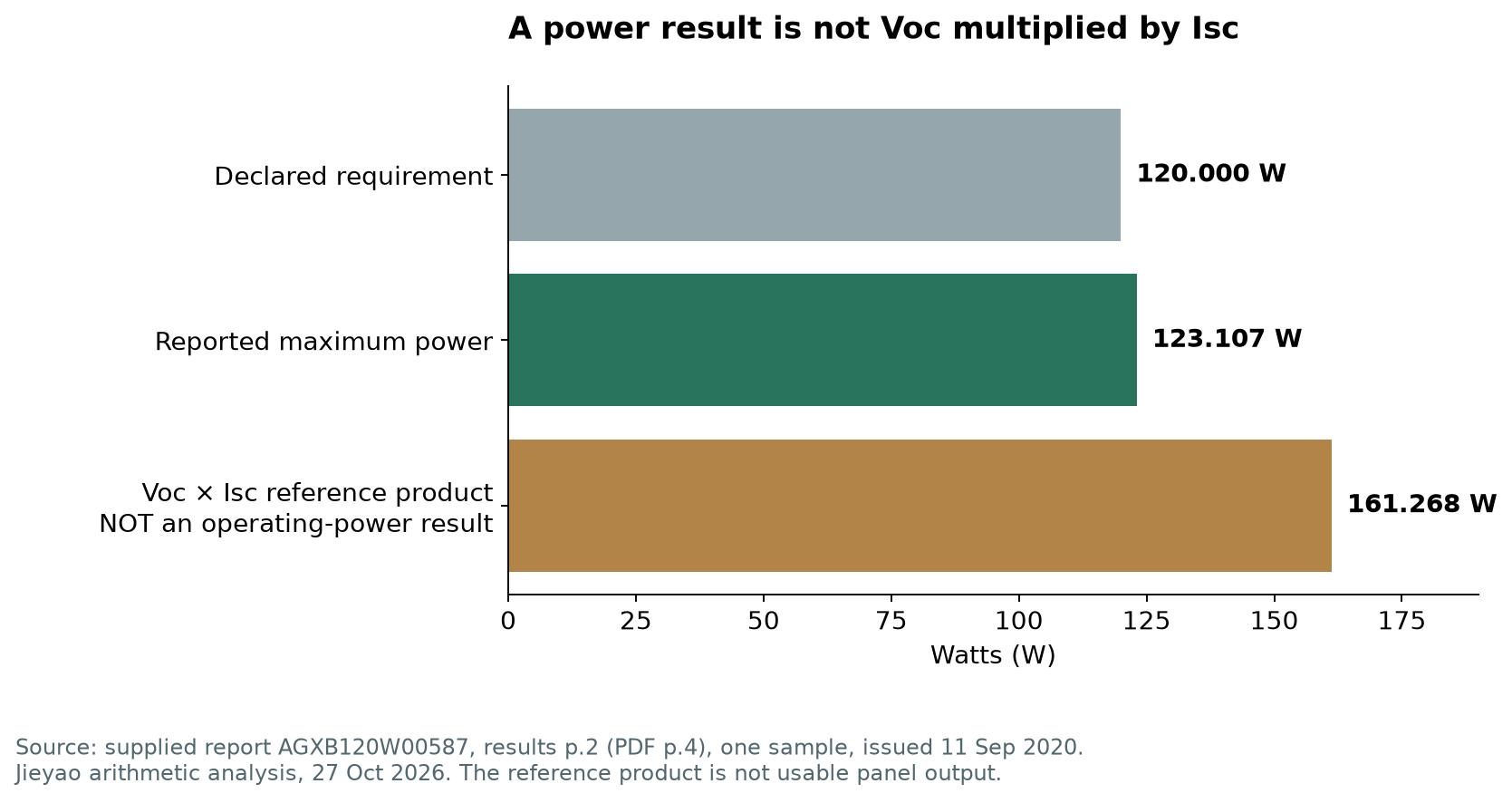
The first two bars come from the report; the third is our calculated reference product, not another measured output.
Fluke’s technical explanation distinguishes the maximum-power operating point from the open- and short-circuit endpoints and gives the fill-factor relationship. The same distinction is visible here: 123.107 ÷ 161.268035 is about 0.7634. 76.34% is fill factor, not module sunlight-to-electricity efficiency.
Calculating conversion efficiency requires the appropriate incident irradiance and module area. Neither an operating-voltage product nor fill factor alone supplies those missing terms. This article therefore makes no module-efficiency claim and does not draw an invented I–V curve from a handful of tabulated points.
The report’s 18.501V Vmp is a module operating-point result under the stated test category; it is not a universal battery charge voltage. A system proposal still needs the chosen module and controller voltage/current limits, battery charge profile and temperature basis. Its open-circuit voltage also needs assessment under the actual design conditions before equipment is matched.
Nor does 123.107W state the energy available each night. Daily charging depends on solar resource, orientation, shading, temperature and losses. A battery can be full when solar energy is available, or unable to charge under its temperature/current limits. A lamp’s programmed duty remains a separate energy demand.
Our eight-location panel-sizing analysis shows the separate daily-balance and recovery calculations. The winter charging analysis explains why sunlight and battery charge permission are different gates. Neither calculation changes the scope of this historical power test.
The report includes front and rear photographs of its submitted sample. They help establish what the document depicts, but appearance alone cannot prove that an offered module has the same cells, construction or electrical behavior. Retain a model/configuration link and the corresponding acceptance record.
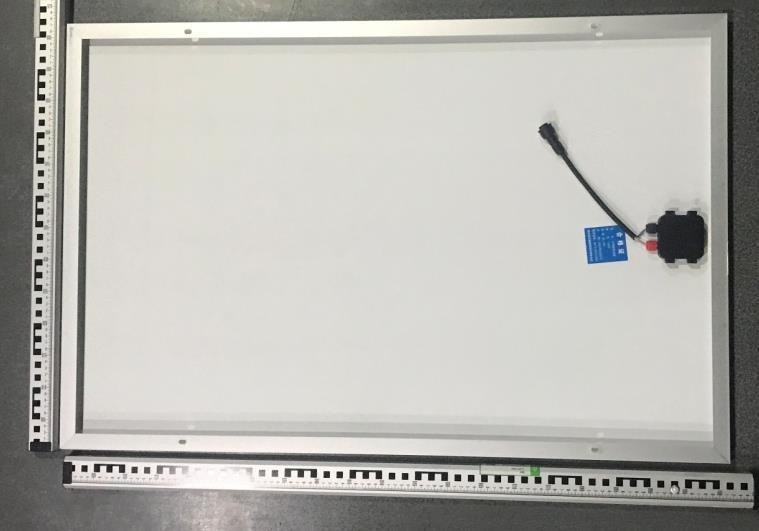
Original sample photograph extracted from PDF p.5. It identifies the historical report specimen, not every current Jieyao panel.
| Question | Document or record to request |
|---|---|
| Is this the same module? | Model, construction revision, rating label and report/specimen cross-reference |
| What does the test cover? | Test categories, conditions, results and applicable acceptance basis |
| Will the controller accept it? | Module and controller limits assessed for the design conditions |
| Will it recharge the lighting duty? | Site-specific generation, load, storage and recovery analysis |
| Will the assembly remain supported? | Agreed production configuration and change-control record |
We read the complete supplied PDF, checked the identification, result and sample-photo pages visually, and recalculated the three relationships above. The issuer’s online record and the mapping to a current sales model have not been independently established here. The original report remains the document to review; this article is an analysis, not a replacement certificate.
Yangzhou Jieyao Lighting Equipment Co., Ltd. supplies outdoor lighting from Yangzhou, China. For a split-type solar street light enquiry, provide the location, lighting target, nightly duty and recovery requirement. Ask which module record applies to the actual offered configuration.
Please identify the proposed module and provide its Pmax, Vmp, Imp, Voc and Isc with the test conditions and report reference. Show the module/controller compatibility review and the project’s charging-energy and recovery calculation separately.
For the wider process, use the battery and panel calculation guide. For measured light output, see the 30W light-source report analysis. Electrical module power and road illumination answer different procurement questions.
The STC performance table reports 123.107W against a printed criterion of at least 120W. That is a result for the one submitted sample, not guaranteed field output.
No. Voc and Isc are separate endpoint conditions. Use the maximum-power result or the corresponding Vmp/Imp operating point.
No. It is fill factor. Sunlight-to-electricity efficiency requires the appropriate irradiance and module area.
Send your project requirements and proposed components to Jieyao. Ask for the relevant drawing, configuration-to-report reference and acceptance evidence together.
Discuss the project with Jieyao →Contact Us
Get a custom lighting solution and quotation for your project. Yangzhou Jieyao Lighting Equipment Co., Ltd. manufactures outdoor lighting and steel poles in Guoji Town Industrial Park, Gaoyou City, Yangzhou, Jiangsu, China. The company reports a 10,000 m² factory site, more than 60 employees including more than 10 technical personnel, and more than 100 production and testing machines. The present company name dates from 2017; Jieyao Poles’ published history traces the team’s manufacturing lineage to 2006. The stated 15 years of experience refers to the team. The company reports exports to more than 60 countries. Do you have any questions or requests?
Email: jay@jieyaolighting.com

Click to Chat.
Im online now.
 English
 Español
 Bahasa Indonesia