
JIEYAO LIGHTING · REPORT-BASED ORIGINAL ANALYSIS
Nine reported measurements turn a generic “6m pole” description into a reviewable specification—with separate checks for dimensions, zinc and powder coating.
One 6m pole in report AGXB123W00550 measured 6003.5mm high with a 3.52mm wall, 88.9µm average zinc coating and 102µm average powder coating. These are sample results, not universal 6m pole requirements or proof of site-specific structural capacity.
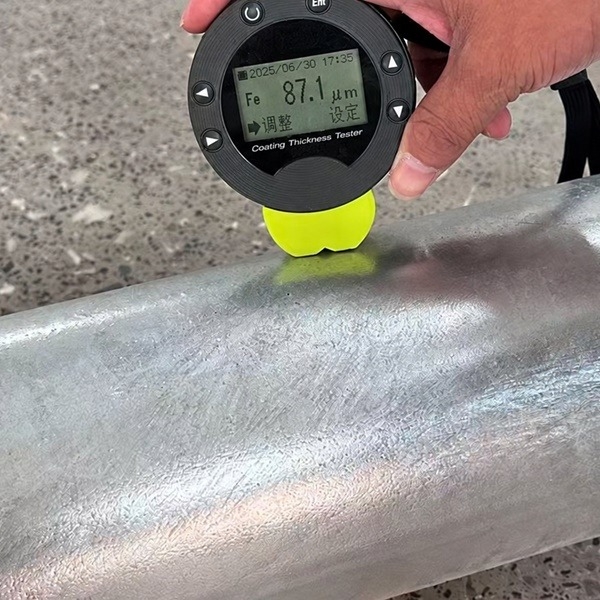
Separate coating-measurement photograph from the supplied library. Its displayed 87.1µm is not the 88.9µm average reported in AGXB123W00550.
“6m street light pole” identifies height, but it leaves wall thickness, diameters, base plate and protective coatings open. Two offers with that same headline can describe different products. An inspection record is useful when it makes those differences visible and connects them to an agreed drawing.
Report AGXB123W00550, supplied from Jieyao’s factory records and issued 19 December 2023, identifies one 6m pole. Its result page reports the dimensions and coating values below. We checked the identification, results and sample-photo pages visually. This article interprets that historical specimen; it does not set a universal 6m pole design.
| Item | Reported value | Criterion printed beside the item |
|---|---|---|
| Pole height | 6003.5 mm | Height identified; no numerical tolerance shown in the row |
| Pole wall thickness | 3.52 mm | No numerical minimum shown in the row |
| Top diameter | 60.20 mm | ≥58 mm |
| Bottom diameter | 150.1 mm | ≥130.5 mm |
| Average zinc-coating thickness | 88.9 µm | ≥85 µm |
| Average powder-coating thickness | 102 µm | ≥100 µm |
| Base-plate length | 260.5 mm | No numerical limit shown in the row |
| Base-plate width | 260.8 mm | No numerical limit shown in the row |
| Base-plate thickness | 14.82 mm | No numerical limit shown in the row |
The report cites GB/T 24460-2009 and gives the company technical conditions as the acceptance basis. Its printed conclusion is that the tested items meet those conditions. We retain that scope instead of replacing it with an unexamined international-standard or wind-resistance claim.
The height result is 3.5mm above 6,000mm, or about 0.0583%. That describes a difference, not whether an unstated manufacturing tolerance has been met. The drawing still needs to define the reference points and acceptance limits. Nominal height can also be confused with installed height if the mounting arrangement is left unspecified.
The 3.52mm wall-thickness result is similarly specific. The row does not show a wall-thickness minimum, a map of positions or a distribution of readings. It would be incorrect to announce that every point on the pole is at least 3.52mm, or to invent a 3.50mm minimum and claim a 0.02mm margin.
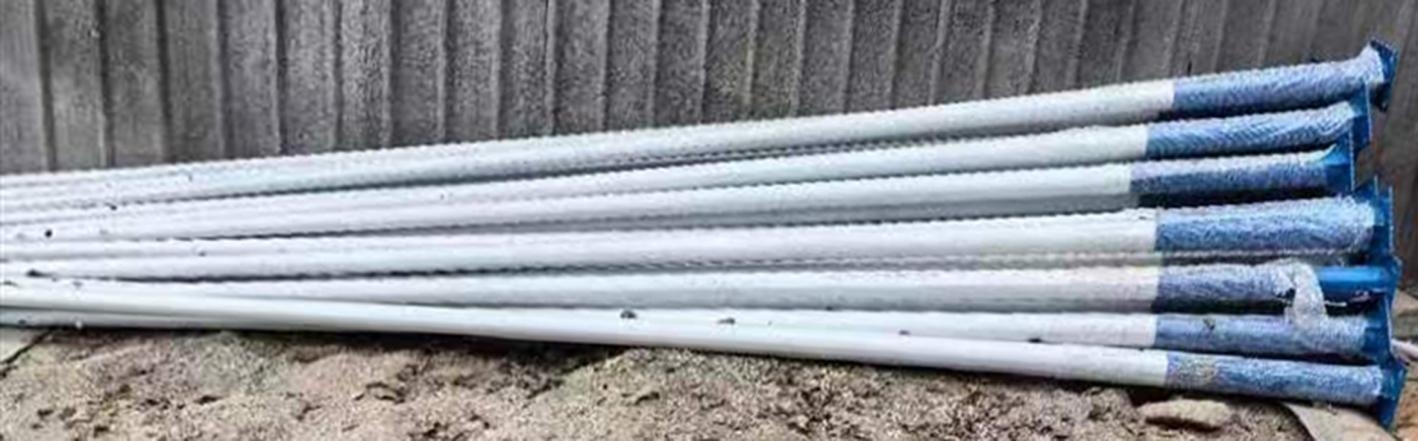
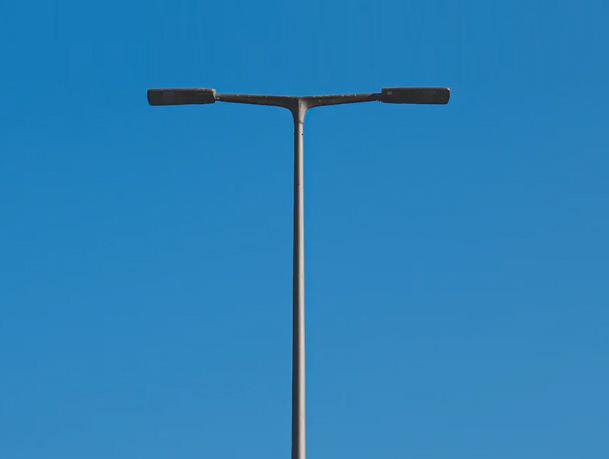
Original photograph from PDF p.5. The report identifies one tested pole; the number of poles visible in the photograph does not increase the inspected sample count.
Base-plate dimensions are reported as 260.5 × 260.8 × 14.82mm. Those numbers do not establish the bolt-hole layout, bolt circle, slot arrangement or anchor compatibility. Use them alongside the actual drawing. A similar-looking plate is not enough to confirm the foundation interface.
The report gives an average zinc thickness of 88.9µm against its 85µm criterion, and an average powder-coating thickness of 102µm against 100µm. These are two separate layer results. A single total-coating number cannot tell a buyer how much belongs to zinc and how much to the outer layer.
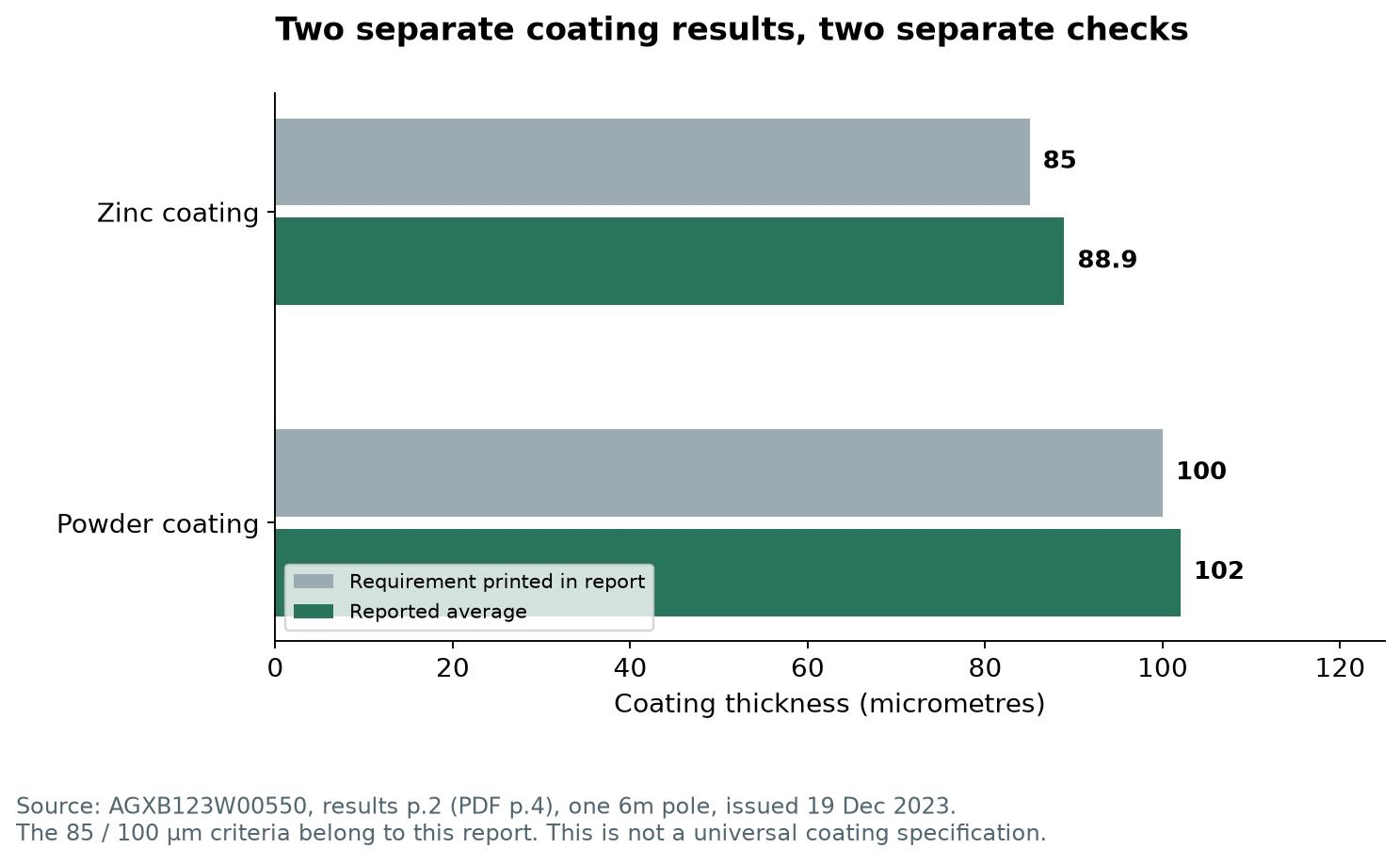
Reported averages and criteria from AGXB123W00550. The chart is not a corrosion-life prediction or a statement that these criteria apply to every pole.
DeFelsko describes why duplex-coated steel requires a method that distinguishes the layers. Ordinary magnetic measurements over coated steel can include more than one non-magnetic layer; dedicated procedures or instruments are needed to separate them. The report does not give us its raw readings, probe method or measurement-location map, so we do not reconstruct them.
The gauge in the cover photograph displays 87.1µm. That photograph is separate application context, not the source of the report’s 88.9µm average. A single reading from another object is not a substitute for the report result or evidence of its sampling method.
The table below subtracts the report’s printed lower limit from the displayed result. It helps a buyer trace the arithmetic; it is not an uncertainty allowance, a design safety factor or a promise about a production lot.
| Item | Displayed result − printed limit | Relative difference from limit |
|---|---|---|
| Top diameter | 60.20 − 58 = 2.20 mm | 3.79% |
| Bottom diameter | 150.1 − 130.5 = 19.6 mm | 15.02% |
| Average zinc coating | 88.9 − 85 = 3.9 µm | 4.59% |
| Average powder coating | 102 − 100 = 2 µm | 2.00% |
The smallest-looking percentage is not automatically the weakest safety feature, and the largest is not automatically the best product. These properties have different functions and acceptance bases. The report provides no numerical measurement uncertainty, so the displayed decimal places cannot be interpreted as the complete measurement accuracy.
The American Galvanizers Association explains that coating requirements depend on the applicable specification, material category and steel thickness. Accordingly, the 85µm limit printed here is this report’s criterion. It should not be advertised as the mandatory zinc minimum for all 3.52mm walls or all street light poles.
Dimensional and coating observations do not establish structural capacity for a particular installation. Wind exposure, luminaire and panel area, arm geometry, welds, access openings, steel properties and the foundation all affect the design question. Those checks need the project’s agreed basis and the matching assembly.
| Question | What to connect to the inspected pole |
|---|---|
| Does it match the order? | Approved drawing, model/revision, specimen and production identification |
| Are the coatings the specified system? | Process/material records, layer-specific method, reading locations and acceptance plan |
| Do the base plate and anchors fit? | Hole pattern, anchor template, nuts/washers and foundation interface drawing |
| Does it satisfy the structural requirement? | Calculation for the actual site, attachments and support conditions |
| Is this representative of production? | Agreed sampling plan, inspection records and change control |
A thickness number also does not, by itself, prove a particular galvanizing process. The primary table labels a zinc coating; process traceability needs its own production record. Nor can coating thickness alone be converted to guaranteed service years. Our salt-spray report analysis discusses a related limit on environmental evidence.
Yangzhou Jieyao Lighting Equipment Co., Ltd. is an outdoor lighting manufacturer in Yangzhou, China. A useful enquiry names the mounting height, attachments, location and design basis, then asks for the drawing, coating system and relevant inspection records together. Confirm which current product configuration corresponds to any historical report offered for review.
For the proposed 6m pole, provide the approved dimensions and tolerances, layer-specific coating requirements and inspection method, base-plate/anchor interface drawing, structural design basis and model-to-report traceability. Identify the production sampling and acceptance plan. For a 6 m hot-dip galvanized curved-arm street light pole, ask for the drawing and inspection records that apply to the exact configuration offered.
Use the existing galvanizing comparison for process-selection background and the sample approval checklist to preserve accepted product configurations. This case adds actual measurements and a clear boundary for what can be concluded from them.
No. It is the result for this sample. The wall and other geometry must meet the approved specification and project design.
Not by itself when another coating is present. Separate the layers with a suitable method and keep the readings connected to the specimen.
Its result table documents specified dimensions and coating averages. Site-specific structural capacity and long-term field performance require separate evidence.
Send your project requirements and proposed components to Jieyao. Ask for the relevant drawing, configuration-to-report reference and acceptance evidence together.
Discuss the project with Jieyao →Contact Us
Get a custom lighting solution and quotation for your project. Yangzhou Jieyao Lighting Equipment Co., Ltd. manufactures outdoor lighting and steel poles in Guoji Town Industrial Park, Gaoyou City, Yangzhou, Jiangsu, China. The company reports a 10,000 m² factory site, more than 60 employees including more than 10 technical personnel, and more than 100 production and testing machines. The present company name dates from 2017; Jieyao Poles’ published history traces the team’s manufacturing lineage to 2006. The stated 15 years of experience refers to the team. The company reports exports to more than 60 countries. Do you have any questions or requests?
Email: jay@jieyaolighting.com

Click to Chat.
Im online now.
 English
 Español
 Bahasa Indonesia