
A breakaway light pole base is designed to release or fracture under specified vehicle-impact conditions, while carrying the normal service loads of the approved assembly. A fixed base is intended to retain its structural connection. Neither behaviour can be confirmed from the pole’s appearance or a base photograph alone.
What this guide covers

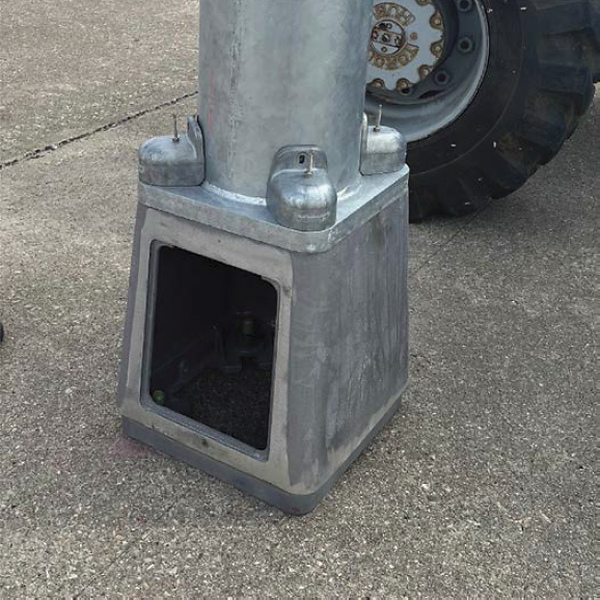
Box-shaped pole base with a side access opening — a configuration example.
A roadside lighting support can become a fixed-object hazard if a vehicle leaves the carriageway. Where the road authority’s design calls for a breakaway support, its controlled response forms part of the roadside-safety solution. The position of the pole, surrounding ground and possible impact directions belong in that decision.
The support must also work during ordinary service. Pole height, arm layout, luminaire mass and wind loading remain relevant. “Breakaway” describes the intended impact response; it does not mean the base may be structurally inadequate in normal conditions.
A slip-base assembly is configured so that parts can separate by slipping at the designed connection during a qualifying impact. Plate geometry, clamping and the assembled detail matter. It is not the same as an ordinary flange whose bolts happen to be loose.
A frangible component introduces a deliberately designed failure location. Depending on the system, this can be in a coupling associated with the anchors or an adapter between the support and foundation. Select it as a named part of a tested or otherwise accepted assembly, rather than choosing a generic fitting by thread diameter.
A transformer-style base places a box-shaped component between the pole and foundation, often with a side access door. Some approved lighting assemblies use a frangible version of this form. The name comes from historical equipment arrangements; the presence of the box does not establish what electrical equipment it contains or whether it has accepted breakaway performance.
The opening photograph is useful for recognising the box-shaped arrangement. A box-shaped housing identifies the physical arrangement; impact performance depends on the exact assembly and its acceptance documents.
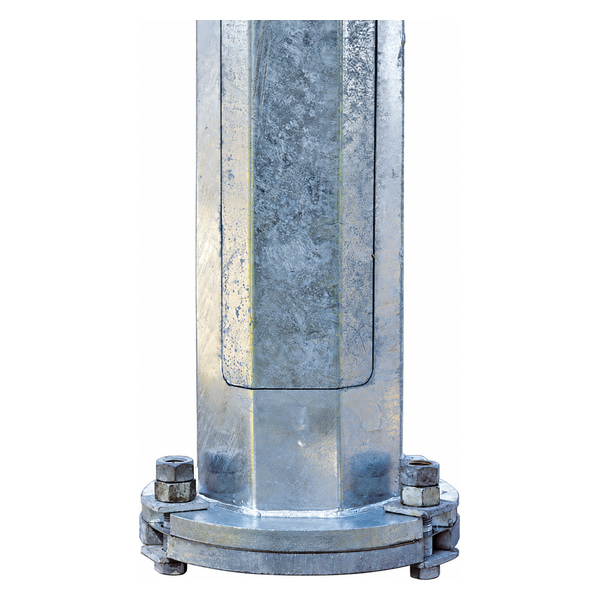
A visible bolted connection — identify the exact system before assigning a breakaway function.
Two assemblies can both have exposed bolts and very different impact behaviour. A base cover may also hide the parts that distinguish them. Look for the system identification and drawings, then connect those to the acceptance or test documentation required by the project authority.
On a phone, swipe this table sideways to see the final column.
| Question | Fixed-base assembly | Breakaway assembly |
|---|---|---|
| What governs selection? | Structural design and the site’s permitted support arrangement | Structural design plus the required impact-performance basis |
| What must be matched? | Pole, plate, anchors and foundation interfaces | The complete accepted combination, including the relevant release/frangible components |
| Can accessories be changed freely? | Loads and connections still need review | Changes can also affect impact response |
| Does a photograph establish suitability? | No; dimensions and design still matter | No; appearance is not a crash-performance record |
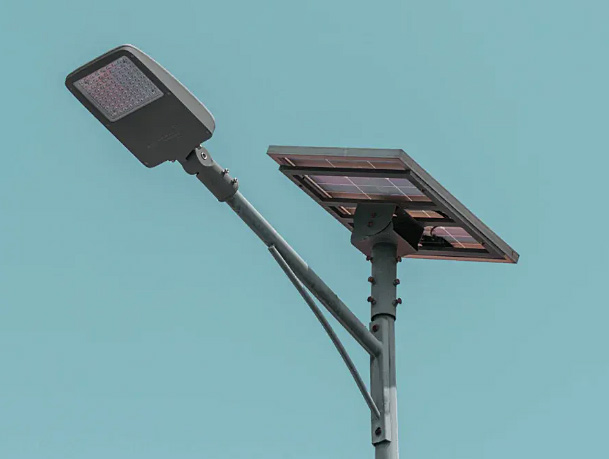
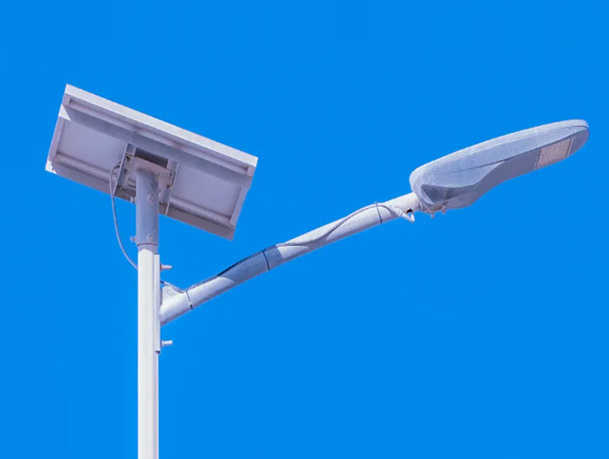
Changes above or around the connection can matter. A different luminaire, sign, battery enclosure or solar panel changes the equipment carried by the support. A decorative shell may interfere with release. The project review should identify the exact configuration, not merely attach a certificate for a base that looks similar.
The electrical arrangement also needs coordination so that the intended response of the support is not defeated by unreviewed attachments. This is an assembly-design and installation-document issue. It is not a reason to improvise disconnection details at site.
First establish the support position and the road authority’s required treatment of that location. Breakaway behaviour is one part of a roadside design; it is not selected simply because a pole is close to traffic in a photograph. The designer must consider where a vehicle could approach and what surrounds the support. The accepted assembly then needs to match that design basis.
These names alone do not decide the base type. Vehicle access, people nearby, property boundaries and the permitted movement of a struck support can change the assessment. A fixed base may be part of the specified solution, but its selection still belongs with the site design. Do not turn “breakaway is useful beside some roads” into a rule for every outdoor pole.
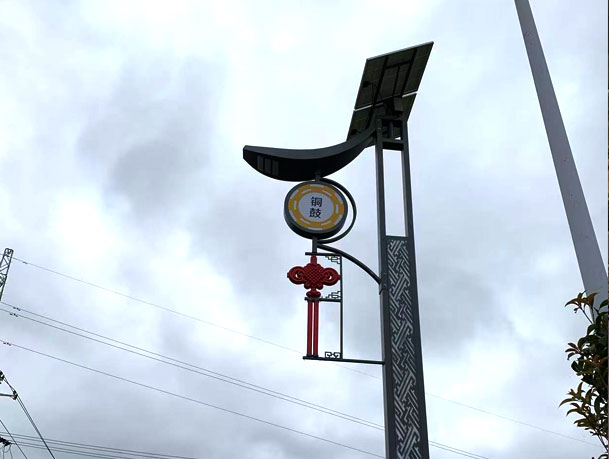
A solar panel, sign or battery enclosure changes the proposed assembly. Send its mounting position and equipment details with the pole information when checking compatibility. An acceptance document for a simpler pole arrangement does not automatically cover the added equipment. Resolve this before comparing quotations, so that all suppliers price the same required configuration.
Read the identification on the offer, assembly drawing and supporting acceptance documents together. The base name is only a starting point. Check the named components, the supported pole and arm arrangement, equipment limitations and installation document revision. A document covering a different base in the same catalogue does not identify the offered combination.
For an existing installation, retain photographs and identification of the parts before requesting replacements. Ask which components may be replaced and which combinations require further review. A visually similar adapter can change the assembly height, connection details or impact response. A bolt pattern that fits is insufficient grounds for approving that substitution.
Routine checks can identify missing parts, visible damage or a changed installation. After an impact, the task is wider than replacing the visibly fractured piece: use the system documents and the responsible designer’s assessment to establish the required inspection and replacement scope. Avoid reusing a component merely because it can still be bolted together.
Keep the impact-response documents with the normal structural and maintenance records. That allows a future owner to recognise why the support was specified and prevents later additions, decorative covers or replacement equipment from being selected without reference to the assembly.
Ask the responsible road designer to define the required support behaviour and applicable acceptance route. Then request the exact base model, compatible pole and arm configuration, relevant test or acceptance documents, foundation interface and manufacturer’s installation instructions. Keep those documents on the same assembly revision.
Installation torque, base elevation and replacement rules are system-specific. A fixed-base pole should not be described as converted to breakaway simply because an adapter can be physically bolted beneath it.
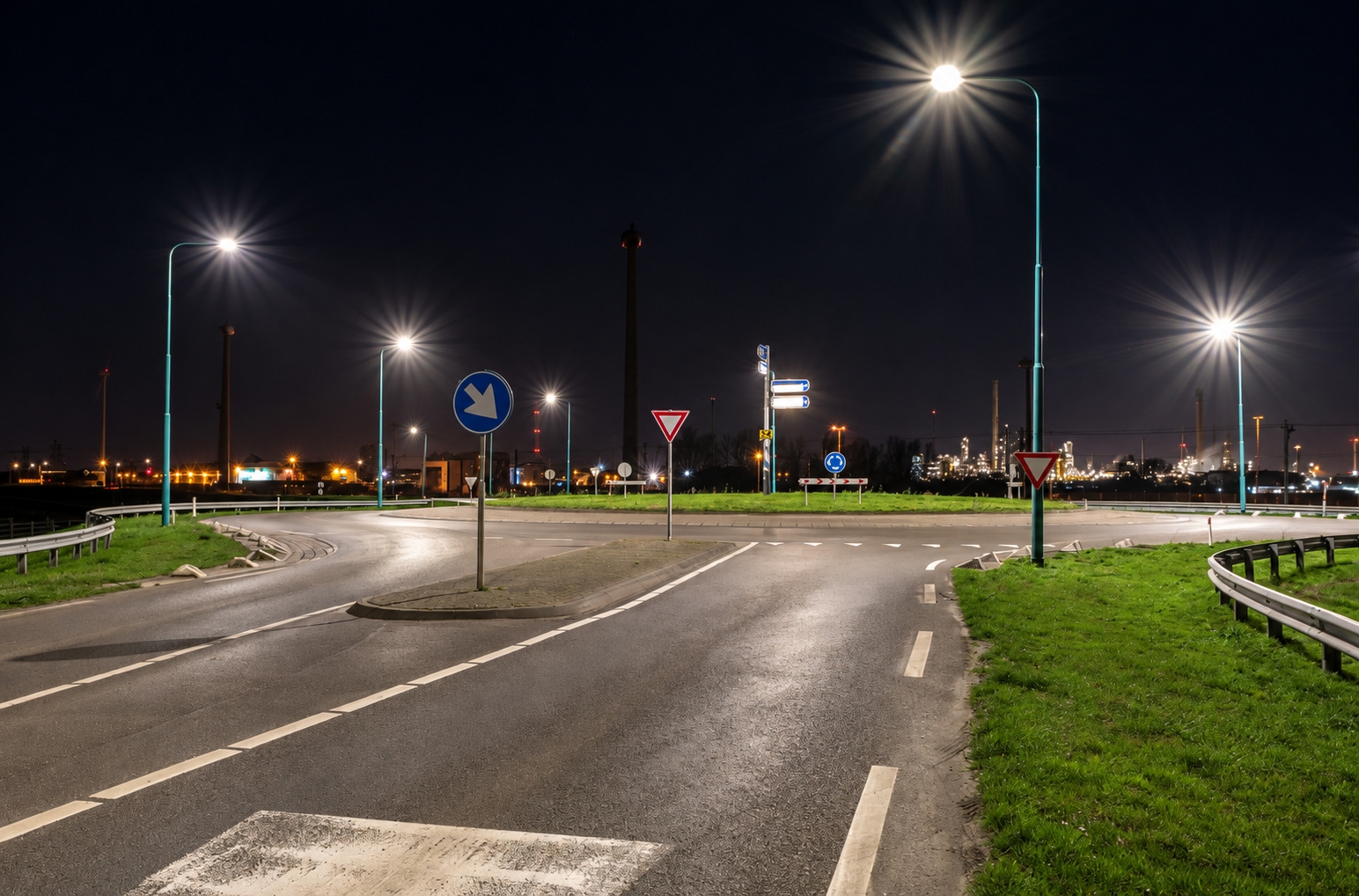
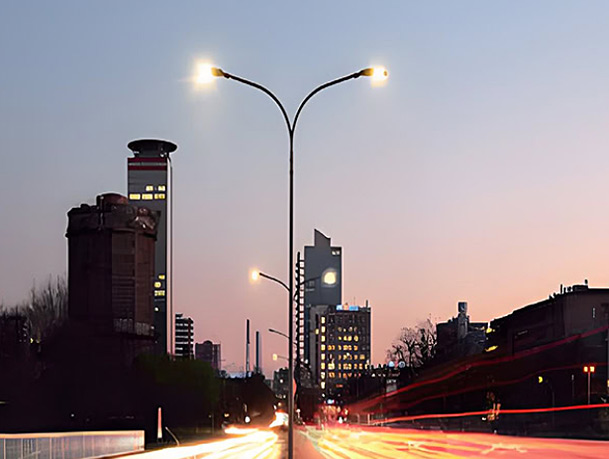
Roadside lighting — the site layout and authority requirements govern support selection.
For the wider pole categories, see types of street light poles. For the civil interface, use the foundation and anchor-bolt guide. Jieyao Lighting can review a steel-pole enquiry against the stated assembly requirements; the required impact qualification must be established for the exact proposed configuration.
FHWA breakaway-support FAQs — Discussion of changes to roadside support assemblies and decorative shells, including historical standards references.
https://highways.dot.gov/safety/rwd/reduce-crash-severity/faqs-breakaway-sign-and-luminaire-supports
TxDOT Highway Illumination Manual, Roadway Illumination Assemblies — US Texas roadway illumination guidance describing transformer-base and shoe-base assemblies.
https://www.txdot.gov/manuals/trf/hwi/lighting_equipment/light_sources-i1002196.html
Contact Us
Get a custom lighting solution and quotation for your project. Yangzhou Jieyao Lighting Equipment Co., Ltd. manufactures outdoor lighting and steel poles in Guoji Town Industrial Park, Gaoyou City, Yangzhou, Jiangsu, China. The company reports a 10,000 m² factory site, more than 60 employees including more than 10 technical personnel, and more than 100 production and testing machines. The present company name dates from 2017; Jieyao Poles’ published history traces the team’s manufacturing lineage to 2006. The stated 15 years of experience refers to the team. The company reports exports to more than 60 countries. Do you have any questions or requests?
Email: jay@jieyaolighting.com

Click to Chat.
Im online now.
 English
 Español
 Bahasa Indonesia