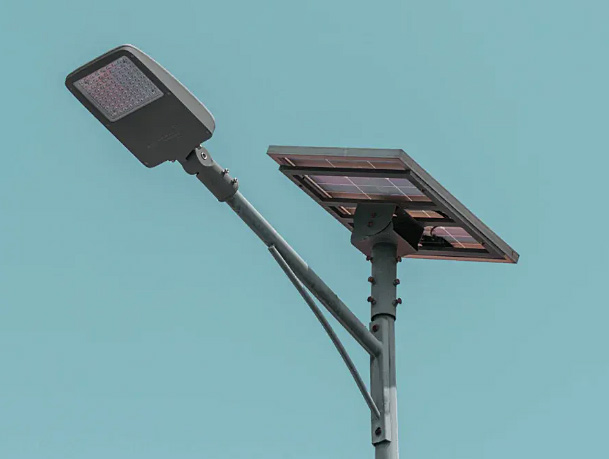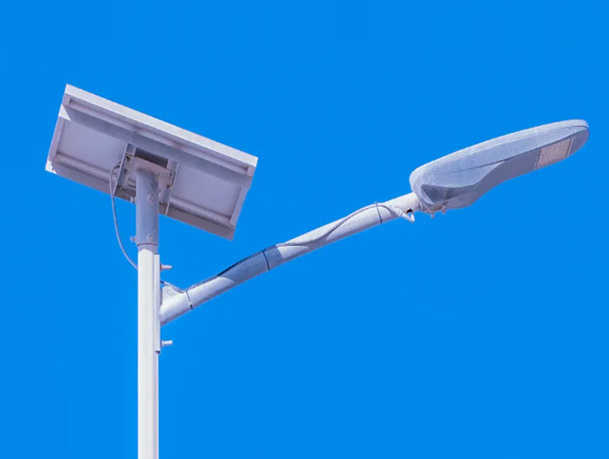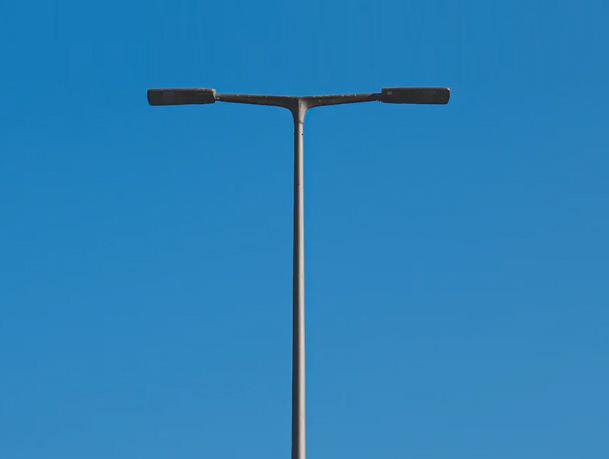

Street lights are usually selected to distribute light along roads and traffic areas; floodlights are aimed toward a defined working area, object or field. The practical difference is the complete optical distribution and mounting arrangement, not a universal wattage or housing shape. Some applications can use either family, but only a matched lighting calculation shows whether it works.
What this guide covers
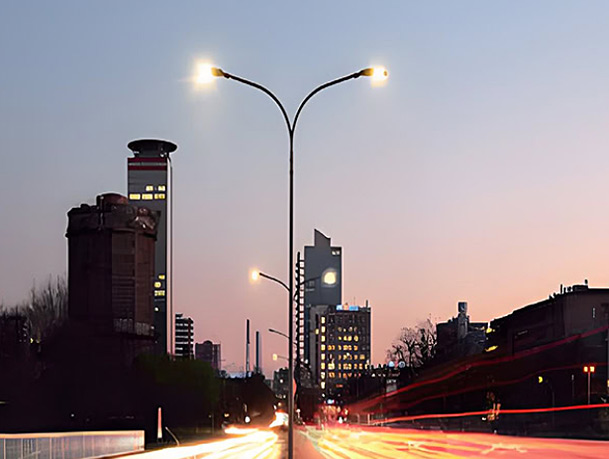
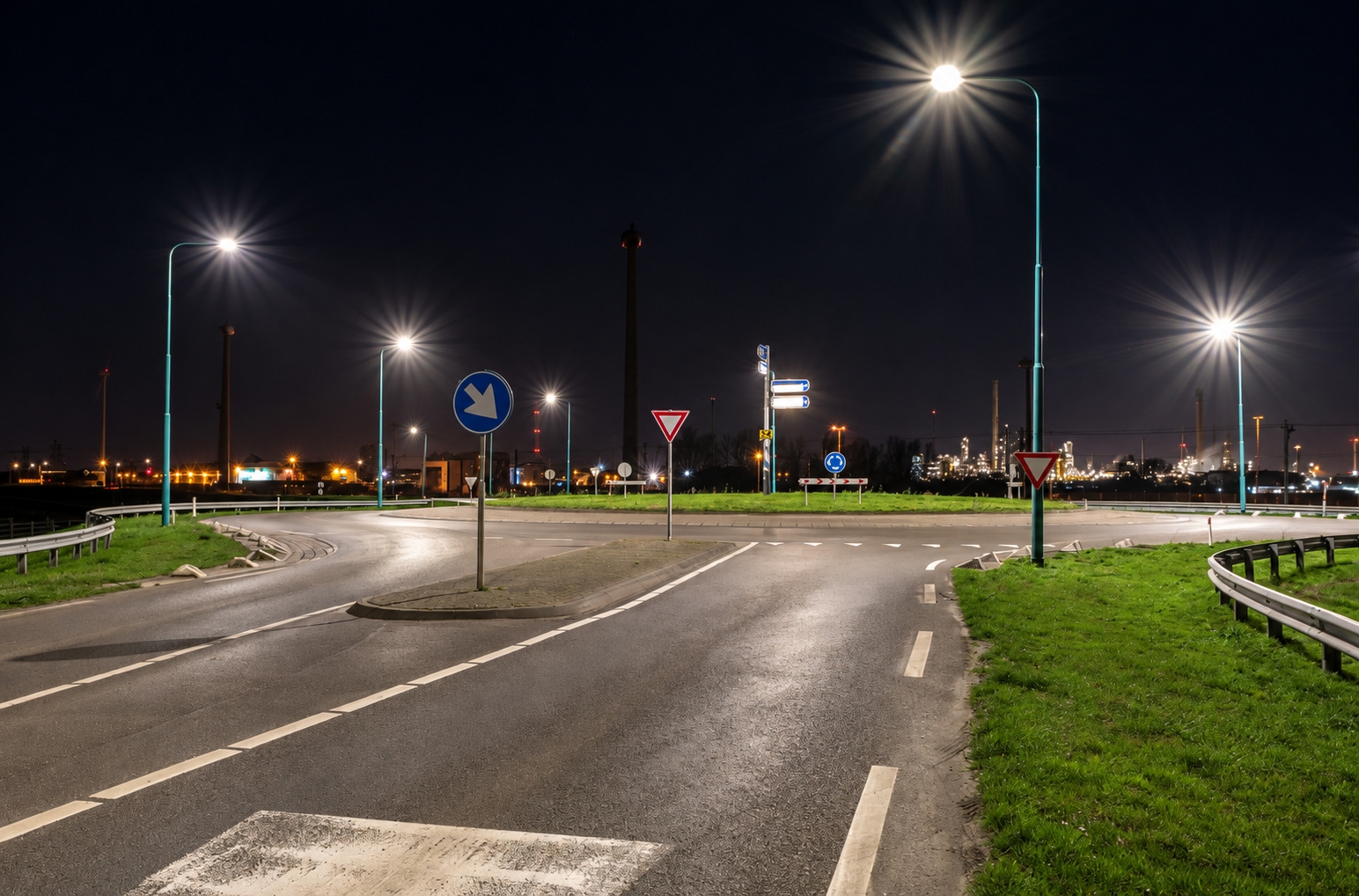
Road lighting at a junction — an application example.
Along a road, the designer considers the repeated pattern between poles, visibility for traffic, pedestrian conflict points and light directed toward neighbouring properties. A bright patch beneath one pole says little about the dark areas between it and the next.
A yard, loading face or sports area may need light aimed toward particular horizontal or vertical surfaces. The useful floodlight distribution depends on the target, mounting position and obstructions. A narrow long-throw beam and a wide area beam can both be sold as floodlights; they do different jobs.
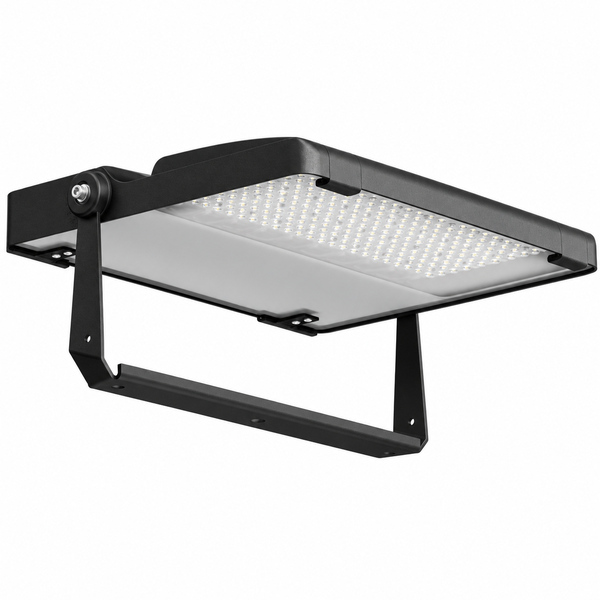
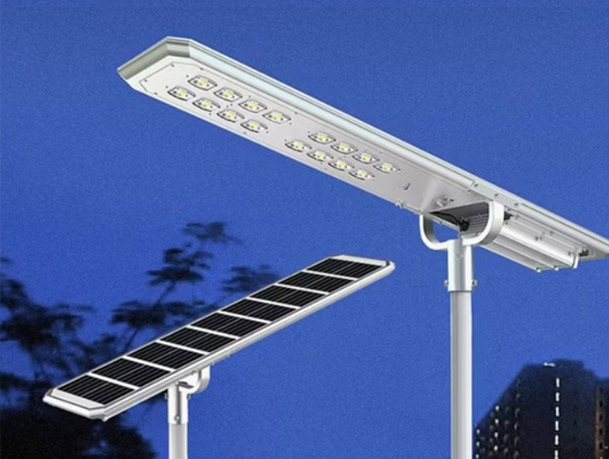
A yoke-mounted floodlight — its optical file determines the beam, not the bracket.
The adjustable bracket gives a clue to mounting, not proof of the beam pattern. Floodlights can use symmetric or asymmetric distributions. Roadway luminaires also have different distributions, and some area-lighting products use roadway-style optics. The intended application name cannot replace the exact model and optic code.
Manufacturer documentation illustrates the difference. Cooper’s Utility Flood Large sheet lists both a 6H × 6V wide distribution and a 3H × 3V spot option within the same product family. These are examples for that manufacturer’s product, not Jieyao performance data. The choice changes the distribution even though the family name remains the same.
A floodlight’s NEMA beam designation describes horizontal and vertical beam spread. Roadway distribution types such as II, III, IV and V use a different classification. Consequently, a floodlight described with “5” in its beam designation is not automatically a Type V roadway luminaire.
When two offers use different naming systems, ask each supplier for its distribution description and the corresponding photometric file. Avoid comparing the labels as though they were one ranking scale.
On a phone, swipe this table sideways to see the final column.
| Selection question | Road-lighting emphasis | Floodlighting emphasis |
|---|---|---|
| What is the task? | A road corridor, junction or pedestrian conflict area | An area, work face, object or playing field |
| How is the light placed? | Pole arrangement and optic positioned relative to the carriageway | Mounting point plus individual aiming toward targets |
| Which information is decisive? | Exact optic, height, outreach, spacing and road criteria | Exact beam, aiming, target surfaces and mounting positions |
| What can a photograph tell you? | Visible installation and mounting form | Visible fixture and support arrangement |
| What still needs calculation? | Levels, uniformity, glare and spill for the layout | Levels, uniformity, glare and spill for the aimed layout |
More input power does not establish a better road result. The replacement can change the light between poles, the view of approaching drivers and illumination beyond the road edge. Compare the proposed fixture in the same road layout before treating it as a substitute. Changes to tilt or outreach can alter the result even with the same fixture.
Aiming floodlights inward can help place light on defined working zones. However, vehicle bodies, containers or other structures can create shadows, and aiming across a site can put bright sources in someone’s line of sight. Use the actual obstructions and viewing directions in the layout, including loading openings and vertical working faces as well as the ground.
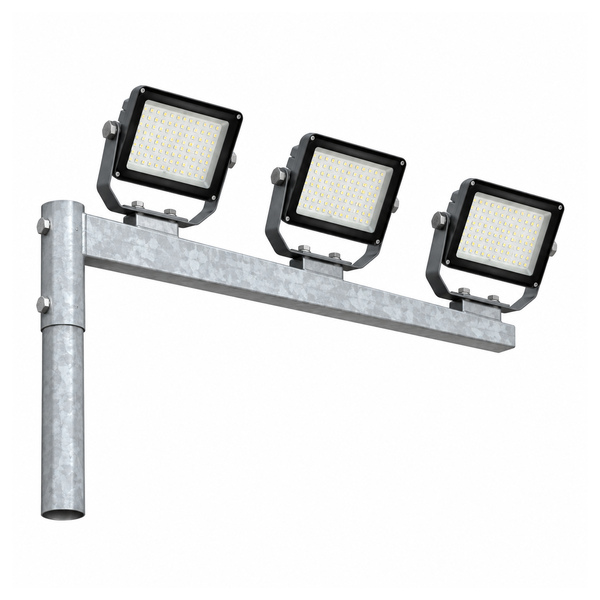
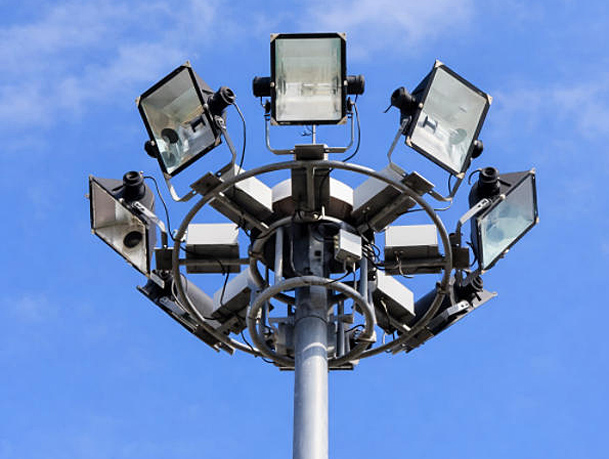
Directional floodlights on a mast crossarm — a mounting arrangement example.
A high mast is the supporting system. Its head can carry luminaires with different beams and aiming directions. Choosing a circular crown or a floodlight bank is therefore separate from choosing the optical distribution. The high mast type guide explains those structural and maintenance choices.
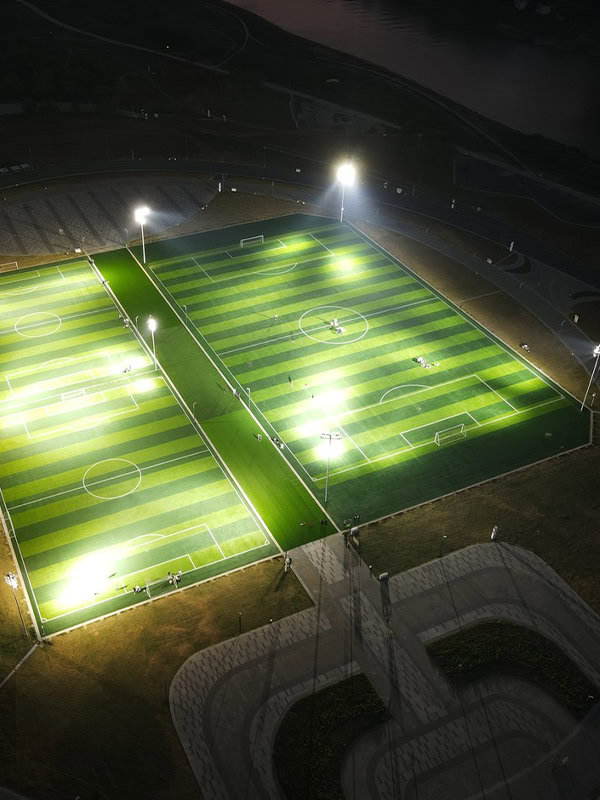
Define the playing or training task and the directions from which users view the lights. Then include surrounding areas that could receive spill. The familiar appearance of a stadium floodlight does not establish that its beam suits a smaller field, and an inward aiming direction alone does not quantify glare or spill beyond the boundary.
Lumens describe luminous flux from the defined light source or luminaire. Illuminance is measured in lux at a defined surface. The same luminaire output can produce different illuminance when the mounting position, optic or aiming changes. Compare output figures on the same basis before using them in a proposal.
Uniformity describes how the selected lighting quantity varies across the defined calculation area. A high average does not tell you how low the darkest evaluated point is. Ask which area, calculation grid and uniformity definition the report uses, and compare proposals using the project’s same criteria. This guide does not assign one lux target to all roads, yards or sports activities.
Input watts describe electrical power, while the optical system determines how the emitted light is distributed. Two fixtures with the same nominal power can therefore illuminate different areas or produce different levels at the same points. Changing the mounting height or aiming introduces further differences, even before maintenance assumptions are considered.
For a fair comparison, hold the site geometry and evaluation criteria constant and identify each proposed model, optic and operating setting. Review the calculated useful light and unwanted light together. Selecting the highest wattage first can force the rest of the design to accommodate a fixture whose distribution was never suited to the task.
Look for a site plan with fixture positions, mounting heights and aiming, plus the calculation surfaces and criteria. The result should identify the model and photometric file used and state the maintenance assumptions. A single coloured rendering without these inputs is difficult to reproduce or compare with another offer.
If two layouts disagree, first check whether they evaluated the same surfaces and used the same geometry and assumptions. Then examine the chosen optics and aiming. That sequence makes the disagreement understandable; it also helps avoid replacing a suitable support or increasing power to compensate for a mismatched beam.
Give each supplier the same site plan, lit surfaces, permitted mounting positions and lighting criteria. Request the selected fixture’s photometric file and a layout identifying height, orientation and aiming. Compare the maintained result, uniformity, glare and spill rather than nominal watts alone.
Then check mechanical and electrical compatibility. A suitable optic can still require a different mount, load allowance or driver arrangement. For those details, use the mounting-interface guide and IES-file review guide.
For a road, yard or high-mast enquiry, send Jieyao Lighting the site layout and operating task through the project enquiry page. Select the product after defining what the light must do.
Cooper Lighting Solutions, Utility Flood Large, PS506065EN — PS506065EN, March 23, 2026: wide and spot options for the Utility Flood Large family.
https://www.cooperlighting.com/api/assets/v1/file/CLS/content/a66e33e7d11e44988202ad4100736e31/streetworks-ufld-l-utility-flood-spec
MagniFlood, Floodlight Beam Spread & Roadway Distribution — Manufacturer explanation of floodlight beam spread and roadway distribution categories.
https://magniflood.com/light-distribution/
For the wider categories of power source, mounting form and controls, continue to types of street lights and their applications. This comparison focuses specifically on the optical task.
Contact Us
Get a custom lighting solution and quotation for your project. Yangzhou Jieyao Lighting Equipment Co., Ltd. manufactures outdoor lighting and steel poles in Guoji Town Industrial Park, Gaoyou City, Yangzhou, Jiangsu, China. The company reports a 10,000 m² factory site, more than 60 employees including more than 10 technical personnel, and more than 100 production and testing machines. The present company name dates from 2017; Jieyao Poles’ published history traces the team’s manufacturing lineage to 2006. The stated 15 years of experience refers to the team. The company reports exports to more than 60 countries. Do you have any questions or requests?
Email: jay@jieyaolighting.com

Click to Chat.
Im online now.
 English
 Español
 Bahasa Indonesia