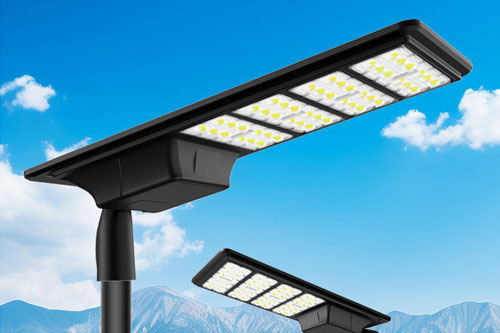


Short answer: Street lights are best grouped by the job they perform and how they receive power, not by a single wattage label. Grid-powered LED road lights are a common choice where dependable electrical infrastructure exists. Solar street lights suit sites where an off-grid design can meet the local lighting and energy duty. High mast systems serve broad outdoor areas from fewer elevated positions. Decorative, pedestrian-scale and smart-enabled fixtures address different visual or control needs. The right type is the one that meets the site's lighting criteria, structural constraints and operating plan as a complete system.
A buyer may ask for a “solar LED street light,” a “high mast light,” or a “smart street light” as though these are mutually exclusive types. They describe different dimensions. Solar tells us where electrical energy comes from. LED describes the light source. High mast describes an elevated mounting system. Smart describes controls and connectivity. One project may combine several of these features, but that does not make every combination technically sensible or available in a particular Jieyao model.
Before comparing products, write down the visual task: road traffic, pedestrian movement, junction, logistics yard or landscape. Then identify grid availability, mounting space, environmental exposure and ownership of maintenance. This prevents a visually attractive catalogue image from being mistaken for a finished lighting design.
| Dimension | Examples | Question it answers |
|---|---|---|
| Power source | Grid-fed or solar off-grid | How will the fixture operate through the required hours? |
| Light source | LED or an older discharge-lamp system | What head and electrical equipment are being specified or replaced? |
| Mounting form | Roadside pole, median arm, post-top or high mast | Where can light be positioned and maintained? |
| Control function | Photocell, scheduled dimming, sensor or network control | When and at what output should the light operate? |
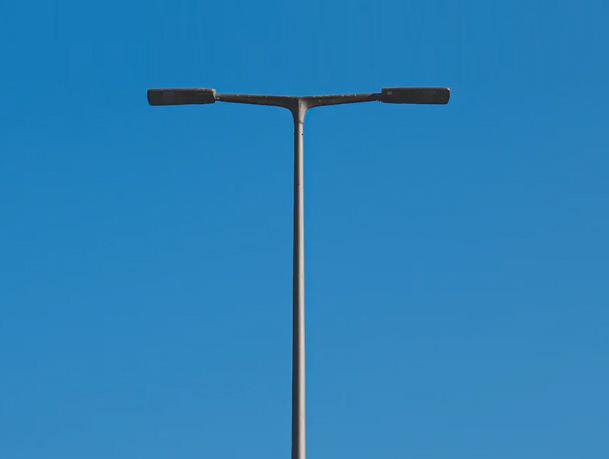
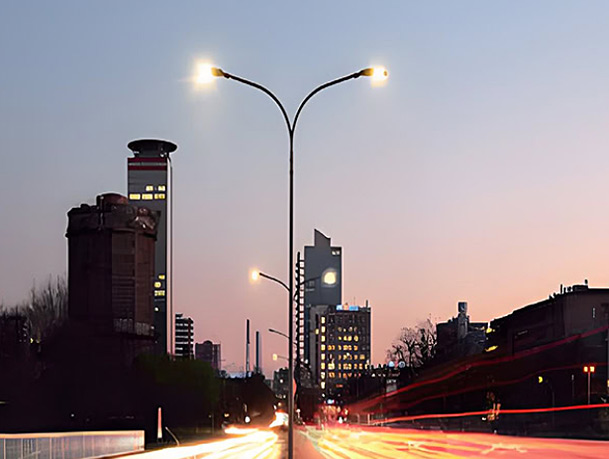
A grid-powered LED roadway luminaire is often the starting point for an urban street, highway segment or industrial access road with an existing power network. Its optical distribution and mounting position can be designed around carriageway geometry, traffic direction and nearby properties. Where older heads are being replaced, the pole and arm may be retained after checking their condition, mount, electrical interface and structural capacity.
Do not equate higher wattage with better road lighting. The same input power can produce different distributions, glare and uniformity. Request the exact model's photometric file and compare layouts against the project's road-lighting criteria. Also check driver access, surge-protection scope, switching method and whether the proposed fixture can be serviced on the existing pole.
Jieyao's modular LED street light is one product option to examine when module access and configuration matter. A model page does not replace the design calculation for a particular road. For a retrofit on retained poles, the separate LED luminaire retrofit guide addresses that more specific decision.
Solar street lights combine a photovoltaic panel, storage, controller and LED luminaire. They can be attractive where running new power cable is impractical, but the lighting duty must fit the solar resource. A panel shaded for part of the day, a battery exposed to unsuitable temperatures or an unexamined late-night dimming schedule can undermine an otherwise promising design.
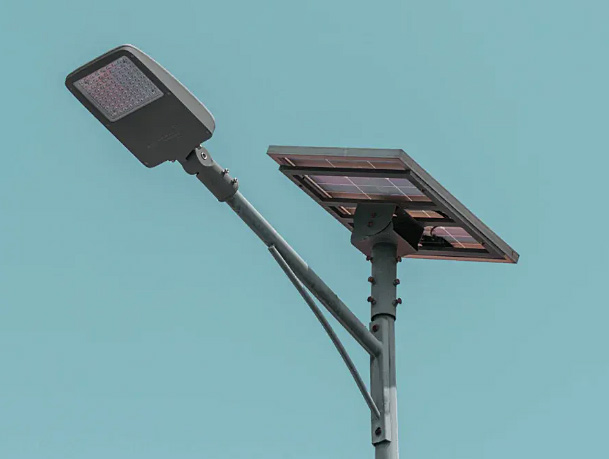
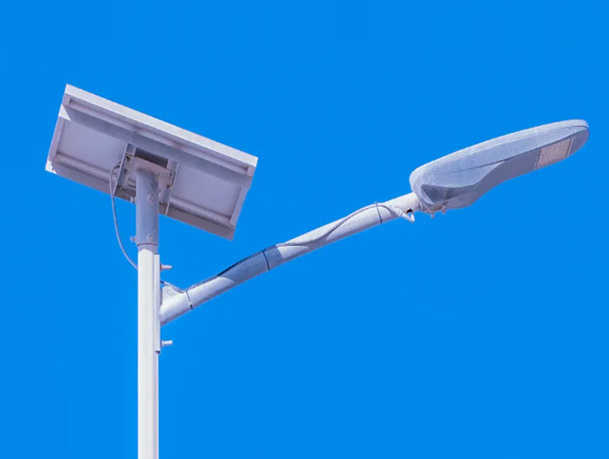
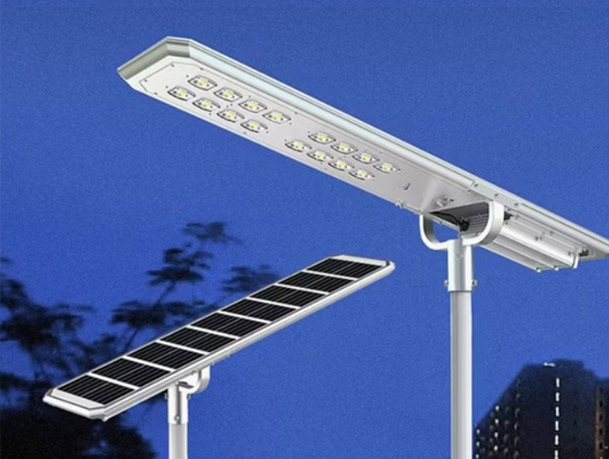
Integrated and split solar forms differ mainly in component arrangement. An integrated head packages parts more closely; a split system places the panel and light head separately. The latter can offer more freedom to orient the collector without changing the road optic, while adding brackets and wiring interfaces. Neither arrangement proves a particular runtime. Compare the actual lighting layout and energy model for the local site before choosing.

Illustrative separate-panel arrangement; it does not establish output, runtime or a completed Jieyao project.
The solar street-light product family is the right place to compare Jieyao configurations and prepare a model-specific enquiry. A solar system should be quoted with its operating profile and maintenance responsibilities, not as a bare fixture.
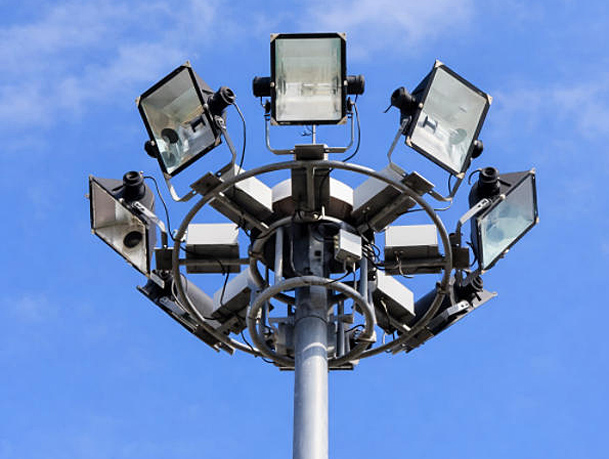
A high mast supports multiple luminaires above an interchange, port yard, large parking area or similar open space. It can reduce the number of separate pole locations and keep some circulation areas clear. It also changes the structural and service problem: headframe loading, wind basis, foundation reactions, glare and access at height must be considered together.
High mast lighting is not simply a taller street light. The headframe's optic choices and aiming govern how light reaches the ground and how much spills toward drivers or adjacent land. The maintenance arrangement may be fixed or lowering; each needs an approved access method. For a narrow road corridor, conventional pole spacing may be easier to design and maintain.
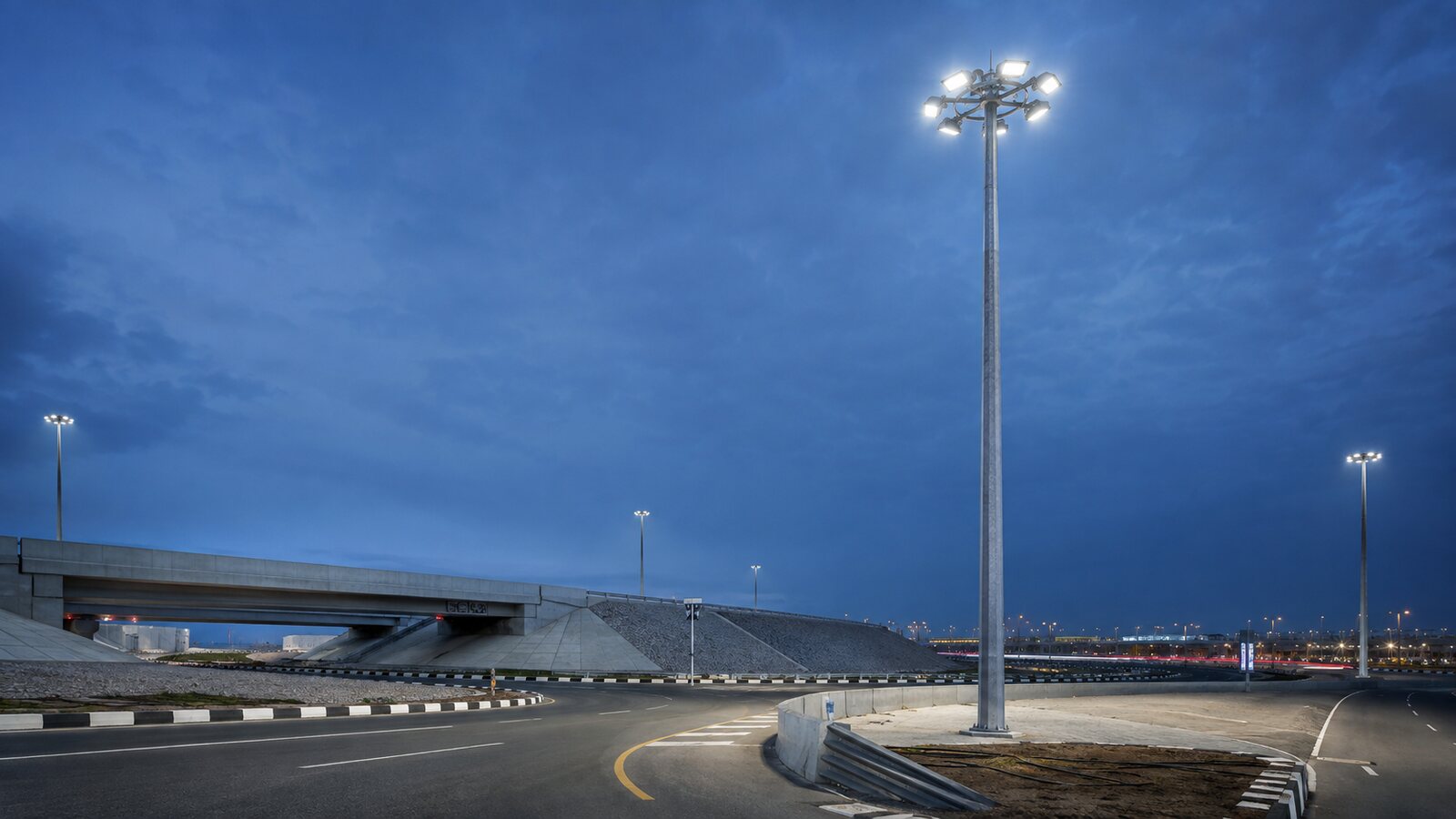
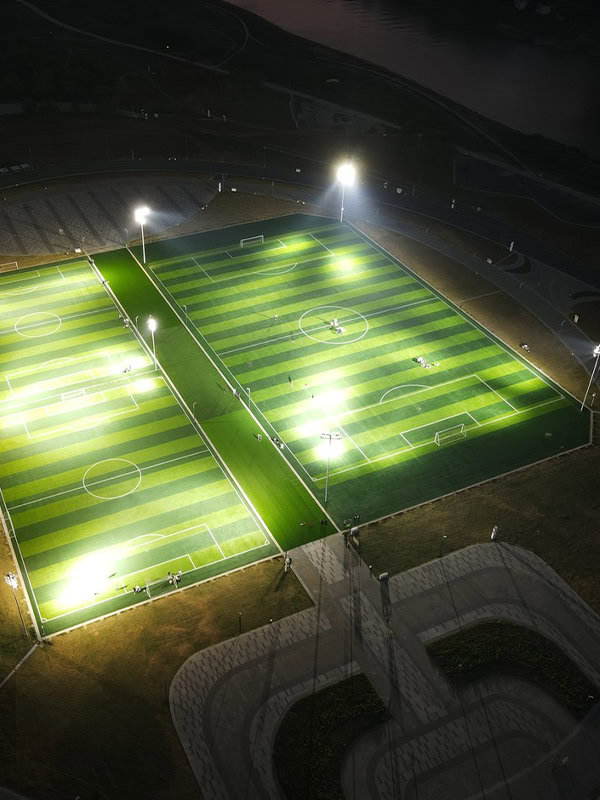
Illustrative wide-area application; confirm any proposed system against the site rather than copying this arrangement.
The high mast lighting system product page covers the coordinated mast, floodlight, structural and maintenance enquiry. It serves a different buying intent from a single LED roadway head.
Garden and post-top luminaires can be suitable for paths, parks and building approaches, where human-scale appearance and eye-level glare deserve more attention than long roadway throw. They should not be substituted into a vehicle-road design without checking distribution and mounting. Conversely, a roadway fixture may look harsh or oversized on a short pedestrian path.
A “smart” street light may add scheduled dimming, local sensors or a communications interface. A multifunctional pole may also carry non-lighting equipment. These terms do not establish interoperability, cybersecurity responsibility, power reserve or maintenance ownership. Specify the function and interface separately from the luminaire and pole so bids can be compared on the same scope.
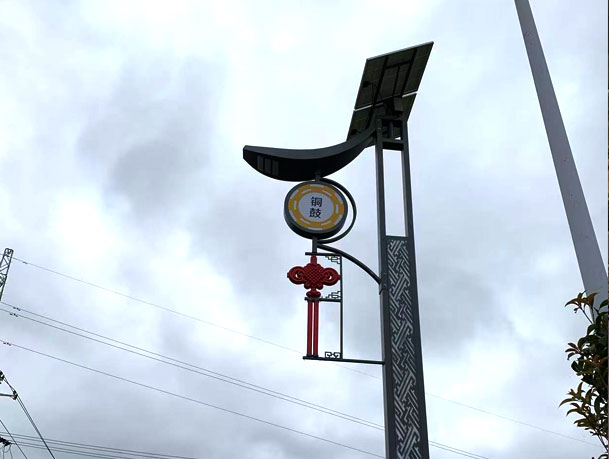
Heritage-style lanterns, bollards and architectural accents are other outdoor-lighting forms, but not all are appropriate as the primary light for a public road. Keep the road safety task and the visual-identity task distinct when both appear in one project.
| Site condition | Type to assess first | Critical check |
|---|---|---|
| Powered road corridor | Grid-fed LED roadway luminaire | Road optics, pole/arm compatibility and electrical supply |
| Remote road without practical grid connection | Solar LED street-light system | Seasonal energy balance, shade, battery service and road layout |
| Broad yard or interchange | High mast system alongside a conventional-pole comparison | Glare, wind/foundation loads and maintenance access |
| Park path or courtyard | Pedestrian-scale garden/post-top light | Eye-level comfort, route edges and landscape integration |
| Networked municipal asset | Control-ready luminaire and pole selected as separate scopes | Interface, ownership, commissioning and failure behaviour |
These are starting points, not fixed rules. A site with both a broad junction and narrow approaches may need more than one mounting form. A remote road may have enough sunlight at one segment but severe shade at another. Split the project into zones before standardising a fixture.
First, define the people and vehicles using the space, the surfaces that need light and any authority criteria. Second, map mounting constraints, power availability, solar exposure where relevant and maintenance access. Third, compare candidate layouts with model-specific photometry and coordinated structural and electrical data. Fourth, align the control schedule with the lighting and, for solar, energy calculations. Finally, compare suppliers on the same bill of materials and the same documented assumptions.
| Decision | Document or test |
|---|---|
| Light reaches the right area | Exact photometric file and layout for the proposed mounting geometry |
| Equipment suits the site | Model drawing, mounting interface, materials and relevant test reports |
| Pole and base are coordinated | Load schedule, structural basis and foundation interface |
| Power and controls work as proposed | Electrical diagram, control schedule and solar calculation if applicable |
| Owner can maintain it | Access method, replacement parts and handover plan |
If the project includes several types, send a marked-up site plan and zone schedule through the Jieyao contact page. A useful proposal will state where one configuration applies and where the design changes.
No. LED describes the light source. It can be powered by the grid or by a solar-battery system. The power architecture affects installation and maintenance.
It depends on the site's width, traffic routes, glare limits, foundation locations and service access. Compare photometric and structural layouts on the same design criteria.
Standardisation can simplify maintenance, but a narrow residential street, open junction and remote road may need different optics, mounting or power systems. Standardise only after zoning the tasks.
Ask which exact luminaire and system configuration is proposed for the site, and request the matching lighting, electrical, structural and service documents. A category name alone is not enough.
Contact Us
Get a custom lighting solution and quotation for your project. Outdoor lighting manufacturer in Yangzhou, ChinaAbout Jieyao LightingYangzhou Jieyao Lighting Equipment Co., Ltd. is an outdoor lighting manufacturer focused on solar street light systems and high mas... Do you have any questions or requests?
Email: jay@jieyaolighting.com

Click to Chat.
Im online now.