

Quick answer: select solar street light height from road width, lighting class, optics, pole spacing, wind conditions and maintenance access. A 6m system often suits community and rural roads, 8m is common for municipal and industrial roads, and 10m can suit wider roads or infrastructure sites. These are application ranges, not universal rules; final spacing and LED power should come from a lighting calculation.
| Mounting height | Typical application | Design emphasis |
|---|---|---|
| 6m | Village roads, communities, parks, schools and local access roads. | Comfortable scale, moderate road width and economical off-grid installation. |
| 8m | Municipal roads, factory roads, public compounds and larger parking areas. | Road uniformity, practical spacing and balanced solar energy system. |
| 10m | Wider roads, highway-related areas and large industrial infrastructure. | Longer optical reach, larger wind area, structural design and sufficient solar collection. |
LED power is calculated from the target lighting level, luminaire efficiency, optical distribution, road width, spacing and dimming schedule. Two 8m projects may need different input power when one is a narrow local road and the other is a multi-lane industrial route. The correct comparison uses a photometric model rather than labels such as “120W model.”
A complete technical schedule should list actual LED input power, optical code, solar-module rating, LiFePO4 battery usable energy, controller settings, pole and bracket dimensions, dimming stages and designed autonomy. Increasing height may improve coverage but can require a different optic, stronger pole, larger foundation and higher-energy configuration.
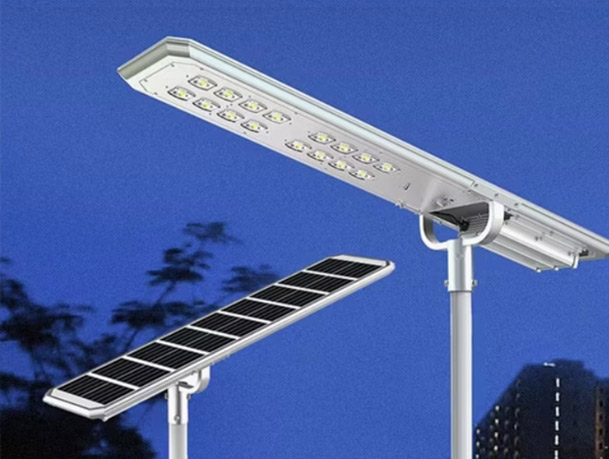
Integrated systems can reduce installation steps and suit many 6m–8m applications. Split systems allow independent panel orientation, larger energy components and easier component-level changes, which can be valuable for demanding 8m–10m projects. Neither arrangement is automatically better; climate, autonomy, appearance, theft risk and maintenance method determine the correct choice.
It is usually more suitable for smaller roads. A wide route should be modelled at higher mounting heights or with an alternative layout before equipment is selected.
Not as a general rule. Battery energy must follow the actual nightly load, losses, autonomy, temperature and allowable depth of discharge.
Spacing is an output of the lighting design. It varies with height, optics, road geometry, arrangement and maintained target.
The economical option is the complete layout that meets the requirement with acceptable civil work, energy storage and maintenance—not necessarily the shortest pole.
Compare Jieyao's 6m, 8m and 10m solar street light systems.
Contact Us
Get a custom lighting solution and quotation for your project. Outdoor lighting manufacturer in Yangzhou, ChinaAbout Jieyao LightingYangzhou Jieyao Lighting Equipment Co., Ltd. is an outdoor lighting manufacturer focused on solar street light systems and high mas... Do you have any questions or requests?
Email: jay@jieyaolighting.com

Click to Chat.
Im online now.