

 English
 Español
 Bahasa Indonesia
 Français

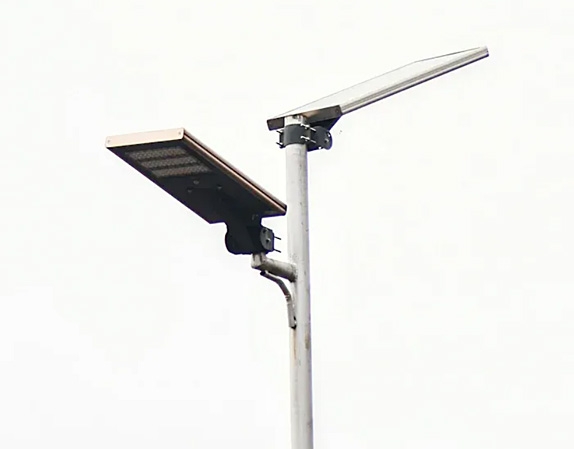
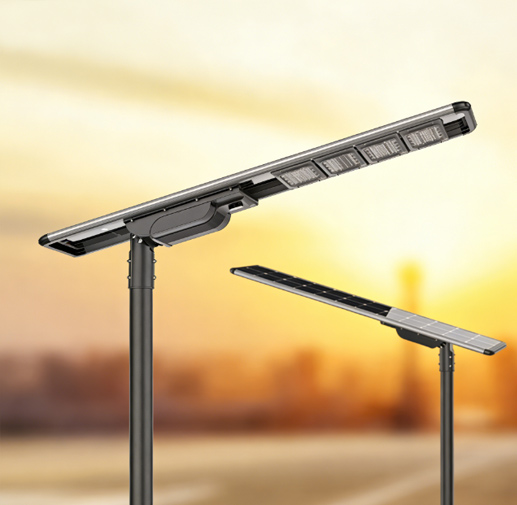
- Product details
-
6m Solar Street Light System for Rural Roads and Communities
A 6m solar street light is a practical off-grid solution for village roads, residential streets, farm access roads, parks, pathways, small parking areas and community projects. Jieyao supplies complete systems that combine the LED luminaire, solar panel, LiFePO4 battery, controller, galvanized steel pole, mounting brackets and foundation accessories.
The system should be calculated from the local solar resource and required night-time operation. A reliable proposal considers road width, target illuminance, operating hours, rainy-day autonomy, installation spacing, shading, temperature and seasonal solar radiation rather than using a single fixed battery for every country.
Typical 6m Project Configuration
Component Typical range Selection principle Pole height 6m Suitable for local roads and moderate road widths; final spacing follows the lighting calculation. LED power Project-dependent, commonly 30–60W Selected from required lux, optics and dimming profile. Solar panel Monocrystalline module sized by energy balance Based on daily load and lowest-month solar radiation. Battery LiFePO4 Capacity follows operating hours, depth of discharge and autonomy requirement. Controller Programmable PWM or MPPT Supports dusk-to-dawn operation and multi-stage dimming. Pole finish Hot-dip galvanized; optional powder coating Coating selected for inland, coastal or decorative environments. Protection Outdoor luminaire and sealed electrical components Ingress protection and thermal design should suit the project climate. How Jieyao Sizes the Solar System
The starting point is the nightly energy demand:
- Confirm the real LED input power and nightly dimming schedule.
- Calculate daily watt-hours rather than relying on the model name.
- Use local peak-sun-hours for the least favourable design month.
- Include system losses, battery depth-of-discharge limits and temperature effects.
- Select the required number of autonomous nights.
- Verify the panel angle and confirm there is no shading.
This project-based method avoids two common failures: an undersized battery that switches off before dawn and an undersized panel that never fully recovers after cloudy weather.
Integrated or Split Solar Street Light?
An integrated system places major components in a compact assembly and is convenient for installation and routine community lighting. A split system separates the solar panel, battery and luminaire, allowing more flexible orientation and larger energy storage. For a 6m pole, either arrangement can be suitable; the correct choice depends on operating time, climate, maintenance access and budget.
Recommended Applications
- Rural and village roads
- Residential communities
- Farm and agricultural access roads
- Schools, clinics and public compounds
- Parks, walkways and recreation areas
- Remote sites without grid power
Pole, Foundation and Wind Considerations
The solar panel produces additional wind-exposed area, so the panel bracket and pole must be checked together. Jieyao can adjust the pole diameter, wall thickness, base plate and anchor bolts after receiving the project wind speed and panel dimensions. The foundation is finalized using local soil bearing capacity and should not be copied from a different site without verification.
Factory and Project Support
Yangzhou Jieyao Lighting Equipment Co., Ltd. manufactures outdoor lighting and steel poles in Yangzhou, China. The current company name dates from 2017, and the team reports 15 years of street-light manufacturing experience. The company reports a 10,000-square-metre factory site and more than 60 employees, including more than 10 technical personnel. Support can include lighting layout, solar energy calculation, pole drawing, OEM/ODM appearance, packaging design and installation guidance.
Frequently Asked Questions
How far apart should 6m solar street lights be installed?
Spacing depends on road width, optical distribution, target lux and whether lights are installed on one or both sides. A lighting calculation is more reliable than a fixed spacing rule.
How many rainy days can the system support?
Autonomy is designed from the battery capacity and control profile. The required number of cloudy or rainy nights should be confirmed before quotation.
Can the light use a motion sensor?
Yes. A motion sensor can increase brightness when a person or vehicle approaches and reduce output during inactive periods, saving battery energy.
Is warm white available?
Yes. Colour temperature can be selected according to the project, subject to LED and optical availability.
What information is needed for a proposal?
Provide the project location, road width, pole spacing target, lighting hours, rainy-day requirement, installation quantity and desired colour temperature.
Explore more solar street light systems or request a project calculation through the contact page.
-
-


