


A complete split solar street light package sized around local sunshine, target road illuminance, operating hours, autonomy and wind conditions—not a one-size-fits-all wattage label.
Jieyao starts with the application instead of selecting a lamp from a fixed catalog. The preliminary design considers road width, pole spacing, mounting height, required average illuminance, uniformity, traffic level, sunshine data, longest low-radiation period and project wind speed.
For a quotation, the LED load, photovoltaic module, LiFePO4 battery, controller profile and pole structure are calculated as one system. This reduces the risk of a bright first night followed by insufficient autonomy during poor weather.
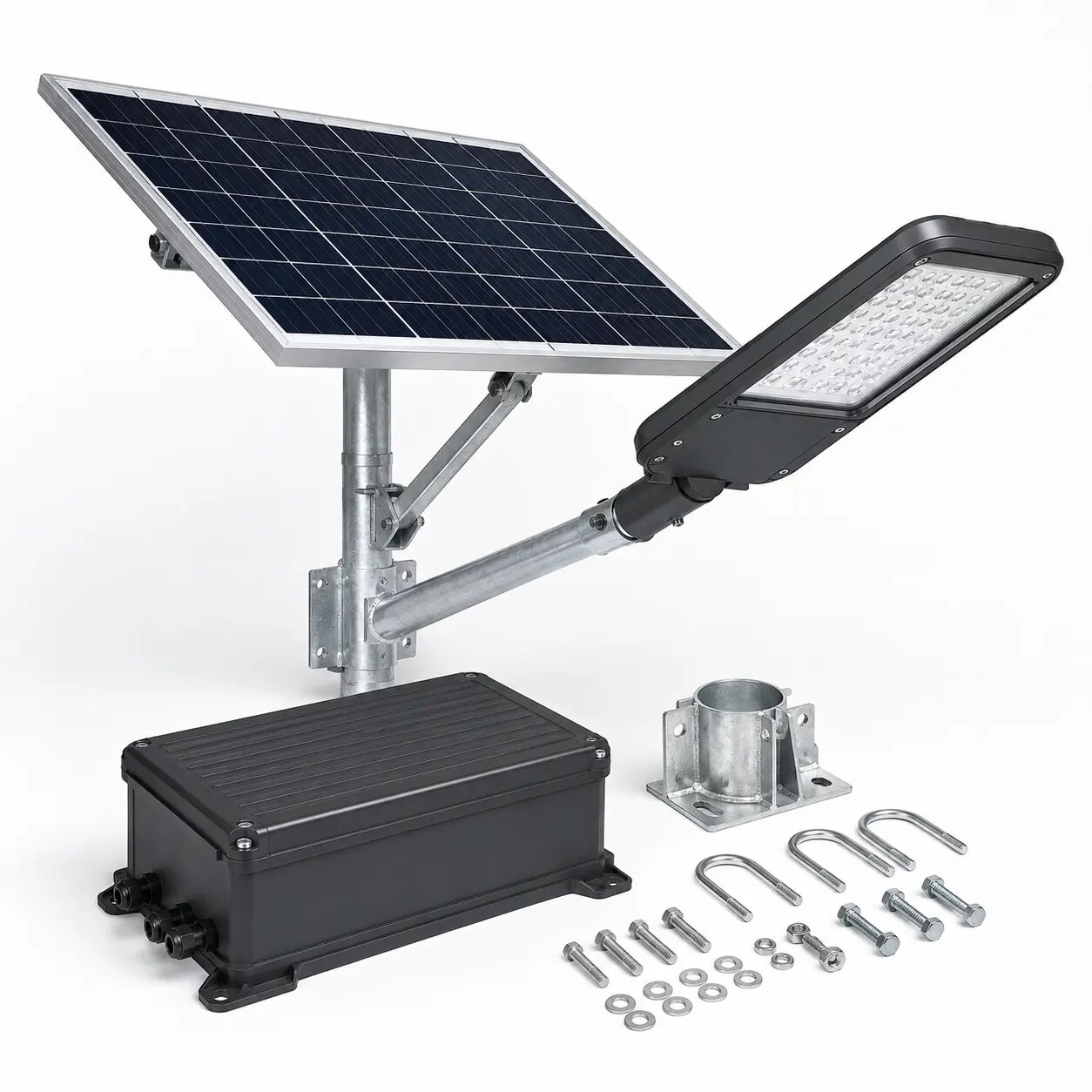
Representative system configuration. Final component sizes are calculated for the project location and lighting schedule.
An 8m split solar street light uses independent LED, photovoltaic and energy-storage components mounted on or around a galvanized steel pole. Separating the components allows the panel size, battery capacity, luminaire power and optical distribution to be changed independently for the road.
Roadway LED optics are selected for mounting height, road width and setback. Luminaire wattage alone cannot predict the lux level or uniformity.
Monocrystalline panel capacity is matched to local peak-sun-hours, system losses and the selected nightly dimming program.
LiFePO4 battery capacity is sized for the usable depth of discharge, temperature, operating hours and required backup nights.
Balanced lumen output, controlled roadway distribution and programmable night dimming for urban access roads and secondary streets.
Higher reserve capacity and robust pole/fixture configuration for factories, logistics parks, warehouses and perimeter roads.
Extended autonomy and serviceable split components for rural roads, construction camps and locations where grid trenching is impractical.
The panel and battery can be enlarged without replacing the roadway luminaire, which is valuable for high-latitude or cloudy locations.
Independent modules simplify diagnosis and planned replacement compared with sealed decorative products.
A dedicated LED road luminaire supports more controlled beam distributions and can improve useful light on the carriageway.
| Item | Typical range / option | Project decision basis |
|---|---|---|
| Mounting height | 8 m nominal | Road width, setback, required distribution and pole spacing |
| LED luminaire | 60–120 W typical | Photometric calculation; not selected by wattage alone |
| Solar module | 180–360 Wp monocrystalline typical | Peak-sun-hours, temperature, load profile and system losses |
| Battery | LiFePO4; capacity calculated per project | Nightly energy use, usable depth of discharge and autonomy target |
| Operating profile | Dusk-to-dawn; timed or multi-stage dimming | Traffic pattern and required energy reserve |
| Autonomy | 2–5 nights typical design target | Climate data, risk level and allowed dimming |
| Color temperature | 3000 K / 4000 K / 5000 K / 5700 K / 6500 K | Road class, visual comfort and local specification |
| Ingress protection | Outdoor-rated components; final IP grade by selected model | Dust, rain, humidity and maintenance environment |
| Pole finish | Hot-dip galvanized; powder coating optional | Corrosion category, appearance and design life |
| Wind design | Project-specific | Local basic wind speed, panel area, pole geometry and code |
Confirm road, solar, operating and wind inputs before releasing the bill of materials.
Forming, welding, base-plate assembly, dimensional checks and surface-protection processing.
Match luminaire, controller, panel and battery interfaces; verify programmed operating modes.
Appearance, dimensions, electrical function, packing list and order-document checks before dispatch.
A useful layout evaluates average illuminance, minimum illuminance, uniformity, glare considerations and light beyond the target road. Excessive brightness directly below a pole can coexist with dark areas between poles.
Jieyao can use the road width, pole setback and preliminary spacing to recommend a luminaire distribution and prepare a project layout for review.
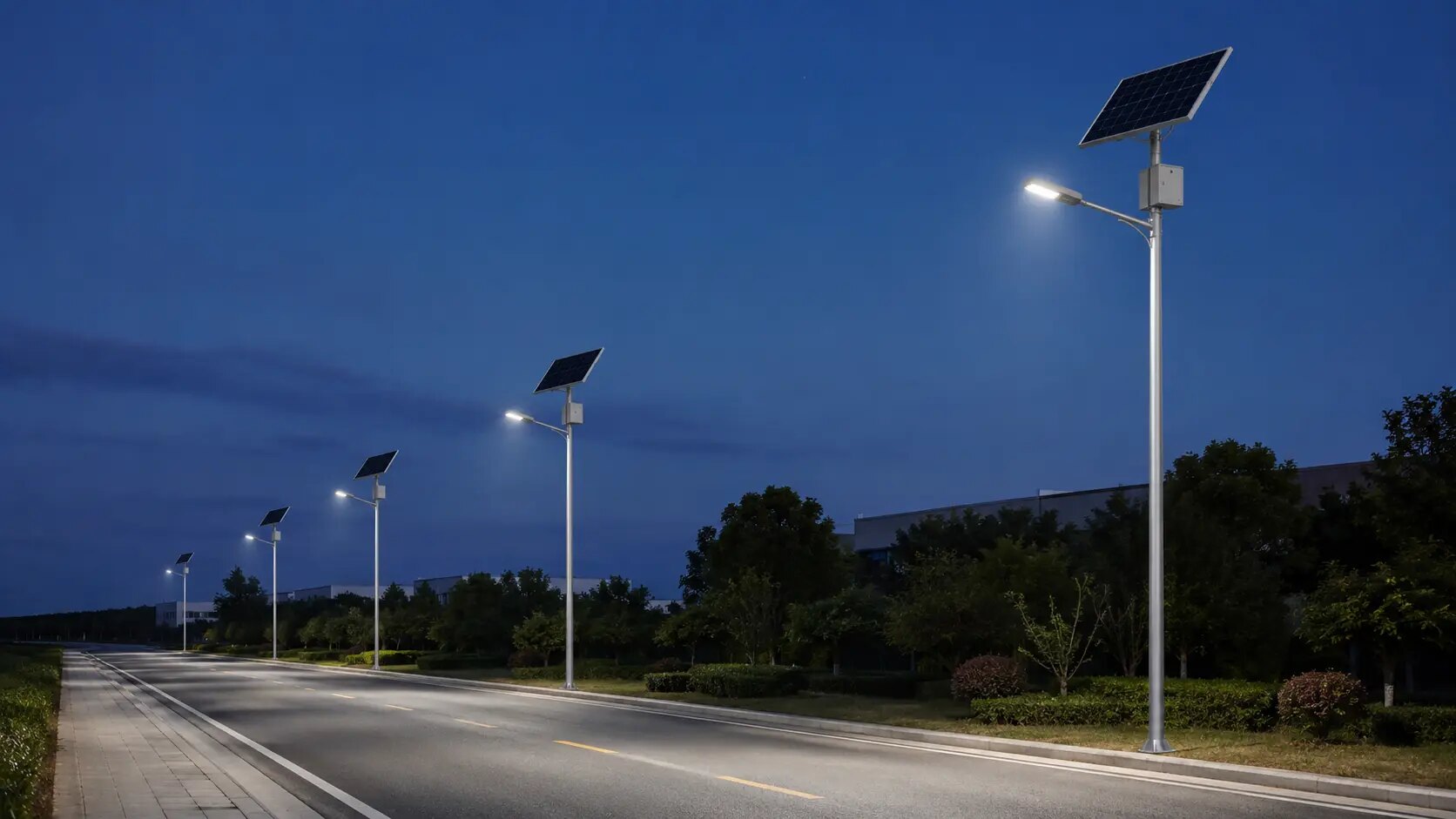
Application rendering: a representative municipal-road arrangement, not a completed-project photograph.
Configuration sheet, component summary and calculation assumptions for commercial comparison.
Photometric layout, pole outline, base/anchor-bolt information and wiring concept as applicable.
Packing list, installation guidance, operating notes and order-specific inspection documents.
Secondary roads, village connectors, new developments and areas where trenching grid power is expensive.
Factory access roads, warehouse perimeters, logistics parks, mining camps and remote operating sites.
School roads, campuses, parking approaches, parks and mixed pedestrian/vehicle areas.
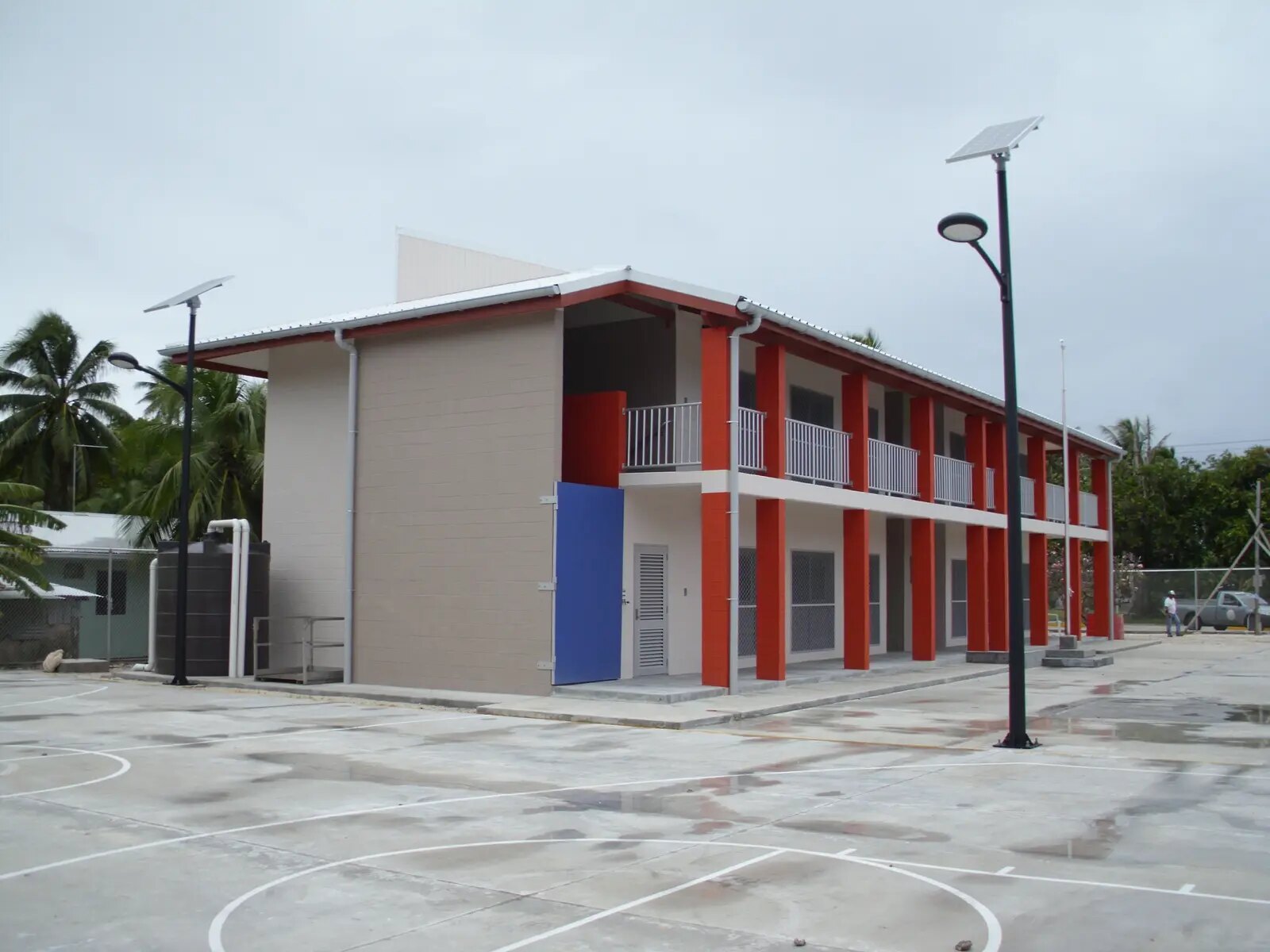
Open-license reference photo: Klau1983, CC BY-SA 3.0, Wikimedia Commons. Illustrative application; not a Jieyao project.
Open-license reference photo: Staff Sgt. Joseph Swafford / ISAF, CC BY 2.0, Wikimedia Commons. Illustrative application; not a Jieyao project.
For tender preparation, also see the solar street light specification checklist and the guide to comparing supplier quotations.
There is no single correct wattage. A preliminary range may be 60–120 W, but the decision must come from the required road illuminance, optic, road width, spacing and operating profile. Two products with the same wattage can produce very different road results.
About 25–35 m is a common preliminary discussion range for secondary roads, but it is not a design guarantee. The final spacing depends on road geometry, luminaire distribution, setback, target uniformity and whether poles are arranged on one or both sides.
Battery capacity is based on the hourly LED load after dimming, controller and wiring losses, usable depth of discharge, temperature, required autonomy and a project safety margin. Nameplate amp-hours should not be compared without voltage and usable-energy assumptions.
Yes, if the requested autonomy and local low-radiation conditions are included in the sizing. More backup nights increase battery and often panel capacity; adaptive dimming can reduce the required storage.
A typical package includes LED road luminaire, solar module and bracket, LiFePO4 battery, controller, galvanized pole, arm, base plate, anchor bolts, mounting hardware and project documents. The quotation should list all inclusions and exclusions clearly.
It can be configured for those environments, but the corrosion-protection system, fasteners, panel mounting, pole section, base plate, anchor bolts and foundation input must be reviewed against the project conditions and local standard.
The mounting height changes the optical coverage, pole structure, panel exposure to wind and typical application. See the detailed 6m vs 8m vs 10m solar street light comparison.
Share the road drawing, project location, lighting target, operating schedule, wind speed and quantity. Jieyao will review the inputs and recommend a project-specific system.
Request a QuoteSolar street light and high mast lighting manufacturer with 15 years of industry experience.
Image licensing: the school application photo is by Klau1983 under CC BY-SA 3.0; the Kabul urban night photo is by Staff Sgt. Joseph Swafford / ISAF under CC BY 2.0. Both are used as clearly labeled application references. Product renders are original generic configuration illustrations and do not represent a completed Jieyao installation or a third-party branded product.
Contact Us
Get a custom lighting solution and quotation for your project. Outdoor lighting manufacturer in Yangzhou, ChinaAbout Jieyao LightingYangzhou Jieyao Lighting Equipment Co., Ltd. is an outdoor lighting manufacturer focused on solar street light systems and high mas... Do you have any questions or requests?
Email: jay@jieyaolighting.com

Click to Chat.
Im online now.