

 English
 Español
 Bahasa Indonesia
 Français

- Product details
-
Project-engineered high-output off-grid road lighting
10m Solar Street Light System for Highways and Wide Roads
A 10m split solar street light system configured from road width, pole spacing, target illuminance, traffic level, solar radiation, autonomy and project wind conditions—not from lamp wattage alone.
Request a Project Configuration15 yearsTeam manufacturing experience10,000 m²Factory site area60+ peopleProduction and support team2017Current company name sinceEngineering capabilityWhen should a project use a 10m solar street light?
A 10m mounting height is commonly considered for wider municipal roads, industrial access roads, perimeter routes and remote highways where a larger illuminated footprint is needed. The increased height can support broader optical coverage, but it also increases the structural demand on the pole and the energy required to maintain the target road-lighting level.
Jieyao treats the LED luminaire, photovoltaic module, LiFePO4 battery, controller and galvanized pole as one calculated system. A credible proposal should state the solar assumptions, operating profile and design limitations instead of presenting only a nominal wattage.
- Photometric layout using road width, setback and preliminary pole spacing
- Daily energy balance based on local peak-sun-hours and system losses
- Battery autonomy and multi-stage dimming calculation
- Pole, panel bracket, base plate and anchor-bolt configuration for project review
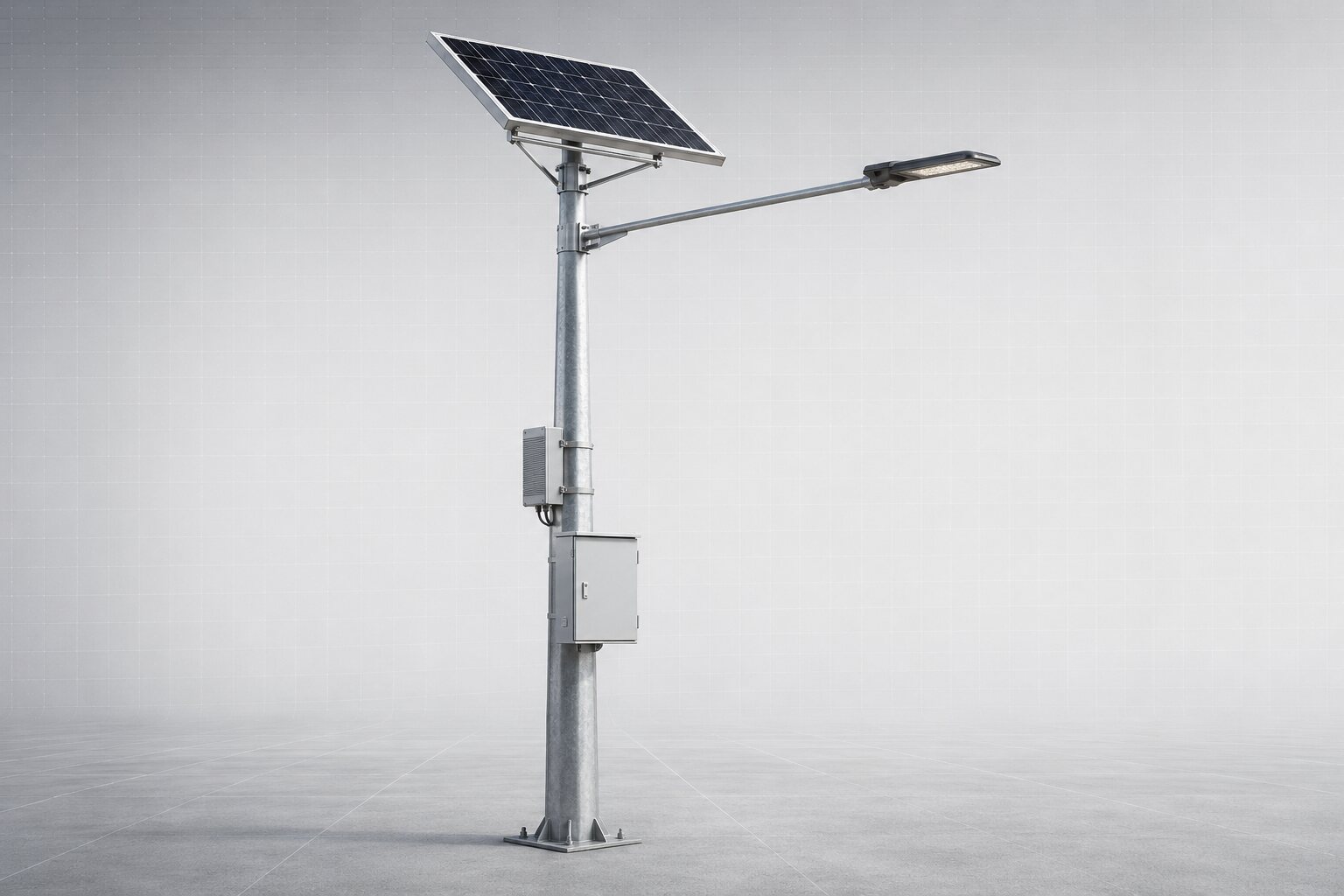
Original generic product visualization prepared for this page. Final dimensions and configuration follow the approved project design.
Configuration optionsConfigure the system around the application
Municipal arterial package
Controlled roadway optics, programmable night profile and balanced energy reserve for wide urban or suburban roads.
Industrial corridor package
Robust pole and electrical configuration for factories, mines, logistics parks and long access routes.
Remote highway package
Extended autonomy and serviceable split components for locations where grid trenching is costly or impractical.
Engineering note: these packages describe a design direction, not a universal fixed specification. Final values are issued only after the project inputs have been reviewed.Core advantagesSystem-level benefits
Greater optical coverage
A higher mounting point can distribute light over a wider carriageway when the luminaire optics and spacing are correctly selected.
Flexible energy sizing
Separate panel and battery components allow the solar generation and storage capacity to be increased for difficult climates.
Maintainable architecture
Independent luminaire, controller, panel and battery modules simplify diagnosis and planned component replacement.
Typical technical parametersPreliminary selection range
Item Preliminary range / option Project decision basis Mounting height 9–10 m typical Road width, setback, lighting class and spacing LED luminaire 100–180 W preliminary range Photometric calculation and allowed dimming Solar module 300–600 Wp preliminary range Peak-sun-hours, temperature and daily load Battery LiFePO4; calculated per project Autonomy, usable depth of discharge and climate Operating mode Dusk-to-dawn; multi-stage dimming Traffic profile and energy reserve Autonomy Specify the required backup nights and verify them against the quoted lighting schedule and usable battery energy. Weather risk and project requirement Color temperature 3000 K / 4000 K / 5000 K / 5700 K / 6500 K Road class and visual comfort Pole finish Hot-dip galvanized; coating optional Corrosion category and appearance Wind design Project-specific Local wind speed, panel area and applicable code Values are preliminary and do not replace a project quotation, photometric report, structural calculation or approved shop drawing.Manufacturing and quality controlFrom engineering review to final inspection
Input review
Confirm site, lighting, wind, operating and corrosion requirements.
Engineering
Prepare the product configuration, loads, drawings and bill of materials.
Production
Fabrication, welding, surface protection and component integration.
Inspection
Dimensions, appearance, function, packing list and document checks.
Design considerationsRoad uniformity and solar autonomy must be checked together
A high peak lux directly below the pole does not prove that the road is adequately illuminated. The layout should evaluate average illuminance, minimum illuminance, uniformity, glare considerations and the dark area between adjacent poles.
The energy model should then apply the selected operating hours and dimming schedule to the LED load. Panel and battery capacity are checked against local radiation data, expected losses and the required number of backup nights.
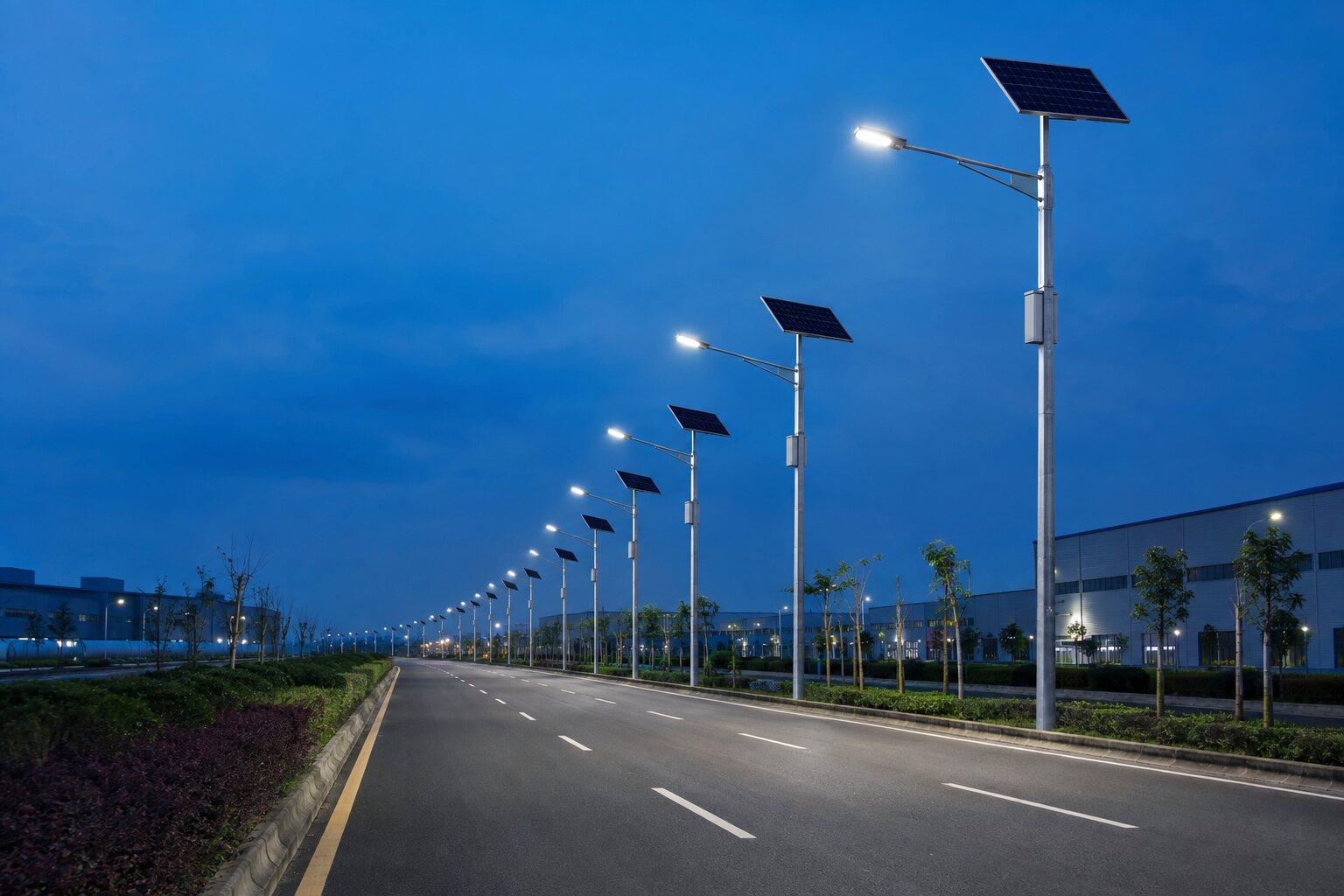
Illustrative 10m solar road-lighting arrangement. It is a generated design reference, not a completed Jieyao project photograph.
Technical resourcesRelated selection and engineering guides
10m vs other solar pole heights
Solar battery and panel calculation
Solar street light tender checklist
8m municipal solar street light
ApplicationsWhere this system is commonly used
Wide municipal roads
Urban and suburban roads where a broader coverage footprint is required.
Industrial access routes
Factory, mining, warehouse and perimeter roads without convenient grid power.
Remote highways
Long road sections where trenching and conventional power distribution are difficult.
Quotation checklistInformation required for an accurate proposal
- Project location and site environment
- Layout drawing or road/yard dimensions
- Required lighting level or applicable standard
- Preliminary pole positions and spacing
- Operating schedule and control requirements
- Design wind speed and reference code
- Corrosion category or coastal exposure
- Quantity, delivery destination and document list
Frequently asked questions10m Solar Street Light System for Highways and Wide Roads FAQ
Is a 10m pole always better than an 8m pole?
No. The correct height depends on road width, target distribution, spacing, obstructions, wind conditions and budget. A 10m pole can cover a wider area but usually requires more optical output, solar energy and structural capacity.
How many watts are required at 10m?
There is no universal wattage. Jieyao selects a preliminary LED load from the photometric layout and then calculates the energy system around the final operating profile.
Can the system run at full power all night?
It can be configured for that requirement, but the panel and battery may become substantially larger. Multi-stage dimming is often used to maintain safety while reducing storage demand.
What information is needed for a quotation?
Project location, road width, pole setback, preliminary spacing, operating hours, target illuminance or road class, autonomy, wind speed and quantity.
Are foundation drawings included?
A preliminary foundation and anchor-bolt arrangement can be provided. Final civil design must be checked against site soil data, structural loads and the local code.
Can the system be supplied for coastal projects?
Yes, but the corrosion category, galvanizing, fasteners, enclosure materials and optional coating system must be specified for the actual marine exposure.
Project inquiryReceive a project-specific configuration and quotation
Send the location, site dimensions, lighting target, operating schedule, wind speed and quantity. Jieyao will review the inputs and recommend a documented system.
Send Your RequirementsSolar street light and high mast lighting manufacturer with 15 years of industry experience.
-
-