
◈ Why can a bright shipyard have dark work faces?
A ship hull, scaffold or crane can block direct light reaching a task. Ground-level lux also describes a different receiving plane from a vertical hull. Shipyard lighting needs checks on the actual work faces with realistic obstruction positions.
A dry dock may look brightly lit in an overview while workers face dark zones beside the hull or behind temporary structures. Increasing the output of the same blocked floodlight leaves that light path blocked. Start with the surface people need to see, then select mast positions and optics that can illuminate it.
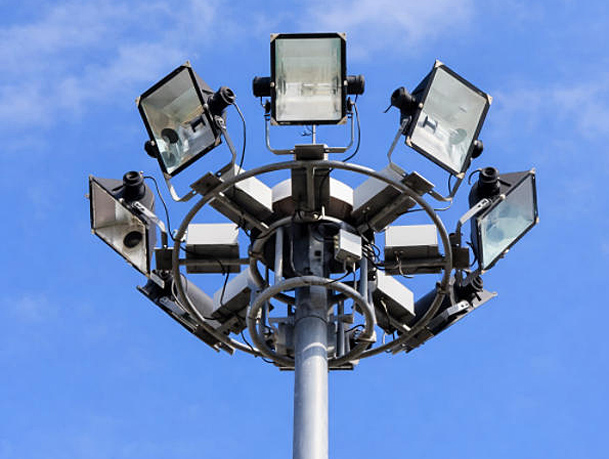
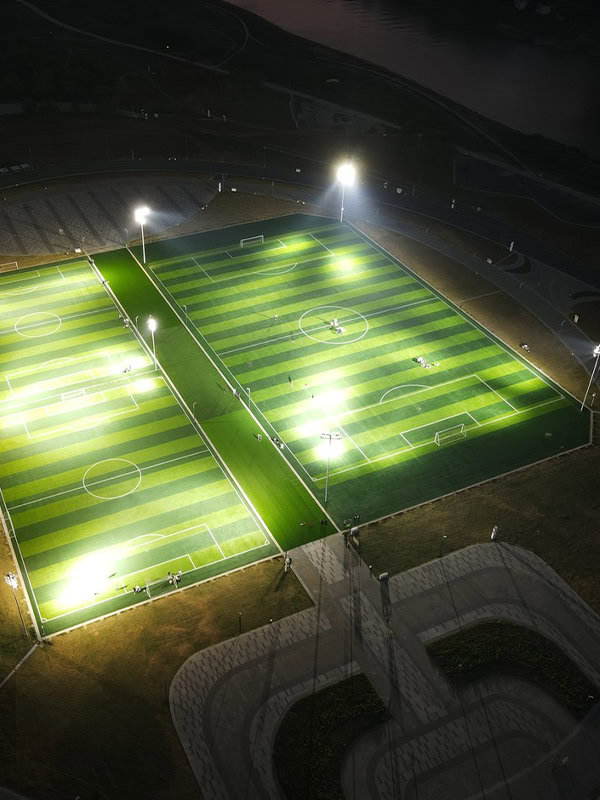
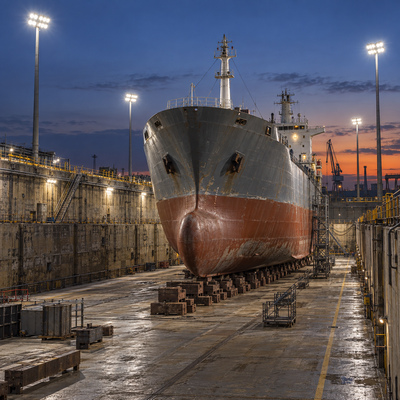
High mast lighting around a dry dock — an application example.
Horizontal illuminance is useful for routes and ground work. Vertical illuminance describes light falling on upright surfaces. The same lamp can produce different values on these two planes at the same point because the incidence angle changes.
For an ideal point source, E = I cos(α) ÷ r². Here I is luminous intensity toward the point in candela, r is distance in metres, and α is the angle between the direction toward the source and the receiving surface normal. A surface facing the source receives more light than one nearly parallel to the light path.
Assumptions: an unblocked point source is 8 m horizontally from a ground-level calculation point. Compare heights of 12 m and 8 m. Assume 10,000 cd toward the point in both cases. The vertical receiving face points horizontally toward the source. This is an ideal geometry example, not an IES simulation or mounting-height recommendation.
↔ Swipe horizontally to read all columns.
| Source height | Source-to-point distance | Horizontal illuminance | Vertical illuminance |
|---|---|---|---|
| 12 m | 14.42 m | 40.0 lx | 26.7 lx |
| 8 m | 11.31 m | 55.2 lx | 55.2 lx |
With h as height and d = 8 m, r = √(h² + d²). Horizontal illuminance is I × h ÷ r³; vertical illuminance is I × d ÷ r³. At 12 m, the vertical result is only two-thirds of the horizontal result. A satisfactory ground reading therefore cannot establish the light level on a hull face.
▤ What this calculation leaves out
Real floodlight intensity changes with direction. Hull curvature, scaffolds, reflections, multiple luminaires and maintenance losses change the result. Use actual photometric files and a site model for design decisions. This table isolates receiving-plane geometry.
Model representative vessel positions and sizes, including spaces beneath overhangs and temporary staging. An empty dock and an occupied dock present different light paths. Check zones that appear after the ship is positioned rather than accepting an empty-site ground grid as the final assessment.
Compare mast positions on more than one side of the work area. Cross-lighting can provide another path to a face hidden from the first mast, but may expose a worker or crane operator to glare. Local task lighting can address a confined face; its placement, protection and supply must suit the operation.
↔ Swipe horizontally to read all columns.
| Work location | Receiving plane / viewpoint | Layout question |
|---|---|---|
| Dock floor and access | Horizontal and worker eye level | Does the hull create a dark route or abrupt transition? |
| Hull repair surface | Vertical or inclined task plane | Can light reach around staging and projections? |
| Under an overhang | Local task plane | Is a separate light path available? |
| Crane or vehicle cab | Operator viewpoint | Are sources visible directly or through reflections? |
HSE workplace-transport guidance highlights placement that limits glare and shadows. Its general advice supports checking the driver and pedestrian experience; it does not supply a universal shipyard repair lux target. Select task criteria through the project’s applicable design requirements. [1]
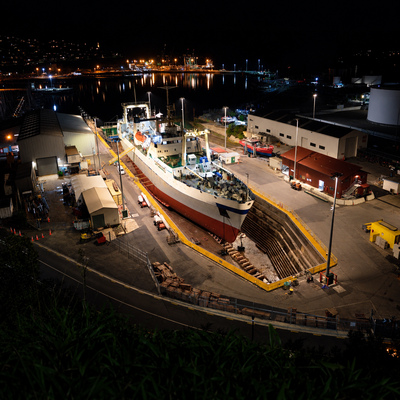
Dry dock work areas and lighting positions — an application example.
Identify whether an area is used for vehicle movement, visual inspection, fabrication, coating work or access. These activities may need different receiving planes, colour discrimination and local lighting. Record whether the task is continuous, occasional or temporary, and the vessel states under which it must remain possible.
Hazardous-area classification is a separate selection input where flammable gases, vapours or dust can occur. A marine finish or sealed housing does not establish suitability for an explosive atmosphere. Select equipment against the classification and project approval requirements.
Use the design’s stated measurement planes and positions, identify the lighting scene, and document obstructions during the survey. Include representative operator viewpoints and compare the recorded conditions with the model. If a new vessel or scaffold changes the geometry, review affected zones rather than treating the original survey as permanent proof.
Height changes coverage, distance, incidence and glare together. This example shows why height cannot be selected from horizontal lux alone. Compare layouts using the work surfaces and obstacles that matter to the operation.
Discuss your project with Jieyao Lighting
Share a dock plan, vessel envelope, working heights and crane or scaffold positions with Jieyao Lighting. These inputs allow the pole and luminaire arrangement to be discussed against the working area. Explore terminal and dock high mast lighting poles or use the website contact form to share the project requirements.
1. HSE workplace transport: lighting — General workplace-transport guidance on glare, shadows and transitions; UK context.
https://www.hse.gov.uk/workplacetransport/factsheets/lighting.htm
The numerical examples are original calculations by Jieyao Lighting using the stated assumptions. They illustrate a comparison method and are not measured results for a supplied product.
Contact Us
Get a custom lighting solution and quotation for your project. Yangzhou Jieyao Lighting Equipment Co., Ltd. manufactures outdoor lighting and steel poles in Guoji Town Industrial Park, Gaoyou City, Yangzhou, Jiangsu, China. The company reports a 10,000 m² factory site, more than 60 employees including more than 10 technical personnel, and more than 100 production and testing machines. The present company name dates from 2017; Jieyao Poles’ published history traces the team’s manufacturing lineage to 2006. The stated 15 years of experience refers to the team. The company reports exports to more than 60 countries. Do you have any questions or requests?
Email: jay@jieyaolighting.com

Click to Chat.
Im online now.
 English
 Español
 Bahasa Indonesia