

A road-lighting calculation should make clear whether its reported illuminance or luminance represents initial output or the maintained condition required by the project. Before comparing two bids, ask for the adopted light loss or maintenance factor, the reasons behind it and the luminaire/cleaning assumptions to which it applies. The same average value on two cover sheets can describe different long-term conditions if one calculation uses initial output and the other applies losses.
The Illuminating Engineering Society defines a light loss factor as an allowance for operation below rated initial conditions and for depreciation. That definition does not supply one number for every LED road light. The project lighting designer must select a method and value consistent with the governing criteria, actual luminaire, environment and maintenance plan. This page is a document-review checklist, not a substitute for the responsible designer's calculation.
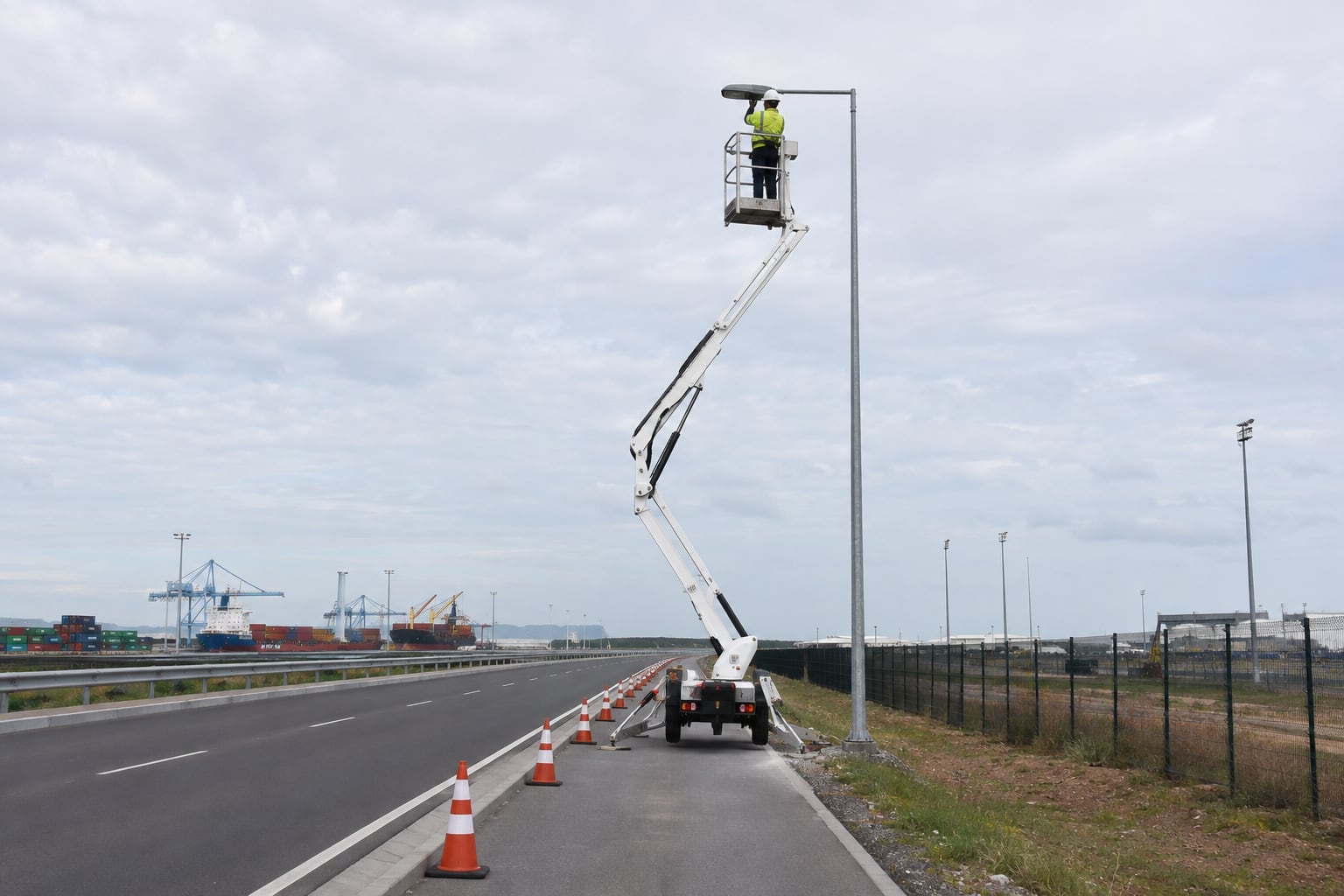
The practical service method and access frequency should match the maintenance assumptions recorded in the lighting calculation.
Request the full calculation report, not only a rendered road scene or one summary row. Identify the calculation surface, grid, metric, luminaire model/optic, output setting, mounting geometry and control state. Then find the factor applied to the output and whether it is global, per-luminaire or per-group. A report that labels a result “maintained” should show the basis; a label by itself is not evidence.
If the tender asks for both initial and maintained values, keep them in separate columns. Do not compare a maintained average from one bidder with an initial average from another. Also check whether the reported minimum and uniformity are derived from the same operating state as the average; a dimmed scene may be a separate case with its own acceptance criteria.
| Review item | Evidence to request | Question before accepting the result |
|---|---|---|
| Required condition | Tender criterion and report label for initial/maintained output | Are both bidders reporting the same condition? |
| Luminaire basis | Exact model, optic, photometric file revision and selected output setting | Does the loss assumption apply to the equipment actually offered? |
| Loss components | Stated factor method, sources and any dirt/output assumptions | Is the adopted value justified rather than copied from an unrelated design? |
| Environment and maintenance | Exposure, cleaning/access plan and review period | Does the assumed maintenance match how this road will be operated? |
| Operating scene | Normal, reduced, emergency or other required state | Is the factor paired with the correct output and control schedule? |
The IES photometric-file review guide addresses whether the file represents the quoted luminaire. This checklist begins after that identity question and tests the maintained-output interpretation.
LED source output can change with operating time and temperature; dust or deposits on an outdoor optic can also alter delivered light. Drivers, controls, replacement parts and cleaning may change the picture further. Ask the supplier and lighting designer what each assumption covers and which records support it. A factor cannot be justified by an unverified “long life” statement or a generic warranty term.
The environment matters. A road with airborne dust, salt spray or industrial deposits may need a different maintenance assessment from a sheltered route. Yet an aggressive cleaning program is not automatically credible when the owner has no safe access method or budget. Record the planned inspection/cleaning responsibility and the consequences if the plan changes. Avoid declaring that every luminaire will lose the same proportion of light; fixture construction and exposure differ.
Do not multiply or combine factors ad hoc. The project's governing method determines whether components are combined, how control settings are represented and what output data are valid. If a report mixes a catalog “initial lumens” figure with a separate file and control setting, ask for a corrected, internally consistent calculation.
Normalize the geometry, grid, criterion and maintained-output method before making a price or wattage comparison. A bidder may propose an alternative luminaire or cleaning plan, but the deviation should be explicit. The lighting designer then decides whether the alternative meets the project requirement and whether pole positions, tilt, mounting height or controls need revision. The road-lighting tender-evaluation guide covers the wider structural and commercial comparison.
| Difference found in tender returns | Why it prevents direct comparison | Required clarification or action |
|---|---|---|
| One report is initial; another is maintained | Values answer different questions | Recalculate or present both on the issued criterion |
| Same nominal factor, different cleaning assumptions | Future service conditions differ | State access, interval basis and owner responsibility |
| Photometric file and quoted optic/revision differ | The reported distribution may not represent the order | Match file, model and output setting; rerun calculation |
| Dimming scene omitted or substituted | Required operating state is not proven | Provide the specified scene and report it separately |
| Factor has no source or method | The maintained result cannot be audited | Supply the governing basis or mark the result provisional |
If the calculation is provisional because a specific luminaire revision or cleaning regime is still open, label it as provisional and keep the acceptance decision open. The high-efficiency LED street-light product page is product-family context only; its marketing ranges are not a substitute for a model-specific photometric file or project maintenance assumption.
No. The calculation allowance addresses light available under the defined service condition. A lifetime claim does not establish the calculation's dirt, output, operating-state and maintenance assumptions.
The buyer can require a common comparison basis, but the adopted value and method still need review against the project standard, equipment and service plan. Any alternative must be clearly identified for the lighting designer.
No. Report required control scenes explicitly. The designer should know which output setting and calculation condition produced each result.
The owner and lighting designer should revisit the maintenance assumption and decide whether monitoring, cleaning, equipment changes or a revised calculation are needed. Do not silently continue using an unsupported maintained result.
For a reviewable road-lighting RFQ, issue one calculation basis and ask every bidder to identify its photometric file, output setting, loss-factor method and deviations before technical acceptance.
Contact Us
Get a custom lighting solution and quotation for your project. Outdoor lighting manufacturer in Yangzhou, ChinaAbout Jieyao LightingYangzhou Jieyao Lighting Equipment Co., Ltd. is an outdoor lighting manufacturer focused on solar street light systems and high mas... Do you have any questions or requests?
Email: jay@jieyaolighting.com

Click to Chat.
Im online now.