

A hollow lighting pole cannot be treated as a sealed container when it is hot-dip galvanized. Cleaning solutions, air and molten zinc need a planned path into and out of each connected cavity. Review those paths on the fabrication drawing before welding and galvanizing, together with the pole's structural, electrical and finish requirements. Do not add an unapproved hole at the galvanizing yard or on site to solve a late access problem.
This guide is for buyers, designers and fabricators reviewing a project-specific hollow steel pole or arm assembly. It is not a hole-size schedule. The galvanizer must confirm immersion orientation and process access, while the responsible structural designer must approve openings and any effect on strength or fatigue-sensitive details. The project specification decides whether and how openings remain visible, are closed or are protected after galvanizing.
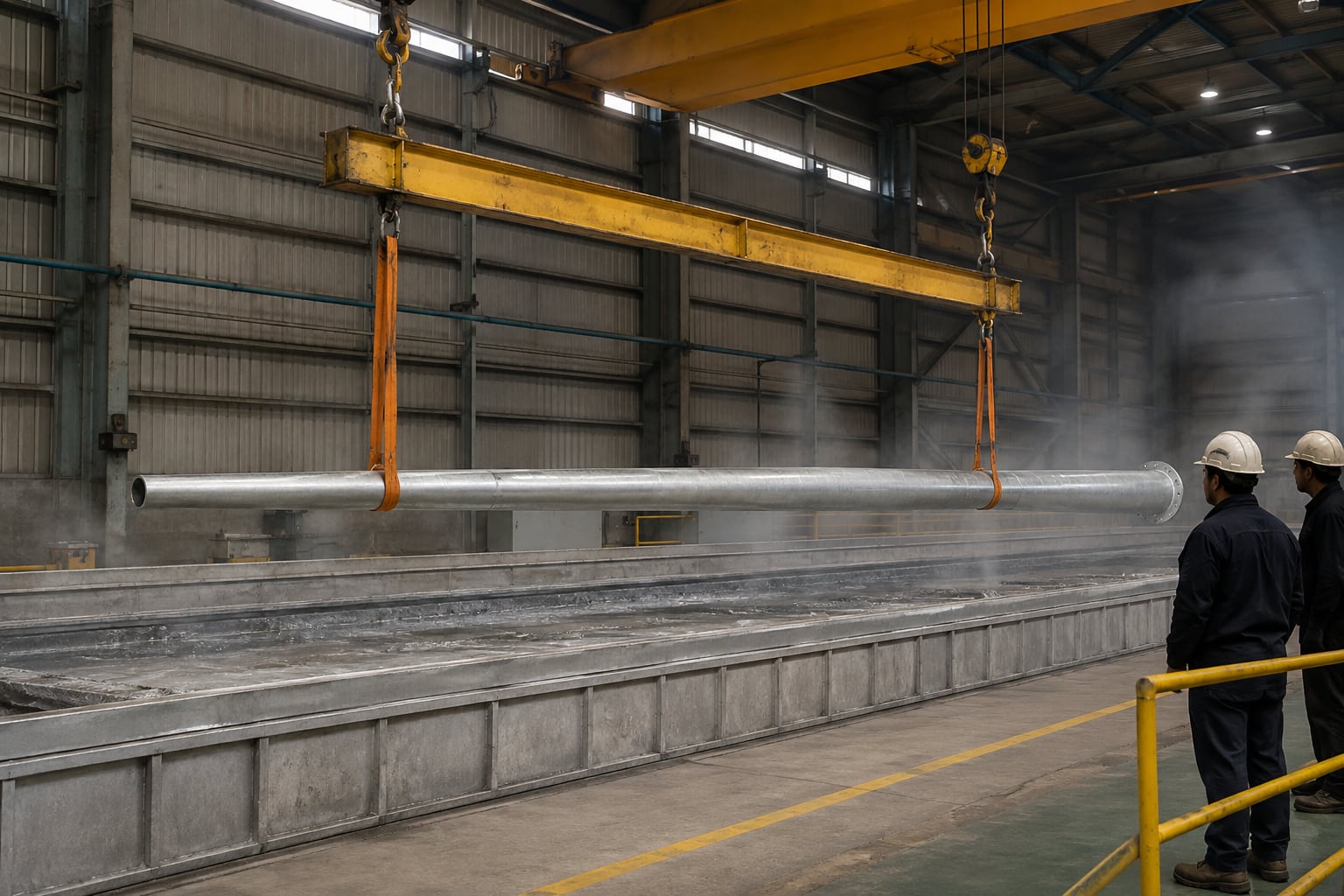
The approved lifting orientation and connected cavities must be reviewed before the pole enters the galvanizing process.
Start with the shaft, detachable or welded arms, tenons, base/upper closures, reinforcement, brackets and any enclosed box sections. Mark which spaces are open to one another and which welds isolate a cavity. A service-door opening is not automatically an adequate vent for every other compartment, and a visible external hole does not prove flow through a hidden internal plate.
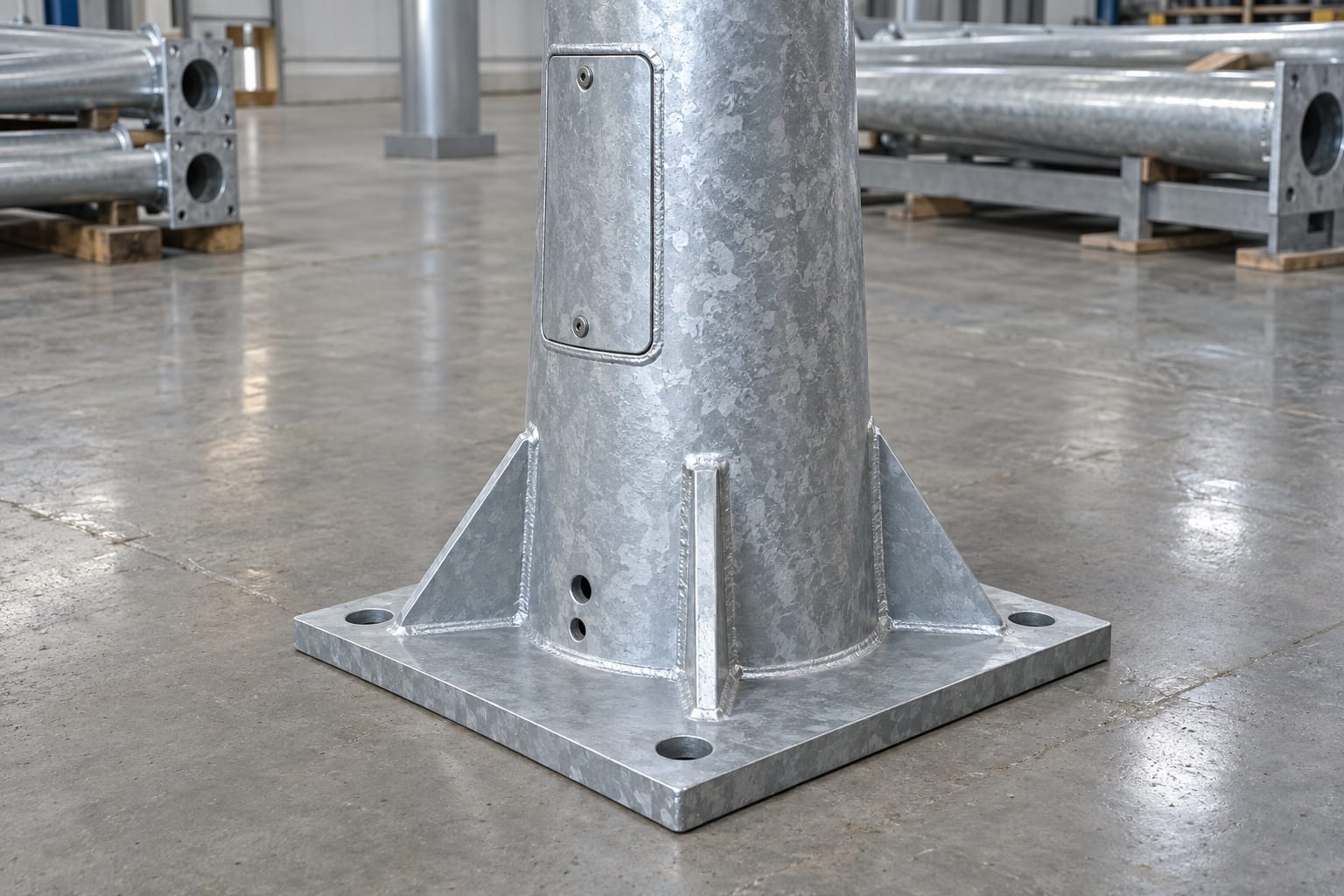
Visible openings must be identified on the approved drawing; their appearance alone does not establish the full cavity flow path.
Ask the galvanizer how the assembly will be suspended, entered and withdrawn. An opening that is at the apparent top of an installed pole may not be at the high point during angled immersion. The American Galvanizers Association explains that vents and drains should be coordinated with the orientation of the part through process stages. The exact geometry and sizing must be agreed for the actual fabrication, not copied from a different pole shape or from a generic illustration.
| Drawing element | What to identify | Review owner/question |
|---|---|---|
| Shaft and base closure | Connected internal volume, base plate, central cable path and any separate compartments | Can liquids and zinc enter and leave without trapped pockets? |
| Arm or tenon | Closed ends, internal welds, branch connection and bracket cavities | Is every hollow segment connected to a verified flow path? |
| Door frame and reinforcement | Opening position, stiffeners, local welds and service envelope | Do process holes conflict with structural or electrical details? |
| Lifting and immersion arrangement | Assumed suspension points and process orientation | Are vents high and drains low for the galvanizer's actual handling plan? |
| Finish and later assembly | Hole visibility, thread/bearing areas, paint interface and closure method if specified | Can the finished pole still be inspected, assembled and maintained as approved? |
The street light pole shop drawing checklist covers the wider geometry, equipment and civil interfaces. The vent/drain review is a focused part of that release package.
Venting and structural detailing must be coordinated. An opening near a base connection, heavily loaded region, access frame or arm joint may require a different location, reinforcement or assembly sequence. The designer must assess that consequence. Conversely, closing a cavity to preserve appearance can make galvanizing unsafe or incomplete. Record the chosen detail as a controlled drawing revision with the galvanizer and designer's acceptance, rather than relying on a verbal instruction to a welder.
Cable paths and galvanizing paths are different design questions. A center conduit opening or access handhole may help liquid flow, but only if its actual geometry and location satisfy the process plan. After galvanizing, the electrical contractor still needs protected cable edges, equipment space and a usable door. The access-door and internal-cable-routing guide addresses those service needs; neither page authorizes extra field drilling.
For a duplex-coated pole, coordinate the subsequent paint system and any masking or sealing at the same time. Do not assume an opening can be covered after galvanizing without considering trapped moisture, inspection, cable routing or future access. The approved coating detail should explain the treatment for the actual assembly. A coastal finish option is described on the duplex-coated lighting pole page; it is product context, not a universal vent pattern.
Before fabrication release, issue a sectioned drawing showing the main shaft and every attached hollow part, weld sequence, openings, sizes/locations determined by the approved process, immersion orientation assumption, responsible sign-offs and drawing revision. If the galvanizer changes the intended orientation or finds an isolated cavity, return the detail to the designer rather than silently altering it.
| Release stage | Evidence to retain | Hold condition |
|---|---|---|
| Design coordination | Sectioned drawing and cavity map; galvanizer and structural review | An enclosed segment lacks an agreed path or conflicts with load detail |
| Fabrication before closure | Opening and internal-connection inspection by pole mark | Required flow path is hidden or blocked by weld/plate |
| Pre-galvanizing receipt | Marked revision, lifting/orientation agreement and process acceptance | Galvanizer cannot process the actual assembly as drawn |
| Post-galvanizing inspection | Openings, drainage, coating and later assembly checks | Retained liquid, obstruction or finish damage needs disposition |
| Project handover | Accepted drawing revision and any approved closure/repair record | Site team cannot distinguish intentional openings from damage |
Post-galvanizing coating acceptance is a separate question. The galvanized coating inspection and repair guide explains how to classify a finish observation rather than mislabeling a designed drain as a pinhole.
Only if the complete internal geometry and galvanizer's handling plan show that every cavity has a safe inlet and outlet. A door in the main shaft does not automatically serve a sealed arm or boxed bracket.
Any change that can affect structural, electrical, finish or appearance requirements needs controlled review and approval before implementation. The project team should agree the disposition, not discover it after shipment.
No. A planned opening is a fabrication/process feature. Inspect its location and finish against the approved drawing; separately assess unintended pinholes or bare areas under the coating specification.
No. Hollow volume, cross-section, connected parts, immersion orientation, process equipment and governing fabrication/structural requirements differ. Request an approved, assembly-specific detail.
For a new pole RFQ, send the preliminary sections and closure/arm concept early enough for the galvanizer and structural designer to review process access before the fabrication sequence is fixed.
Contact Us
Get a custom lighting solution and quotation for your project. Outdoor lighting manufacturer in Yangzhou, ChinaAbout Jieyao LightingYangzhou Jieyao Lighting Equipment Co., Ltd. is an outdoor lighting manufacturer focused on solar street light systems and high mas... Do you have any questions or requests?
Email: jay@jieyaolighting.com

Click to Chat.
Im online now.