
What are the main lamp post charging arrangements?
For site planning, compare three arrangements: a charging module integrated into a suitable lighting column, an external charger attached to a suitable pole, or a separate charging bollard near the parking bay. The first two share a support with the light; the third separates the user connection from it. All need an approved electrical supply and a usable parking location.
On this page
Lamp post charging puts a vehicle connection beside an existing everyday asset: the street light. The visible difference between the main arrangements is simple. The socket can be part of the column, a separate charger box can sit on its outside, or the user connection can stand on a nearby pedestal. The right arrangement puts the connection within a practical reach of the parking bay.
This guide explains how to recognize those forms and where each can be useful. Equipment selection starts with the street layout; the electrical designer, asset owner and network operator then establish the supply and connection for the selected site.

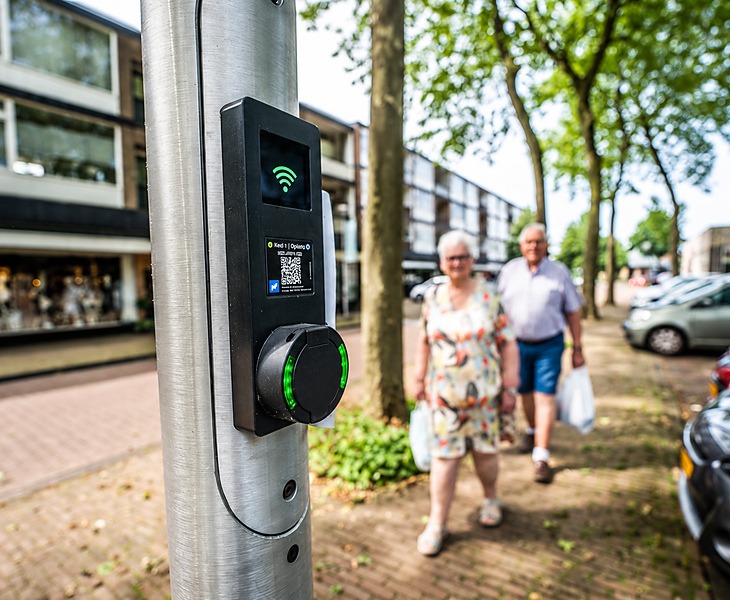
A lighting-column access panel incorporating a charging interface — an application example.
In an integrated arrangement, the charging module and user connection are incorporated into a purpose-designed column or a compatible conversion of an existing one. The result can keep the visible equipment close to the pole body and reduce the number of separate pieces of street furniture.
Look for the charging socket or interface incorporated into the column body or access-panel assembly. The rest of the pole remains visually close to an ordinary street light. This can suit a narrow residential streetscape where the existing column is already beside a useful parking position. The internal equipment and access opening still have to fit that particular column.
The main trade-off is space inside the column. Charging and lighting equipment share a small service area, so the design needs a workable route to each component. A purpose-designed new column can coordinate the openings from the start; an existing narrow column may be better suited to another arrangement.
The Energy Saving Trust’s lamp-column guidance identifies column dimensions, door position and wiring as feasibility considerations. It also distinguishes a dedicated charger supply from use of the column’s supply. That distinction matters even when the finished installation looks integrated. [1]
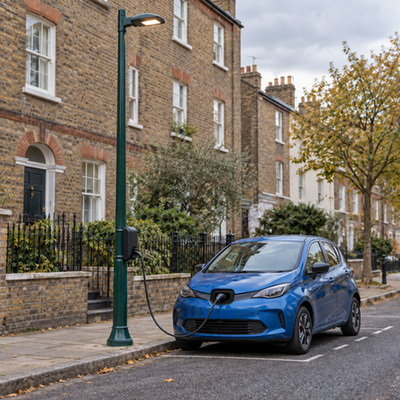
An external charging enclosure on a lighting pole — a residential-street example.
An external arrangement places a chargepoint enclosure on a suitable pole using a designed mounting system. The charging equipment remains visible and accessible outside the main shaft. This can make the charger a more clearly separate service unit, with its own enclosure and operator identification.
The support has to be assessed for the actual enclosure, attachment position, exposed area and any changes to the pole. Added mass and wind area belong in the structural review; an existing streetlight should not be treated as spare mounting capacity simply because a band or bracket fits around it. New holes, cable entries and altered coatings also need a coordinated detail.
For users, the most important feature may be lower down: where the socket or managed cable sits relative to the bay and the accessible route. A technically feasible enclosure can still create a poor charging position if drivers have to stretch a cable around the back of the pole or across a busy pedestrian path.
An external box is worth considering when a suitable column stands in the right place and a separate serviceable charger is useful to the operator. Its outline, cable storage and attachment remain visible. Compare those practical features with an integrated module at the same bay, rather than choosing from appearance alone.
A separate pedestal puts the charging interface where the vehicle and user need it, while the lighting column stays in its original role. In some schemes a nearby column’s infrastructure may be relevant to the supply design; in others the charger has a separate connection. Proximity alone does not establish which electrical arrangement is available.
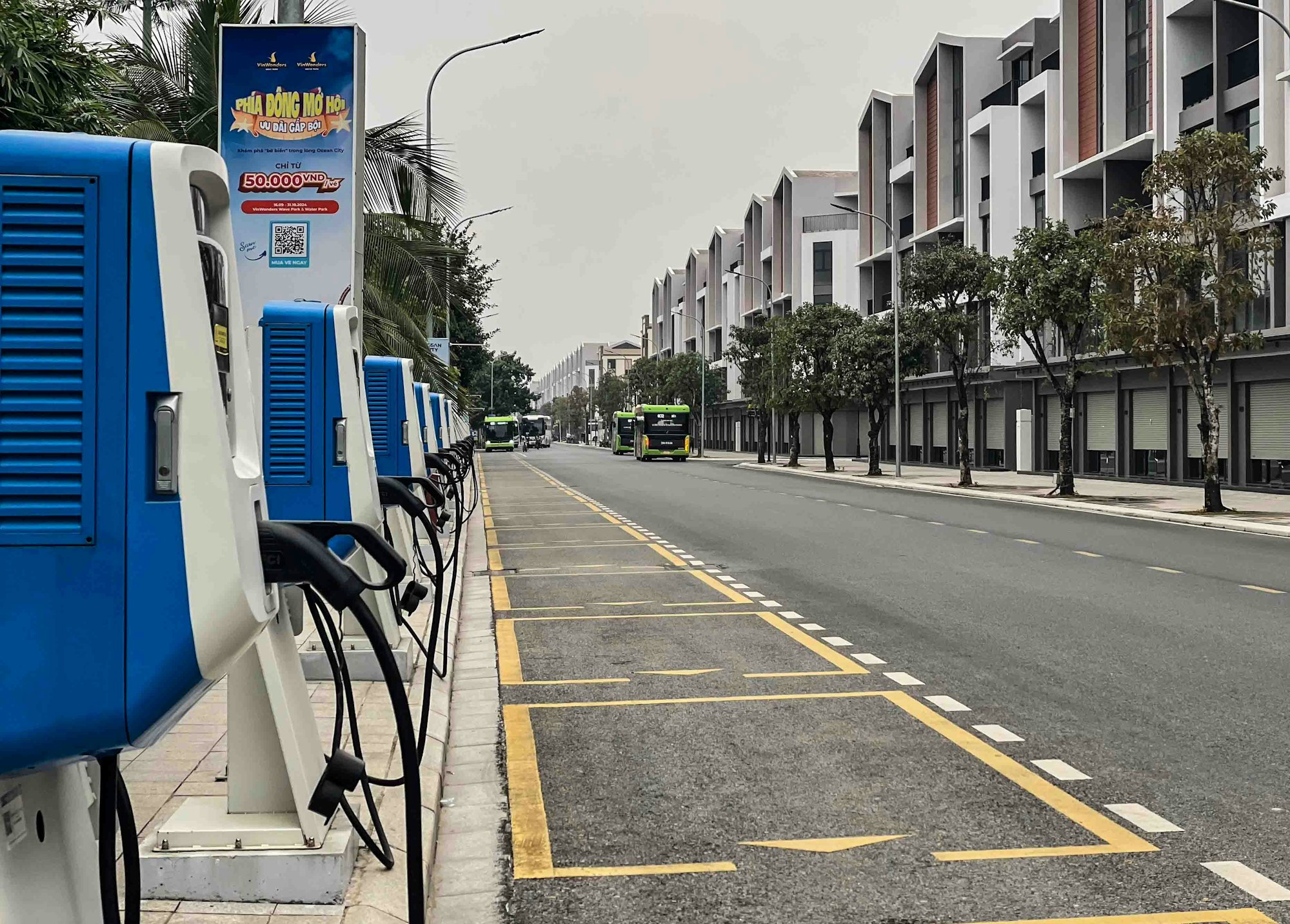
Separate curbside charging pedestals — an example of locating equipment beside the parking bays.
This option deserves attention when the existing lamp is at the back of the pavement, near a building line or otherwise beyond a sensible cable route. Moving the user interface toward the bay may solve a location problem that cannot be resolved by choosing a smaller pole-mounted charger. The trade-off is additional street furniture and potentially more civil or cable work.
Review the complete pedestrian route, including dropped kerbs, signs, trees and the space a person needs beside the vehicle. A bollard that avoids one cable crossing can still block another access route if its position is chosen from a plan without considering how the street is used. UK government design guidance explicitly treats cable reach and the surrounding user experience as design issues. [2]
Charging equipment location versus site constraints · Swipe the table horizontally on a small screen.
| Arrangement | Why shortlist it | What can rule it out |
|---|---|---|
| Integrated column module | A coordinated appearance and a compact shared support at a suitable bay. | Incompatible shaft/door geometry, inaccessible components or an unsuitable supply arrangement. |
| External pole-mounted charger | A distinct enclosure and a clear service interface on a suitable column. | Unacceptable attachment loads, interference with access or a poor cable path. |
| Separate bollard or pedestal | The user connection can be positioned independently of the existing light. | Insufficient pedestrian space, unsuitable civil route or no approved electrical connection. |
These are physical arrangements, not three charging speeds. Socket type, AC rating, connection method, metering, payment and network management are separate specifications. Two installations with similar-looking columns can have different usable charging capability and different responsibilities for maintenance.
The charger needs a supply suited to its demand and operating hours. An existing lighting circuit may have limited spare capacity or may be switched with the lights. The site assessment therefore looks at voltage, capacity, switching and the proposed charging service together.
A simple power comparison explains why this matters. In a hypothetical example, one 5 kW charger draws 5,000 W at its stated input. Compared with a 100 W lighting load, that is 50 times the power. This is arithmetic for scale, not a claim about the rating or spare capacity of a particular street-light circuit.
Power and energy answer different questions
If the illustrative 5 kW input were maintained for 8 hours, input energy would be 5 × 8 = 40 kWh. Energy actually stored in a vehicle would depend on the vehicle, losses, interruptions and charging control. Neither the power ratio nor this calculation approves a connection to a lighting circuit.
The Kansas City streetlight-charging case documented by the U.S. Department of Energy is useful evidence of the difference between a promising concept and a buildable site. Supply voltage, circuit ratings, ownership and available nearby power affected the route to installation. The project also had to consider adjacent parking and cable paths. These were site-specific findings, rather than proof that every city should use the same arrangement. [3]
A lamp may be well placed for lighting while being poorly placed for charging. Lighting positions respond to the road and optical layout; charging positions must also work with a parked vehicle, its charge-port location and a pedestrian using the equipment. The two functions sometimes align, but they should not be assumed to.
Check the normal vehicle position in the bay and the route a charging cable would take. Consider vehicles facing either permitted direction and the parking rules that make the bay available. A theoretical charger location beside an often-blocked bay may offer little useful access. Local parking management and user demand belong in the site decision, alongside technical feasibility.
For a lamp at the back of a footway, investigate a suitable alternative interface position or an approved cable-routing solution through the local design process. Do not assume that a loose lead across the pavement is acceptable. The design needs to preserve access and respond to the actual jurisdiction and street geometry.
A new column can coordinate the required equipment, openings and interfaces from the start. A retrofit starts with the condition, geometry and ownership of an existing asset. Those are different starting points, even if the final street scene looks similar.
For a new scheme, locate the lighting and charging functions together during layout development. The pole position should be tested against both tasks before the civil works are frozen. For a retrofit, survey the existing column and circuit, then let unsuitable sites drop out of the shortlist. Keeping every initially proposed location can force unnecessary compromises.
Jieyao Lighting’s smart poles with EV charging page describes the coordinated pole-package discussion. Identify the pole, chargepoint, electrical work and network service in the agreed scope so the complete installation has a clear owner and service arrangement.
If CCTV or Wi-Fi is also required, use the multifunction smart-pole interface guide to coordinate those devices. This charging guide focuses on where the equipment and vehicle connection can work; it does not repeat the wider device schedule.
A terrace with columns beside marked bays. Begin with an integrated module and an external pole-mounted unit. Compare the connection’s position, the column’s usable space and how each option would be serviced. Keeping the interface at the existing pole can preserve space for people walking past.
A street with columns at the back of a wide footway. Investigate a separate connection near the bay, such as a suitable pedestal, where the site design allows it. Changing the shape of a pole-mounted box will not shorten the distance from the column to the vehicle.
A new campus or mixed-use development. Develop pole locations and parking bays together. A new multifunction column may coordinate the appearance and interfaces, while separate pedestals may give more freedom to position the vehicle connections. Compare both on the same access and charging duty.
A useful early site record brings together the column ID and condition, measured bay relationship, accessible route, proposed equipment location, supply findings and named asset owners. It should make a clear decision possible: integrated module, external pole-mounted unit, separate pedestal, or a different location.
Before procurement, align the proposed charging duty, electrical design, metering and operator arrangement with the selected hardware and column drawing. Confirm who maintains the lighting equipment and who maintains the charger, including how faults are reported and access is arranged. The user should not have to guess which service owns a broken connection.
No. Column condition, physical space, available supply, parking geometry and the owner’s approvals all affect feasibility. The quickest useful exercise is a site shortlist with defined rejection reasons, rather than purchasing chargers for every visible pole.
That depends on the approved supply and control arrangement. Do not infer charger availability from the light’s switching schedule. A charging service intended for daytime or overnight use needs the electrical design and operator configuration to support that duty.
No. Reusing a support may reduce some work, but the supply, cable route, bay arrangement or separate interface can still require civil works. Compare a surveyed scope instead of accepting a universal “no digging” statement.
For a new coordinated pole enquiry, send the layout, proposed equipment arrangement and site responsibilities through Jieyao’s contact page. For an existing public column, begin with the asset owner and relevant network operator before treating it as an available power or mounting point.
[1] Energy Saving Trust, Lamp column charging
UK-focused practical guidance on column geometry, charging arrangements and network coordination. Local supply rules remain project-specific.
https://energysavingtrust.org.uk/advice/lamp-column-charging/
[2] UK Office for Zero Emission Vehicles, Design considerations for chargepoints
Published 25 March 2022. Referenced for user access and cable-reach considerations, not as a universal electrical installation rule.
https://www.gov.uk/government/publications/design-considerations-for-electric-vehicle-chargepoints/design-considerations-for-electric-vehicle-chargepoints
[3] U.S. Department of Energy AFDC, Kansas City streetlight-charging case
Published 13 August 2024. A documented project example of supply, ownership, parking and community-selection constraints.
https://afdc.energy.gov/case/3134
Contact Us
Get a custom lighting solution and quotation for your project. Yangzhou Jieyao Lighting Equipment Co., Ltd. manufactures outdoor lighting and steel poles in Guoji Town Industrial Park, Gaoyou City, Yangzhou, Jiangsu, China. The company reports a 10,000 m² factory site, more than 60 employees including more than 10 technical personnel, and more than 100 production and testing machines. The present company name dates from 2017; Jieyao Poles’ published history traces the team’s manufacturing lineage to 2006. The stated 15 years of experience refers to the team. The company reports exports to more than 60 countries. Do you have any questions or requests?
Email: jay@jieyaolighting.com

Click to Chat.
Im online now.
 English
 Español
 Bahasa Indonesia