


Quick answer: A photocell switches lighting in response to sensed ambient light, while an astronomical time switch uses a programmed schedule based on location and date. A photocell responds to actual local brightness; a time switch follows a calculated sunset/sunrise schedule. The better choice depends on the control objective, site conditions, available electrical/control interfaces and the project’s commissioning and maintenance plan. Neither method should be selected by name alone: document the intended switching behavior and verify it at the site.
This guide compares basic dusk-to-dawn control methods for project planning. It is not a specification for a particular Jieyao luminaire or controller. Confirm the supported control interface, wiring arrangement and operating limits against the exact equipment documentation before procurement.
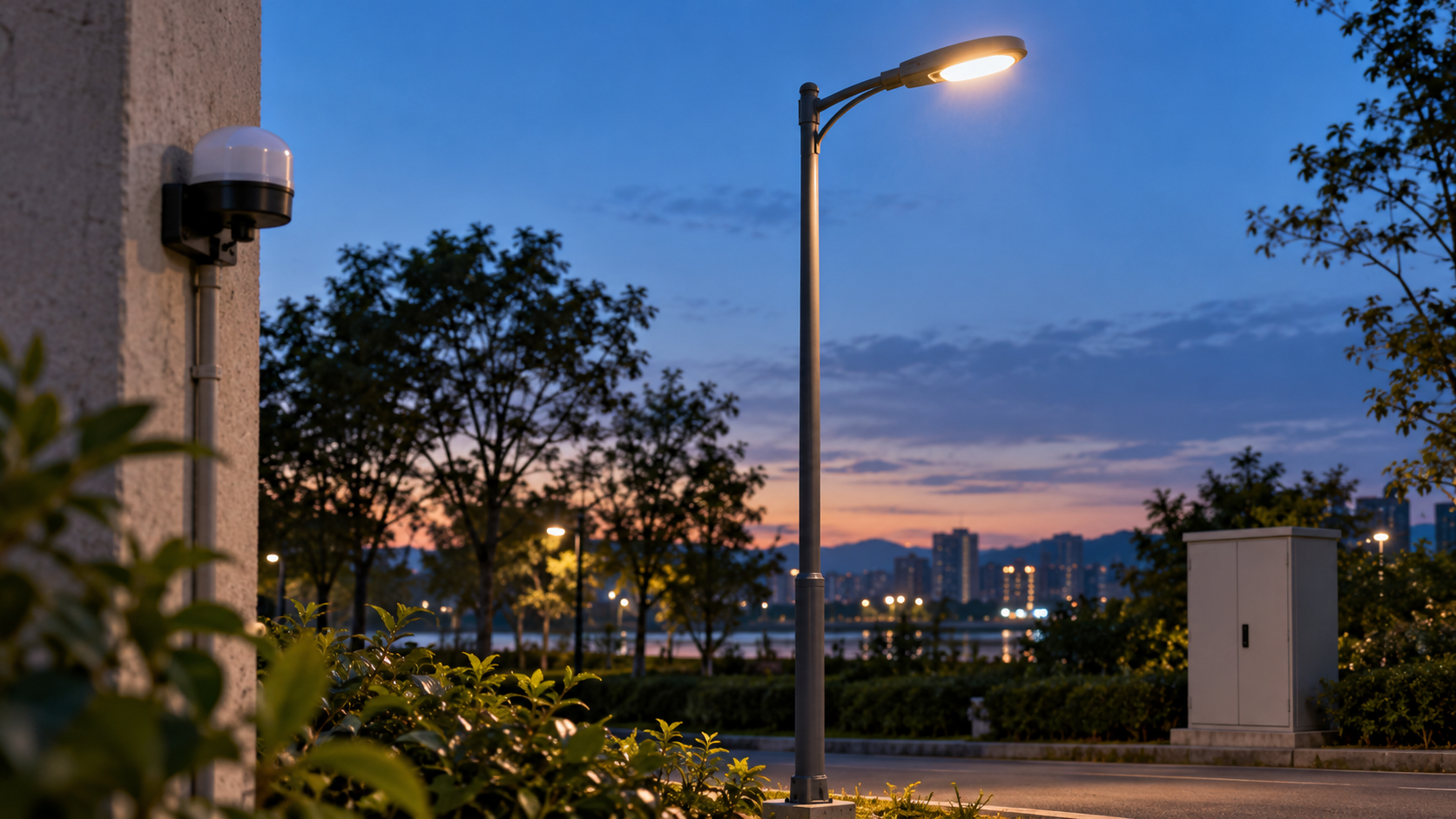
How a photocell controls a street light
A photocell, also called a light sensor or photoelectric switch in some markets, detects light at its sensing element. At a configured threshold, its output changes state and can command a lighting circuit or compatible controller. In a basic dusk-to-dawn arrangement, falling ambient light triggers the on condition and rising daylight triggers the off condition.
Because it reacts to the light reaching the sensor, placement matters. A sensor exposed to a luminaire’s own output may experience feedback: the light turns on, illuminates the sensor, then turns off or cycles. Nearby signs, vehicle headlights, building lights, shadows, dirt or physical obstruction can also affect what the sensor sees. A project should define where the sensor is mounted, what it observes and how it is shielded from unwanted light.
How an astronomical time switch works
An astronomical time switch calculates switching events from configured location and calendar data. Instead of sensing current brightness, it uses its programmed schedule to estimate local sunset and sunrise. Some controllers allow offsets or separate schedules; the available functions depend on the specific product.
This approach avoids placing a light sensor where it can be affected by a nearby lamp, but it depends on correct setup. A wrong location, date, time zone or schedule can shift the switching event. Confirm the controller’s clock, configuration and behavior after power interruption. If a project requires a daylight sensor, a time-based schedule alone does not measure real sky conditions.
Photocell and time-switch comparison
| Project question | Photocell | Astronomical time switch |
|---|---|---|
| What determines the switching event? | Light sensed at the installed sensor | Configured location and calendar-based schedule |
| What must be set or checked? | Sensor location, orientation, threshold and output interface | Location, date/time, time zone, schedule and any offsets |
| What can disturb operation? | Obstruction, dirt, local shadows or artificial light reaching the sensor | Incorrect configuration, clock drift or schedule assumptions |
| What does it directly observe? | Brightness at the sensor | It does not directly observe current brightness |
| What should commissioning prove? | Correct response to the intended light-level change without cycling | Correct switching times and controller behavior for the selected location |
The table describes control principles, not a guarantee that either device is compatible with every luminaire or network. Check the voltage, switching capacity, wiring, enclosure and control protocol for the exact components in the design.
Choose from the operating requirement
Start with the requirement rather than a preferred device. If the project needs the light to react to actual brightness at one representative point, a properly placed photocell may fit that control objective. If the project needs repeatable calendar-based events without a sensor at each location, an astronomical schedule may fit better. In some systems, a controller can combine schedule and sensor inputs, but this must be supported by the specified equipment and designed deliberately.
| Define before selection | Why it changes the decision |
|---|---|
| Required on/off behavior and acceptable switching window | Determines whether the project prioritizes actual local response or a calculated schedule |
| Number of circuits and controlled locations | Changes sensor placement, wiring and whether one device can serve the intended group |
| Existing controller and luminaire interface | Prevents selecting a control device that cannot safely command the load |
| Site lighting around the sensor location | Nearby artificial light can affect a photocell’s reading |
| Configuration and maintenance responsibility | Identifies who sets the schedule, checks the sensor and handles overrides |
| Fail-safe behavior after power loss or device fault | Makes abnormal operation and recovery expectations explicit |
Plan commissioning and fault checks
For a photocell, verify the sensor is installed at its intended location, the sensing surface is unobstructed, and the switching threshold and output are consistent with the approved design. Test the response without allowing the controlled fixture to illuminate the sensor directly. Record the observed on/off behavior and investigate repeated cycling rather than treating it as normal.
For an astronomical switch, check the programmed site location, local time and date, time zone and schedule. Observe the output at the expected switching event or use the controller’s documented test procedure. After a power interruption, verify that the clock and program are retained as intended. Record any manual overrides and their expiry or reset method.
Keep the commissioning record focused on the control method and its input/output behavior. A dimming scene test is a separate task: see the site's road-lighting dimming-scene commissioning checklist for that distinct control objective.
Common mistakes to avoid
- Mounting a photocell where a nearby luminaire, sign or vehicle light illuminates its sensor.
- Assuming a time switch knows current weather or sky brightness; it follows a configured calculation.
- Leaving the controller’s location, date, clock or time zone undocumented.
- Combining control devices without checking electrical rating, wiring and compatibility.
- Using a generic dusk-to-dawn schedule where the project has a different operating requirement.
- Failing to record overrides, reset behavior and who is responsible for future changes.
Frequently asked questions
Is a photocell better than an astronomical timer?
Neither is universally better. A photocell reacts to sensed brightness, while an astronomical timer follows a configured schedule. Select the method that matches the project requirement and can be installed, commissioned and maintained correctly.
Can a photocell turn a street light on during a dark, cloudy day?
It may switch if the brightness at its sensor crosses its configured threshold, but actual behavior depends on the sensor, threshold, placement and circuit. Verify the specified device rather than relying on a generic expectation.
Does an astronomical time switch need a light sensor?
Its basic astronomical calculation uses configured location and calendar information rather than measuring ambient light. A particular controller may offer additional inputs, which must be checked in its documentation.
Can one photocell control multiple street lights?
That depends on the control design, switching capacity, circuit arrangement and applicable electrical requirements. Do not connect multiple loads based only on a general rule; have the circuit and device ratings reviewed.
What should be included in an RFQ for lighting controls?
State the intended on/off logic, site location, number of controlled circuits, required interface, switching schedule, override behavior and commissioning records. Ask suppliers to identify model-specific compatibility and configuration limits in writing.
For product selection, request the exact luminaire and control-device documentation for the proposed configuration. Share the project brief with Jieyao so compatibility can be checked against the model and control scope under review.