

Short answer: A solar street light turns daylight into electrical energy with a photovoltaic panel, stores usable energy in a battery, and releases it through a controller to an LED luminaire after dark. The controller manages charging, protects the battery and follows the agreed switching or dimming schedule. This simple sequence becomes a dependable road-lighting system only when the panel, battery, luminaire, pole and local weather are designed for the same duty.
A complete solar road light has more than a panel and a lamp. The photovoltaic module captures energy. A charging controller regulates the transfer to storage and prevents operation outside its programmed limits. A battery makes night-time lighting possible. The LED driver and luminaire convert stored electrical energy into a road-lighting distribution. Mounts, cables, fuses, enclosures and the pole connect and protect those parts. The exact architecture varies by model, so a product drawing should show where each component sits.
| Part | Job | Question for the supplier |
|---|---|---|
| PV panel | Converts available sunlight to DC electrical energy | What panel is quoted, and how will it be oriented without shade? |
| Charge controller | Manages charging, protection and often operating scenes | What are its settings, limits and service interface? |
| Battery | Stores energy for use after sunset | What is the usable capacity under the stated duty and temperature basis? |
| LED head and driver | Deliver the selected road-lighting distribution | Which exact optic and operating output were used in the layout? |
| Pole and wiring | Support the equipment and connect it safely | Are panel, enclosure, arm and wind loads included in one design? |
Do not infer the presence of a specific battery chemistry, controller algorithm or ingress rating from the phrase “solar street light.” Ask for model-specific documents. A visible panel in a photograph establishes the physical arrangement, not the internal configuration or performance.
When light reaches the photovoltaic cells, the panel produces DC power. Output changes with irradiance, panel temperature, orientation and shade. The controller manages power going into the battery according to its design and settings. If the battery is already full or temperatures are outside allowable limits, the controller may limit charging; the specific response should be checked in the offered unit's manual.
Because the panel is part of the energy supply, its installed position matters as much as its catalogue label. A pole next to a tree or building may receive a very different amount of usable sun from one in the open. Dirt, deposits and new vegetation can alter collection over time. A site survey should therefore show shade through the relevant seasons, not just a photograph taken at noon on a clear day.

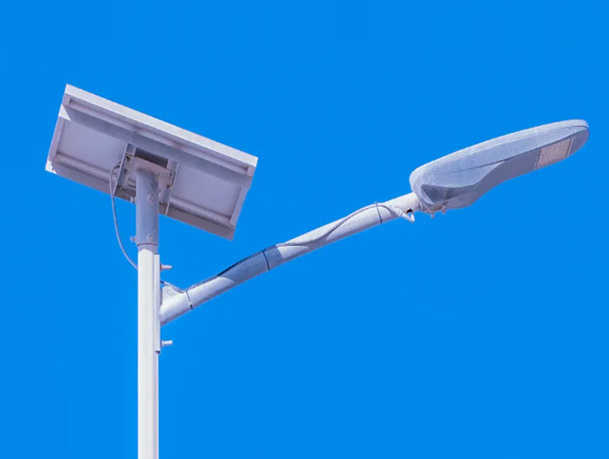
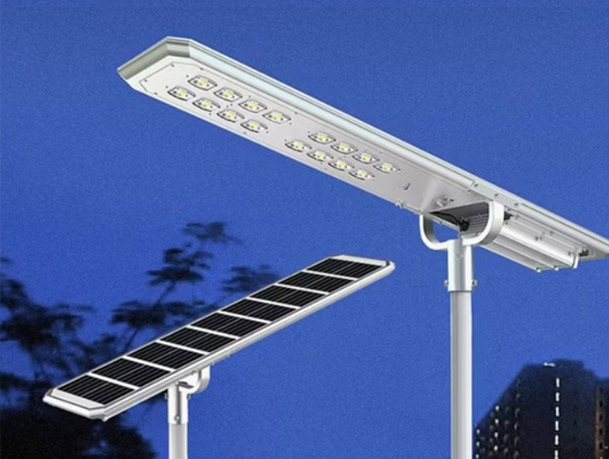
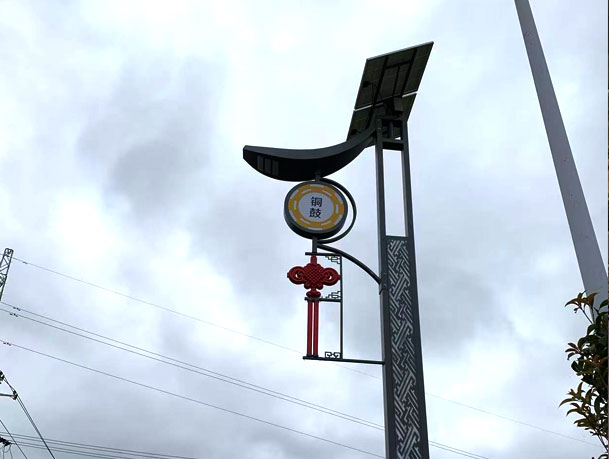
Illustrative split arrangement: the panel and road-lighting head can be positioned separately, subject to the actual mounting design.
The controller determines when the lamp should operate. Some systems use the panel's light-level signal; others use a programmed clock or additional sensor. The controller then supplies energy from the battery to the LED driver and follows the configured output scene. It may run one output level after dusk and another later in the night, but no schedule should be assumed for a model until it is documented.
Dimming changes the energy used per night. It also changes the light actually delivered on the road. A proposal should show the operating profile used in the energy calculation and the lighting level expected in each scene. If a pedestrian crossing, junction or work area has a continuing visibility need, an aggressive low-output period may be inappropriate even if it extends battery runtime.
| Stage | Normal energy movement | What can change it |
|---|---|---|
| Daylight | Panel to controller to battery | Shade, weather, panel condition and temperature |
| Dusk transition | Controller detects the start condition and enables the LED head | Sensor position or programmed settings |
| Night operation | Battery to driver and luminaire | Output scene, traffic-dependent controls and battery limits |
| Low-charge state | Controller follows its documented protection behaviour | Stored energy, settings and battery condition |
Clouds reduce collection but do not switch off an already charged battery. A system can continue to illuminate from stored energy, subject to its usable capacity and the actual night-time load. Consecutive low-sun days progressively change that energy balance. Claims such as “works for several rainy days” mean little unless the supplier states the starting charge, lighting scene, weather assumption, temperature and allowed minimum battery state.
Panel and battery sizing are therefore linked. A large battery without adequate seasonal charging may remain chronically undercharged. A large panel with insufficient usable storage may collect enough energy in daytime but still not meet the required night duty. The engineering question is whether the selected combination meets the site's hardest relevant operating period, not whether one component looks generous in isolation.
For road projects, also decide what happens when energy is scarce. Should the controller dim, shorten operation or issue a fault indication? The answer belongs in the project's accepted operating policy. No generic Jieyao runtime or autonomy value is asserted here; request the calculation for the exact configuration.
The energy flow is similar, but the physical arrangement changes. An all-in-one head combines components in a compact package near the LED luminaire. A split system can position the panel separately from the light head, which may help solar orientation and roadway aiming. The latter also adds mounts, external cable routes and interfaces to protect and maintain. “All-in-two” terminology is not consistent enough to specify without a component-location drawing.

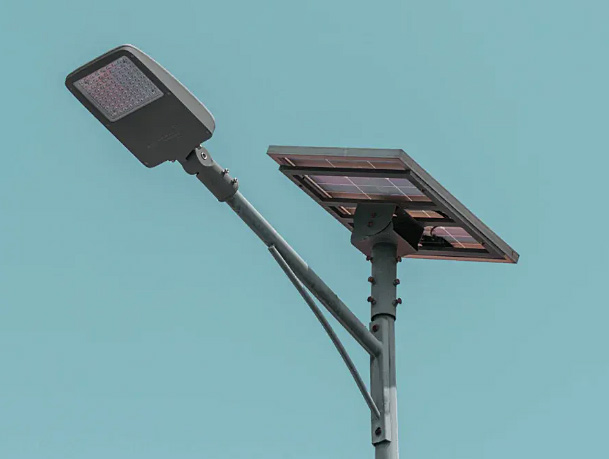
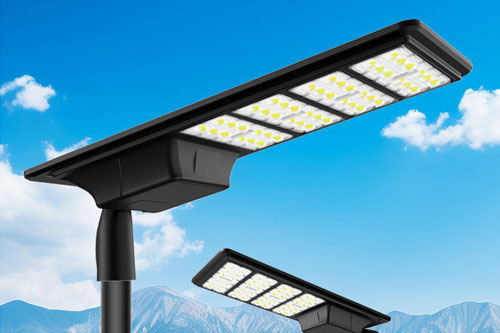
Illustrative integrated form; check the offered model's battery, controller and mounting details separately.
When comparing forms, inspect the location of the battery, panel and controller, the light distribution, the total pole loads and the service method. The Jieyao split-type solar street light page describes one product family; the broader solar street-light range covers the selection framework.
A dark light does not always mean a failed LED. The panel may be shaded or dirty, a connector may be loose, a battery may have reached a protection threshold, a sensor or timer may be set incorrectly, or the driver may have a fault. The safe diagnostic order is to identify the installed model and isolate it according to its instructions, then review controller status, panel condition, battery condition, wiring and luminaire operation using qualified personnel.
Before ordering replacement parts, check the as-built electrical diagram and settings. Swapping a lamp without understanding why the controller stopped supplying power can leave the underlying problem unchanged. Maintenance logs should record the symptom, weather, controller indication and corrective work so recurring failures can be distinguished from a one-off component fault.
| Symptom | Evidence to review | Possible next question |
|---|---|---|
| Dark from dusk | Controller status and switching settings | Was the dusk signal or schedule received? |
| Shorter operating time | Recent sun exposure, battery data and scene settings | Did collection fall, load rise or usable storage change? |
| Intermittent output | Fault log, connections and thermal conditions | Which component reports the event, and when? |
| One section of road underlit | Aiming and photometric/as-built layout | Is the light operating normally but pointed or spaced incorrectly? |
Ask for an exact component schedule rather than a generic “solar light” label: panel, battery, controller, LED head, pole, brackets, wiring and protections. Supply the site location, shade conditions, road geometry, lighting criteria, operating profile and desired maintenance approach. Then request a coordinated photometric layout, solar-energy calculation, pole/foundation design basis and installation drawings. The same models and settings should appear across all documents.
If the design is for multiple roads, group locations by similar shade, traffic and geometry before using a standard configuration. A single sunny sample site cannot prove performance in a shaded section. Share the project brief through the Jieyao contact page and ask bidders to mark assumptions that still need site confirmation.
A genuinely off-grid configuration operates from its panel and battery without a grid feed. Check the exact wiring diagram because hybrid or backup arrangements have different electrical interfaces.
No. The battery normally supplies night-time power; the panel collects energy during daylight and the controller manages storage and operation.
Not by itself. Usable capacity, charging opportunity, temperature, lighting load and controller settings all matter. Review a site-specific energy balance.
Ask for the coordinated package: exact component schedule, operating scenes, photometric layout, seasonal energy calculation, pole drawing and service instructions. Any one document alone leaves important assumptions hidden.
Contact Us
Get a custom lighting solution and quotation for your project. Outdoor lighting manufacturer in Yangzhou, ChinaAbout Jieyao LightingYangzhou Jieyao Lighting Equipment Co., Ltd. is an outdoor lighting manufacturer focused on solar street light systems and high mas... Do you have any questions or requests?
Email: jay@jieyaolighting.com

Click to Chat.
Im online now.