

 English
 Español
 Bahasa Indonesia
 Français

- Product details
-
JIEYAO LIGHTING · PROJECT-CONFIGURED SUPPLY
Solar Floodlight Mast Lighting for Area Projects
Several floodlight aiming directions, with solar equipment specified for the complete lighting duty.
Jieyao coordinates solar-powered floodlight mast proposals for outdoor areas that need more than a single road-lighting head. The enquiry brings together the steel support, floodlight carrier, PV modules, storage and controls as a project package. Define how many heads are needed and where they aim, then size and position the supply equipment around their operating programme.
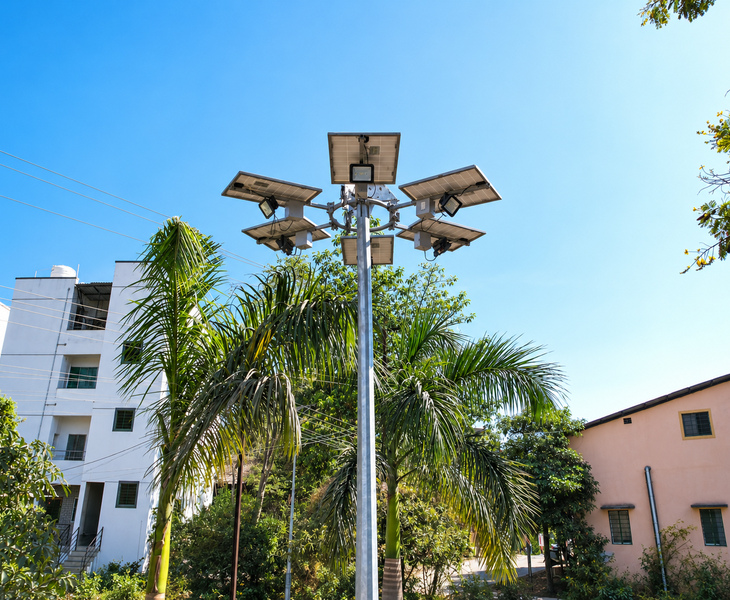
The visible multi-head arrangement is a layout reference. The offered lamp count, head geometry, PV support and battery arrangement are identified in the project quotation and drawings.
Discuss this configuration ↗ Multi-head solar layout reference. It is not identified as the two-floodlight configuration below or as a Jieyao delivered project.
An area-lighting package rather than a taller road lamp
A single road luminaire normally has a defined orientation along a road. A floodlight mast can carry heads aimed toward different parts of an area. Each head has its own optic, mounting angle and useful target, so a lamp count alone cannot establish coverage or lighting quality.
The product enquiry therefore starts with a plan of the target area, mast positions, obstructions and lighting criteria. A junction forecourt, yard edge or open compound may need different aiming directions and control groups. Where one road optic meets the task, the split solar street light configuration may be the more direct starting point.
A two-floodlight configuration reference
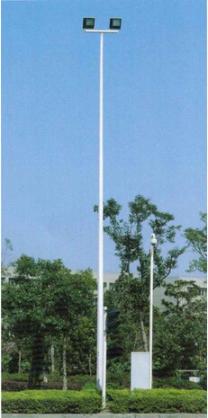 Archived mounting-form reference. The photo does not show PV modules or battery equipment.
An archived solar mast quotation records a 12 m support with two 100 W floodlights, four 100 W photovoltaic modules and a battery specified as 12 V / 160 Ah. The document does not name the supplier, so these values are used as a technical configuration example, not a Jieyao stock model or completed supply record.
Part Archived value Define in a new offer Floodlight head 2 × 100 W Actual model, operating input, optic, aiming and bracket interface for each head. PV equipment 4 × 100 W; 400 W combined module rating Selected module models, electrical connection, mounting positions and shading. Storage 12 V / 160 Ah as recorded Battery chemistry, actual pack configuration, usable energy and enclosure. Steel support 12 m stated height Mounting levels, complete attachment loads, structural design and maintenance access. Control Detailed model and programme not identified Controller compatibility, lighting stages, source/load interfaces and low-energy behaviour. The example describes one combined component schedule. It is not a family of standard options obtained by changing the mast height. The pictured multi-panel head and the archived two-floodlight reference are kept separate because their physical arrangements have not been shown to match.
Lay out the light heads and PV supports together
Floodlight carrier
Show the yoke or bracket for each head, aiming space and access to the fixing points. Include the actual fixture mass and exposed area when specifying the carrier and supporting mast.
PV support
Locate the modules where their orientation and solar access can be assessed. The module frames and brackets add their own loads; putting more panels on the head may change the steelwork and maintenance arrangement.
Storage and controls
Identify the storage enclosure and controller position on the assembly drawing. Cable lengths, service access, temperature limits and environmental protection depend on those actual locations.
The visible reference uses several modules around the lamp head. That appearance does not establish whether the electrical circuits or batteries are shared. A new proposal must show the actual electrical grouping rather than infer it from the photograph.
Agree the night programme before selecting storage
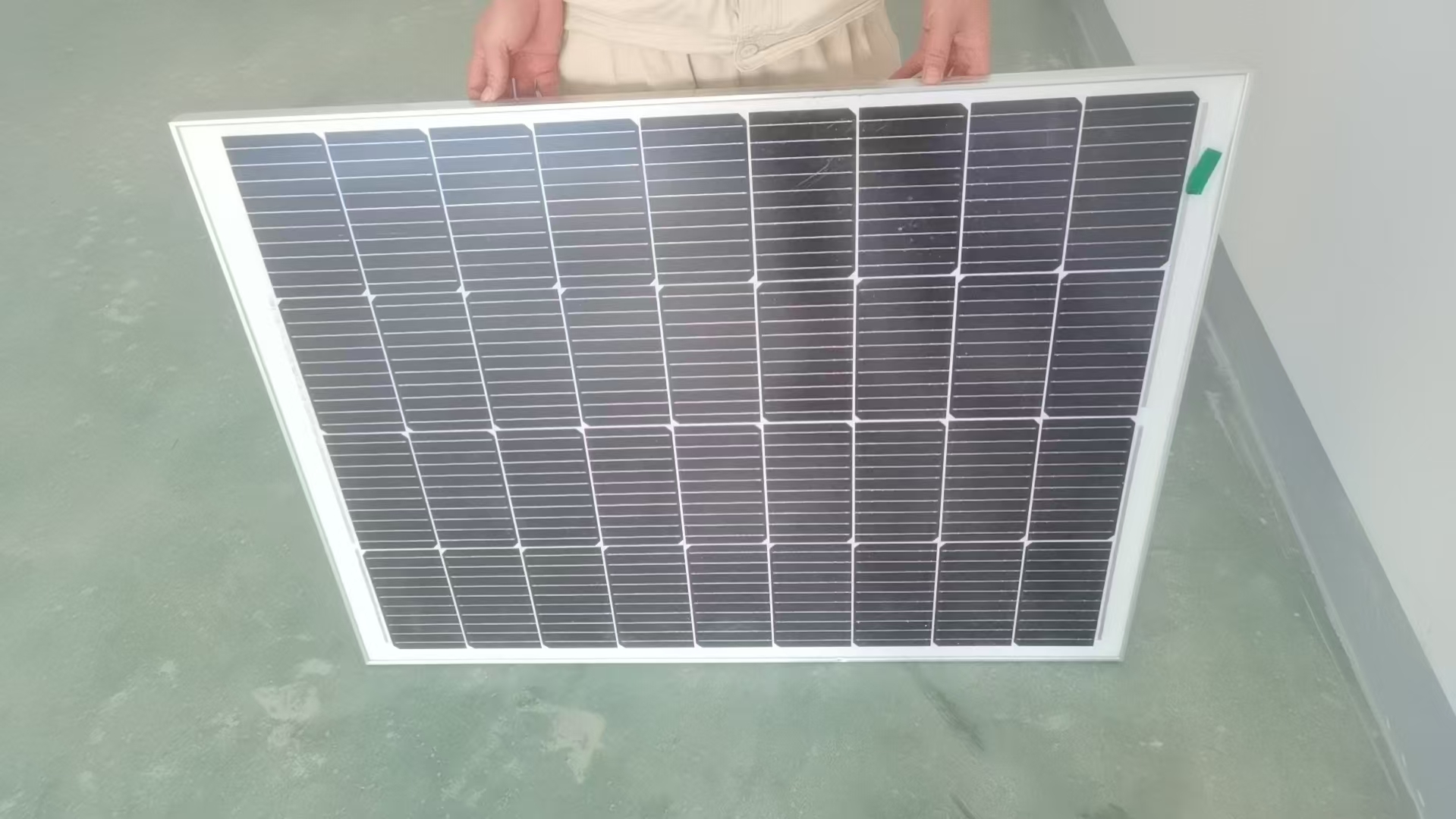 Module appearance reference. Use the selected module datasheet for the proposed electrical and mechanical values.
The source battery values give 12 × 160 = 1,920 Wh nominal. A hypothetical continuous 200 W combined lamp load for 12 hours would require 2,400 Wh before losses. The record therefore cannot establish that full-power battery-only operating duration. The actual programme, usable battery energy and charging conditions need to be assessed together.
Specify whether all heads run together, whether some switch off earlier and whether later stages dim. Use actual input at each stage rather than assume a dimming setting is a linear energy reduction. Seasonal solar resource, shading and the required recovery after poor weather shape the PV and storage selection.
If mains support is part of the requirement, identify it explicitly as a different supply arrangement. A PV-equipped mast does not acquire mains-backup capability from its appearance, and this package is not a claim of all-weather autonomy.
Fixed head, service access and steelwork scope
The proposal should identify whether the head is fixed and how the lamps, PV equipment and controls will be reached. The archived two-head quote does not specify a lowering mechanism. Do not assume that a motorized lamp-ring system also lowers pole-mounted PV modules or storage.
For a fixed arrangement, the site needs a compatible maintenance-access plan. Show the mast base, electrical enclosure position and any access constraints on the project layout. Changes to lamp aiming, PV tilt or equipment position must remain within the approved steelwork and electrical arrangement.
The fixed or lowering high mast assembly page covers the wider steel-support choice. Specify the solar equipment, floodlight carrier and maintenance access together in the assembly schedule.
Make the quoted kit identifiable at site
Define each supplied part
List the steel mast, carrier, brackets, floodlights, PV modules, battery, controller, cables and named protection devices separately. Identify buyer-supplied items and any foundation hardware. Civil work, mounting equipment, installation and commissioning need their own scope lines.
Agree the checks before dispatch
Before dispatch, agree checks for head/bracket fit, module fixing points, cable and connector identity, equipment labels and the programmed lighting stages. A short function check can verify the agreed sequence under its test conditions; it does not prove seasonal energy availability or the required cloudy-weather duration.
Match the parts to site documents
The delivery set should match the part marks on the assembly drawing. Specify protection for PV faces, lamp brackets and coated steel, and agree battery transport documentation for the selected product. Packed sizes, unit weights and the erection sequence follow the final assembly, not a generic “solar high mast” description.
Questions before choosing a solar floodlight mast
Can more floodlights be added later?
Recheck the lighting layout, carrier and mast loads, energy demand, controller outputs and storage. Spare-looking mounting space is not an approved capacity.
Does each lamp need its own solar panel and battery?
The electrical architecture determines that. Identify the actual circuit and component grouping in the offer; the number of visible panels does not answer it.
Is it a mobile solar lighting tower?
This enquiry concerns a site-installed mast and defined support arrangement. Trailer equipment, relocation and transportable-tower features are separate products and are not included by this name.
Send the area plan and required operating stages
Include the target surfaces, proposed mast positions, lighting criteria, intended aiming directions, quantity, site location and seasonal solar constraints. Add nightly hours, any dimmed periods, autonomy requirement and maintenance-access limits.
State the delivery destination and which civil, electrical and site activities are supplied by others. Those inputs allow the lamp carrier, solar equipment and steel support to be quoted as the same coordinated package.
Contact Jieyao ↗ -
-


