

 English
 Español
 Bahasa Indonesia
 Français

- Product details
-
Compact integrated solar road lighting
60W All-in-One Solar Street Light for Rural Roads
An integrated 60W solar street light for rural roads, communities and secondary access routes, with the panel, LiFePO4 battery, controller and LED optics packaged in one serviceable luminaire body.
Request a Project Configuration15 yearsTeam manufacturing experience10,000 m²Factory site area60+ peopleProduction and support team2017Current company name sinceEngineering capabilityWhat does “60W all-in-one” actually mean?
An all-in-one solar street light combines the photovoltaic panel, LED source, battery and controller into a compact luminaire. It reduces external wiring and installation steps, making it suitable for community roads, rural routes, campuses, paths and small public areas.
The 60W label describes the luminaire class; it does not automatically mean the lamp can operate at 60W continuously from dusk to dawn. A professional configuration must match the actual LED load and dimming schedule to the available panel surface, battery capacity and local sunshine.
- Single integrated luminaire reduces separate component installation
- Programmable dusk-to-dawn and multi-stage dimming profiles
- Optional motion-sensing strategy for low-traffic roads
- Pole height, optic and spacing selected from the road requirement
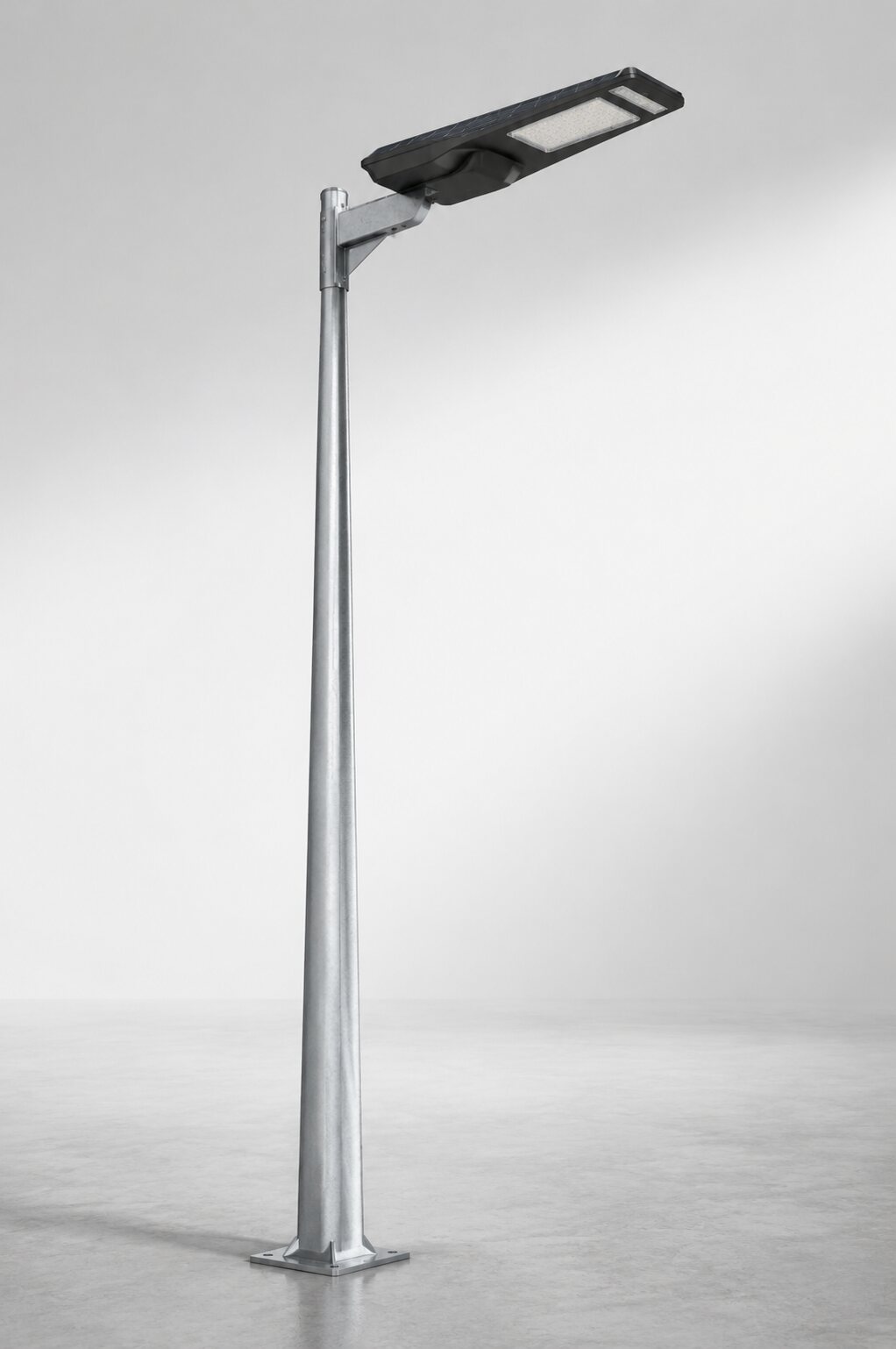
Original generic product visualization prepared for this page. Final dimensions and configuration follow the approved project design.
Configuration optionsConfigure the system around the application
Rural road package
Efficient programmed lighting for village roads, agricultural access routes and secondary roads.
Community package
Comfort-oriented output and optional motion response for residential lanes and public spaces.
Campus package
Clean integrated appearance for schools, parks, resorts and low-speed internal roads.
Engineering note: these packages describe a design direction, not a universal fixed specification. Final values are issued only after the project inputs have been reviewed.Core advantagesSystem-level benefits
Fast installation
The integrated head minimizes separate solar-panel brackets, battery boxes and field wiring.
Clean appearance
A compact luminaire is visually simpler than a split system and suits community or campus environments.
Smart energy control
Timed dimming and optional sensing can allocate limited solar energy to the periods of highest activity.
Typical technical parametersPreliminary selection range
Item Preliminary range / option Project decision basis Rated luminaire class 60 W nominal product class Confirm actual programmed output and LED model Recommended height 5–7 m preliminary range Road width, optic, setback and spacing Solar architecture Integrated photovoltaic top surface Local peak-sun-hours and shading Battery Integrated LiFePO4; model-specific Nightly load, temperature and autonomy Operating mode Dusk-to-dawn; timed dimming Traffic profile and required reserve Sensor option PIR or microwave, model-dependent Road use and acceptable light-response pattern Autonomy 2–4 nights typical target Climate, season and dimming strategy Color temperature 3000 K / 4000 K / 5000 K / 5700 K / 6500 K Visual comfort and project standard Pole finish Hot-dip galvanized; coating optional Corrosion category and appearance Values are preliminary and do not replace a project quotation, photometric report, structural calculation or approved shop drawing.Manufacturing and quality controlFrom engineering review to final inspection
Input review
Confirm site, lighting, wind, operating and corrosion requirements.
Engineering
Prepare the product configuration, loads, drawings and bill of materials.
Production
Fabrication, welding, surface protection and component integration.
Inspection
Dimensions, appearance, function, packing list and document checks.
Design considerationsIntegrated size limits must be respected
An integrated housing has a finite solar collection area and battery volume. Oversized wattage claims without a stated operating profile can create unrealistic expectations. Jieyao therefore confirms the local solar resource, worst-season condition, lighting schedule and required backup nights before selecting the model.
For higher output, longer autonomy or heavily shaded locations, a split solar street light may be a more suitable architecture because the panel and battery can be enlarged independently.
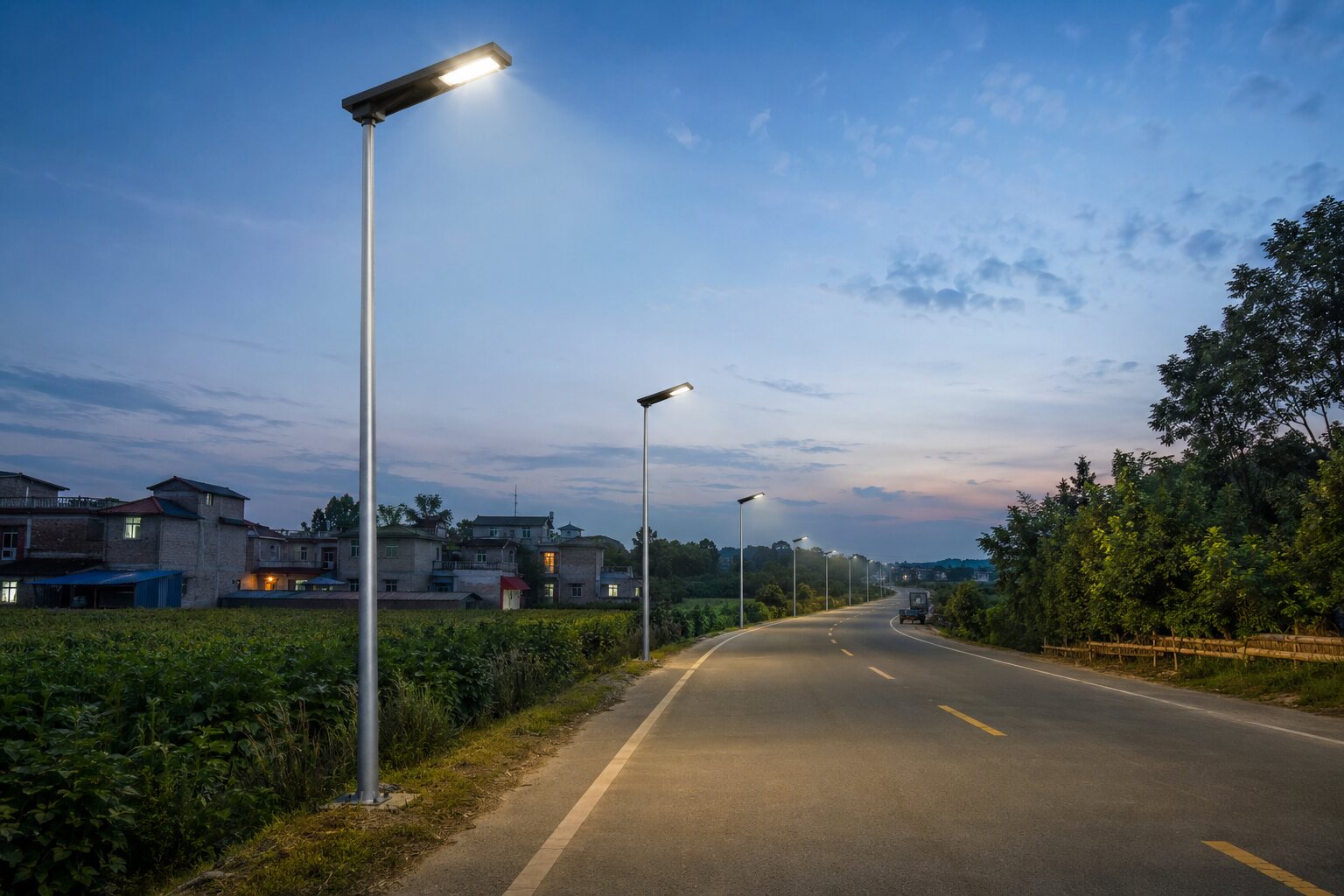
Illustrative rural-road application of integrated solar luminaires. It is a generated design reference, not a completed Jieyao project photograph.
Technical resourcesRelated selection and engineering guides
Compare 6m, 8m and 10m solar lights
Compare solar street light quotations
Solar tender specification checklist
6m rural solar street light system
ApplicationsWhere this system is commonly used
Village and rural roads
Low- to medium-traffic roads where installation speed and energy independence are priorities.
Communities and campuses
Residential lanes, schools, parks and internal access roads requiring a clean appearance.
Agricultural access roads
Farm tracks and service roads where underground cabling is not economical.
Quotation checklistInformation required for an accurate proposal
- Project location and site environment
- Layout drawing or road/yard dimensions
- Required lighting level or applicable standard
- Preliminary pole positions and spacing
- Operating schedule and control requirements
- Design wind speed and reference code
- Corrosion category or coastal exposure
- Quantity, delivery destination and document list
Frequently asked questions60W All-in-One Solar Street Light for Rural Roads FAQ
Does 60W mean full power for 12 hours?
Not necessarily. The programmed power profile may use full output during high-traffic hours and lower output later. The quotation should state the actual schedule.
Is an all-in-one light suitable for cloudy climates?
It may be, if the model is selected using local low-radiation data and the required autonomy. Difficult climates can require a larger integrated model or a split system.
What spacing should be used?
Spacing depends on mounting height, road width, optic, required illuminance and surrounding obstructions. A photometric layout is preferred over a fixed spacing rule.
Can the battery be replaced?
Serviceability depends on the selected housing. Jieyao can propose a model with replaceable LiFePO4 battery modules and accessible controller components.
Can warm white be supplied?
Yes. 3000 K or 4000 K can be selected where visual comfort is prioritized, subject to the final luminaire configuration.
What should a quotation include?
Luminaire model, programmed output, panel data, battery voltage and capacity, controller functions, pole, mounting hardware, packing, warranty scope and calculation assumptions.
Project inquiryReceive a project-specific configuration and quotation
Send the location, site dimensions, lighting target, operating schedule, wind speed and quantity. Jieyao will review the inputs and recommend a documented system.
Send Your RequirementsSolar street light and high mast lighting manufacturer with 15 years of industry experience.
-
-


