

 English
 Español
 Bahasa Indonesia
 Français

Quick answer: A PV module for outdoor lighting must be selected as part of the complete system, not as a standalone wattage choice. Match the exact module’s electrical data and dimensions to the controller, battery, mounting structure, location, seasonal solar conditions and the luminaire’s operating schedule. Request a model datasheet and system compatibility confirmation before purchase.
The cover image is an AI-generated category concept, not a verified Jieyao module or installation.
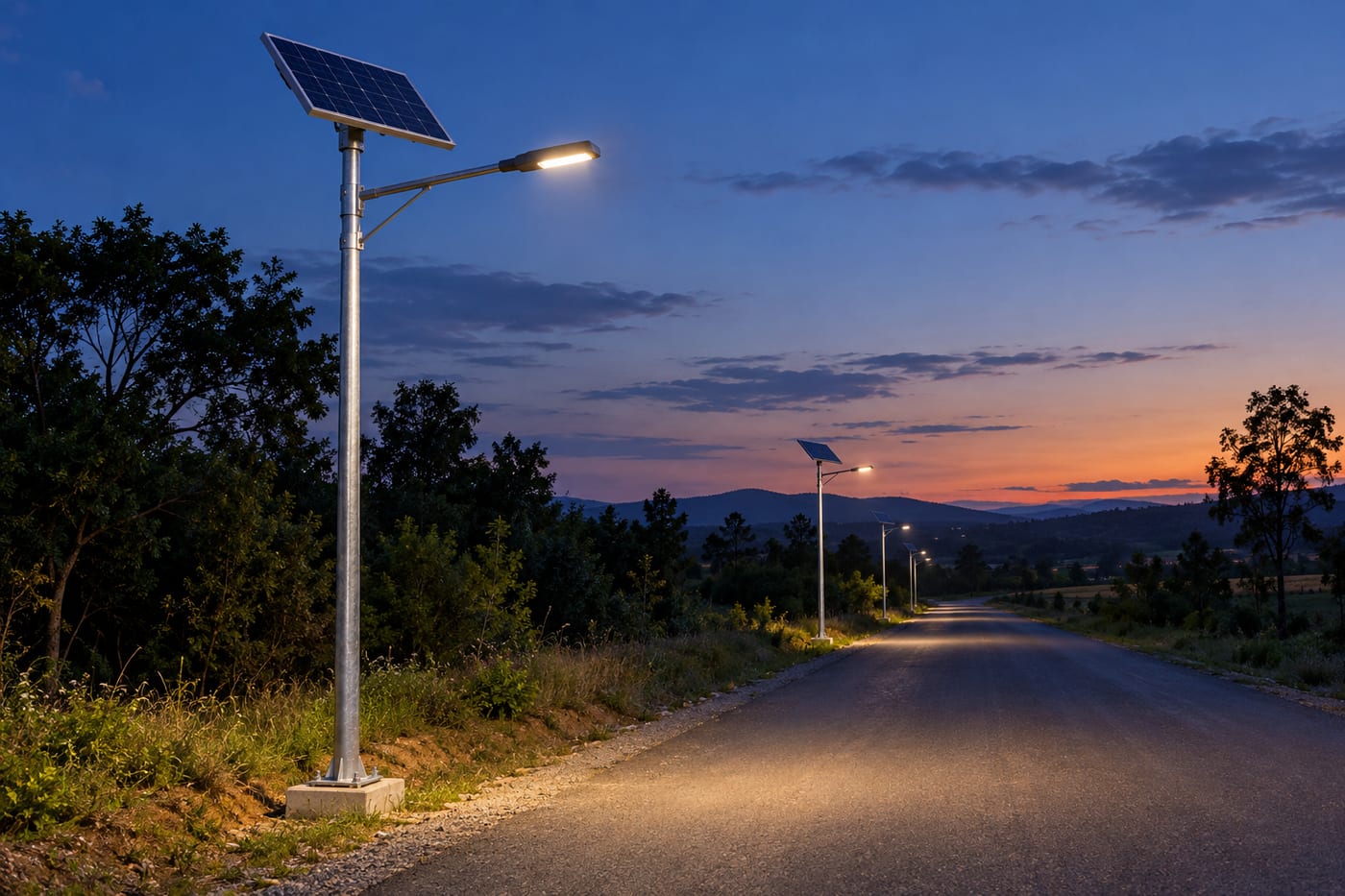
AI-generated category concept for visual context only. It does not depict a verified Jieyao module, SKU or installation.
What the PV module does in an outdoor lighting system
The module converts available sunlight into electrical energy. In a standalone solar street-light system, the rest of the design must manage charging, storage, lighting demand and seasonal conditions. Module size alone does not reveal whether the full system can meet a specified schedule. For system-level context, read how solar street lights work and compare the existing solar street-light product range.
Match the module to the system
| Interface | Details to confirm |
|---|---|
| Electrical output | Model datasheet values and controller input limits for the intended system |
| Storage and charging | Battery chemistry, charging profile and controller compatibility |
| Mechanical fit | Module dimensions, mounting holes, bracket range and service access |
| Site conditions | Seasonal sunlight, shading, soiling, temperature and exposure assumptions |
| Lighting load | Luminaire configuration, dimming schedule, nightly duty and reserve requirement |
Review the site before specifying
Check the proposed mounting orientation and available solar window across the year. Nearby buildings, trees, signs or future development can shade a module. Dust, bird activity, snow or salt may affect cleaning and output. Record who can access the module, how it will be cleaned and whether the bracket can be serviced without disturbing the pole or luminaire.
Mechanical and electrical coordination
Confirm bracket geometry and loading with the pole or support designer. Wind exposure, projected area, cable routing and access all matter to the complete assembly. On the electrical side, request connector type, cable details, polarity, protection and controller limits for the offered configuration. Use the exact drawings and labels supplied for the model; avoid substituting connectors or combining components without written compatibility review.
Module procurement checklist
| RFQ item | Buyer benefit |
|---|---|
| System and module model references | Prevents ambiguity between a module quote and a complete lighting system |
| Datasheet and electrical labels | Allows the designer to check controller and storage compatibility |
| Mounting and dimensional drawing | Supports pole/bracket coordination and service access planning |
| Site and operating profile | Gives the supplier context for seasonal conditions and lighting demand |
| Inspection and replacement scope | Clarifies how modules, connectors and brackets will be serviced |
Frequently asked questions
Can I choose a PV module only by its nominal power?
No. The electrical characteristics must match the controller and storage, while site conditions and the lighting schedule affect system design.
Can one module work with any solar street light?
No. Confirm the exact voltage/current range, connectors, controller limits and mechanical fit for the proposed system.
Does a larger module guarantee more nights of operation?
Not by itself. Storage, load, controls, weather and system losses also affect operation.
What documents should I request?
Ask for the exact model datasheet, dimensional drawing, wiring/interface information, installation instructions and any project-specific test documents.
Does Jieyao list solar modules in its product range?
The company overview lists solar-cell modules among its products. Confirm current models, standalone supply scope and compatibility for the specific project.
For model and system coordination, share the project load and location through the Jieyao project inquiry page.


