

 English
 Español
 Bahasa Indonesia
 Français

- Product details
-
Integrated off-grid lighting for roads and industrial parks
80W All-in-One Solar Street Light
An integrated solar street lighting system combining photovoltaic surface, LED optics, LiFePO4 battery and intelligent controller in a streamlined luminaire for municipal roads, industrial parks, campuses and off-grid access routes.
Request a Solar Configuration15 yearsTeam manufacturing experience10,000 m²Factory site area60+ peopleProduction and support2017Current company name sinceProduct overviewClean installation with no trenching or grid connection
The 80W all-in-one architecture places the solar collection surface, battery, controller and LED light engine in one luminaire. It reduces external component boxes and can simplify installation where trenching, cable routing or grid extension is expensive.
“80W” describes the nominal luminaire class, not a promise of continuous full output throughout every night. A responsible proposal states the programmed lighting schedule, local solar resource, worst-season assumptions, battery capacity and required backup nights. Jieyao selects the model only after reviewing these inputs.
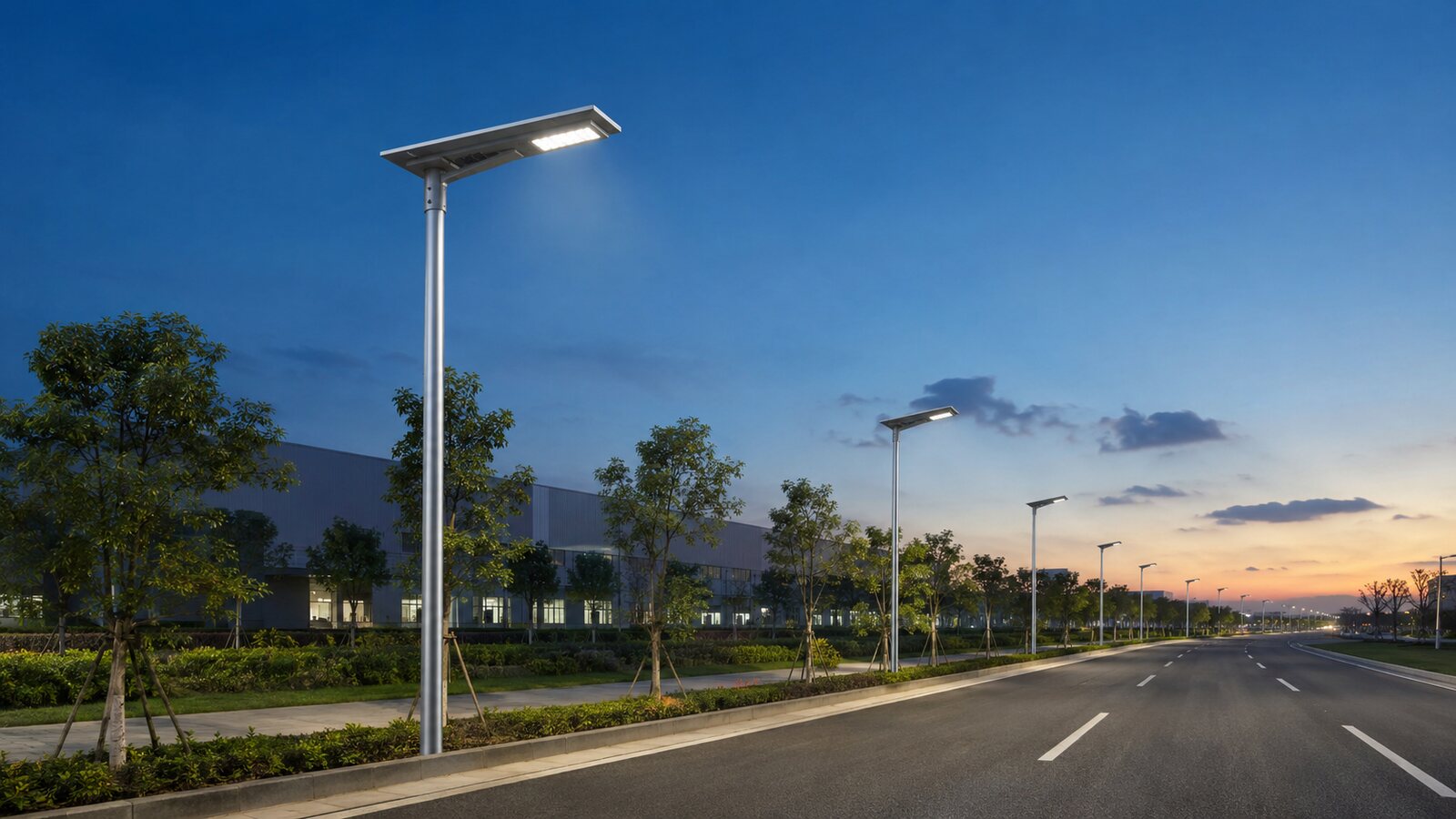
Illustrative product application prepared for this page. It is not presented as a completed customer project.
System architectureFour coordinated components in one luminaire
Photovoltaic surface
Converts daytime solar energy and must be oriented away from persistent shade. Available collection area is one of the key limits of an integrated design.
LiFePO4 battery
Stores energy for night operation. Required capacity depends on the actual power profile, temperature, depth-of-discharge limits and autonomy target.
LED optical module
Road-specific distribution supports longitudinal spacing and uniformity. Beam type should be selected from a lighting calculation.
Intelligent controller
Manages charging, low-voltage protection, timed dimming and optional motion response to balance usable light and stored energy.
Preliminary parametersTypical selection framework
Item Preliminary option Final decision basis Nominal LED class 80 W Programmed output and selected LED model Recommended mounting height 7–10 m preliminary Road width, optic, setback and spacing Battery Integrated LiFePO4; model-specific Night load, temperature and reserve Operation Dusk-to-dawn with timed dimming Traffic pattern and autonomy target Sensor PIR or microwave, model-dependent Application and accepted response pattern Color temperature 3000–6500 K options Visual comfort and project standard Pole Tapered galvanized steel; coating optional Wind, bracket load and corrosion exposure Battery and photovoltaic sizes are not stated as universal values because they change with climate, operating schedule and autonomy requirement.
Sizing methodHow Jieyao selects the solar package
1. Define light demand
Confirm the road width, target lighting level, mounting height, spacing and nightly operating profile.
2. Check solar resource
Review the project location, worst-season peak-sun-hours, temperature and shading conditions.
3. Set reserve
Choose the required backup nights and conservative battery operating limits for the intended climate.
4. Verify fit
Confirm that the integrated housing can provide adequate collection area and storage; otherwise propose a split system.
ApplicationsWhere an 80W integrated solar light fits
Municipal and collector roads
Roads where a clean integrated appearance and avoidance of trenching support fast deployment.
Industrial parks
Internal roads, staff access routes and perimeter areas with adequate daily solar exposure.
Campuses and communities
Schools, residential developments and public spaces requiring a streamlined off-grid luminaire.
Related resourcesCompare before specifying
Define the purchased configuration before comparing an 80W quotation
The nominal wattage does not define the panel, storage capacity or useful light delivered to the road. A comparable quotation identifies the luminaire version, optical distribution, programmed output, battery nominal voltage and watt-hours, photovoltaic rating, controller version and mounting interface. Optional components should be listed separately so a lower price is not confused with the same delivered system.
Energy balance: an explicitly assumed example
For illustration only, assume an electrical load of 80 W for four hours followed by 40 W for eight hours. The nightly load is (80 × 4) + (40 × 8) = 640 Wh. This is a calculation assumption, not the rating or operating programme of a supplied Jieyao model. Controller consumption and conversion losses still have to be added, and the actual power at each dimming step must be measured or documented. A percentage shown in an application is not by itself a verified wattage.
Battery Ah can be compared only with its nominal voltage: nominal Wh = nominal V × Ah. Nominal energy is not the energy available to the lamp. The design must state the allowed operating window, temperature assumptions, conversion efficiency and reserve policy. Panel output must be assessed using the project location, the design month, installation orientation, shading and system losses. A clear-day demonstration does not validate recovery after a sequence of poor charging days.
Road lighting and mounting review
Supply the road cross-section, carriageway and footpath widths, pole positions, setbacks, mounting arrangement and lighting criteria. Request a calculation using the photometric file for the quoted optic and output setting. Review uniformity and glare together with average lighting level. Check whether the submitted file describes the full luminaire or an individual light source; figures for these two boundaries cannot be substituted.
The integrated solar surface and luminaire create a combined attachment. The pole review must include the complete assembly, bracket offset and installation angle. A pole selected for a small conventional luminaire cannot be assumed suitable for a larger integrated solar unit. The site designer should coordinate wind inputs, equipment loading, pole connections, anchors and foundation using the accepted project requirements.
Inspection, commissioning and maintenance
Agree a receiving inspection covering model identity, quantity, mounting parts, damage, component labels and the approved documentation revision. Commission the lighting programme against the ordered schedule and record the installed location and orientation. If a unit reduces output early, investigate charging conditions, shading, battery condition and settings before treating the symptom as a luminaire fault. Electrical work and work at height require competent personnel and an appropriate site procedure.
Plan access to the battery and controller before installation. Confirm whether replacement requires removing the luminaire, how the replacement interfaces are identified, and which settings must be preserved. Cleaning and inspection intervals should reflect actual dust, vegetation, bird activity and weather exposure. Do not specify a universal battery replacement year or assume a company-level certificate proves the performance of a replacement component.
Delivery documents and warranty scope
Request the quoted configuration sheet, approved mounting drawing, component identification, operating programme, installation and maintenance instructions, agreed inspection records and applicable compliance documents. Confirm which optical or electrical reports apply to the delivered version. Define packing, spares, delivery terms and document language in the order. Warranty duration, covered parts, exclusions, claim evidence and remedy follow the written quotation and contract; no single warranty term is assigned by this page.
For a configuration with more panel orientation freedom or greater storage space, compare the split-type solar street light. Review the battery and panel calculation guide before sending your location, operating schedule and backup requirement through the project enquiry form.
Frequently asked questions80W All-in-One Solar Street Light FAQ
Does the light operate at 80W all night?
Not necessarily. A well-designed schedule can use higher output during active hours and reduced output later. The quotation should show the actual programmed profile.
How many rainy or cloudy nights can it support?
Autonomy depends on battery capacity, usable depth of discharge, temperature, solar conditions and dimming strategy. It must be calculated for the project rather than claimed as a universal number.
What pole height is suitable?
A preliminary range is 7–10m, but the correct height and spacing depend on road width, optic, lighting target and nearby obstructions.
When is a split solar street light a better choice?
A split system may be preferable when the project requires higher output, longer autonomy, flexible panel orientation or more battery capacity than an integrated housing can accommodate.
Can the battery and controller be serviced?
Serviceability depends on the selected product housing. Jieyao can recommend a model with accessible, replaceable battery and controller components.
Who supplies the complete system?
The present company name dates from 2017. Jieyao Poles' published company history traces the team's outdoor-lighting manufacturing lineage to Gaoyou City Haozailai Electric Appliance Factory in 2006. The company's stated 15 years of street-light manufacturing experience describes the team's industry experience; it is not the age of the current legal entity. The company reports a 10,000 m² factory site and more than 60 employees, including more than 10 technical personnel, supporting configured solar street lighting systems.
Request an 80W solar street light configuration
Send the project location, road width, pole spacing, nightly schedule, backup-night requirement, quantity and destination. We will review the inputs before quoting.
Send Project Requirements -
-


