


A project-engineered 12m split solar street light system for urban arterial roads, industrial boulevards and wide off-grid corridors, configured from photometric demand, local solar resources, autonomy and wind load.
A 12m mounting height may be considered where a wide road, central median or long setback requires a larger optical footprint than a conventional 6m to 10m system. Typical applications include urban arterial roads, industrial boulevards, airport perimeter roads and wide remote corridors where trenching for grid power would be disruptive or expensive.
The height does not guarantee better lighting by itself. Higher mounting positions increase the required optical output, pole loading and solar-energy demand. Jieyao therefore treats the LED luminaire, optics, photovoltaic modules, LiFePO4 battery, controller, pole, panel brackets and foundations as one coordinated system.
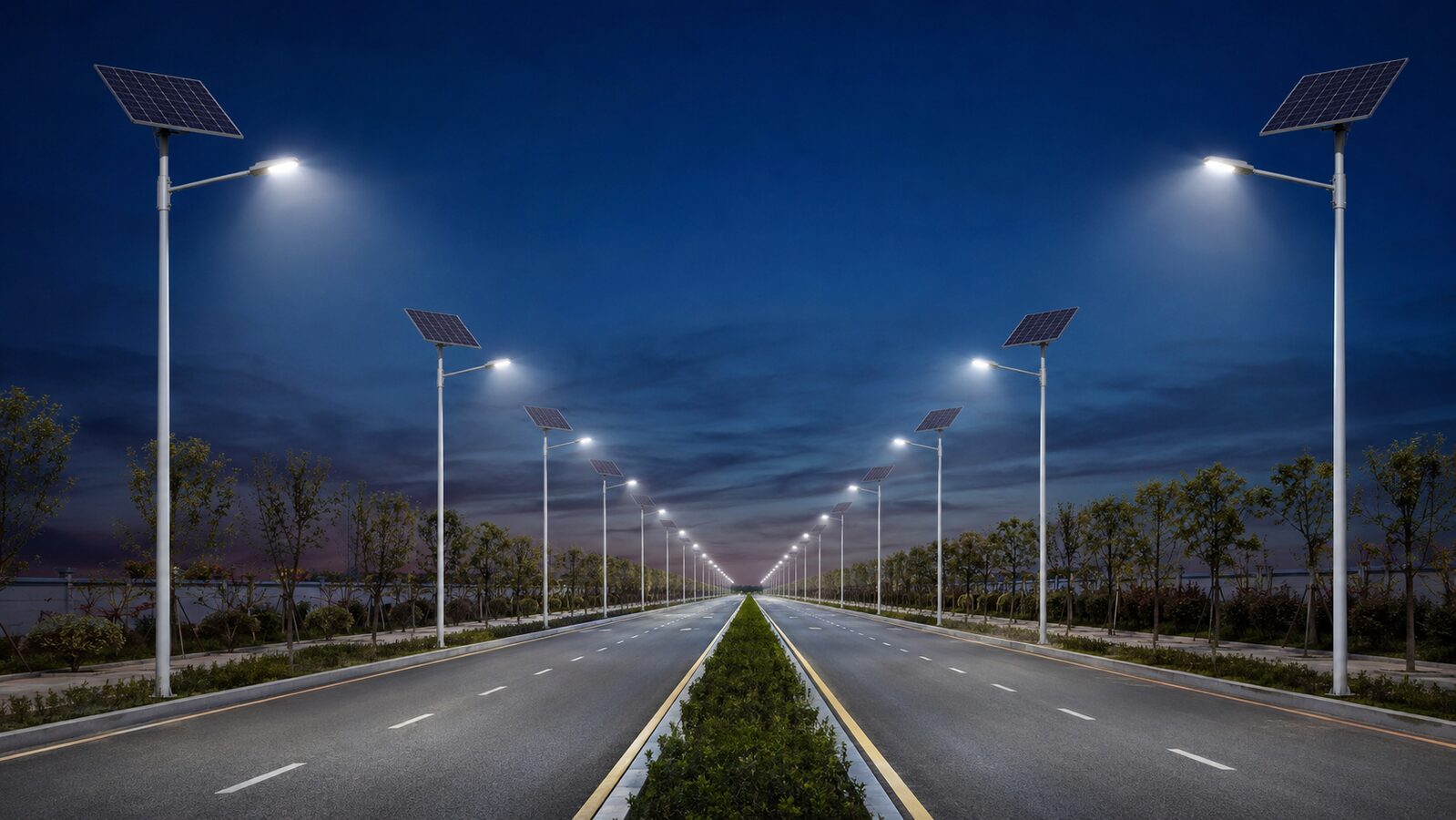
Original generic product visualization prepared for this page. Final dimensions and configuration follow the approved project design.
Double-arm or directional optics for broad carriageways, central medians and controlled pole positions.
Serviceable split components, robust galvanized pole and high-output road optics for plants and logistics zones.
Expanded solar generation and storage for highways or perimeter roads where grid distribution is impractical.
A 12m mounting point can distribute light over a broad carriageway when optical distribution and spacing are validated by a photometric calculation.
Separate photovoltaic modules and battery storage allow the energy system to be enlarged beyond the physical limits of an integrated luminaire.
Lighting, energy and structural assumptions can be issued together for consultant review and procurement comparison.
| Item | Preliminary range / option | Project decision basis |
|---|---|---|
| Mounting height | 10–12 m typical design range | Road geometry, lighting class, setback and pole spacing |
| LED luminaire | 150–240 W preliminary range | Photometric layout, optics and programmed output |
| Solar array | 500–900 Wp preliminary range | Location, tilt, shading, temperature and daily load |
| Battery | LiFePO4; calculated per project | Usable depth of discharge, autonomy and climate |
| Pole arrangement | Single or double arm | Carriageway layout and median position |
| Operating mode | Dusk-to-dawn; multi-stage dimming | Traffic pattern and energy reserve |
| Autonomy | 2–5 nights typical target | Worst-season weather risk and project requirement |
| Optics | Roadway distributions selected by layout | Uniformity, glare, setback and spacing |
| Pole finish | Hot-dip galvanized; coating optional | Corrosion category and appearance |
| Wind design | Project-specific | Local wind speed, code, terrain and panel EPA |
Confirm site, lighting, wind, operating and corrosion requirements.
Prepare the product configuration, loads, drawings and bill of materials.
Fabrication, welding, surface protection and component integration.
Dimensions, appearance, function, packing list and document checks.
Increasing LED output may improve the initial photometric result, but it also increases daily energy consumption and can require larger panels and batteries. Larger panels add projected area and wind load to the pole. The design must therefore be checked as an iterative system rather than as three unrelated calculations.
A proposal should identify the solar-data basis, operating schedule, assumed losses, usable battery capacity and autonomy target. The photometric report should show average and minimum illuminance, uniformity and the dark zones between poles—not only the maximum lux beneath a luminaire.
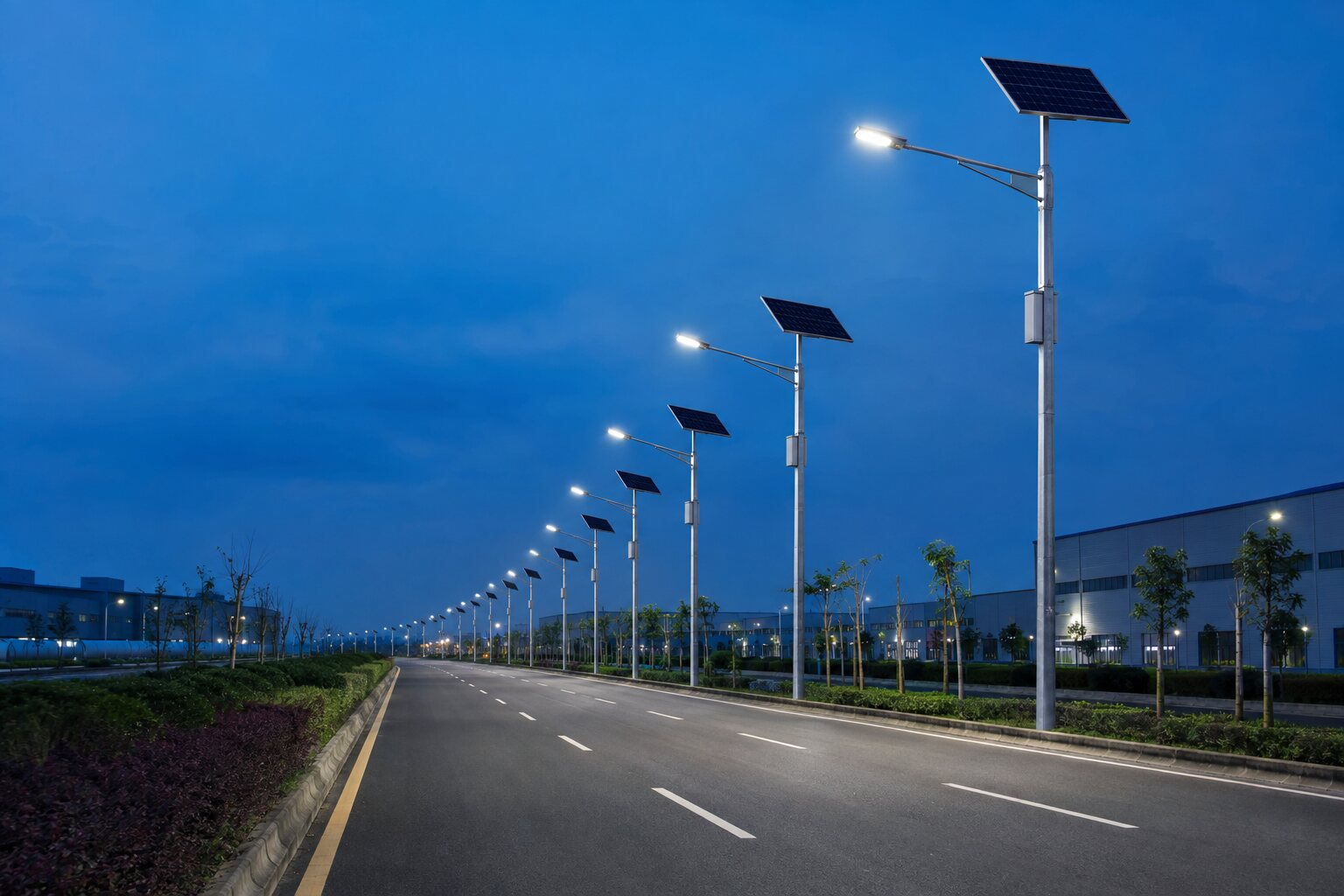
Illustrative high-output solar lighting layout for a wide road. It is an original generic visualization, not a completed Jieyao project photograph.
Wide municipal carriageways and median installations requiring a larger lighting footprint.
Factory, logistics, mining and airport access roads where dependable serviceable components are important.
Highways and perimeter routes where grid cabling, substations or trenching are not economical.
No. The LED load is selected from the road geometry and photometric target. The panel, battery and dimming profile are then calculated around that confirmed load.
Yes, a double-arm arrangement may serve two carriageways or a central median, but the total lighting load, bracket geometry, panel area and wind load must all be recalculated.
Two to five nights is a common project target, but the correct value depends on climate risk, service expectations, available solar array size and the allowed dimming strategy.
Provide the road cross-section, carriageway and median widths, pole setback, proposed spacing, mounting height, lighting class or lux target and any restrictions on pole locations.
Anchor bolts and preliminary foundation reactions can be supplied. Final foundation dimensions require soil parameters and local structural review.
Yes. The specification should state the marine exposure, corrosion category, required galvanizing or duplex coating, fastener materials and enclosure expectations.
Send the location, site dimensions, lighting target, operating schedule, wind speed and quantity. Jieyao will review the inputs and recommend a documented system.
Send Your RequirementsSolar street light and high mast lighting manufacturer with 15 years of industry experience.
Contact Us
Get a custom lighting solution and quotation for your project. Outdoor lighting manufacturer in Yangzhou, ChinaAbout Jieyao LightingYangzhou Jieyao Lighting Equipment Co., Ltd. is an outdoor lighting manufacturer focused on solar street light systems and high mas... Do you have any questions or requests?
Email: jay@jieyaolighting.com

Click to Chat.
Im online now.