

 English
 Español
 Bahasa Indonesia

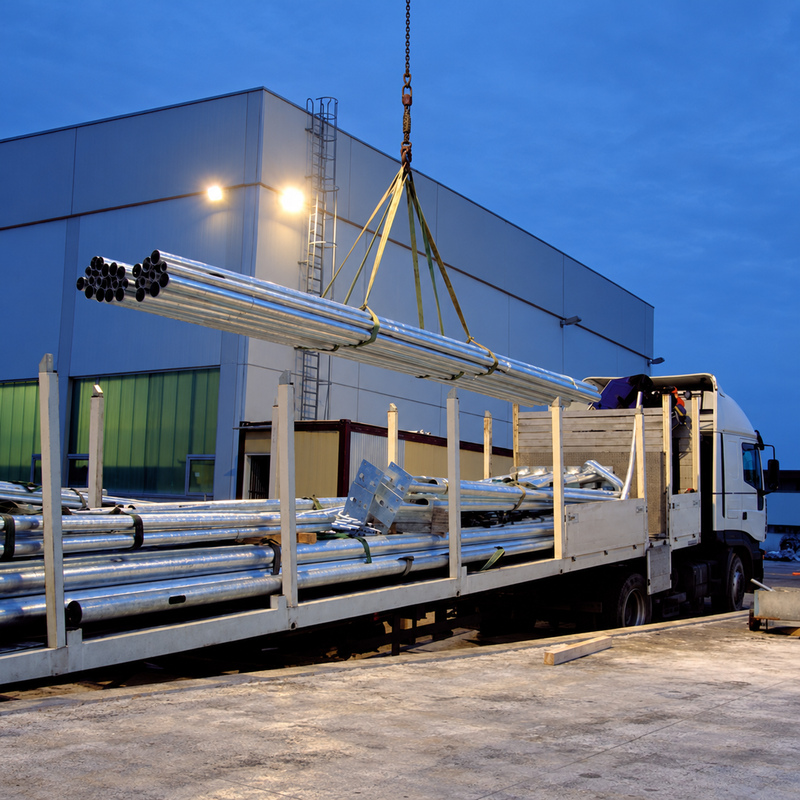
- Product details
-
Product focus: Steel pole and floodlight-support configurations for logistics loading yards, dock approaches and operational vehicle areas. Review single-arm, multi-light and taller floodlight-pole directions against the truck movement plan, maintenance access and approved equipment loads.
Lighting supports around loading operations
A logistics loading yard has more than parked cars. Truck turning paths, trailer bodies, dock doors, stacking areas and service routes affect where a pole can be installed and how its lighting head is arranged. This product scope focuses on the support assemblies and their interfaces. General parking-lot poles and high-mast systems remain separate related products.
Jieyao product materials show single-arm and multi-light steel pole arrangements, flanged shafts and manufacturing references. For a yard order, identify the pole marks against the operational layout. The support geometry should follow the accepted luminaire positions and structural design; the yard application name does not establish a standard height or universal floodlight count.
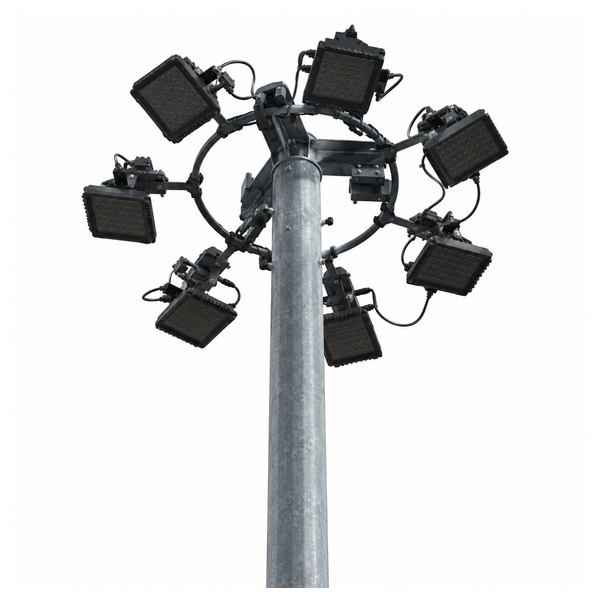 Multi-light product reference. The number, orientation and mass of fixtures follow the selected yard assembly.
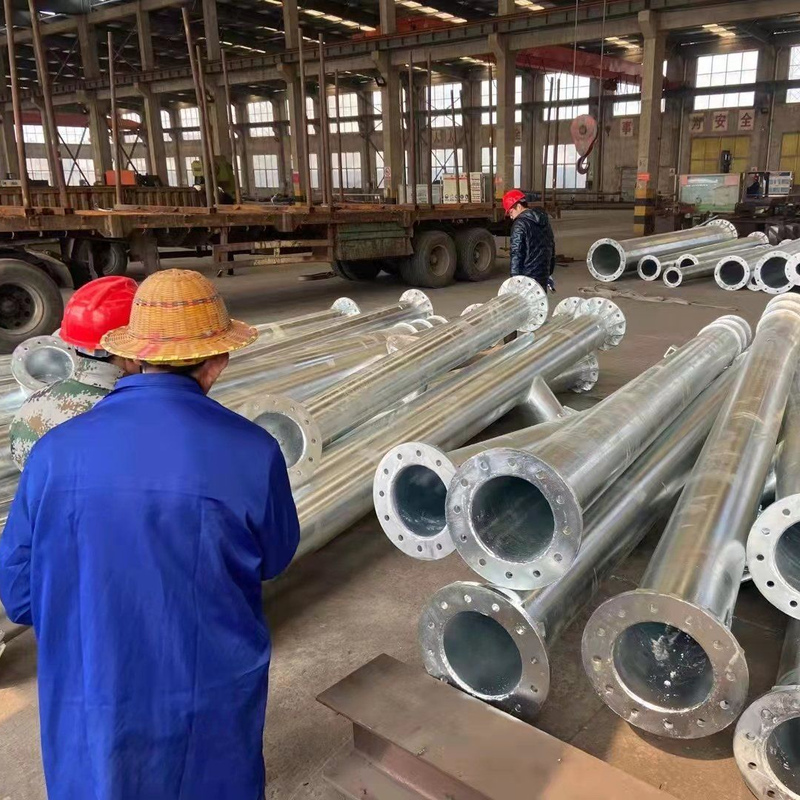 Production reference for flanged steel supports. Base dimensions are specified for each pole mark.
Real 15 m floodlight-pole reference: JYZMTGD-5688
Jieyao factory inspection file No. (2026) 219 identifies a 15 m floodlight-pole product, with conformity-document model JYZMTGD-5688 and production date June 2026. The file records two samples from a batch of two, inspected on 1 July 2026. This is manufacturer inspection evidence, not a third-party certification or a named logistics-yard installation.
Inspection item Requirement in the file Recorded result Height 15 m 15 m Top diameter 120 mm 120.5 mm / 120.2 mm Bottom diameter 280 mm 281 mm / 280.5 mm Base-plate thickness 25 mm 25.2 mm / 25.2 mm Base-plate diameter Ø600 mm Ø600 mm Anchor pitch circle Ø550 mm Ø550 mm Base openings 35 × 45 mm 35 × 45 mm Section wall thickness 5.0 + 6.0 mm 5.03 + 6.05 mm Powder-coating readings Powder layer noted in result table 81 μm / 82 μm Surface / weld appearance Specified appearance checks Reported conforming 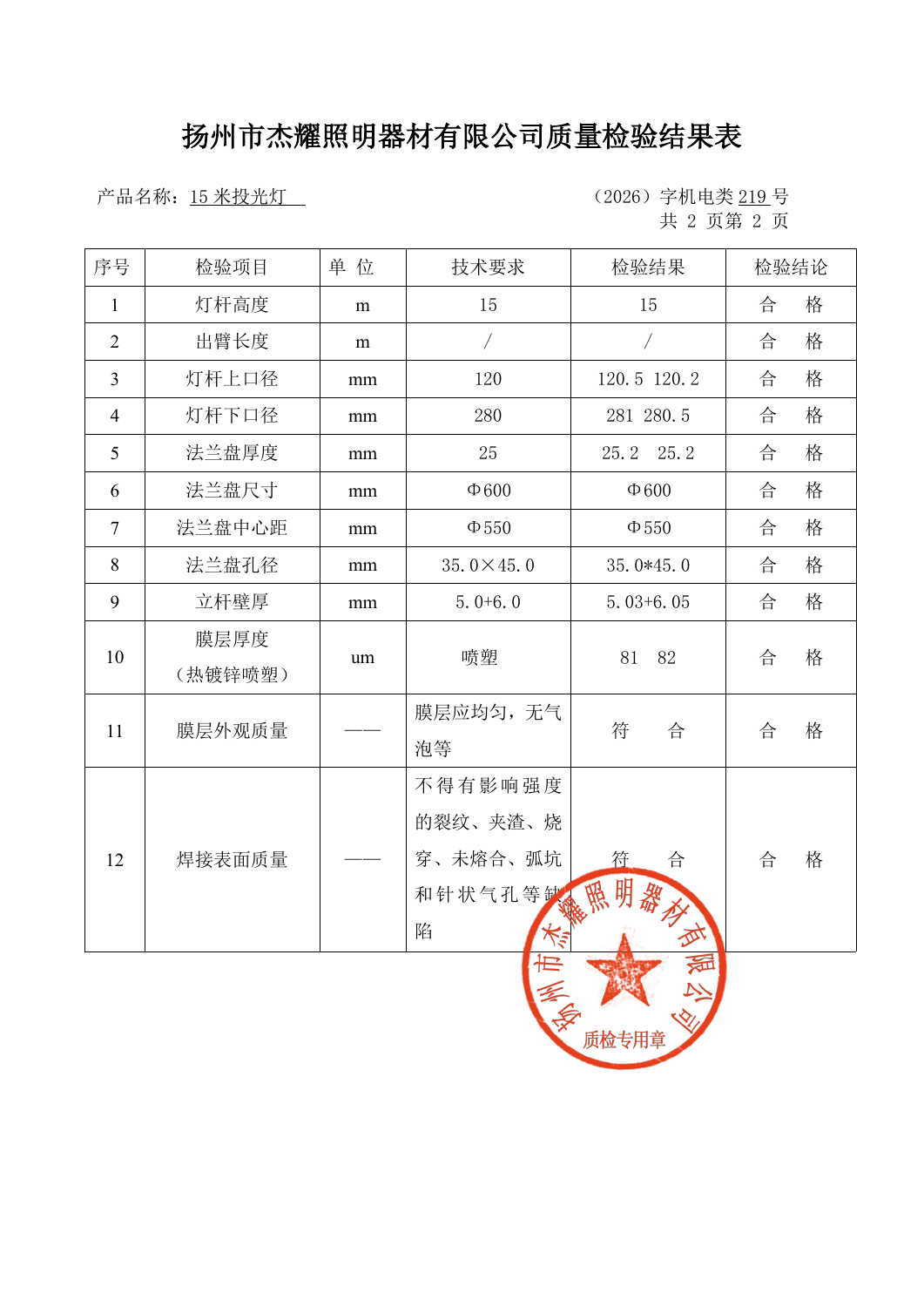 Factory inspection No. (2026) 219: results for the identified 15 m product and sampled batch; not evidence of every yard-pole configuration.
The 81 μm and 82 μm results are reported for the powder coating. They must not be relabelled as zinc-layer thickness. The sampled wall measurements describe the tested sections; they do not establish that another height or headframe can use the same walls. The record provides a concrete manufacturing reference while keeping the final yard arrangement subject to its own released design.
The reference file cites Q/321084 JYZM002—2023 as its inspection basis. Its conformity document and result sheet should be read together to connect the model, batch and measured product. A buyer selecting a different pole mark should request the corresponding drawing and inspection schedule rather than treating this report as a certificate for the entire product range.
Configuration schedule for a loading-yard order
Product item Specify for each pole mark Operational interface Shaft Height, profile, section arrangement, material and finish Vehicle route, setback and structural design Arm or headframe Directions, outreach, fixture positions and fixing details Dock / yard lighting layout Floodlights Exact fixture model, mass, projected area and mounting Photometric calculation and mechanical load schedule Base and anchors Plate, hole pattern, orientation and accepted foundation interface Site foundation and cable-entry drawing Electrical access Door direction, cable route, terminals and earthing Maintenance position and site electrical design Accessories Only identified cameras, signs or other equipment Revised load and attachment checks Truck clearance should be reviewed using the actual vehicle envelope, turning movements and trailer positions. A pole outside a parking bay may still sit in a trailer sweep or a service route. The location decision belongs on the site plan, with any impact protection designed separately. Do not count a steel pole itself as a vehicle barrier.
At loading docks, the luminaire direction must be coordinated with the accepted lighting plan and the approach used by drivers and workers. The pole supplier needs the required mounting geometry and fixture data. A generic “yard floodlight” power rating cannot establish glare control, uniformity or the number of fixtures needed for the operating task.
Shaft, headframe and base details
A multi-light headframe transfers the combined fixture loads to the shaft. Its geometry should show the fixture positions, mounting holes and aiming range. The shaft design needs the actual fixture mass and wind area, together with any cable, sign or other permitted attachments. Adding extra fixtures after delivery changes that configuration and requires review.
For sectioned poles, identify the joint arrangement and assembly marks. The 15 m reference result records a 5 mm plus 6 mm section schedule; it is not a universal sectioning pattern for all yard poles. The released drawing should establish each section, the connection and the assembly procedure for the ordered product.
The base plate coordinates the pole with the foundation and its anchor assembly. Plate diameter, pitch circle and slot dimensions are different measurements and should remain separate in the schedule. The 15 m reference uses a Ø600 mm plate and Ø550 mm pitch circle; neither value alone defines the complete anchor assembly or the foundation capacity.
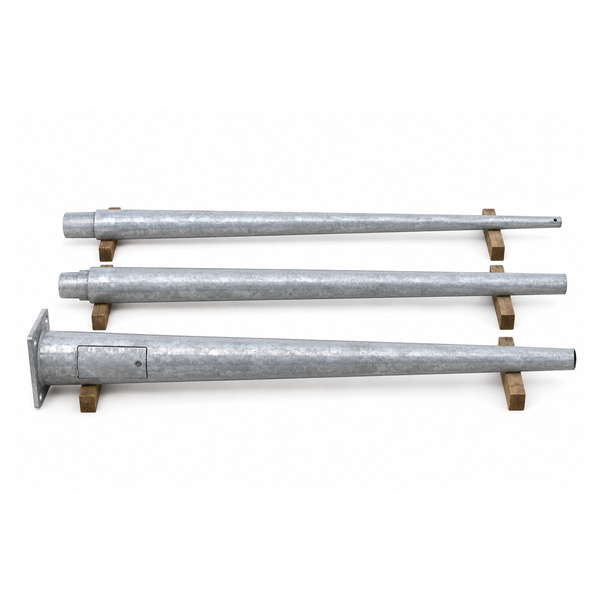 Section-batch reference. Identify the ordered shaft sections and their assembly sequence by pole mark.
Manufacturing and inspection for the selected assembly
Production stage Inspection focus Evidence scope Material receipt Grade identification and plate thickness Material documents for the order Forming and welding Profile, taper, seam and attachment welds Dimensional and visual records; specified further examinations Base and head fit Hole pattern, joint fit, door and fixture orientation Released drawing comparison Protective finish Preparation, zinc and topcoat checks as specified Separate layer measurements and visual observations Equipment fit Fixture brackets, cable access and supplied hardware Assembly checklist for the selected pole mark Release and packing Identification, counted loose parts and document set Factory records and packing list The factory result sheet above demonstrates recorded dimensions and appearance checks for one identified product. For a new order, agree the inspection plan with the required hold points, sampling basis and acceptance criteria. Specified weld examination should state its method and coverage; a general factory inspection statement does not imply every weld received ultrasonic testing.
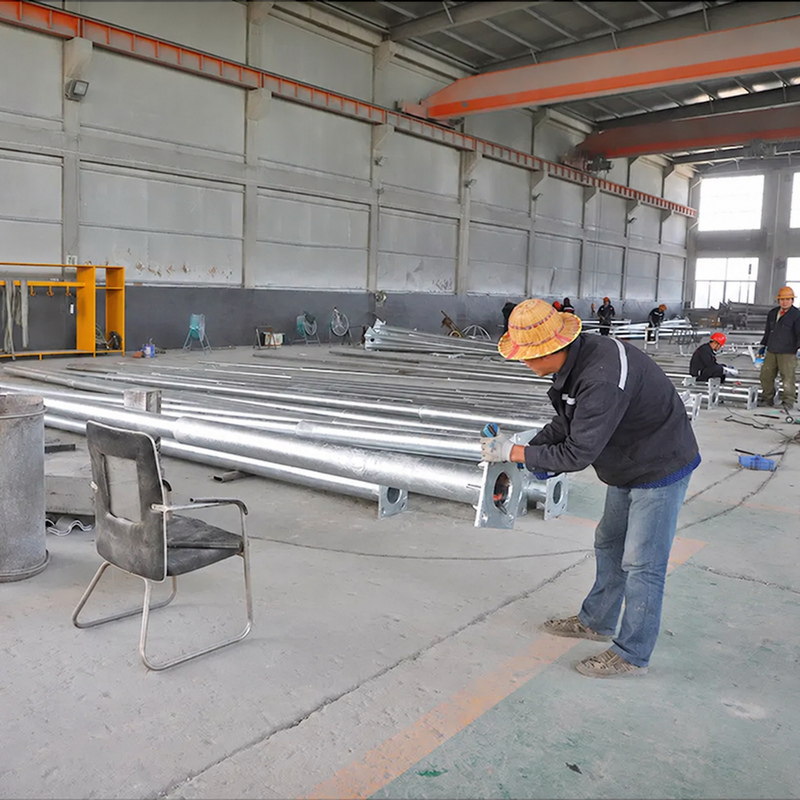 Factory inspection context. Order-specific results identify the measured member, method and accepted drawing.
Yard exposure can include industrial contaminants, washdown or coastal air, depending on the site. Specify the required finish from the actual exposure and project criteria. Do not convert a salt-spray duration from an unrelated sample into a promised service life for the yard poles. Transport damage and site repairs should follow the accepted coating repair procedure.
Maintenance access, shipment and handover
Choose the access method before fixing the product arrangement. Fixed heads can require suitable elevated access equipment; a lowering system is a different assembly with its own components and operating documents. The vehicle route must accommodate the maintenance work zone as well as normal operation. The separate high-mast product page addresses lifting-system supply scope.
The electrical door should remain reachable after impact protection, fences and surrounding equipment are installed. Coordinate cable entry and earthing with the local electrical design, and identify what is supplied inside the pole. A photograph of an access door does not establish an enclosure rating or a complete distribution-board specification.
Packing should preserve the coating and identification of shafts, arms and headframes. List loose fasteners, covers and electrical accessories separately. Where multiple headframe layouts are supplied, mark their destination pole locations so a symmetric-looking assembly is not installed in the wrong orientation.
Send the yard plan, vehicle movement constraints, pole marks, selected luminaire data, structural requirements, foundation interfaces, finish, quantity and destination. The quotation can then identify the pole-and-head scope and its documents, while keeping civil works, incoming power and site erection as explicit responsibility lines. This produces a usable product schedule rather than a generic area-lighting description.
Frequently asked questions
Is a logistics-yard pole the same as a parking-lot pole?
Some components may overlap, but a loading-yard schedule must address truck movements, operational zones, equipment arrangement and maintenance access. The selected assembly follows those requirements.
Is JYZMTGD-5688 certified for any loading yard?
No such blanket claim is made. The file records factory checks for a 15 m floodlight-pole product and sampled batch. Site suitability requires the selected design and equipment schedule.
Are 81 μm and 82 μm zinc readings?
No. The result table identifies powder-coating readings. They are not presented as measured zinc thickness.
Can more floodlights be added later?
The combined loads, headframe, shaft and foundation must be reviewed before changing the fixture arrangement.
Does the pole protect against truck impact?
Do not treat it as a vehicle barrier. Location, setbacks and any impact protection need a separate site design.
What should be supplied with the poles?
The agreed drawings, equipment schedule, factory inspection documents, counted packing list and relevant assembly / maintenance information should match the supplied pole marks.
Related products and enquiry
Send the current drawing, equipment schedule, quantity and destination through Contact Jieyao for a configuration-specific quotation.
-
-