

 English
 Español
 Bahasa Indonesia
 Français

- Product details
-
In brief: A bridge-lighting package should coordinate luminaires, poles or brackets, deck-edge clearances, electrical routes and the roadway photometric design. Because bridge structures and exposures vary, mounting and product selection must be confirmed against project drawings—not a generic pole-height rule.
What makes bridge lighting a distinct procurement task?
A bridge is not simply a road with poles placed at regular intervals. The deck, parapet, barriers, expansion joints, drainage, cable routes and inspection access can constrain where supports fit. A luminaire position can also affect the driver’s view, maintenance access and the lighting transition at each approach. The project's structural engineer and lighting designer need to coordinate the final arrangement.
Exposure can differ from an inland street: wind, moisture, salt, vibration and temperature depend on the site and structure. Specify the actual environment and required documents rather than assuming a universal corrosion class or wind rating. If the package includes a pole or support, the responsible engineer must define the design loads and acceptance criteria.

Bridge roadway application overview; this is not a named Jieyao project.
Bridge lighting package: scope and interfaces
Package element Design question RFQ evidence Luminaire and optics Which distribution, output and mounting orientation meet the approved calculation? Photometric file, model schedule and calculation criteria. Pole, bracket or gantry Where can support be fixed without conflict with barriers or inspection zones? Deck cross-section, support detail and load/interface notes. Electrical routing How will conductors pass through or along the structure and remain serviceable? Conduit/cable route, connection point and maintenance access. Approach transitions How does the bridge lighting connect to adjoining road sections? Approach plans, adjacent luminaire schedule and calculation boundary. Environmental evidence What material, coating, enclosure and test documents does the tender request? Site exposure statement and model-specific compliance schedule. Design review sequence
Start with the roadway model
Define the road width, lanes, barriers, approaches, curve geometry and pedestrian/cycle facilities. Confirm the governing lighting criteria with the project authority.
Coordinate the mounting
Overlay pole or bracket locations on structural drawings. Review clearances, maintenance access, cable routes and conflicts with signs, barriers and expansion joints.
Check the actual submission
Verify the offered luminaire file, support drawing and material documents against the exact model and project revision. Record open deviations rather than relying on brochure descriptions.
Jieyao bridge-roadway enquiry
Jieyao Lighting provides roadway LED lighting products and lighting-pole/structure categories. For a bridge or viaduct enquiry, the project should identify whether supply covers luminaires only, poles and brackets, or a broader coordinated package. The offered scope and technical submittal can then be aligned to the tender. No bridge installation or structural rating is claimed by the illustrative scene on this page.
Review related LED roadway lighting, galvanized steel light poles and overhead-line pole structures as separate product families; project suitability depends on the design brief.
Information to attach to a bridge-lighting RFQ
- Bridge plan, elevation, cross-section and approach-road drawings.
- Lighting class/criteria, calculation grid, target metrics and required file format.
- Permitted mounting zones, structural interface and any load data set by the engineer.
- Site exposure, maintenance-access method, electrical supply and cable routing.
- Bill of quantities, tender schedule, required certificates/reports and delivery terms.
Coordinate the package before quotation.Share the drawings and supply-scope split through the Jieyao contact page so the luminaire, support and documentation can be reviewed together.
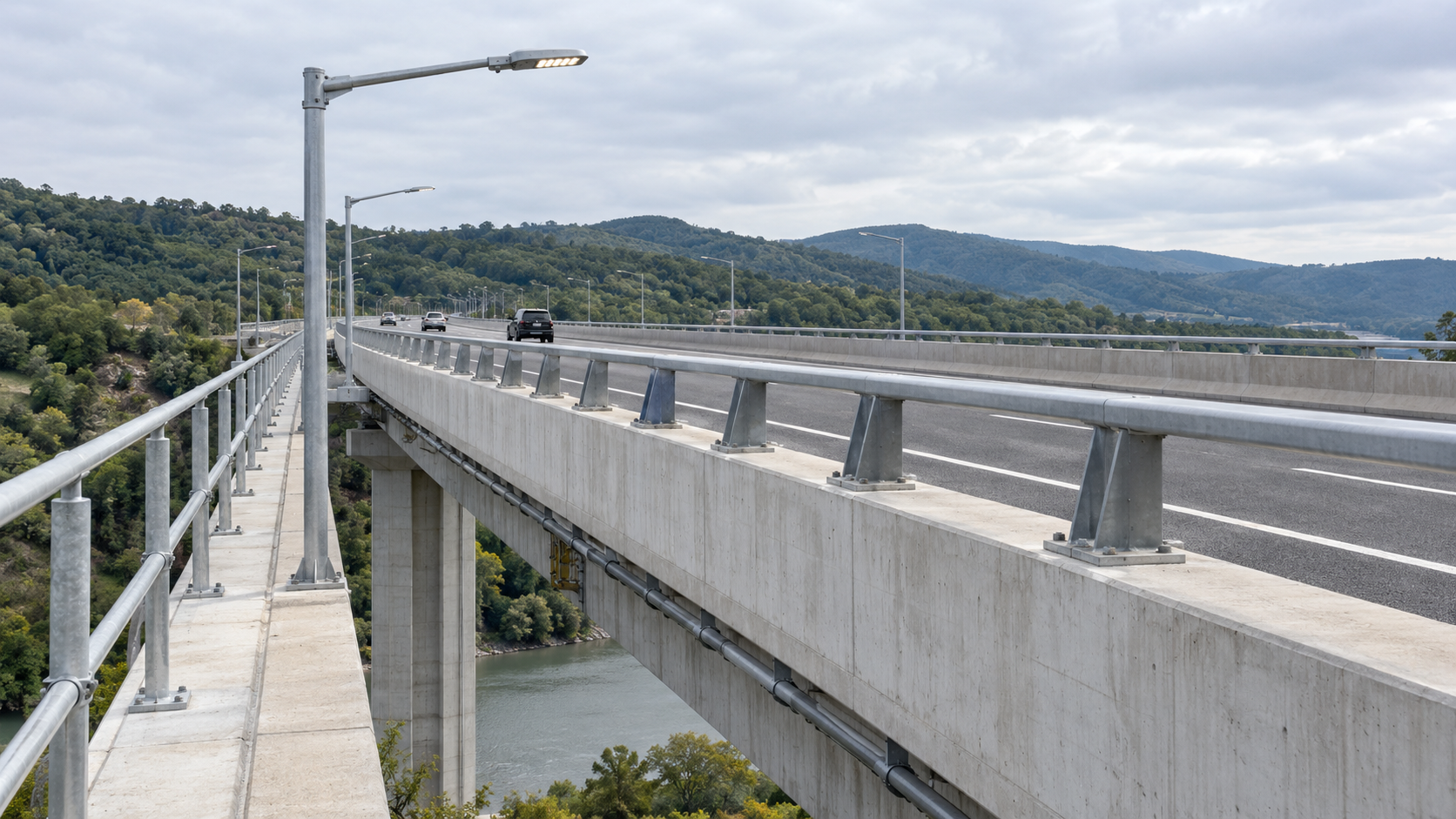
Bridge-edge interface context; the structural fixing and clearance must be checked against approved drawings.
Fabrication, delivery and maintenance coordination
Large bridge projects often split responsibility among the road authority, bridge designer, electrical contractor and lighting supplier. Before production, align the drawing register, revision status, interface responsibility and inspection plan. The supplier's fabrication drawings should use the support details and tolerances approved by the engineer; they should not redefine a foundation or bridge attachment without design approval.
Plan delivery around site access. Bridge components may have transport-length limits, lifting restrictions or restricted installation windows. Confirm the packing/marking scheme, assembly sequence and receiving inspection required by the project. For maintenance, identify how a failed luminaire will be reached and isolated, how the circuit is identified and which parts are intended to be replaceable. These details influence the mounting and control design even when the roadway photometry is unchanged.
Coordination stage Record to close Design freeze Approved luminaire/pole schedule, latest interface drawings and list of deviations. Pre-production Material/finish requirements, inspection checkpoints and approved samples if specified. Delivery Pack list, component marks, handling requirements and delivery sequence. Handover As-supplied schedule, circuit/control notes and maintenance documentation. Design for the bridge approach as well as the deck
Drivers experience a continuous route, not a procurement boundary. Review the bridge deck together with its approaches, transitions, ramps and nearby junctions so a change in mounting geometry does not create an abrupt visual gap or inconsistent calculation. The road authority's criteria determine the accepted limits and metrics; the lighting designer should show those limits on the plan.
Consider sightlines from each approach and the locations of parapets, barriers, sign panels, overhead utilities and maintenance walkways. These features can obscure a luminaire, create a visual obstruction or restrict access to a bracket. Where the deck has more than one carriageway or level, keep each calculation area identifiable and confirm the right photometric file and mounting height are assigned to it.
During design review, record the assumptions that connect the bridge's structural design to the lighting package: approved attachment points, permitted loads, cable routes, access method and responsibility for sealing or reinstating penetrations. These are project interfaces, not generic values. A supplier should manufacture only to drawings accepted by the responsible engineer.
Clarify what the supplier is responsible for
Bridge-lighting contracts may separate luminaire supply, pole fabrication, structural attachment design, electrical works, foundations and commissioning among different parties. Write those boundaries into the responsibility matrix. Identify who approves calculations, who owns the attachment and anchor design, who provides site measurements and who accepts the finished electrical installation.
When comparing supplier offers, check that quantities, optics, mounting details, finish requirements and supporting documents match the same tender revision. A proposal based on an earlier bridge section or a different parapet detail is not directly comparable. If the scope excludes poles or brackets, say so explicitly; if they are included, require drawings and design interfaces before release for production.
Plan for repair and asset identification before the bridge opens. A useful handover identifies the luminaire type and circuit, access/isolation method, replacement interface and the accepted control setting. These details are project-specific, but asking for them early can prevent maintenance constraints from being discovered after installation.
Coordinate the support with the bridge structure
Before comparing bridge roadway luminaires, establish what supports them. A project may use a pole on the deck, a bracket on a parapet, a median support or another arrangement approved by the bridge designer. Each option changes the load path, clearances, cable route and access requirements. The lighting supplier can review the requested interface, but the bridge engineer remains responsible for confirming the structural capacity and approving any attachment to the bridge.
Drawings should show the relationship between luminaires, barriers, inspection walkways, expansion joints, drainage outlets, utilities and maintenance routes. This helps identify conflicts before fabrication. It also prevents a visually convenient position from blocking access or creating a roadside obstruction that the authority has not accepted. For an existing bridge, provide record drawings and survey notes where available; do not assume the as-built structure exactly matches an old general arrangement.
Separate environmental requirements from generic assumptions
Bridges can experience wind, moisture, salt spray, vibration and temperature conditions that differ from nearby roads, but exposure varies by location and construction. Specify the project environment and required coating, corrosion, ingress-protection or structural evidence in the tender. The same principle applies to foundations and fasteners: identify the approved materials and inspection criteria rather than relying on a generic “bridge grade” description.
Compare offers on a common basis. Use the same calculation boundary, mounting height, orientation, photometric criteria and control state for each candidate. If one offer assumes a different pole, optic or dimming profile, ask for a revised calculation before comparing it with the baseline. Keep the luminaire file, structural interface drawing and electrical schedule tied to one model and revision so the procurement decision remains traceable.
Decision stage Bridge-specific check Owner to involve Concept Identify permitted support locations and maintenance access. Road authority and bridge designer. Design Coordinate photometry, clearances, routes and attachment loads. Lighting and structural engineers. Procurement Match the offered configuration to drawings and calculations. Buyer, consultant and supplier. Handover Record installed model, optic, orientation and approved revision. Installer and asset owner. How to compare bridge-lighting offers fairly
Normalize the offers before comparing price or headline output. Confirm that each bidder has priced the same supply boundary, quantities, drawing revision, optics, mounting details, finish and required documentation. A luminaire-only quotation should not be compared directly with a package that also includes poles, brackets, controls or structural attachments. List exclusions beside the priced scope so a missing engineering or installation task is not mistaken for a cost saving.
Then compare technical evidence model by model: the photometric file, declared operating configuration, mounting orientation, product schedule and requested certificates or reports. If a submittal proposes an alternative, ask for a clear deviation list and the calculation or drawing revision that supports it. Keep unanswered questions visible in a clarification log so the owner, designer and supplier share one review record.
A useful bridge-lighting enquiry identifies the road task, structure interface, environmental conditions, responsibility split and acceptance documents. With those inputs, a supplier can respond to the actual tender rather than filling gaps with assumptions.

Bridge-to-road transition is a separate coordination point in the lighting layout.
Frequently asked questions
Are bridge poles always mounted on the parapet?
No universal arrangement applies. Mounting depends on the bridge design, safety clearances, structural approval and maintenance requirements.
Can the same luminaire schedule be used on the bridge and approaches?
It may be possible, but the designer must check geometry, optics, transitions and criteria. The calculation should define where each segment begins and ends.
What environmental rating should I request?
Use the site and tender requirements. Salt exposure, moisture, temperature and cleaning conditions should be stated; exact model evidence must be reviewed before selection.
Does the page show a real bridge installation?
No. The wide bridge image is an application illustration. The second image is a Jieyao roadway-light product example, not proof of a bridge project.
-
-