Quick answer: Electrified-railway overhead-line poles must be designed around the railway system, clearance envelope, contact-wire geometry, loads, foundation and installation method. A buyer should provide the rail authority’s design basis and system drawings; there is no safe universal pole height or section that can be selected without those inputs.
Yangzhou Jieyao Lighting Equipment Co., Ltd. lists steel poles for electrified railway transmission among its product families. This page is a procurement overview, not a certified railway design. Project engineers and the railway authority remain responsible for system design, electrical clearances and acceptance criteria.
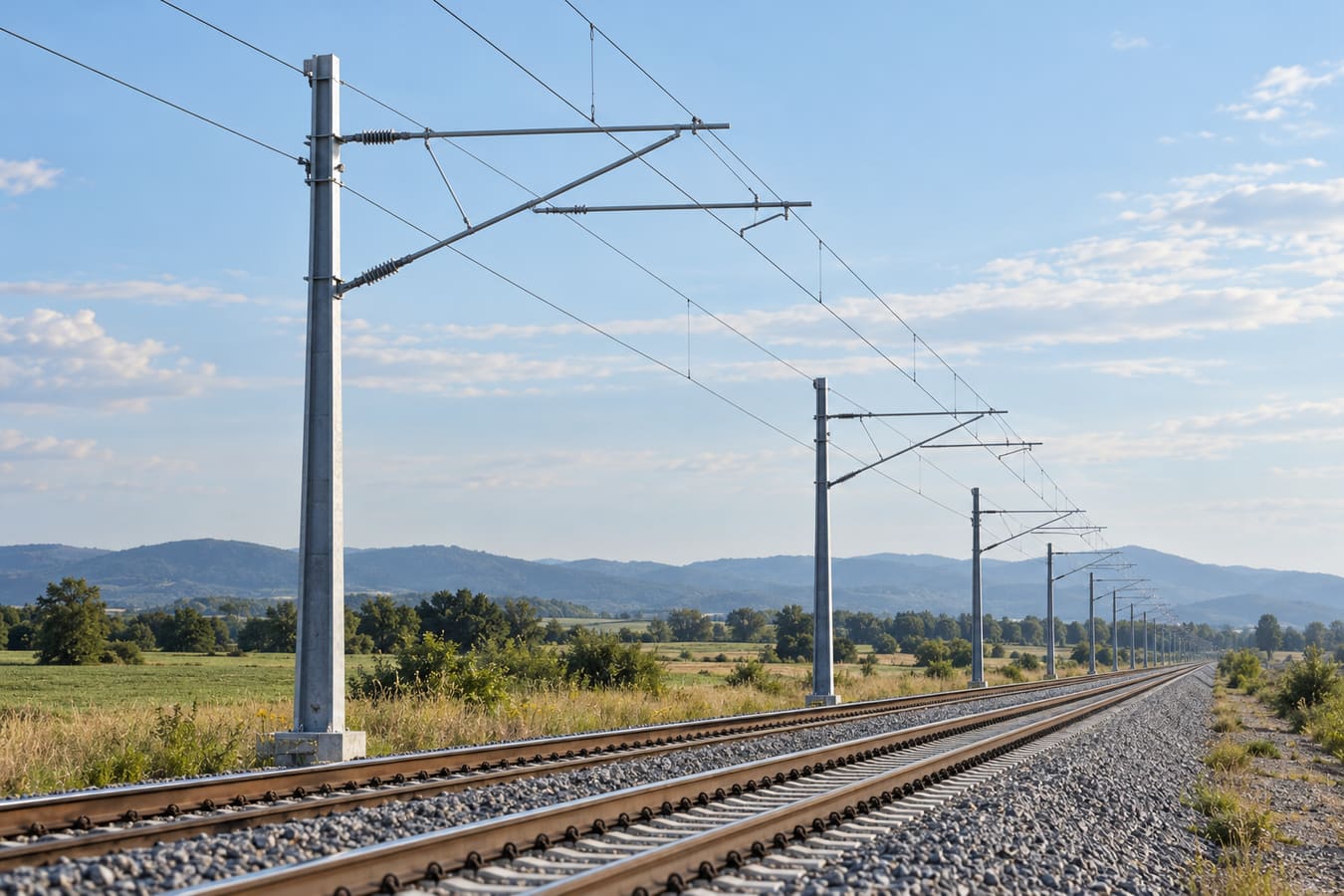
Image note: AI-generated category artwork for visual context. It is not a verified Jieyao pole, railway project or installation.
Where overhead-line poles fit in an electrified railway
Overhead-line support structures hold the equipment that positions conductors above the track. The required geometry is part of the railway electrification system, not a stand-alone steel-pole decision. Track alignment, curves, turnouts, platforms, bridges, tunnels, signals, access routes and adjacent utilities can change the support arrangement.
Start by identifying the system role and location of each pole. The designer can then coordinate the support with contact-wire and messenger-wire positions, insulators, brackets, cantilevers, feeders or other system equipment that the project requires. Confirm which items are within the pole supplier’s scope and which are supplied by the railway systems contractor.
Coordinate the system interfaces before selecting a section
Railway overhead-line pole interfaces to review| Interface | Project information to provide | Review purpose |
|---|
| Track geometry | Alignment, chainage, track count, curves and nearby structures | Position, clearance envelope and support location |
| Electrical system | Authority-approved conductor arrangement and required clearances | Bracket, insulator and equipment compatibility |
| Structural basis | Loads, combinations, exposure and applicable railway criteria | Member design and connection review |
| Foundation and ground | Geotechnical data, buried services and civil interface | Base arrangement, anchor system and constructability |
| Installation method | Access windows, lifting approach, possessions and logistics | Transport sections, lifting details and site sequencing |
| Environment and durability | Corrosion exposure, drainage and maintenance access | Protective finish, inspection and service planning |
Use railway drawings and authority criteria as the source of truth
Do not infer a pole’s required section from a photograph or neighboring structure. Ask the railway systems designer to issue the pole schedule, arrangement drawings, equipment loads and governing design criteria. Where the supplier prepares fabrication drawings, they should be checked against the project design and approved before manufacture.
Clarify tolerances, orientation, connection details, access openings, grounding or bonding interfaces where applicable, and the boundary between structural steel and electrical equipment. These decisions can affect fabrication and installation, so unresolved interfaces should be recorded rather than assumed.
Fabrication evidence and inspection planning
For a procurement package, specify the material documentation, weld and dimensional inspections, protective-finish records, traceability and release documents required by the contract. Requirements depend on the railway authority and the purchase specification; do not accept generic statements as evidence of compliance. Ask the supplier to identify any proposed inspection hold points and the records delivered with each shipment.
Site access may be constrained by track possessions and lifting limits. Confirm shipping lengths, handling points, temporary storage, lifting accessories and erection responsibility early. The railway contractor should verify the installation method against the approved drawings and site safety plan.
Railway pole RFQ information checklist
Documents to include when requesting overhead-line poles| Document or input | Buyer benefit |
|---|
| Railway pole schedule and location plan | Prevents confusion between similar support locations |
| Authority design basis and load data | Gives the structural designer the project criteria, not assumptions |
| Approved system arrangement and interface drawings | Coordinates the pole with conductors, brackets and adjacent assets |
| Foundation and ground information | Defines the base connection and civil works boundary |
| Inspection, traceability and finish requirements | Clarifies what evidence the fabricator must deliver |
| Transport and installation constraints | Supports a buildable delivery and erection plan |
Questions to settle before order release
- Who approves the structural drawings and who approves the electrification interfaces?
- Which attachments are supplied by the pole fabricator and which by the systems contractor?
- How are deviations, drawing revisions and inspection records controlled?
- What site possessions, lifting constraints and delivery sequence govern installation?
Frequently asked questions
Can railway pole dimensions be generated without a project drawing?
A supplier can explain information needed for a quotation, but final dimensions depend on approved system geometry, loads, clearances and foundation inputs.
Does one overhead-line pole design fit every railway?
No. Railway systems and authority criteria differ. Confirm the exact project standard and interface before comparing offers.
Which documents should arrive with the shipment?
Follow the purchase specification. It may identify material, inspection, traceability, finish and release records; the supplier’s offer should state exactly what is included.
Can the pole manufacturer approve electrical clearances?
Electrical clearance and system acceptance belong to the responsible railway designer and authority. The pole supplier should fabricate to approved requirements rather than substitute for that approval.
How can Jieyao review a railway pole inquiry?
Share the pole schedule, authority details, system drawings, load data, foundation interface and delivery constraints through the project inquiry page. For adjacent outdoor pole context, see the existing street-light pole range.
Quick answer: Electrified-railway overhead-line poles must be designed around the railway system, clearance envelope, contact-wire geometry, loads, foundation and installation method. A buyer should provide the rail authority’s design basis and system drawings; there is no safe universal pole height or section that can be selected without those inputs.
Yangzhou Jieyao Lighting Equipment Co., Ltd. lists steel poles for electrified railway transmission among its product families. This page is a procurement overview, not a certified railway design. Project engineers and the railway authority remain responsible for system design, electrical clearances and acceptance criteria.
Image note: AI-generated category artwork for visual context. It is not a verified Jieyao pole, railway project or installation.
Where overhead-line poles fit in an electrified railway
Overhead-line support structures hold the equipment that positions conductors above the track. The required geometry is part of the railway electrification system, not a stand-alone steel-pole decision. Track alignment, curves, turnouts, platforms, bridges, tunnels, signals, access routes and adjacent utilities can change the support arrangement.
Start by identifying the system role and location of each pole. The designer can then coordinate the support with contact-wire and messenger-wire positions, insulators, brackets, cantilevers, feeders or other system equipment that the project requires. Confirm which items are within the pole supplier’s scope and which are supplied by the railway systems contractor.
Coordinate the system interfaces before selecting a section
Railway overhead-line pole interfaces to review| Interface | Project information to provide | Review purpose |
|---|
| Track geometry | Alignment, chainage, track count, curves and nearby structures | Position, clearance envelope and support location |
| Electrical system | Authority-approved conductor arrangement and required clearances | Bracket, insulator and equipment compatibility |
| Structural basis | Loads, combinations, exposure and applicable railway criteria | Member design and connection review |
| Foundation and ground | Geotechnical data, buried services and civil interface | Base arrangement, anchor system and constructability |
| Installation method | Access windows, lifting approach, possessions and logistics | Transport sections, lifting details and site sequencing |
| Environment and durability | Corrosion exposure, drainage and maintenance access | Protective finish, inspection and service planning |
Use railway drawings and authority criteria as the source of truth
Do not infer a pole’s required section from a photograph or neighboring structure. Ask the railway systems designer to issue the pole schedule, arrangement drawings, equipment loads and governing design criteria. Where the supplier prepares fabrication drawings, they should be checked against the project design and approved before manufacture.
Clarify tolerances, orientation, connection details, access openings, grounding or bonding interfaces where applicable, and the boundary between structural steel and electrical equipment. These decisions can affect fabrication and installation, so unresolved interfaces should be recorded rather than assumed.
Fabrication evidence and inspection planning
For a procurement package, specify the material documentation, weld and dimensional inspections, protective-finish records, traceability and release documents required by the contract. Requirements depend on the railway authority and the purchase specification; do not accept generic statements as evidence of compliance. Ask the supplier to identify any proposed inspection hold points and the records delivered with each shipment.
Site access may be constrained by track possessions and lifting limits. Confirm shipping lengths, handling points, temporary storage, lifting accessories and erection responsibility early. The railway contractor should verify the installation method against the approved drawings and site safety plan.
Railway pole RFQ information checklist
Documents to include when requesting overhead-line poles| Document or input | Buyer benefit |
|---|
| Railway pole schedule and location plan | Prevents confusion between similar support locations |
| Authority design basis and load data | Gives the structural designer the project criteria, not assumptions |
| Approved system arrangement and interface drawings | Coordinates the pole with conductors, brackets and adjacent assets |
| Foundation and ground information | Defines the base connection and civil works boundary |
| Inspection, traceability and finish requirements | Clarifies what evidence the fabricator must deliver |
| Transport and installation constraints | Supports a buildable delivery and erection plan |
Questions to settle before order release
- Who approves the structural drawings and who approves the electrification interfaces?
- Which attachments are supplied by the pole fabricator and which by the systems contractor?
- How are deviations, drawing revisions and inspection records controlled?
- What site possessions, lifting constraints and delivery sequence govern installation?
Frequently asked questions
Can railway pole dimensions be generated without a project drawing?
A supplier can explain information needed for a quotation, but final dimensions depend on approved system geometry, loads, clearances and foundation inputs.
Does one overhead-line pole design fit every railway?
No. Railway systems and authority criteria differ. Confirm the exact project standard and interface before comparing offers.
Which documents should arrive with the shipment?
Follow the purchase specification. It may identify material, inspection, traceability, finish and release records; the supplier’s offer should state exactly what is included.
Can the pole manufacturer approve electrical clearances?
Electrical clearance and system acceptance belong to the responsible railway designer and authority. The pole supplier should fabricate to approved requirements rather than substitute for that approval.
How can Jieyao review a railway pole inquiry?
Share the pole schedule, authority details, system drawings, load data, foundation interface and delivery constraints through the project inquiry page. For adjacent outdoor pole context, see the existing street-light pole range.


 English
 Español
 Bahasa Indonesia
 Français