

 English
 Español
 Bahasa Indonesia

- Product details
-
JIEYAO · LIGHT POLE FOUNDATION COMPONENTS
Screw Pile Foundations for Street Light Poles
Specify a screw pile for a street light pole as a coordinated steel foundation assembly: shaft, helical bearing elements and a pole connection matched to the selected base. Jieyao accepts project enquiries for screw-pile supply with the required geometry, protective finish and connection details.
Send the pole-base drawing, foundation loads and ground information for a configuration quotation. Pile length, shaft section, helix geometry and the head connection are selected together; pole height alone is not a foundation specification.
Request a Screw Pile Quotation
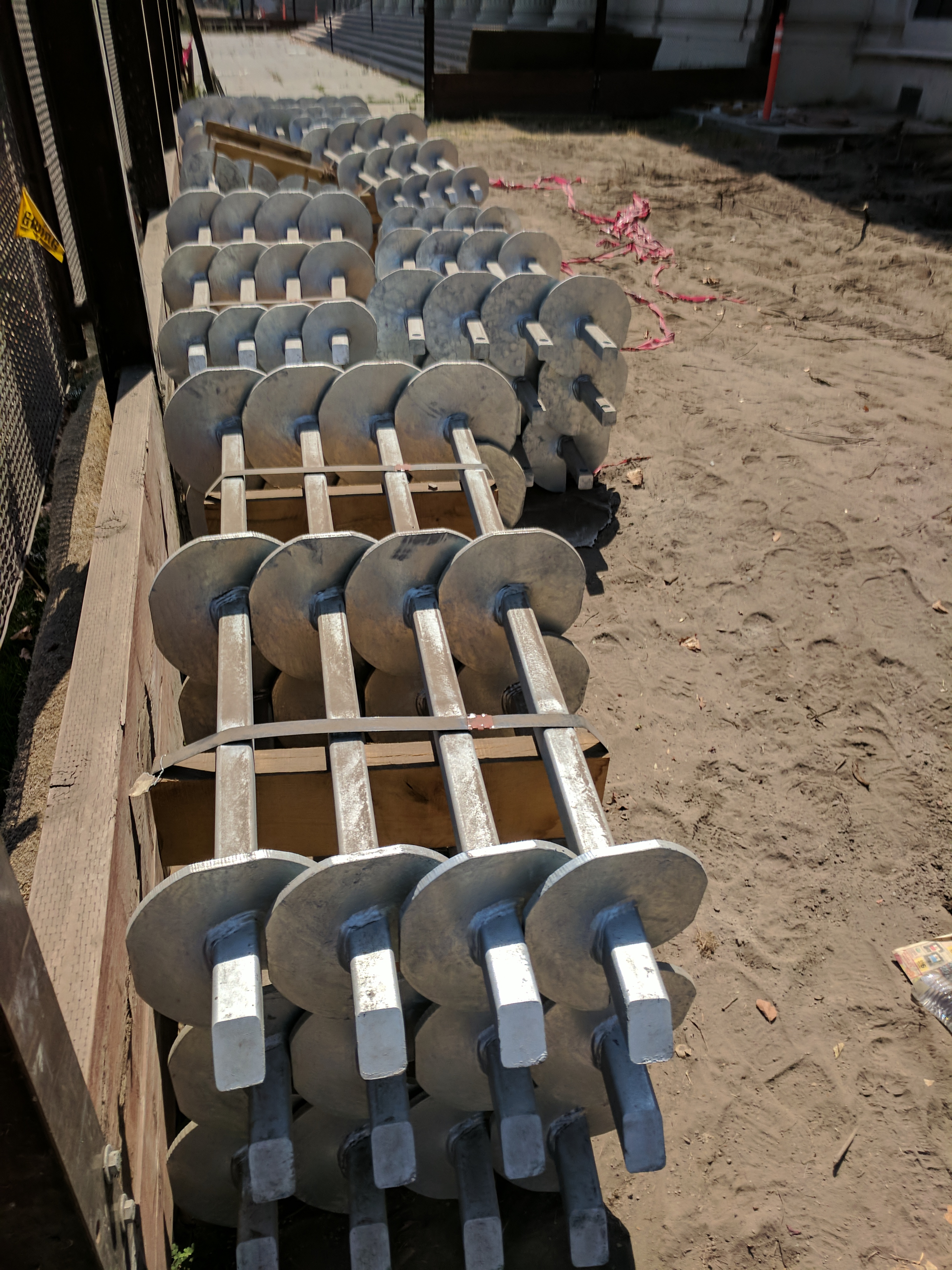
External construction photograph: helical piles staged at Alameda High School, not a Jieyao installation. Photo: Argyriou (https://commons.wikimedia.org/wiki/File:StackOfScrewPiles.jpg), CC BY-SA 4.0 (https://creativecommons.org/licenses/by-sa/4.0/), unchanged.
Define the foundation package
Pile body
Specify the steel shaft, helix arrangement, installation end and any designed extension joints. The released drawing identifies the complete below-ground assembly.
Pole-head connection
Match the pile head or engineered adapter to the pole flange. Define hole pattern, fasteners, level and orientation rather than relying on a nominal pole size.
Installation interface
Agree the drive connection, installation equipment and acceptance records with the installer. Pile supply and installation services are separate items in the quotation.
Select the helix arrangement
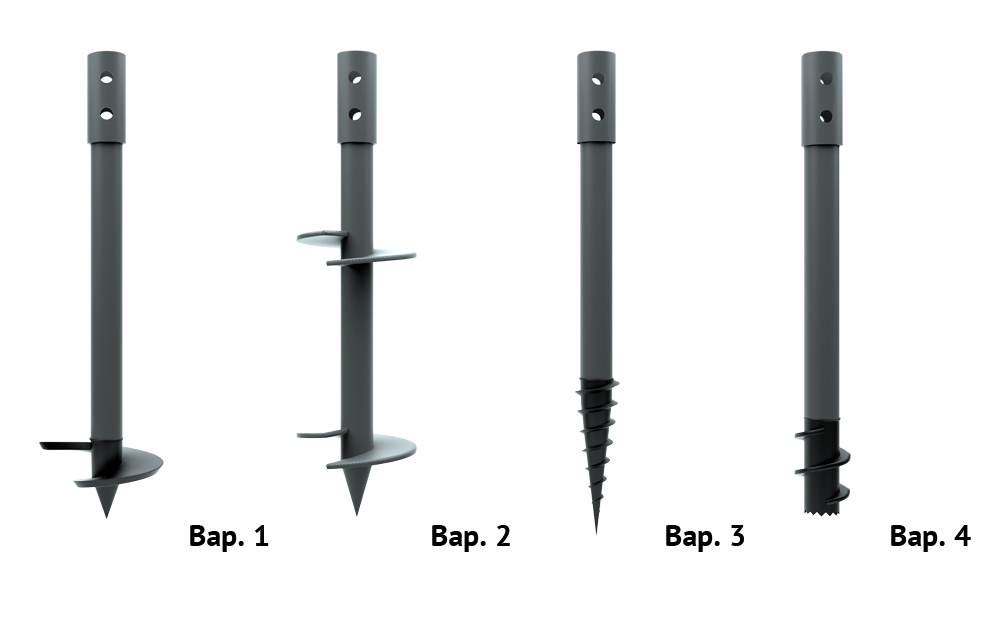
Ground screws and helical piles are related terms used for steel foundations installed by rotation. Products can have different shaft shapes, bearing plates or continuous screw-form sections. The appropriate form depends on the designed loads, ground profile and installation method.

Helix-form illustration for comparing geometry, not a Jieyao stock-model catalogue. Максимка Воронцов (https://commons.wikimedia.org/wiki/File:%D0%92%D0%B8%D0%B4%D1%8B_%D0%B2%D0%B8%D0%BD%D1%82%D0%BE%D0%B2%D1%8B%D1%85_%D1%81%D0%B2%D0%B0%D0%B9.jpg), CC BY-SA 4.0 (https://creativecommons.org/licenses/by-sa/4.0/), unchanged.
Single bearing helix
A single plate provides one defined bearing level. The designer specifies its diameter, thickness, position and connection to the shaft for the intended ground conditions.
Multiple bearing helices
Several spaced plates provide a different foundation geometry. Plate spacing, shaft details and installation requirements must be designed together; more plates do not automatically mean a suitable light-pole foundation.
Screw-form ground anchor
A narrower screw-form profile is another configuration to review. Do not substitute it for a separately designed helical foundation solely because both products rotate into the ground.
Product configuration schedule
Component Data to define for the quotation Matching document Shaft Section shape, outside dimensions, wall thickness, length and steel designation Released pile drawing and material requirements Helical elements Number, diameter, thickness, spacing and pitch or formed profile Foundation designer’s geometry Pile head Flange or adapter dimensions, bolt holes, orientation and finished elevation Pole-base interface drawing Extensions Required segments and joint detail, where included Assembly drawing and installation sequence Finish Protective system, coverage and inspection requirements Project corrosion specification Cable coordination Cable route, conduit interface and protection, if required Electrical and foundation layout Supply scope Pile, head/adapter, fasteners, loose accessories and quantities Itemised quotation and packing list Project configuration: This page does not assign a universal pile length, load rating or service life. Those values belong to the selected foundation design and site acceptance basis.Structural details worth checking

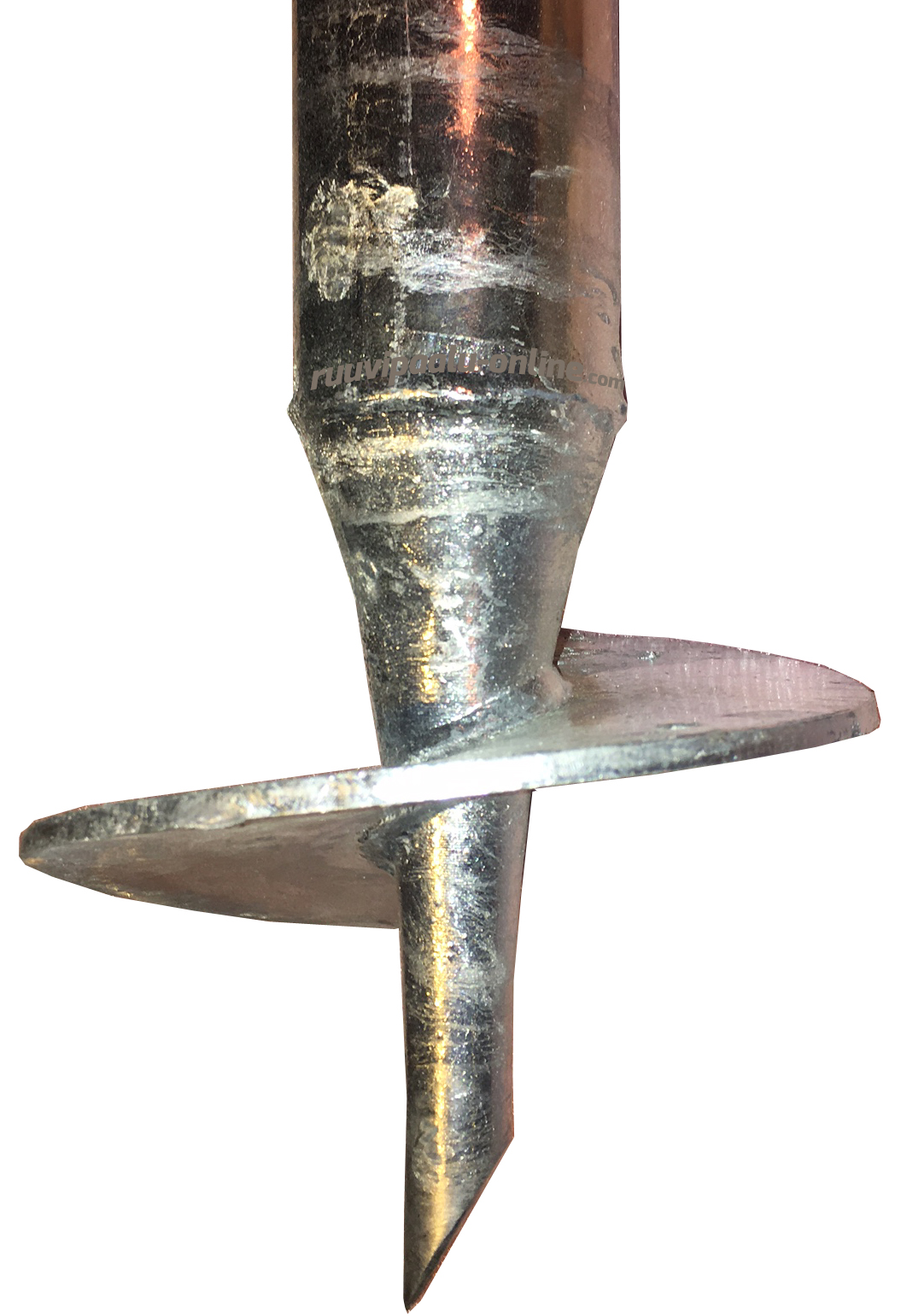
External screw-pile tip detail, not a tested Jieyao sample. ruuvipaalu-online (https://commons.wikimedia.org/wiki/File:Ruuvipaalun-k%C3%A4rki.jpg), CC BY 3.0 (https://creativecommons.org/licenses/by/3.0/), unchanged.
The helix transfers force through its connection to the shaft. Review the plate geometry, attachment and the installation end on the same drawing. The shaft must also suit the installation process and the required foundation actions.
At the top, check how the pole connects to the pile. A flanged light pole requires a matching connection with defined bolt locations and access for assembly. Include any adapter in the load path and in the corrosion-protection schedule.
Where extensions are needed, identify the segment lengths and joint parts before supply. Keep the connection accessible during installation and record the final installed arrangement against the pile mark.
Ground conditions and foundation loads
A street light produces lateral force and overturning moment as well as vertical actions. Solar panels, long arms, banners or cameras change the equipment arrangement and may change the foundation demand. Provide the complete pole and equipment schedule, not just luminaire wattage.
Input What to provide Why it matters Ground profile Site investigation, layers, groundwater and known obstructions Controls embedment feasibility and the design approach Foundation actions Design compression, uplift, lateral loads and bending moments with their basis Defines what the foundation must resist Pole interface Base drawing, equipment arrangement and connection elevation Coordinates the pile head with the complete support Installation constraints Access, buried services, available equipment and working clearances Determines whether the proposed method is practicable Acceptance plan Required testing, installation records and acceptance authority Establishes how suitability is checked for this project Ground-screw manufacturer Krinner’s technical FAQ (https://www.krinner.io/en/service/faq/) likewise identifies soil information, the foundation plan and on-site load testing as important inputs. This is background guidance, not a Jieyao test certificate or a rating for the illustrated piles.
Manufacturing and inspection requirements
Before fabrication
Confirm material identity, drawing revision, shaft and helix dimensions, head connection and any required welding examination. Keep the inspection scope in the purchase specification.
Dimensional and surface checks
Check the supplied geometry against the released drawing, including helix positions and pole-head holes. Review the agreed protective finish and handling damage before dispatch.
Delivery documentation
Agree material records, dimensional results, finish records and identification required for the order. A photograph alone does not establish steel grade, weld acceptance or foundation capacity.
Site acceptance is a separate stage. Record pile location, installed depth and other installation measurements required by the foundation designer. Any use of installation torque as a capacity indicator needs a documented project-specific basis; a generic torque value is not a load certificate.
Screw pile or concrete anchor cage?
A screw-pile foundation is rotated into soil as a designed foundation system. A cast-in anchor cage positions the bolts embedded in a concrete foundation. These are different supply packages with different design and site requirements.
If your project already specifies a concrete foundation, see light pole anchor bolts and foundation cages. For the above-ground assembly, compare custom steel street light poles. Confirm the foundation route before ordering either package.
Send a complete foundation enquiry
Include quantity, destination, pole drawing, equipment schedule, base connection, foundation actions and available ground information. State the requested pile-body and head scope, finish, documentation and delivery requirements.
The quotation should identify the proposed configuration, included components and information still required before manufacture. Installation equipment, site testing, electrical works and foundation engineering should each have an agreed responsible party.
Request a Screw Pile QuotationScrew pile product questions
Can I choose the screw pile from the pole height?
No. Pole height is only one input. Supply the pole and equipment arrangement, foundation actions, base interface and site ground information.
Are ground screws and helical piles interchangeable?
The names overlap in searches, but the actual geometry and design basis can differ. Select the specified assembly rather than substituting by name.
Can a screw pile be used for a solar street light?
It can be considered as a foundation option after the solar-panel, pole and ground requirements are reviewed. The panel arrangement must be included in the foundation design.
Is a screw pile suitable for every soil?
No universal suitability is claimed. The site investigation, obstructions, installation constraints and required verification determine whether the proposed system is appropriate.
Do the photographs show your completed projects?
They are attributed external geometry and construction references. They do not represent Jieyao installations, stock-model dimensions or product test results.
What information is needed for a firm quotation?
Provide the required configuration and quantity, pole-base drawing, load and ground information, finish, accessories, inspection documents and destination.
-
-