

 English
 Español
 Bahasa Indonesia
 Français

- Product details
-
In brief: A roundabout lighting plan should evaluate the circulating roadway, entry and exit lanes, central island and pedestrian/cycle crossings together. There is no universal pole location or wattage: the designer must use the adopted project standard, verified photometric files and actual site geometry.
Why a roundabout is not just a short road segment
Vehicles approach, yield, circulate and leave along different paths. A lighting design therefore needs to consider the driver's view at each entry, the circulating lane, the central island edge and any pedestrian or cycle movement. Nearby intersections, signs, landscaping and buildings may also affect visibility or create obstructions. The project boundary should include enough of each approach to review the transition into and out of the circle.
Roundabout lighting should be coordinated with the road authority's criteria. A product datasheet cannot determine the correct arrangement by itself: mounting position, distribution, tilt, pole location and operating strategy influence the result and should be assessed in the calculation.

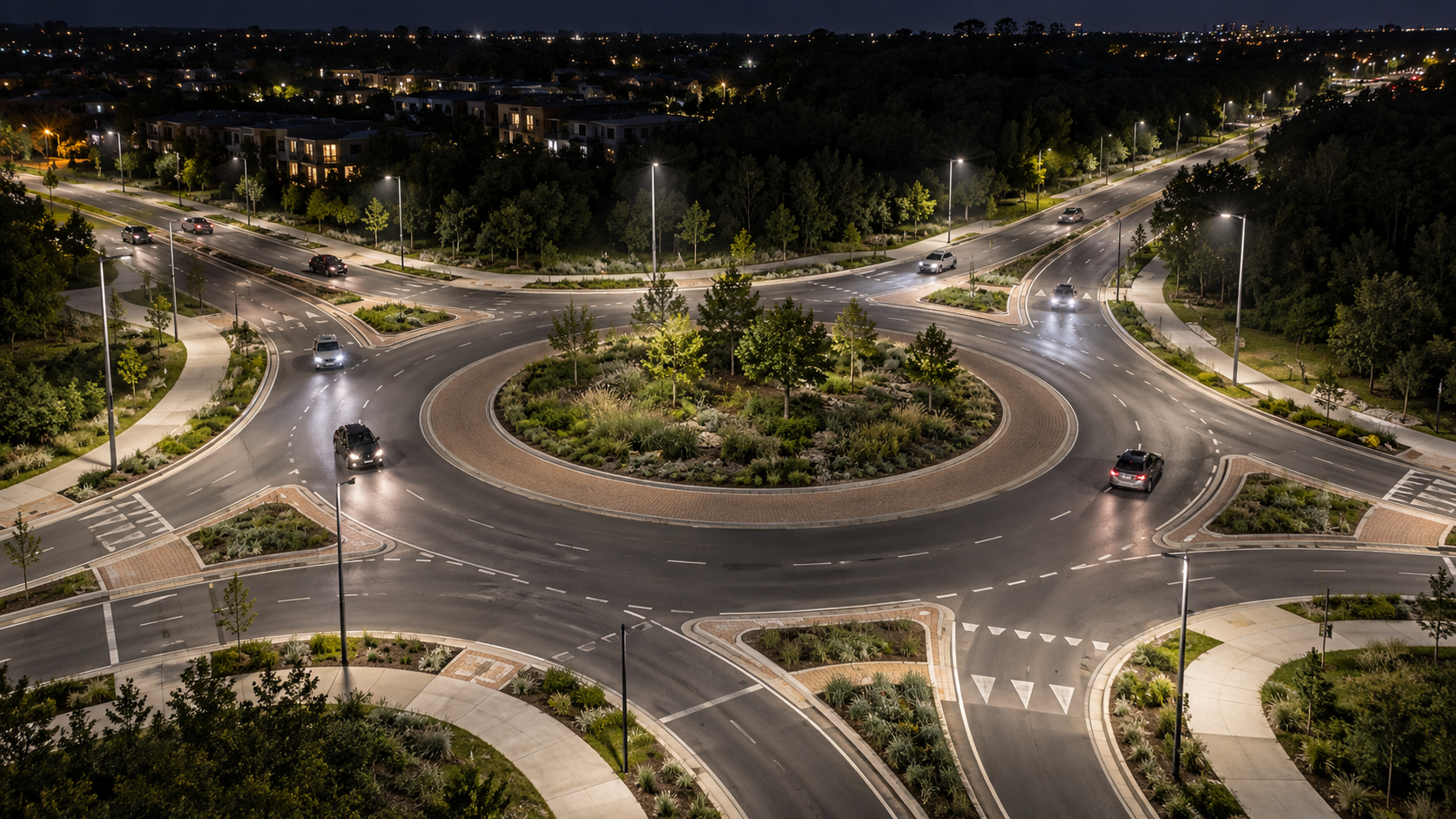
Roundabout application overview; no measured project result is implied.
Roundabout design inputs and product interfaces
Design input Question to resolve Project evidence Geometry What are the circle, entries, exits, splitter islands and approach lengths? Survey or CAD plan with dimensions and lane markings. Users and conflict points Where do pedestrians, cyclists, vehicles and transit routes interact? Crossing locations, paths, refuges and operating context. Lighting criteria Which class, calculation metrics and maintenance basis are specified? Authority standard, tender clauses and calculation boundary. Mounting and optics Where can luminaires be placed while respecting sight lines and access? Pole locations, mounting details and model-specific IES/LDT files. Environmental constraints Are there nearby homes, trees, signs or sensitive areas? Site photos, property boundaries and spill/glare requirements. Practical review sequence
1. Map the full movement
Draw vehicle trajectories and pedestrian/cycle crossings, including approach transitions. Mark signs, landscape and structures that could obstruct light or sight lines.
2. Set the calculation boundary
Follow the tender's method and include the circulating lane, conflict points and relevant approaches. Keep assumptions and calculation inputs visible for review.
3. Coordinate supports and service
Compare proposed poles, brackets and access with the civil plan. Confirm the required electrical/control interface and the documents needed for acceptance.
Jieyao roundabout product coordination
Jieyao Lighting supplies roadway LED lighting products and associated lighting-pole categories. For a roundabout project, define whether the RFQ covers luminaires only or also poles, foundations and controls. A project-based review can then match available product evidence to the specified criteria. This page does not promise a safety outcome or claim a completed Jieyao roundabout installation.
Related pages: LED street lights, high-mast lighting and galvanized steel light poles. These pages have different product intents and should not be treated as automatic roundabout design selections.
What to send for a roundabout-lighting quotation
- Current plan, survey, road geometry and any available cross-sections.
- Traffic, pedestrian and cycle movement notes plus crossing locations.
- Applicable authority criteria, specified class and photometric deliverables.
- Existing or permitted pole locations, supply and control requirements.
- Nearby property boundaries, obstructions, signage and landscape constraints.
- Quantity schedule, required reports, delivery location and project timeline.
Get the calculation boundary right first.Send the roundabout layout and tender criteria via the Jieyao contact page for a project-specific product review.
Keep a clear calculation and approval trail
Roundabout layouts can change during civil coordination. A shifted splitter island, new sign, revised crossing or landscape feature can affect the light distribution and the visibility of a luminaire. Keep the CAD base, calculation file, product schedule and marked-up comments at the same revision. The reviewer should be able to trace each change to an updated input and see whether it affects the circulating lane, an approach or a pedestrian area.
When comparing alternatives, change one design input at a time where practical. For example, compare an optic or mounting adjustment using the same calculation boundary and surface assumptions. If several assumptions change together, it becomes harder to tell which change improved or weakened the result. Document the reason for the preferred option, any residual deviation and the party authorized to accept it.
Review record Good practice Drawing revision Show date, revision and the civil/lighting documents used as the model base. Photometry Record the exact luminaire file, output, tilt and mounting coordinates. Alternatives Keep comparable runs with unchanged criteria and identify the single variable tested. Approval Log authority comments, accepted deviations and final product schedule. Include the full conflict area in the review
The design boundary should show the approaches, entry curves, circulating lane, exits and any marked pedestrian or cycle crossings requested by the project. A calculation that stops at the roundabout edge can miss a transition, waiting area or location where drivers judge another vehicle's path. The authority's criteria define the required extent; the plan should make it visible and reviewable.
Map the lighting layout against signs, trees, central-island features, barriers, bus stops and adjacent properties. These can affect sightlines, shadowing, glare or spill. Note planned landscaping at mature size when that information is available, and identify assumptions that remain provisional. If civil geometry or signs change after calculation, revisit affected areas rather than assuming the prior result still applies.
For a useful comparison, document the reason for each alternative: a dark approach, an obstructed view, glare toward a nearby property or a maintenance-access concern. Compare options against the same criteria and disclose trade-offs. This creates a defensible selection record without promising that one pole arrangement suits every roundabout.

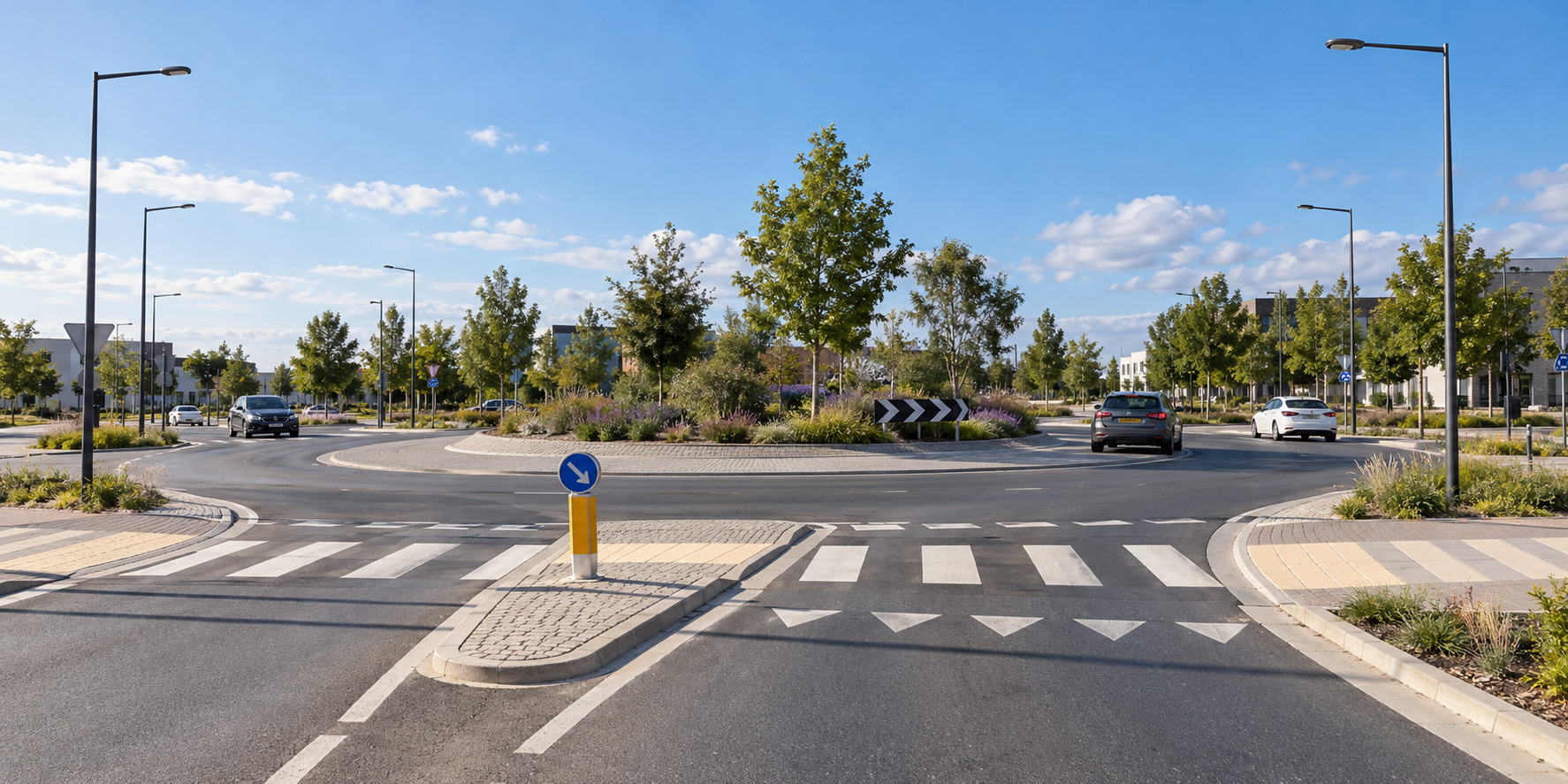
Roundabout layout context; the calculation boundary should include relevant entries and exits.
Coordinate with signs, landscape and future maintenance
Check the approved layout against the final positions of directional signs, regulatory signs, trees, public art, barriers and utilities. A design can change when one of these items moves, even when the road geometry appears unchanged. Record which civil and landscape revisions were used, and request an updated calculation if a luminaire becomes obstructed or a new visual feature is introduced.
For maintenance planning, identify how each fixture will be accessed, isolated and replaced without creating an unmanaged traffic conflict. Confirm whether access equipment, circuit labeling or controls documentation is included in the project handover. The operating agency should know which party is responsible for inspection and how the system can be returned to the approved setting after service.
If the project combines a roundabout with crossings, a bus stop or a nearby junction, define each area separately in the schedule while showing how they connect. This makes procurement and review easier: the engineer can see the specific application, the supplier can match the offered configuration to it, and the authority can approve the combined arrangement against its own criteria.
Compare entry, circulation and exit conditions together
A roundabout plan should not be reviewed as a circle alone. Entry lanes, circulating paths, exits, splitter islands, pedestrian crossings and any cycle movement create different viewing directions and conflict points. The calculation boundary should include the parts of the approach that the project authority expects to evaluate. If a nearby junction or shared-use path affects the design, include it in the brief instead of assuming the standard roundabout template covers it.
When comparing layouts, use the same assumptions for each option: road geometry, mounting arrangement, luminaire file, output setting, aiming direction and evaluation criteria. A candidate that appears brighter in a visualization may still leave a low point or create glare. Review the calculation results and the rendered distribution together, and have the lighting designer explain any trade-off between the central island, circulating lane and entries. Do not use an illustrative scene as a substitute for a project calculation.
Coordinate lighting with visibility, landscape and service needs
Central-island planting, signs, barriers, pedestrian refuges and utility equipment can obscure a luminaire or a driver's view. Check current and expected vegetation, including mature tree canopy, and confirm that supports do not obstruct accessible paths or vehicle clear zones. The authority should approve sign visibility and road-safety interfaces; the lighting supplier should not be expected to make those decisions from an image alone.
Maintenance planning should identify access to each unit, safe work zones, isolation points and any traffic-management requirements. Record the selected optic and orientation so a replacement does not silently change the approved distribution. For a multi-entry roundabout, group the schedule by location or circuit so installation, aiming and future maintenance can be checked against the same plan.
Area to review Design question Project record Entries and exits Are transitions and driver approaches included in the calculation? Plan showing lane geometry and evaluation boundary. Central island Could planting, signs or structures obstruct light or sightlines? Landscape and sign coordination drawing. Pedestrian/cycle routes Which paths and waiting points are within the task? Route plan and applicable criteria. Operations How are circuits, controls and maintenance access arranged? Schedule, control narrative and service plan. Build a review package that can be checked through handover
Keep the roundabout plan, luminaire schedule, calculation report and support drawings tied to one revision register. The package should show the geometry used for each calculation, the location of every support, the adopted criteria and any assumptions about future planting or nearby works. When a reviewer asks for a change, record whether it affects photometry, structural coordination, electrical routing, quantity or maintenance access.
Before procurement, compare offers against the same schedule and supply boundary. Check model identity, optical distribution, mounting arrangement, finish, control interfaces and required technical documents. A substitution should include enough information for the designer to assess the changed arrangement; a similar product name or wattage is not a substitute for the specified photometric file. Keep a list of open deviations and assign each to an approver.
At handover, retain the approved drawings, as-supplied product schedule, commissioning records required by the contract and maintenance instructions. This traceable set helps the road operator understand what was installed and gives future maintenance or redesign work a reliable starting point.

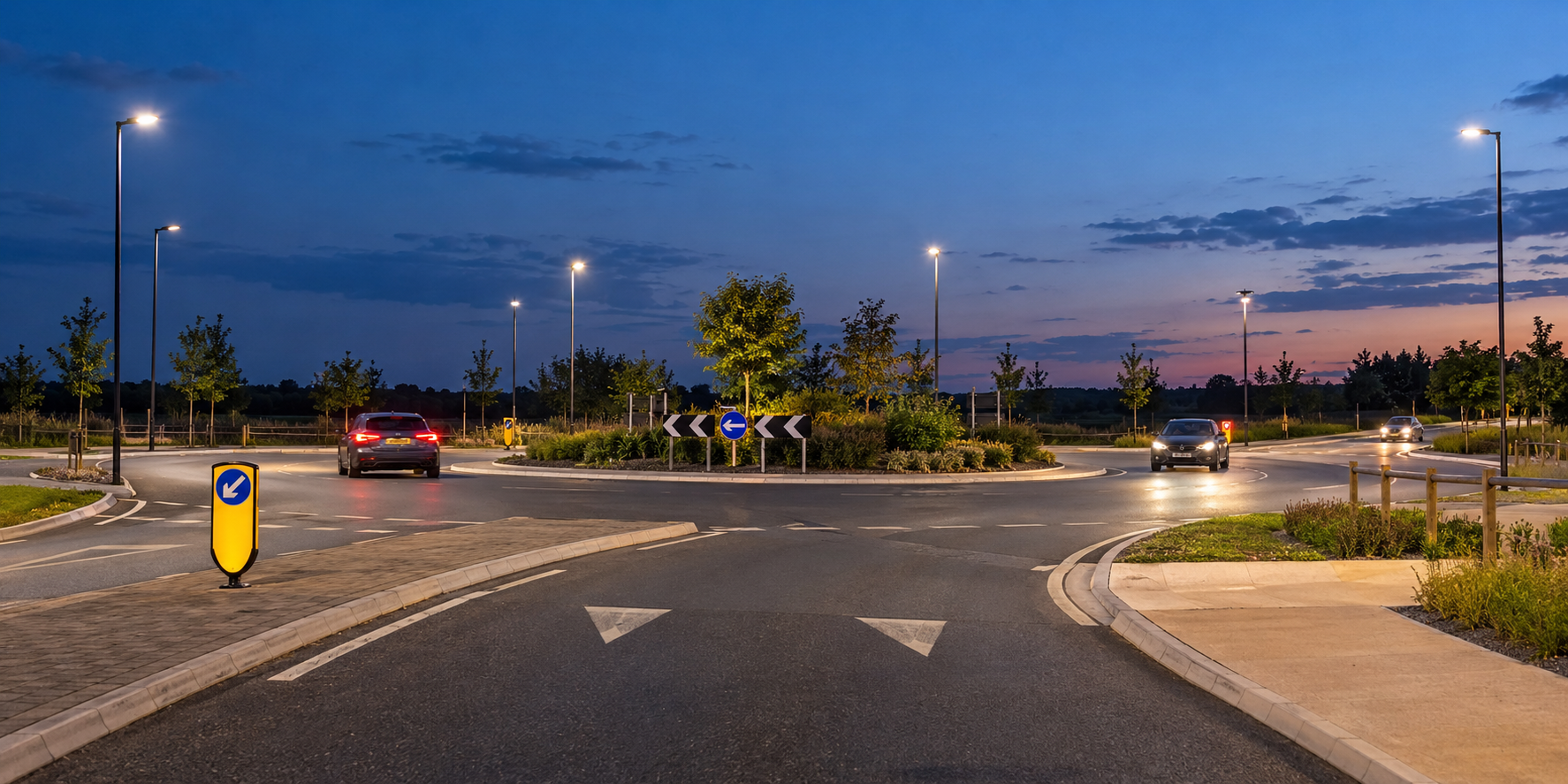
Evening driver-view context for reviewing the circulating road and approach transitions.
Frequently asked questions
Should the central island always contain a light pole?
No. The pole concept depends on the geometry, authority criteria, structural constraints, visibility and access. Compare alternatives in the approved design.
Do the entries and exits need to be included?
The project calculation boundary should follow the specification and capture relevant transitions and conflict points; the lighting designer defines the accepted extent.
Can I select a fixture by wattage alone?
No. Confirm the photometric file, mounting, output configuration, glare control, electrical interface and project criteria together.
Does this page show a measured roundabout project?
No. The roundabout scene is an illustrative application image. The product image is an existing Jieyao roadway-light example.
-
-


