

 English
 Español
 Bahasa Indonesia
 Français

- Product details
-
JIEYAO LIGHTING · PROJECT-CONFIGURED SUPPLY
Cobrahead LED Street Lights with Hinged Covers
A complete road-lighting head with a visible, hinged service cover.
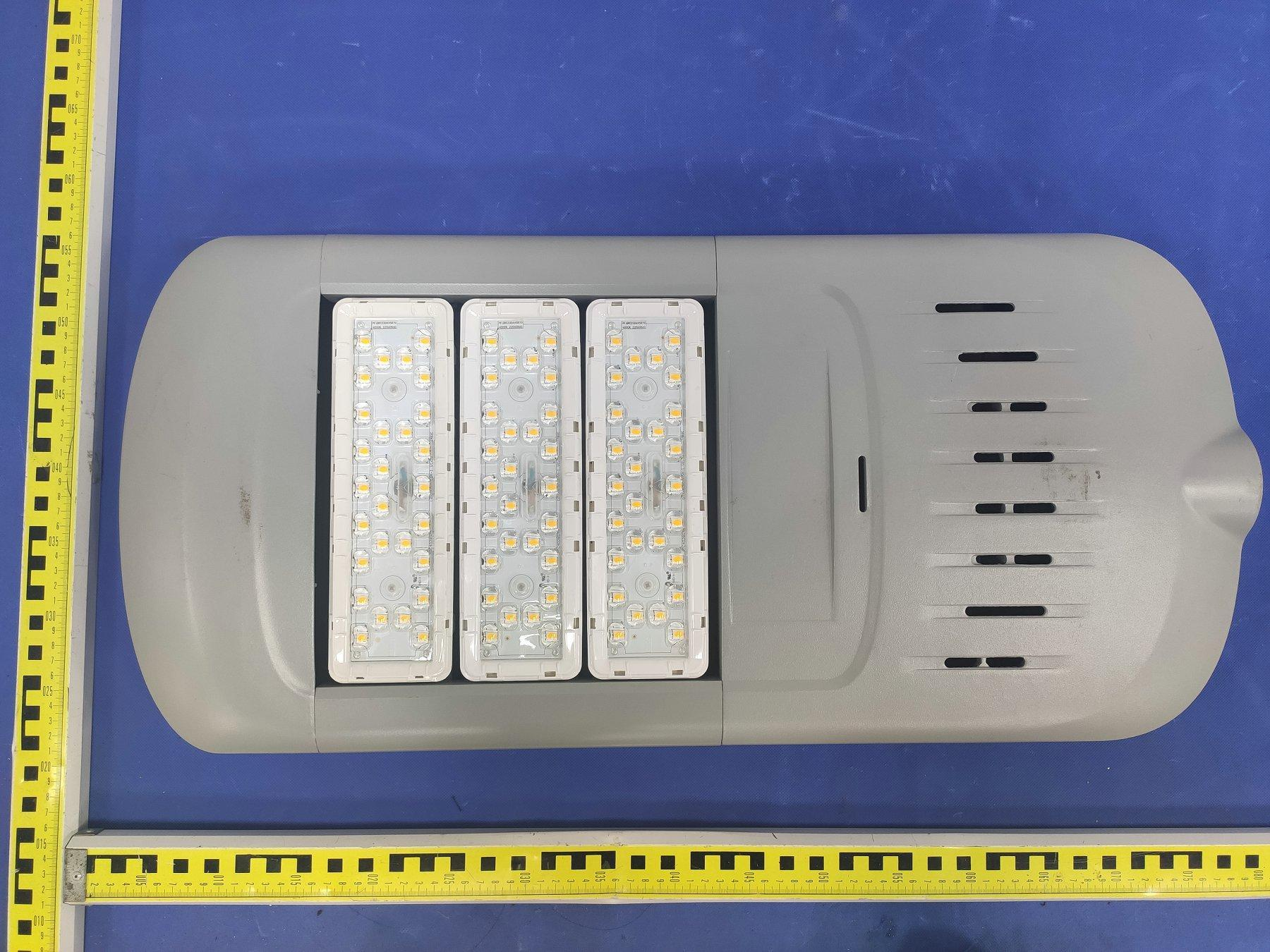
Jieyao offers project-specific enquiries for cobrahead-style LED street-light heads with a hinged rear cover. The physical reference shown here has a rounded housing, three front optical sections and an openable rear cover over the driver and wiring. Define the exact housing revision, mounting connection, optical configuration and electrical equipment as one supplied luminaire.
This page focuses on that physical construction. It does not turn a housing silhouette into a generic efficacy, lifetime or enclosure-rating promise.
Discuss this configuration ↗ Physical sample from archived Jieyao-named report photo-documentation. Current supply follows the identified model and revision.
What the physical sample shows
View Visible construction Ordering implication Optical face Three rectangular optical sections in a rounded common body Identify the actual optic and LED configuration; three sections do not prove three independently replaceable field modules. Rear exterior A separate slotted rear cover over the body Confirm cover attachment, required clearance and the service arrangement on the offered revision. Open rear cover Hinges, a driver position, internal wiring and the backs of the optical assemblies Ask for the parts schedule and instructions for the exact service operation. Mounting end A narrowed connection end with cable entry Use the selected mounting drawing for spigot size, engagement and fastening. Do not measure it from the report photograph. The photographs are taken from a report naming Yangzhou Jieyao Lighting Equipment Co., Ltd. as applicant and manufacturer. They give a traceable physical reference, not proof that every luminaire now offered uses identical components or shares the report’s scope.
Select the complete lighting head
Housing and mount
Specify the housing revision, arm connection and permitted mounting orientation. The fixture must fit the retained arm without losing the required aim or service clearance.
Optical assembly
Identify the lens or cover, LED configuration and corresponding IES or LDT file. Match the road calculation to that exact option, rather than choosing by the shape of the front face.
Driver and controls
Specify supply, driver output and required switching or dimming interface. Any photocell, control socket or external node needs a named compatible configuration; none is assumed from these photographs.
For the wider housing comparison, see the LED street light range. Specify the hinged-cover housing, mounting interface, optics and electrical equipment as one luminaire configuration.
Rear cover and maintenance clearance
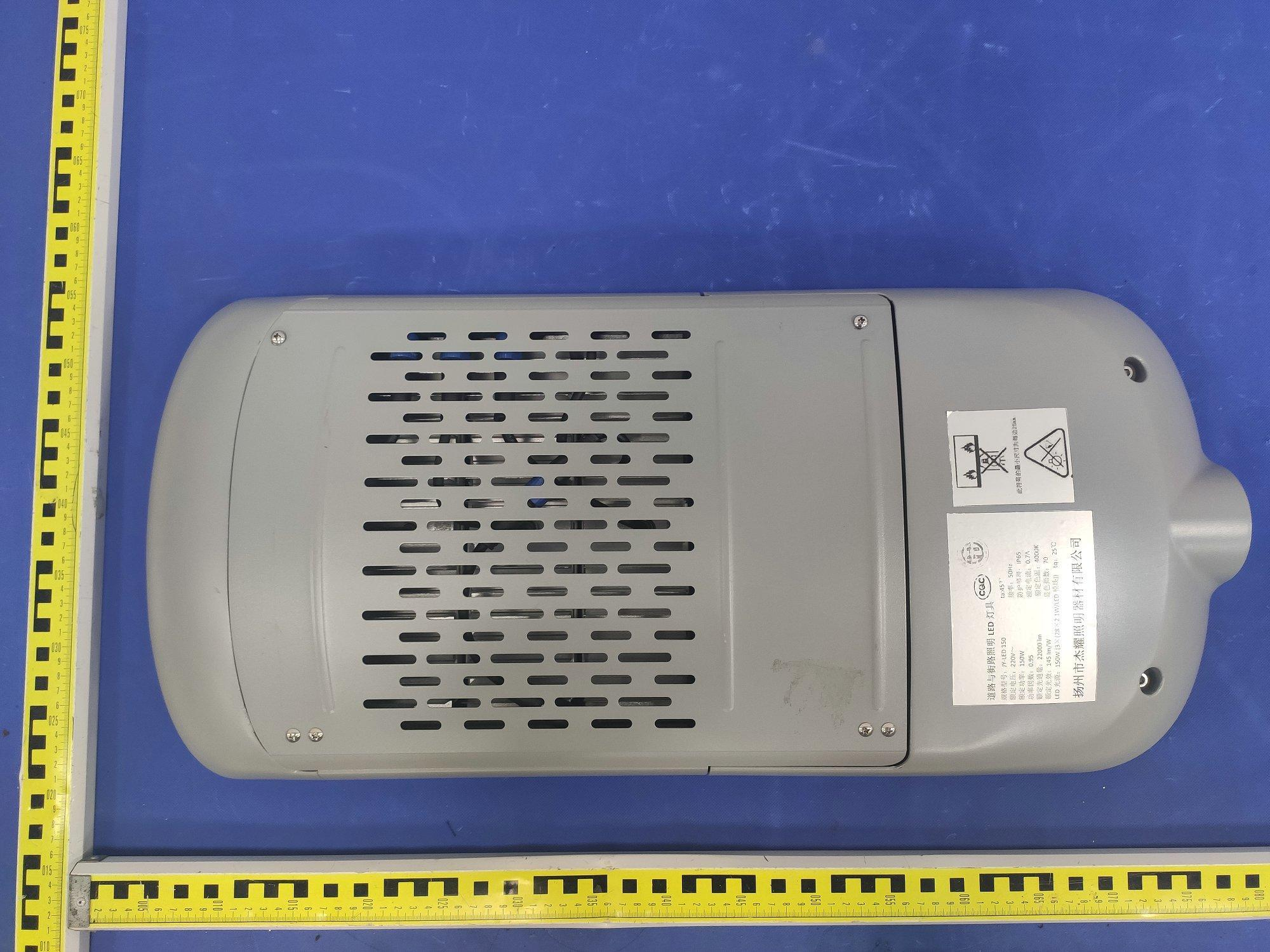 Rear view from the same archived sample. The cover pattern alone is not an enclosure or thermal test result.
A hinged cover needs space to open after the fixture is attached to its arm. Check whether the arm, pole, cable loop or neighbouring hardware obstructs that movement. The mounting drawing and service instructions should identify the intended access position and any retained or removable fasteners.
The visible rear slots should not be interpreted as openings into every protected electrical or optical part. The actual assembly and model-specific documentation establish the enclosure arrangement. Similarly, the fact that a cover opens does not establish tool-free maintenance, a hot-swap function or an automatic return to the original sealing condition after service.
Define what can be serviced
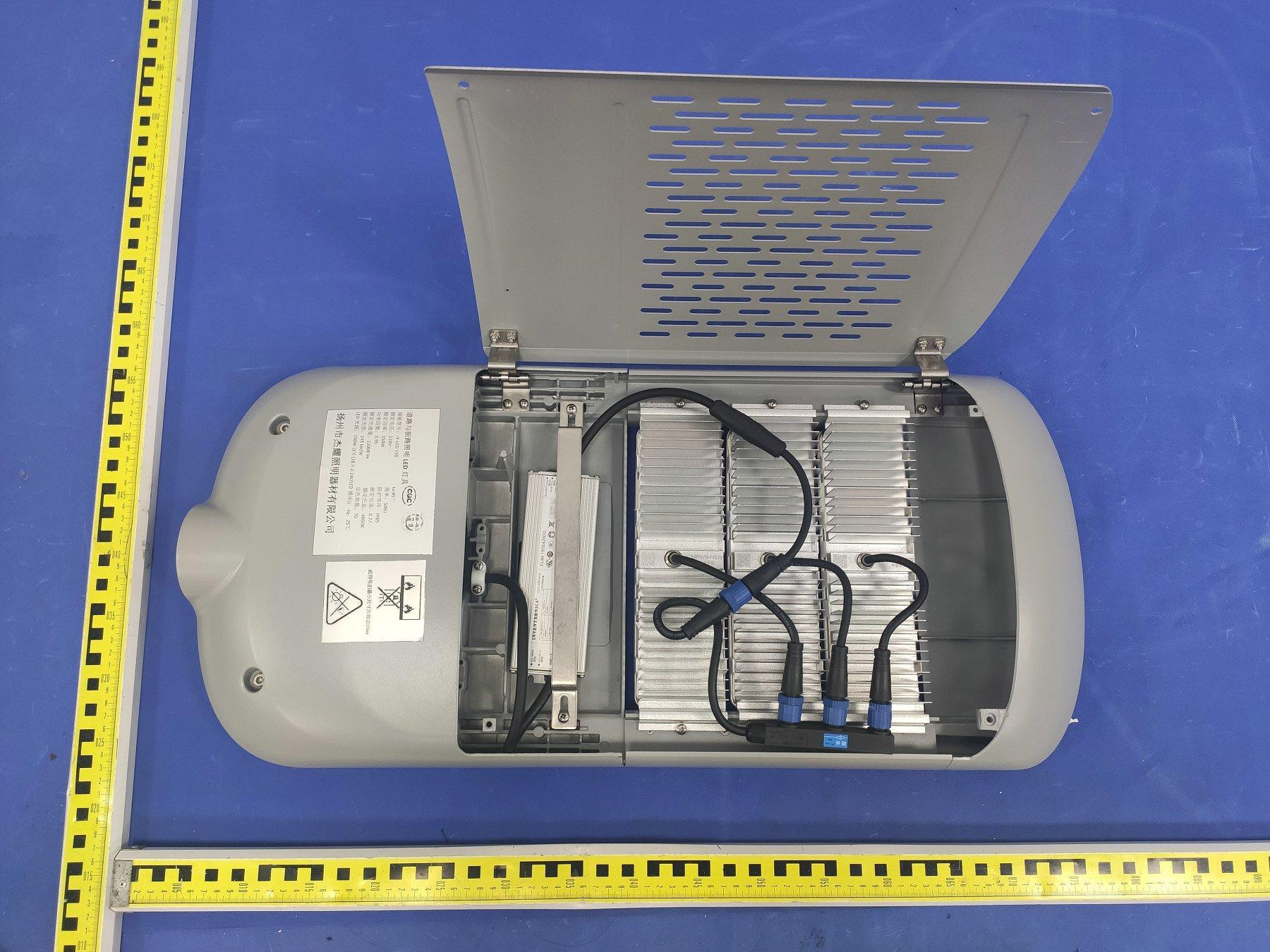 Archived open-cover sample. It illustrates component locations, not a live-work or field-replacement procedure.
The open view places the driver and wiring within reach of the rear access area and shows distinct backs to the optical assemblies. For a maintenance-oriented order, identify which parts may be replaced, their model and revision, the authorized procedure and any checks needed afterwards.
A replacement driver must match the electrical load and control interface as well as fit the available space. A changed optical part can also change the approved lighting result. Use a controlled spare-parts list instead of assuming that any physically similar driver or board is interchangeable.
The modular LED street light page explains the broader replacement-scope question. Confirm the replaceable parts and service procedure for the offered revision.
A documented sample, with model boundaries
The archived report’s marking artwork identifies JYZM-150W and states 220–240 V AC, 50 Hz and 150 W. Those are the recorded sample markings, not a new catalogue power range. The photographs are retained as sample-construction references; the current quotation must identify the offered model, driver, input and supporting documents.
The same file lists many other model names. This page does not infer that every listed power has the pictured housing or shares valid test coverage. Any requested electrical, ingress, impact or destination-compliance evidence must match the actual offered variant and its current construction.
Use the housing in a road-lighting proposal
The cobrahead selection guide explains the wider housing and road-optics questions. This product page identifies a particular visible construction for a configuration-specific offer.
For an existing-arm replacement, collect the arm dimensions and condition, mounting height, outreach, orientation and cable interface. Compare the proposed fixture’s mass, projected area and geometry with the retained support design. A lamp head that slides onto an arm is not automatically approved for the pole or the lighting task.
For new road works, select the optic and operating input using the road geometry and project lighting criteria. Check the proposed tilt, spacing and neighbouring properties with the actual photometric file. The hinged cover is a service-access feature; it does not establish uniformity, glare control or a fixed lamp spacing.
If controls are required, include the operating stages and the exact electrical interface in the equipment schedule. State whether the enquiry is for fixture-only supply, a fixture with controls, or a pole-and-arm package. Those offers contain different hardware and service responsibilities.
Keep the supplied revision identifiable
Agree the luminaire drawing and parts schedule before release, including the housing, optics, driver, connectors and any control devices. Define inspection of the mounting interface, cover attachment and internal wiring arrangement, together with the functional and electrical checks required for the order.
Pack the fixture so its optical face, mounting end and cover fittings are protected. Mark the model and revision on the shipment list, and keep any separately supplied controller or spare part identifiable with that fixture. Include the applicable mounting and service instructions; an archived sample photograph cannot replace those documents.
Questions before ordering
Does the hinged cover mean the driver can be changed on the pole?
The cover provides access in the pictured construction. The offered model’s instructions must establish the approved maintenance method, isolation and access arrangements, replacement part and post-service checks.
Can the same body be supplied at a different wattage?
Request an identified model and component schedule. A broad model-name list does not establish thermal, optical or electrical suitability for a different operating power.
Is a photocell or dimming node included?
Only when the quotation names the device, socket or interface and compatible driver configuration. These functions are not inferred from the housing form.
Send the arm interface and lighting requirements
Include the road layout, lighting criteria, quantity, mounting height and arm details. Add the incoming supply, required controls, exposure conditions and maintenance expectations.
For replacement work, send clear photographs and the existing fixture and arm identification. We can organize a proposal around the required housing, optical and electrical configuration, with the parts and documents named in the offer.
Contact Jieyao ↗ -
-


